In insurance, a rate increase is a change the insurer files to the price per unit of exposure for a whole class of policies, and a premium increase is what one policy's bill does at renewal. The rate increase is one input to the premium increase, often not the largest. In the example on this page the filed homeowners rate rose 8.6% on average and 9.1% in the policyholder's territory, while the policy's premium rose 36.8%; the rate accounted for $158 of a $678 increase. Telling the two apart matters because a renewal letter, a complaint answer and an examiner all ask a different question of each. Botminds' Premium Increase Explanation is software that splits every renewal increase into its reasons, including the rate revision, and ties each reason to its worksheet line and, for the rate, to the approved filing.
The renewal used throughout is from a fictional sample carrier, Tallowmere Mutual: Margaret and Owen Lindqvist's Washington homeowners policy, renewing December 11 at $2,520.00 against $1,842.00. The filing, territory and figures are sample data; the rules and textbook definitions quoted are real and linked.
One filing, one territory, one policy: three different percentages
+8.6%
the filed homeowners rate change, on average across the state
+9.1%
the change in this policy’s territory
+36.8%
the change in this policy’s premium at renewal
23%
of the premium increase that came from the rate revision
What is the difference between a rate increase and a premium increase?
A rate is a price per unit of exposure, set for a class and filed with the state; a premium is the amount one policyholder pays. The Casualty Actuarial Society's ratemaking text puts the relation in one sentence: “The price the insurance consumer pays is referred to as premium, and the premium is generally calculated based on a given rate per unit of risk exposed” (Werner and Modlin, Basic Ratemaking). A rate increase changes the price per unit. A premium increase is the result of the rate, the exposure and every rating factor on one policy moving at once.
So a premium can rise when no rate changed: the house is insured for more, the roof crossed into an older band, a claim ended a discount, a teen joined the auto policy. And a premium can fall in a year the rate rose, if a credit was earned or a vehicle dropped off. The words get blurred in ordinary speech, and even New York's new statute speaks of factors that resulted in a “premium rate increase” (N.Y. Ins. Law §2356(c)). For an explanation, the distinction is the whole point: the rate is the part the policyholder shares with everyone in the territory; the rest is theirs.
Rate increase against premium increase, row by row
Rate increase: Base rates and rating tables for a class of risks.
Premium increase: One policy’s bill at renewal.
Rate increase: The insurer files it; the state reviews or approves it, depending on the state and line.
Premium increase: Nobody decides it directly; it results from the rate and the policy’s own changes.
Rate increase: An average over the class, with a range by territory or segment.
Premium increase: Expiring premium against renewal premium, in dollars and percent.
Rate increase: The rate filing and the rating manual.
Premium increase: The declarations and the rating worksheet.
Rate increase: Expected losses, expenses and profit for the class.
Premium increase: The rate, plus exposure, property, coverage, claims, drivers and discounts.
Rate increase: One sentence, the same for everyone in the territory.
Premium increase: Every reason, each in dollars, adding up to the change.
One dollar, traced from the filing to the letter
Follow the rate revision on the Lindqvists' renewal through the four places it appears, and the difference between the two increases becomes concrete. At each step the number changes meaning: an average for the state, a percentage for a territory, a dollar amount on one worksheet line, a sentence in one letter.
The rate revision on one renewal: filing, territory, worksheet, letter
1The filing
WA-HO-2026-03
Homeowners, condominium and renters. +8.6% overall; by territory from −1.2% to +12.4%. Approved September 2, effective December 1, 2026.
Applies to a class
2The territory
Territory 14: +9.1%
The Lindqvists’ base premium, $1,736.00 at 2025 rates, becomes $1,894.00 at the December 1, 2026 rates.
Applies to everyone here
3The worksheet
Line 03: +$158.00
Factor 1.000 → 1.091, applied first in rating order. Premium after this line: $2,000.00.
One of seven changed lines
4The letter
One approved sentence
“Our homeowners rates in Washington went up on December 1, by 9.1% in your area … This applies to every Tallowmere home policy near you, not just yours.”
23 cents of each dollar of the increase
Two things happen on the way. First, the state average becomes a territory figure: the filing moved territories by anything from −1.2% to +12.4%, and territory 14 got 9.1%. A letter that quoted the filing's 8.6% would have told the Lindqvists something true about Washington and false about them. Second, the territory percentage becomes dollars only on the worksheet. The 9.1% applies to the base premium of $1,736.00, giving $158.00, and that line is applied first in the rating order, before the dwelling amount and the roof, so its dollars are measured on the expiring policy's characteristics.
The last step is the one most often skipped. The sentence in the letter is not written by whoever drafts the letter. Each approved filing has one plain-words explanation, approved by compliance, that every letter reuses word for word; a filing still under review, such as the sample carrier's WA-HO-2027-01, is never used. That keeps the rate sentence identical across thousands of letters and true to what the state approved.
Why the filed average is not your increase
Because a filing is an average over many different changes. The CAS text warns that even the base rate is not the average: “The base rate is the rate that is applicable to the base risk. As such, it is not usually the average rate” (Basic Ratemaking). A filing that moves the base rate and several rating tables at once produces a different change in every cell of the book, and the overall figure is their weighted average.
The sample filing shows the spread on the face of it: +8.6% overall, but from −1.2% in one territory to +12.4% in another. Inside a territory the change can differ again by coverage, deductible or tier if those tables moved. A policyholder who reads a headline about an 8.6% approved increase and then receives a 36.8% renewal is not looking at a contradiction; they are looking at a rate change plus six changes to their own policy.
How is an insurance premium determined? Rate, exposure and rating factors
By a rating algorithm: a base rate for the base risk, multiplied or adjusted by a factor for each rating variable, with discounts, credits and flat charges applied where the rating plan says. In the CAS text's words, “The rate variation for different risk characteristics is achieved by modifying the base rate by a series of multipliers or addends or some unique mathematical expression as defined in the rating algorithm.” The rating worksheet is that algorithm written out for one policy, line by line, with the premium after each line.
Expiring and renewal side by side, and the worksheet lines that moved
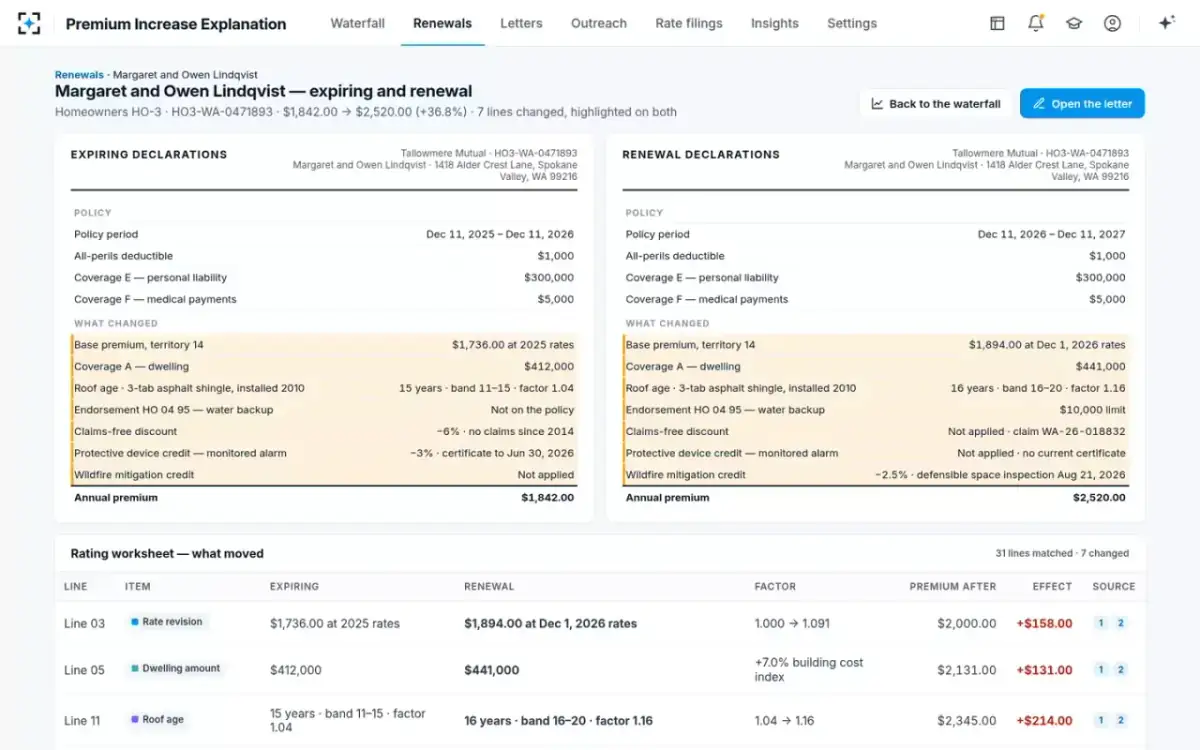
Read the worksheet and the rate revision is visibly one line among seven. Line 03 carries it; lines 05 and 11 carry the dwelling amount and the roof, which are exposure and property changes, not rate. A carrier whose service desk reads only the bottom line of the worksheet will describe all seven as “rates”. One that reads line by line, in rating order, can say which part of the increase the rate caused.
What does a premium increase mean on a renewal, and what does total premium increase mean?
A premium increase at renewal is the renewal premium minus the expiring premium, for the same policy; the total premium increase is that difference for the whole policy, all coverages and charges together. Rules that set a threshold usually define what goes in. New York's explanation rule applies when the total policy premium increase is more than 10% once any increase due to insured value added is left out (§2356(a)), so a higher dwelling limit does not count toward the 10%, while a rate revision does.
New York's commercial conditional-renewal rule draws a similar line in different words: its 10% trigger for increased premiums excludes increases from increased exposure units and from experience rating, loss rating, retrospective rating or audit (N.Y. Ins. Law §3426(e)). Both rules are trying to isolate the price change from the change in what is insured. That is the same separation a rate-versus-premium explanation makes.
Separating the two: re-rate the renewal at the old rates
The rate's share of an increase is found by holding everything else still: rate the renewal policy, with its new characteristics, at the expiring rates, and compare it with the renewal premium at the new rates. The CAS text describes the same method for premium transition rules, which cap rate-driven increases: the premium change “may be calculated as the ratio of new premium on new risk characteristics to old premium on new risk characteristics.” The ratio isolates the rate; the remainder of the increase is the policy's own changes.
The sample carrier's attribution does the equivalent line by line, and the rate's share varies widely across its renewals. In seven sample renewals listed on its renewals screen, the rate revision supplied from under a quarter to half of the increase.
Share of each sample renewal’s increase that came from the rate revision
The pattern is what you would expect. Where little else changed, as on Ingrid Solheim's Idaho home, the rate is half the story. Where a roof aged, a claim landed or a teen driver arrived, the rate is a quarter. An explanation that leads with “rates went up” is accurate for the first kind of renewal and misleading for the second.
What examiners check: the rate charged against the filed rate
Examiners treat the rate as a compliance fact, not a talking point. The NAIC's examination standard asks whether “the rates charged for the policy coverage are in accordance with filed rates (if applicable) or the regulated entity's rating plan” (NAIC Market Regulation Handbook standards). When the rate charged and the rate filed part company, regulators act: among the failures in a 2023 New York consent order with a $360,000 fine, Tokio Marine America Insurance Company “failed to charge rates in accordance with filed and approved rates and rating rules”, alongside failures in its conditional renewal notices (NY DFS disciplinary actions, July 20, 2023).
That is a second reason to keep the rate sentence tied to the filing. A letter that says the rate rose 9.1% in the policyholder's territory is a statement about the filed rate. If the worksheet applied something else, the letter has documented the discrepancy. Washington's rule lists rate changes among the primary factors an explanation may have to name, alongside property, claims, discount and demographic factors (WSR 26-15-007), so the same statement will increasingly be made in writing.
Approved filings, each with one approved plain-words explanation
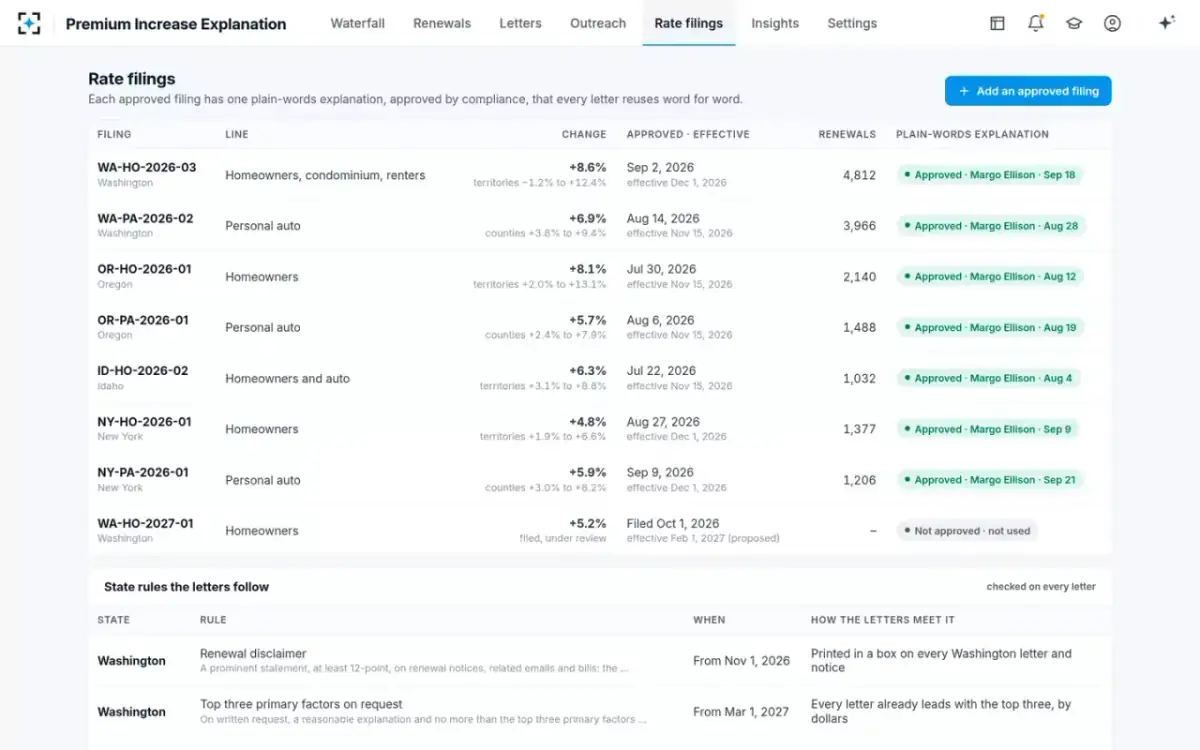
Where Premium Increase Explanation keeps the two apart
The solution separates the rate from the rest in three places. The change attributor applies the worksheet lines in rating order and gives the rate revision its own reason, with dollars, so the letter can say how much of the increase it caused. The filing matcher finds the approved filing for the state, line, territory and effective date and attaches its approved wording, never its own paraphrase. And the letter writer names the rate only in that wording, while every other reason is described from the policy's own documents: the permit for the roof, the claim for the lost discount, the declarations for the dwelling amount.
It does not price. It reads the carrier's filed rates and worksheets; it does not compute indications, select rate changes or measure their effect across the book before filing, which is a pricing team's job. For a deeper look at how each factor's dollars are calculated, see the premium increase percentage calculator; for how a higher dwelling amount is handled, see why dwelling coverage increases. To see the screens, start from Premium Increase Explanation.
Questions people ask
Is a rate increase the same as a premium increase?
No. A rate increase changes the filed price per unit of exposure for a class of policies; a premium increase is the change in one policy's bill. In the sample renewal on this page the rate rose 9.1% in the policyholder's territory and the premium rose 36.8%, because six other things on the policy changed too.
Can my premium go up if the insurer's rates did not?
Yes. A higher dwelling amount, an older roof band, a lost discount, a claim, a new driver or a new vehicle each raise the premium with no rate change at all. New York's list of primary rating factors includes claims history and policy changes such as adding a vehicle or a change of address, alongside territory losses and claim costs.
Why did my premium go up more than the approved rate increase?
Because the approved figure is an average across the state, and your territory may have moved more, and because your own policy changed. The sample filing averaged +8.6% but ranged from −1.2% to +12.4% by territory, and the sample policy's 36.8% increase was 23% rate and 77% other reasons.
What is a rating factor?
A multiplier or addend in the rating algorithm that adjusts the base rate for one characteristic of the risk, such as territory, roof age, deductible or claims history. The rating worksheet shows each factor for the expiring and the renewal term; a factor that moved is a candidate reason for the increase, but its dollars depend on the other changes applied before it.
How is a renewal premium increase calculated?
Renewal premium minus expiring premium, divided by the expiring premium: $678 on $1,842 is 36.8%. New York's 10% explanation threshold leaves out increases due to insured value added, such as a higher coverage limit, so the percentage it tests can be smaller than the one on the bill.