Washington's premium change notice template is printed in the rule itself, WAC 284-30A-080, and every insurer's notice must use it as its basis: the company and policy details, the old and new total premium, the primary factors behind the increase, an explanation of each, a fixed note that future premiums may change, and every way to contact the insurer. When each piece is needed is set by phases the Insurance Commissioner reset in July 2026: a new, prescribed renewal disclaimer from November 1, 2026; explanations with the top primary factors, up to three, on written request from March 1, 2027; and automatic notices for renewal increases of 10% or more from January 1, 2029 (WSR 26-15-007). Botminds' Premium Increase Explanation splits every renewal increase into its reasons and drafts the explanation from that split, which is the hard part of each phase; this page turns the rule into a build list.
Examples refer to a fictional sample carrier, Tallowmere Mutual, writing homeowners and auto in Washington; its names and figures are sample data. Everything said about the rule is from the Washington State Register order and is quoted where the wording matters.
Washington’s premium change transparency, phase by phase
- A reasonable explanationJun 2024 – Feb 2027
- Explanation and the top primary factors, at most threeMar 2027 – Dec 2028
- A full noticefrom Jan 2029
- The 2024 disclaimerJun 2024 – Oct 2026
- The prescribed “Did my premium go up?” disclaimerNov 2026 – Dec 2028
- Automatic notice at a 10% increase or morefrom Jan 2029
What a Washington premium change notice template must say
It must say what the rule's model says, because the rule makes the model mandatory: “Failure to use the premium change notice in WAC 284-30A-080 as the basis for the insurer's notice is a violation of this chapter” (WAC 284-30A-090(4)). An insurer can add to it, and the rule says so; it cannot write its own from scratch. The model has seven parts, each of which maps onto something the insurer already holds or must now produce.
The model notice, line by line, and what fills each line
1
LICENSED INSURANCE COMPANY – NAME, ADDRESS, NAIC Number, & Notice Date
Company header and the date the notice is produced.
2
Policyholder Name, Policy Type, Covered Risks, Policy Number, Policy Period, and Effective Date
From the renewal declarations.
3
Your premium for this insurance policy has increased from (Total Amount) to (Total Amount)
Expiring and renewal total premium, both in dollars.
4
Your premium is impacted by (insurers insert primary factors such as auto-related factors, demographics, discounts, rates, and property related factors)
The primary factors that apply, named in the rule’s own categories.
5
Here is an explanation for each listed primary factor that contributed to your premium increase
One plain-words explanation per factor; from January 2029 with the percentage or dollar change it caused.
6
*Please note: Your future premiums may increase or decrease if you change your coverage …
Fixed text, carried as written.
7
If you have any questions, please contact your insurance company via telephone ( ), email ( ), postal mail ( ), or visit our website ( ).
Every channel filled in; an email and a mailing address are required for written requests.
Five of the seven lines are clerical. Lines 4 and 5 are not: they need the reasons the premium rose, in the rule's categories, and an explanation of each that a policyholder can understand. Those are the lines a notice system cannot fill from the declarations alone, because the declarations show what the premium is, not why it moved. The instruction in line 5 tightens in 2029, when the explanations “must include the percentage or dollar change occurring to the policyholder's premium at renewal.”
Is there a premium change notice form? The model in WAC 284-30A-080
Yes, in the sense that the rule supplies the model text an insurer's notice must be based on; there is no separate form to file or fill in. The model's heading is “Premium change notice contents”, and its first subsection says it sets out “the explanation required and minimum amount of information to include in the contents of the premium change notice”, adding that insurers may give more. A template built from it should keep the rule's sentences, fill the bracketed parts, and add the carrier's own material after them rather than in place of them.
Two other parts of the rule shape the template's content. Primary factors are a closed list of categories: auto-related factors, claims history, discounts, fees and surcharges, demographic factors, property-related factors, premium capping and rate changes; anything else is an optional factor the insurer may add. And if an insurer uses a composite rating variable, it must explain the increase that variable caused, so a combined “risk score” line cannot stand on its own in the explanation.
What is the Washington premium change transparency law?
It is a rule of the Washington Insurance Commissioner, chapter 284-30A of the Washington Administrative Code, first adopted in 2023 and amended in 2026. The 2026 order describes the original rules as adopted “to achieve transparency for policyholders receiving premium increases from insurers at renewal on policies like residential property and private passenger auto”, and explains that the amendment creates “a new phase two with additional insurer requirements” and delays the original phase two, now phase three, “until 2029” (WSR 26-15-007). It was filed on July 2, 2026 and took effect on August 2, 2026.
Breaches are treated as unfair practices. Insurers that fail to follow the chapter, “including the provisions on content requirements, timing, notice, and retention, are considered to have committed unfair and deceptive practices”, and the rule adds that insurers “cannot avoid liability by delegating premium change transparency requirements to third parties.” A carrier that hands notices to a print vendor or explanations to an outsourced desk keeps the responsibility.
Premium increase notice requirements in Washington state, phase by phase
There are three phases, and the build should follow them in order. Today, until the end of February 2027, an insurer must give a reasonable explanation for any renewal increase on written request. From March 1, 2027, the explanation on request must also give the top primary factors, at most three, though no dollar or percentage figure is required for them. From January 1, 2029, notices go out automatically for any renewal with a 10% or larger increase, and on written request for any other increase.
On request, 2026–2028, against automatic, from 2029
On written request, until 2029: A written request about any renewal increase; email counts.
Automatically, from January 1, 2029: A renewal increase of 10% or more, plus any written request.
On written request, until 2029: Within 20 calendar days of receiving the request.
Automatically, from January 1, 2029: At least 20 calendar days before the renewal takes effect.
On written request, until 2029: A reasonable explanation; from March 2027, the top primary factors, at most three, without dollars required.
Automatically, from January 1, 2029: The model notice, with primary factors and the percentage or dollar change for each.
On written request, until 2029: The policyholder and their producer, if any.
Automatically, from January 1, 2029: The policyholder and their producer, if any.
On written request, until 2029: Only the households who ask.
Automatically, from January 1, 2029: Every renewal at 10% or more; in a hard market, a large share of the book.
The jump in 2029 is from explanations for the households that ask to notices for every household over the line. In the sample carrier's window of 14,212 renewals with an increase, 6,931 rose 10% or more. On today's rule, the carrier answers the few who write in; from 2029 it would owe every one of those 6,931 a notice with dollars or percentages per factor, at least 20 days before renewal.
From November 1, 2026: the prescribed renewal disclaimer
From November 1, 2026 through December 31, 2028, every renewal notice, every email relating to a renewal notice and every renewal billing statement must carry a prominent disclaimer, in at least 12-point font, on its first page or first view. Unlike the 2024 disclaimer, which allowed substantially similar language, this one is given word for word:
“Did my premium go up? If your premium increases when your policy renews, you have the right to ask your insurance company why and they must explain the reasons. You must ask for the explanation in writing (this can be by email or another electronic message). But once asked, your company is required to explain the specific reasons for your increase. For more details about your rights, see Washington state rules (Chapter 284-30A WAC).”
WAC 284-30A-050(2), as amended by WSR 26-15-007
Alongside it, the insurer's contact information must include “an email and mailing address the consumer can use to provide a written request”, and may include a website or online form and the producer's details. This is the phase with the shortest runway: the order was filed on July 2, and the disclaimer starts on November 1. Its work is mostly in the print and email systems, not in the explanation itself: the text has to reach the first page of three kinds of document, in the right type size, for every Washington renewal, including those whose premium went down.
The disclaimer will also raise the number of written requests. It tells every renewing policyholder, in plain words, that the insurer must explain the specific reasons, and that an email is enough. A carrier that today answers a handful of requests a month by hand should plan for more.
From March 1, 2027: the top primary factors, on request
From March 1, 2027, the explanation a policyholder asks for must include the top primary factors behind the increase, no more than three. Two details in the rule set the build. The factors need not be tied to a dollar amount or percentage until 2029, but they must be the top ones, which means the insurer has to rank them, and ranking requires knowing roughly how much each contributed. And the rule allows an insurer to give estimated dollars, provided it explains how accurate the estimates are for that policy.
In practice the ranking is the work. A renewal that rose for seven reasons, as the sample Lindqvist homeowners policy did, needs those seven measured before anyone can say which three are on top. In that sample the top three were roof age, the rate revision and the dwelling amount, $503 of a $678 increase; a ranking by gut feel would probably have put the rate revision first, and it was second. How the split is measured is set out in the premium increase percentage calculator.
From January 1, 2029: automatic notices at 10%, with dollars or percentages
From January 1, 2029, the notice is automatic for any renewal whose premium rises by 10% or more, sent no less than 20 calendar days before the renewed policy takes effect, and the explanation of each factor must carry the percentage or dollar change it caused. The primary factors must appear in the notice for renewals effective on or after that date, where they apply to the increase.
This phase turns the explanation from a service-desk task into a renewal-production task. Every Washington renewal has to be measured for its percentage change before the notice deadline, every one at 10% or more needs its factors ranked and priced, and the notice has to go out on the model, on time, to the policyholder and the producer. The other states' notice rules that a multi-state carrier will build alongside it are compared on the Personal Lines page on rate increase notice requirements in California and other states.
The build list, by phase
- Now, before November 1, 2026: put the prescribed disclaimer on three document types
Renewal notices, renewal emails and renewal bills; first page or view; at least 12-point; exact wording; with an email and a mailing address for requests.
- Now: log every written request with its postmark or timestamp
The earlier of the two counts if a request arrives both ways; the 20-day clock runs from receipt.
- Now: answer within 20 calendar days, to the policyholder and the producer
In writing; by email only where the policyholder has consented to electronic delivery.
- Now: keep the explanations retrievable for the commissioner
Records follow the state’s retention rule for insurer records.
- By March 1, 2027: rank the primary factors on every requested explanation
Map the rating plan’s variables to the rule’s categories; explain any composite variable you use.
- By March 1, 2027: decide whether to show dollars
Not required yet; if you show estimated dollars, explain their accuracy for that policy.
- By January 1, 2029: measure every Washington renewal’s change before the notice deadline
Every renewal at 10% or more gets the model notice at least 20 calendar days before it takes effect.
- By January 1, 2029: price each factor in the notice
The percentage or dollar change per factor, adding up to the increase.
The clocks: 20 days, postmarks and the producer’s copy
Washington's rule runs on 20 calendar days in both directions: 20 days to answer a written request, and from 2029, 20 days' lead before a renewal for an automatic notice. Two less obvious rules decide whether a carrier meets them. Requests and responses are dated “by either postmark or electronic timestamp for delivery”, the earlier of the two if both are used; and the explanation goes to the policyholder “and their producer (if any)”.
Washington’s clocks and delivery rules for premium change transparency
| Rule | What it requires | Where it bites |
|---|---|---|
| Answer a written request | No later than 20 calendar days from receipt | A request emailed to a general inbox starts the clock |
| Answer a follow-up request | No later than 20 calendar days from receipt of any later request | Each follow-up is its own deadline |
| Automatic notice, from 2029 | No less than 20 calendar days before the renewed policy takes effect | Notices must be produced earlier than many renewal offers |
| Dating requests and replies | Postmark or electronic timestamp; the earlier if both | An email copy can start the clock before the letter arrives |
| Who receives it | The policyholder and the producer, if any | The agent of record needs the same explanation |
| How it is sent | In writing; electronically only with the policyholder’s consent | Consent status must be known per household |
| Every explanation | A statement that the policyholder may ask for more information | A closing sentence, easily forgotten |
Who owns each piece of the build
The build crosses four teams, and the rule's anti-delegation clause means the carrier answers for all of them. Compliance owns the wording and the factor mapping. Renewal operations owns the timing. Whoever produces the print and email owns placement and type size. The service desk owns the request clock. Agents receive a copy of every explanation and will be asked about it.
Who builds what for Washington’s rule
Today
Reads the order; maps the disclaimer and the model notice to existing documents.
With agents
Approves the factor mapping and each filing’s plain-words wording once; letters reuse it.
Still theirs: the interpretation, and sign-off on every template
Today
Produces renewal offers on the existing calendar.
With agents
Plans letters to be ready before each notice mails, and from 2029 at least 20 days before renewal.
Still theirs: the calendar and the exceptions
Today
Prints the 2024 disclaimer in substantially similar words.
With agents
Prints the prescribed text, first page or view, 12-point or larger, on three document types.
Still theirs: proof of what went out and when
Today
Answers written requests by hand from the worksheet.
With agents
Logs each request with its date, answers from the split within 20 days, and copies the producer.
Still theirs: the reply and its signature
Where Premium Increase Explanation fits a Washington go-live, and where it does not
Premium Increase Explanation does the part of each phase that needs reasons. It splits every renewal increase into its reasons overnight, so a written request can be answered from the split rather than a fresh calculation; it ranks the reasons by dollars, so the top three are known before March 2027 asks for them; and it already prices every factor, which is what the 2029 notices require. Its letters lead with the top three reasons by dollars, reuse each filing's approved wording for the rate, and go to the agent of record as well as the policyholder.
Approved filings and the Washington rules the letters are checked against
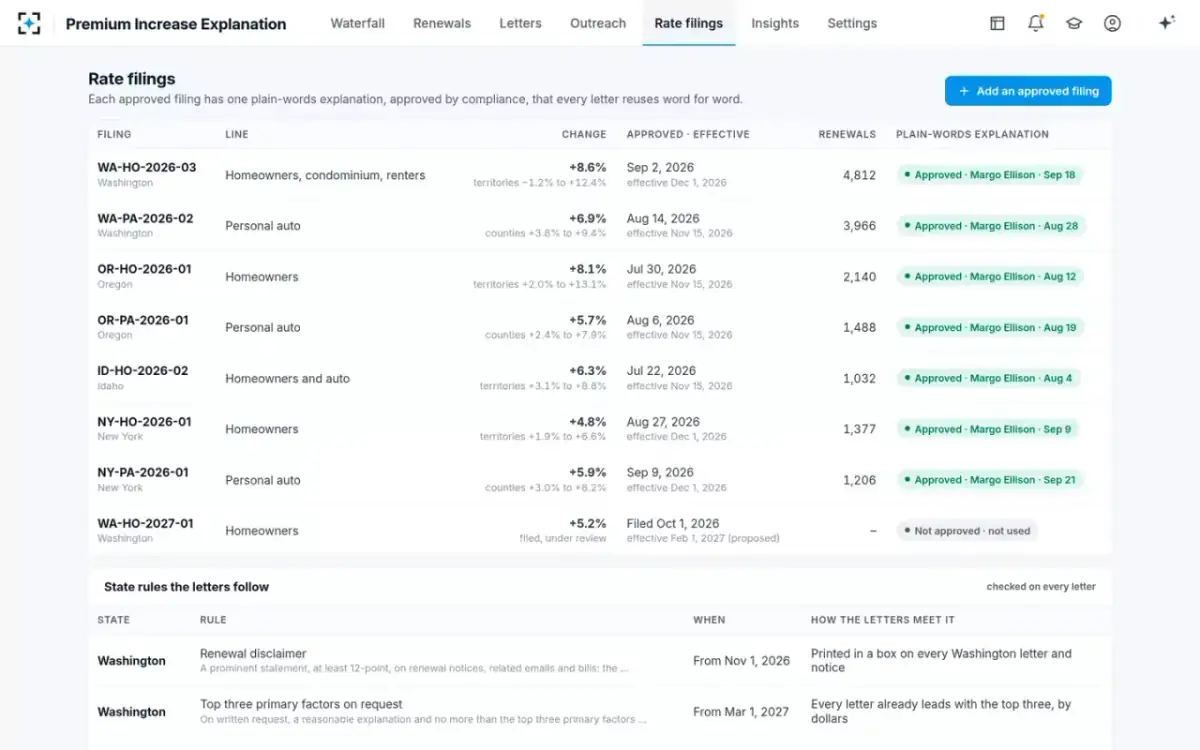
It does not replace the carrier's notice production. The prescribed disclaimer belongs on the first page of the renewal notice, the renewal email and the renewal bill, which are produced by the carrier's own policy and billing systems; an explanation letter that carries its own box of text does not satisfy that requirement by itself, and the sample letter's box is not the prescribed wording. It does not send: a representative approves and e-signs every letter. And it does not decide how the rule applies; compliance approves the mapping and the templates. To see the screens, start from Premium Increase Explanation; the letter itself is set out in the premium increase explanation letter template.
Questions people ask
When does Washington require premium change notices?
Automatic premium change notices start on January 1, 2029, for renewals with an increase of 10% or more, at least 20 calendar days before the renewal takes effect. Until then insurers explain on written request, and from March 1, 2027 those explanations must include the top primary factors, at most three. The order that set these dates, WSR 26-15-007, took effect on August 2, 2026.
What does Washington's new renewal disclaimer have to say?
From November 1, 2026 through December 31, 2028, it begins “Did my premium go up?” and tells the policyholder they may ask in writing, including by email, and that the insurer must explain the specific reasons. It goes on the first page or view of renewal notices, renewal emails and renewal bills, in at least 12-point font, with an email and a mailing address for requests.
How long does an insurer have to answer a written request in Washington?
No later than 20 calendar days from receiving it, and the same again for any follow-up request. The request is dated by its postmark or electronic timestamp, the earlier if it arrives both ways, and the answer goes to the policyholder and their producer.
Can the explanation be sent by email?
Yes, if the policyholder has consented to receive notifications electronically; otherwise it goes by post. A policyholder's request, by contrast, may be made by email or another electronic message, as the new disclaimer itself says.
Does Washington require a dollar amount for each factor?
Not until 2029. For explanations on request from March 2027, the top primary factors need not be tied to a dollar amount or percentage; from January 2029 the notice's explanations must include the percentage or dollar change. An insurer that shows estimated dollars before then must explain how accurate they are for that policy.
What happens if an insurer does not follow Washington's rule?
The rule treats a failure on content, timing, notice or retention as an unfair and deceptive practice, subject to the penalties in the state's unfair practices rules and statute. Not using the model notice as the basis for the insurer's notice is a violation on its own, and handing the work to a third party does not move the liability.