If your car insurance went up and nothing changed, something usually did, just not something you did on purpose. The insurer's rate may have risen in your territory; a discount or credit may have ended; a claim or a ticket from earlier in the term may have reached your rating at renewal; a driver may have moved into a different age band; or your credit-based insurance score may have changed. The last of these comes with paperwork: an increase based even partly on a credit report is an adverse action under federal law, and the insurer must send you a notice naming the reporting agency and your right to a free report. Botminds' Premium Increase Explanation is software insurers use to split each renewal increase into its reasons, dollar by dollar, so that a service representative can tell you which of these it was, and how much each added.
The auto renewals used as examples belong to fictional sample policyholders with a fictional insurer; their figures are sample data. The rules and statistics are from statutes, a Supreme Court decision, the NAIC and the Texas Department of Insurance, linked where they appear.
Car insurance increases, and the complaints they cause
+14.42%
national average auto premium per vehicle, 2022 to 2023
+17.6%
average cost of a collision claim, 2021 to 2022
658
Texas auto complaints closed in 2025 that cite premium and rating
2.9×
that count against 2019
Why did my car insurance go up if nothing changed? Four places a change hides
Because your premium depends on more than your car and your driving. It depends on the insurer's rates for your territory, the discounts and credits you qualify for on renewal day, your record as the insurer's reports show it, the ages and details of everyone on the policy, and, where the state allows it, a credit-based insurance score. Any of those can move without anything you would call a change.
“Nothing changed”: four questions, in the order to ask them
1Did the insurer’s rate change where the car is garaged?
Look forAsk how much of your increase the rate revision accounts for, in dollars, and what it was in your territory.
Why it mattersA filed rate change moves every policy in the territory. New York’s law lists anticipated losses in the rating territory and higher claim costs, such as vehicle repairs, among primary rating factors.
2Did anything reach your record during the term?
Look forA claim, including one you did not think counted, or a ticket. Ask for your claims history and driving record as the insurer used them.
Why it mattersA claim or ticket from months earlier can first reach the rating at renewal. Claims-history reports are consumer reports you can see and dispute.
3Did a discount, a credit or a person’s factor change?
Look forA multi-policy or paperless discount ended; a driver moved into a different age band; the address or garaging changed.
Why it mattersWashington’s list of primary factors includes driver age and other demographic factors, discounts, and garaging location. A birthday is a change.
4Did your credit-based insurance score change?
Look forAn adverse action notice in the mail or your email; it names the reporting agency.
Why it mattersAn increase based in whole or in part on a credit report is an adverse action under federal law, with its own notice and dispute rights.
None of these? Ask the insurer for the reasons in writing, each in dollars. In New York and Washington it must answer within 20 days.
Can my car insurance go up for no reason?
Not legally for no reason, but often for a reason nobody told you. Insurers charge rates they have filed with the state, and every renewal premium comes from a rating calculation. What is missing is usually the explanation, not the reason. That gap shows up in the complaints: on our count of Texas's published data, 658 complaints about automobile coverage citing premium and rating were closed in 2025, against 230 in 2019, and in most premium complaints across auto and home the department's outcome included furnishing information rather than finding the insurer at fault.
Texas auto complaints that cite premium and rating, by year closed
A rate revision is the reason most often given, and the one most often over-credited. In the sample insurer's renewals, the auto rate revision was a third or less of each increase: $96 of a $284 increase for one driver in New York, $142 of $562 for a household in Washington. The NAIC's figures explain why rates have moved at all: the average incurred loss per collision claim rose 17.6%, from $6,113 in 2021 to $7,191 in 2022 (NAIC). That is a reason everyone in a territory shares; the rest of an increase is usually particular to the policy.
Why did my insurance go up with no accidents or tickets?
Because a clean year does not freeze the other factors. The rate in your territory can rise. A discount can end: a multi-policy discount when another policy was cancelled, a paperless or autopay discount when a setting changed, a telematics discount when a program ended. A driver can move into a different age band; Washington's list of the primary factors an explanation must cover names “demographic factors (age, credit history, education, gender, marital status, and occupation)” alongside garaging location, driving record, miles driven and the number of drivers and vehicles (WAC 284-30A-070(2)). Which of those an insurer may use differs by state.
And a claim can count even when it did not feel like one. An insurer reads claims history from reports it buys, and a claim filed on your policy by someone else, or a small claim you forgot, may appear there. In 2025, 102 of the Texas auto and home premium complaints also cited the use of CLUE reports, the claims-history database. Ask the insurer which claims it rated, and request your report if one is wrong.
Why did my car insurance go up after renewal?
Because renewal is when most rating changes take effect. Rate revisions usually reach a policy at its first renewal on or after the filing's effective date; claims and violations found during the term are generally picked up when the insurer re-rates the policy; discounts are re-checked against their conditions. A mid-term premium change is usually tied to a change you made, such as adding a vehicle. So an increase that appears at renewal, with nothing changed by you, is typically a set of changes on the insurer's side or in your records that all landed on one date.
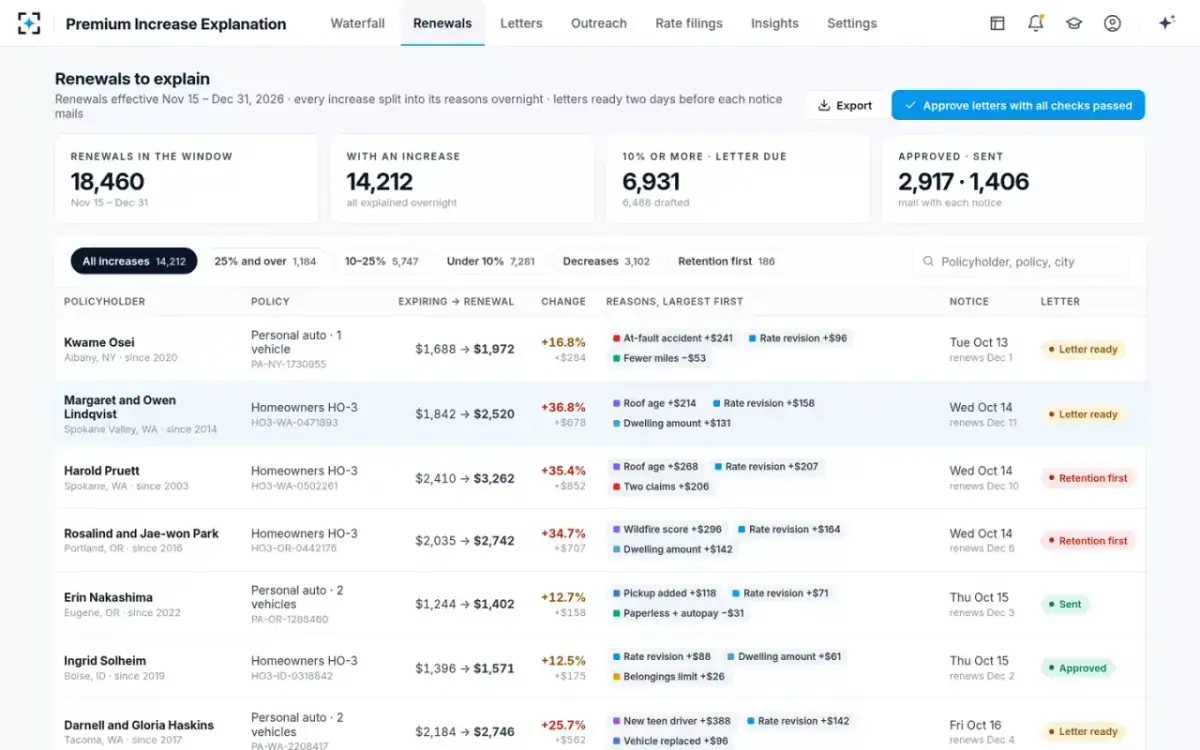
Two sample renewals show how different those sets can be. Kwame Osei's New York auto rose 16.8%, $284: an at-fault accident earlier in the year added $241, the rate revision $96, and fewer miles took $53 off. Darnell and Gloria Haskins's Washington auto rose 25.7%, $562: a new teen driver added $388, the rate revision $142, and a replacement vehicle $96. Neither household would describe its year as “nothing changed”, yet both increases would be explained as “rates went up” by a desk without the split.
Auto renewals, each with its largest reasons
Your credit-based insurance score: the reason that comes with its own notice
If any part of your increase rests on a credit report, federal law gives you a notice and rights that no other reason does. For insurance, “adverse action” includes “an increase in any charge for” any insurance, “existing or applied for” (15 U.S.C. §1681a(k)(1)(B)(i)). An insurer that takes adverse action based in whole or in part on a consumer report must tell you, name the reporting agency, state that the agency did not make the decision and cannot give the specific reasons, and tell you of your right to a free copy of the report within 60 days and to dispute it (15 U.S.C. §1681m(a); the same notice, as lenders send it, is set out in adverse action notice requirements).
The Supreme Court addressed when a renewal counts. In Safeco Insurance Co. of America v. Burr (2007), it held that the first rate on a new policy can be an adverse action when it is higher than the rate the applicant would have received had the insurer not taken the credit score into account, and the Court's syllabus summarises the rule for later dealings:
“[O]nce a consumer has learned that his credit report led the insurer to charge more, he need not be told with each renewal if his rate has not changed. After initial dealing between the consumer and the insurer, the baseline for ‘increase’ is the previous rate or charge.”
Safeco Ins. Co. of America v. Burr, 551 U.S. 47 (2007), syllabus
So if your score fell and your renewal went up because of it, the insurer owes you a notice. Some states add more. Texas requires the notice within 30 days, with “a description of not more than four factors that were the primary influences” of the action, and says a generalized term such as “poor credit history” is not sufficient. It also lets an insured, or the insured's agent, ask the insurer at renewal to re-underwrite and re-rate the policy on a current credit report or insurance score, once in each 12-month period (Tex. Ins. Code §559.054 and §559.058).
What a credit-based adverse action notice must tell you
| Item | Federal law, every state | Texas, in addition |
|---|---|---|
| That an adverse action was taken | Yes, orally, in writing or electronically | In writing or electronically, within 30 days, with the reasons |
| The reasons | The reporting agency cannot give them; the insurer’s notice states the action | Up to four primary factors; “poor credit history” is not enough |
| The reporting agency | Name, address and telephone number | Also its toll-free number and website, if any |
| Your free report | Right to a free copy from that agency within 60 days | The same, during the 60 days after the notice |
| Disputes | Right to dispute the report’s accuracy with the agency | If the dispute succeeds, the insurer re-rates within 30 days and credits overpaid premium |
| A fresh look | Not required by §1681m | On request at renewal, re-rate on a current report once every 12 months |
Who can answer which question
Four parties hold different pieces of the answer, and asking the wrong one wastes a week. The insurer knows the reasons and their dollars. The agent can explain them and quote alternatives. A consumer reporting agency holds the report but, by law, cannot tell you why the insurer acted. The state insurance department takes complaints when an insurer will not explain.
Where to take the “why did it go up” question
Today
Sees the old and new premium and the worksheet; explaining takes minutes of matching lines.
With agents
Sees the increase already split into reasons with dollars, and reads them to you.
Still theirs: the explanation, and any written reply
Today
Hears about the increase from you.
With agents
Gets the insurer’s explanation and the options you qualify for before the notice arrives.
Still theirs: quotes, such as bundling, and advice on deductibles
Today
Holds your credit or claims-history report.
With agents
The same: it gives you the report and handles disputes.
Still theirs: the report; it cannot say why the insurer acted
Today
Receives the complaint when the explanation never came.
With agents
Fewer complaints that end with information finally furnished.
Still theirs: enforcement
What to ask, and what you are owed
Ask for the reasons in writing and in dollars, and ask whether any part of the increase rests on a credit-based insurance score or a claims report. In New York, since August 24, 2026, an auto renewal that rises by more than 10%, leaving out increases from added coverage, must come with the amount of the increase and an explanation of the primary rating factors, and for any increase you can ask in writing and get an answer within 20 days (N.Y. Ins. Law §2356). Washington gives a right to a written explanation on request, answered within 20 calendar days (WSR 26-15-007). The details are in New York premium increase explanations.
When you get the answer, check that the reasons add up to the increase. If they add to less, one is missing; if the explanation is only “rates went up”, ask what the rate revision was in dollars. A claim you dispute is worth raising before renewal, not after; the Personal Lines page on whether an insurance company can drop you after one claim covers the claims-report side in more depth.
What a service desk should check before saying “rates went up”
For an insurer, the “nothing changed” call is a test of whether the desk can see the split. A representative who answers from the bottom line of the worksheet will say “rates”; one who sees each changed line in dollars will say “your territory's rate rose $96, and the accident in March added $241”. The second answer is the one the policyholder can check, and the one regulators in New York and Washington now expect in writing.
Premium Increase Explanation is built for that call. It reads both declarations and both rating worksheets, finds the approved rate filing and the year's claims, drivers, vehicles and discount changes, and splits the increase into reasons that add up to the cent; it handles personal auto as well as homeowners. Its letters keep credit-score language out and point to the adverse action notice instead, and a person approves every one. To see the screens, start from Premium Increase Explanation; for how the dollars per reason are calculated, see the premium increase percentage calculator.
Questions people ask
Why did my car insurance go up for no reason?
There is always a reason in the rating calculation, even if no one explained it: a rate revision in your territory, a discount that ended, a claim or ticket rated at renewal, a driver's age band, or a credit-based score. In Texas, auto complaints citing premium and rating nearly tripled between 2019 and 2025 on our count, and most premium complaints ended with information furnished rather than a finding against the insurer.
My car insurance went up for no reason. What should I do?
Ask the insurer or your agent, in writing, for each reason and how many dollars it added, and whether a credit-based score or a claims report was used. If credit played a part, you should have an adverse action notice naming the reporting agency; you can get a free copy of the report within 60 days and dispute errors. If the insurer will not explain, your state insurance department takes complaints.
Why does car insurance go up without claims?
Because claims by other drivers in your territory, and the cost of repairing cars, set the rate you share with them: the NAIC found collision claims cost 17.6% more on average in 2022 than in 2021. Discounts, age bands and credit-based scores can also move without a claim.
Does my credit score affect my car insurance renewal?
Where state law lets insurers use a credit-based insurance score, an increase based in whole or in part on a credit report is an adverse action requiring a federal notice. After the first notice, the Supreme Court's reading in Safeco measures a later increase against your previous rate. Texas lets you ask at renewal for a re-rate on a current report, once every 12 months.
Can my insurer raise my rate because of a not-at-fault claim?
It depends on the state's rules and the insurer's filed rating plan. Ask the insurer which claim it rated and under which rule, and check that the claim on your report is yours. New York's list of primary rating factors that an explanation should name begins with individual claims history.