The commercial insurance renewal process is the work a broker does between roughly 120 days before a business policy expires and the day its replacement is bound: refresh the client's exposures and loss runs, read the incumbent insurer's renewal offer, decide line by line whether to renew or take the account back to market, send submissions, compare the quotes against the expiring program, present a proposal and get the client's sign-off. None of it is hard on its own. It is hard because each step waits on someone outside the agency, a controller, an underwriter, a wholesaler, and a few days lost early become a rushed placement at the end. Botminds' Renewal & Remarketing Management exists for that calendar: it opens every renewal 120 days out, and its agents chase the data, read the offers and quotes, and forecast where each renewal will really land.
This guide follows the season from the broker's desk. The insurer's side of the same months, when the underwriter re-reads the account, is set out in the commercial insurance renewal timeline written for carriers. Examples use a fictional sample agency, Larkmoor & Wren Insurance Brokers, and its client Kessler Ridge Foods; every person and company in them is invented.
Two clocks run on every commercial renewal: the broker's runway and the insurer's notice window
- Open, request data120–90
- Offer, decide, submit90–70
- Markets quote70–45
- Proposal45–30
- Sign-off30–21
- Bind, binders21–7
- Spare7–0
- Notice may go out120–60 days
- Too late for a timely notice60–0 days
What is the commercial insurance renewal process?
It is a sequence of nine dated jobs, each owned by a named person, that turns an expiring program into a bound one. Every account renews every year, so a middle-market account manager runs dozens of these at once, each at a different stage. The sample agency writes the sequence down as nine milestones counted back from expiry: opened (120 days), data requested (115), exposures and loss runs in (90), offer and decision (75), submissions out (70), quotes in (45), proposal (30), client sign-off (21) and bound (7).
The numbers matter less than the logic between them. Each milestone is the latest date at which the next stage can still start on time. If quotes need about 25 days, submissions must leave by day 70. If a remarket decision needs the incumbent's offer and the client's new values, both must be in by day 75. The calendar is a chain, and the account manager's real job is knowing which link is slipping.
The insurer works to its own deadline. In New York, a commercial policy carries on "in full force and effect pursuant to the same terms, conditions and rates" unless the insurer mails a nonrenewal or conditional-renewal notice to the insured and to its broker, between 120 and 60 days before expiry (§ 3426(e)). A conditional renewal covers a cut in limits or cover, a higher deductible, a new exclusion, or a premium rise of more than 10% that is not explained by exposure, experience rating or audit. Other states set different windows; the New York nonrenewal notice rules are set out in full on a separate guide.
For the broker that window is a planning fact. An incumbent that intends to cut a limit or raise a rate by more than the statute's 10% can lawfully say so as late as day 60. In the sample book, Kessler Ridge Foods' incumbent released its offer on 2 October, exactly 60 days before a 1 December expiry. A runway that waits for the offer before doing anything else has already lost half the season.
When should a commercial renewal start?
Start early enough that the slowest realistic chain still lands before expiry, which for most middle-market accounts means about 120 days out. The arithmetic is easier to see backwards. On the Kessler account the steps after submissions took 30 days of market turnaround, 7 to compare and negotiate, 3 to write the proposal, 13 for client review and 7 to bind: 60 days. Add the 15 days from exposures to submissions and the 30 from opening to exposures, and a renewal that starts at 90 days is already short.
Starting earlier is not free. Loss runs pulled 150 days out leave five months of the current policy year unreported, and a client asked for payroll too early sends last year's. The 120-day start is a compromise: late enough that the data is current, early enough that a survey request or a declined market can still be absorbed. An agency can reasonably run small accounts that renew unchanged on 90 days, and large layered programs on more than 120.
One renewal's arithmetic on the sample runway
120days
runway opened before the 1 December expiry
60days
from submissions out to bound, at the account's real pace
28days
late, the client's exposure update
50days
out, when the late landing showed and was fixed
What happens 120 days before renewal?
The renewal is opened and the information requests go out: an exposure update to the client and a loss-run request to every carrier on the account. Opening means more than a reminder. It means a dated plan for this account, with each milestone set from expiry, the client contacts named, and the carriers listed whose loss runs are needed.
The client request is the one that slips. It goes to a controller or office manager who has a day job, and it asks for things that live in different places: the statement of values from facilities, payroll by class from payroll, the vehicle schedule from the fleet manager, sales from finance. The commercial insurance renewal questionnaire lists each item, who at the client holds it and why the underwriter needs it.
Loss runs are faster where the law sets a clock. In New York, every nonrenewal or conditional-renewal notice must tell the insured and its broker that loss information is available, and on written request the insurer must send it within ten days, including "Information on closed claims, including date and description of occurrence, and any payments" (§ 3426(g)). Other states set different periods; the loss run requirements by state are compared on their own guide.
Who is involved in a commercial renewal?
At the agency, usually four roles: the account manager who runs the calendar, the account executive who owns the remarket call and the client relationship, the producer who owns the account, and a service team lead who balances the load and approves exceptions. Outside it, the client's finance and operations people, the incumbent underwriter and every market approached. Titles vary; in a small agency one person holds three of the four seats.
Four seats carry one commercial renewal, and each sees a different risk
Today
Carries a dozen renewals in the next 120 days on reminders and an inbox. Finds out a renewal is late when the quotes are.
With agents
Sees each renewal's projected landing every morning, and accepts or rejects a recovery plan weeks before expiry.
Still theirs: The client relationship day to day, every first message to a client contact, and the plan.
Today
Makes the remarket call from memory and an email thread, often after the incumbent's offer is already late.
With agents
Gets a line-by-line recommendation with the triggers met and the evidence, and writes down the decision and its reason.
Still theirs: The remarket decision and the market plan.
Today
Hears about the renewal at proposal stage, sometimes with a coverage gap nobody has explained.
With agents
Sees the runway and every decision on the accounts, and a proposal that flags each difference from the expiring program.
Still theirs: The client's trust and the final conversation.
Today
Learns a renewal is late when someone asks for a binder extension.
With agents
Sees which renewals lean late across the whole book, weeks ahead.
Still theirs: Approving extensions and moving work between account managers.
The federal statistics do not separate these roles. The nearest occupation the Bureau of Labor Statistics counts is insurance sales agents: about 572,600 jobs in 2025, 63% of them in insurance agencies and brokerages (BLS Occupational Outlook Handbook). What the statistics cannot show is how the renewal season concentrates their work into a few months.
Why are January renewals so busy?
Because the work of a 1 January renewal does not happen in January. It happens from early September to late December, on top of every October, November and December renewal already in flight, and its last three milestones fall in the holiday weeks. On the sample runway, a policy expiring on 1 January 2027 is opened on 3 September, needs its exposures by 3 October, its submissions out by 23 October and its quotes by 17 November. Client sign-off is due on 11 December and the bound milestone falls on 25 December.
A 1 January renewal on the sample runway: the last milestones land in the holidays
| Milestone | Days before expiry | Date for a 1 Jan 2027 expiry | Who it waits on |
|---|---|---|---|
| Opened, data requested | 120 · 115 | Thu 3 Sep · Tue 8 Sep | Account manager |
| Exposures and loss runs in | 90 | Sat 3 Oct | Client's controller, every carrier |
| Offer and decision | 75 | Sun 18 Oct | Incumbent underwriter, account executive |
| Submissions out | 70 | Fri 23 Oct | Account manager |
| Quotes in | 45 | Tue 17 Nov | Every market approached |
| Proposal | 30 | Wed 2 Dec | Account manager, producer |
| Client sign-off | 21 | Fri 11 Dec | The client's signatory |
| Bound | 7 | Fri 25 Dec | Incumbent or new market |
The table makes two points. The first is that a busy 1 January season is a busy autumn, so the useful count is not renewals by expiry month but open renewals by week. Count your own book that way and the peak appears where the work is, not where the expiry dates are. The second is that holiday milestones should be pulled forward on purpose, a week or more, before the season starts, rather than discovered in December.
How long does a commercial renewal take?
From opening to bind, about 113 days on the sample settings, of which the agency controls only a few. The rest is waiting: on the client for exposures, on the incumbent for its offer, on markets for quotes, and on the client again for sign-off. The estimate published with the solution, for a typical middle-market renewal run by hand, puts the days lost at each of those steps like this:
Where a renewal's days slip: estimated days late per step, worked by hand
The largest slips are outside the agency's walls, which is why a reminder system rarely fixes them. A reminder tells the account manager that the controller is late. It does not say that, at this client's usual pace, the remaining steps will now run past expiry. That forecast is what the renewal pipeline stages guide tests in detail.
What is a renewal strategy meeting?
A renewal strategy meeting is the point, usually between 90 and 75 days out, where the broker and the client agree what this renewal is for: which lines renew as they are, which go to market, which limits or deductibles to test, and what changed in the business. Its output should be written: the decisions, the reasons and the client's requests.
Writing it down is not paperwork for its own sake. New York's highest court has held that a broker's duty is to obtain the coverage a client specifically asks for within a reasonable time, or to tell the client it cannot, and that the broker has no continuing duty to advise on more (American Building Supply v. Petrocelli Group, 2012). What the client asked for at the strategy meeting is therefore the measure the placement will be judged against. The remarketing decision made in that meeting deserves its own written reason too.
Where the season breaks, and where Renewal & Remarketing Management fits
The season breaks in the same place in most agencies: the renewal list knows every expiry date and nothing about pace. Renewal & Remarketing Management replaces the list with a runway. Every renewal opens at 120 days with its nine milestones, a planned bind date and, every night and on every reply, a projected landing worked out from the account's own history: how slowly this client has answered before, and how long the markets on its plan have taken to quote risks of this class and size.
Twelve renewals on one scale, each with the date it will really bind
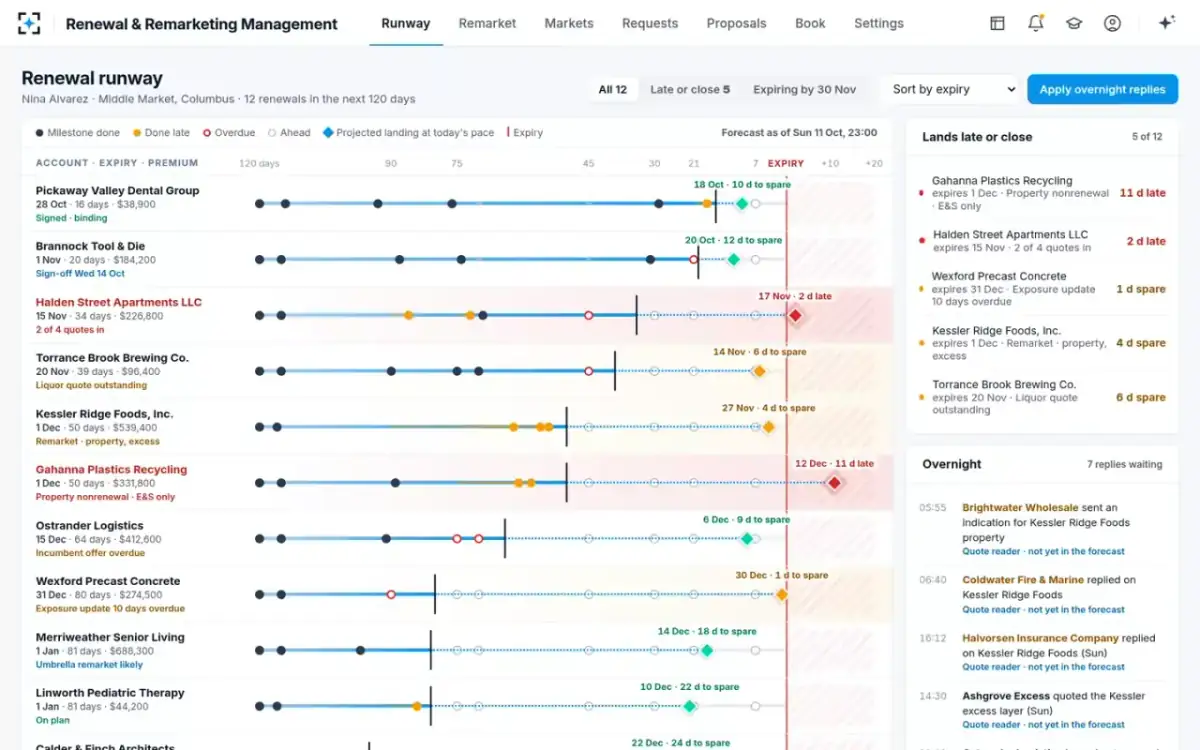
On Monday 12 October the overnight replies moved Kessler Ridge Foods past its line. Two property markets asked for a new survey of a refrigerated building, adding about ten days to their quotes, and the client's exposure update had arrived 28 days late. The forecast moved the landing from 27 November, four days to spare, to 7 December, six days past expiry, and showed the arithmetic step by step.
Why it lands there: the landing as a chain anyone can check
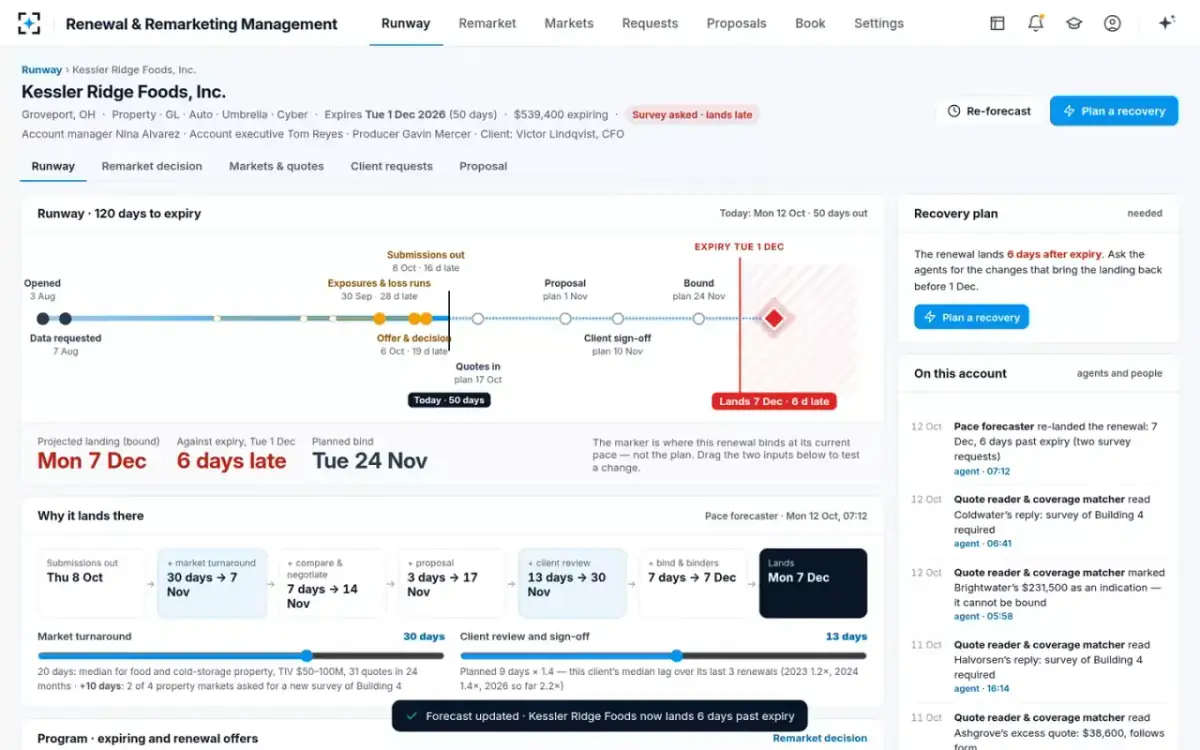
The account manager asked for a recovery plan. The agents found a loss-control report 13 months old that both markets accept in place of a new survey, and an open slot in the client's calendar, and tested both against the pace model: eight days and six days saved. Accepted at 07:31, the plan put the landing back on 23 November, eight days to spare, seven weeks before expiry rather than in the last week.
What the solution does not do matters as much. It never moves a milestone or an expiry date; people do. It never binds, never signs an application for a client, and contacts only markets on the approved plan. It needs the agency's own policy list, offers, loss runs and market history to forecast well, and a new agency's first season runs on settings until that history builds.
Five questions to ask of your own renewal season this week
- Which open renewals will land after expiry at their current pace?
Not which are overdue on a reminder: which ones the remaining steps will carry past the line.
- Which 1 January milestones fall in the holiday weeks?
Move client sign-off and bind dates forward now, while the stages before them can still absorb it.
- Whose exposure updates are already late, and what is each client's usual lag?
A client that answered 40% slower last year will probably do so again.
- Which incumbents have not sent an offer, and when must they by law?
In New York a conditional renewal or nonrenewal must reach the insured and the broker at least 60 days out.
- Is every remarket decision written down, with its reason, before the first submission?
The reason is what the account executive will be asked for if the placement goes wrong.
Questions people ask
How far in advance should a business insurance renewal start?
For most middle-market commercial accounts, about 120 days before expiry, so that a late exposure update, a survey request or a declined market can still be absorbed. On the sample runway the steps from submissions to bind alone took 60 days. Small accounts that renew unchanged can often start at 90 days.
What is the difference between a renewal and a remarket?
A renewal keeps the program with the incumbent insurer, on its renewal offer or on negotiated terms. A remarket takes one or more lines back to other markets, usually because the offer rose past a trigger, a limit was cut or the insurer gave notice. The decision is best made line by line and written down before any submission goes out.
Does the insurer have to tell the broker about a nonrenewal?
In New York, yes: a nonrenewal or conditional-renewal notice on a covered commercial policy must go to the first-named insured and to its authorized agent or broker, at least 60 and not more than 120 days before expiry. If no valid notice is sent, the policy continues on the same terms, conditions and rates. Other states set their own windows.
What is a book roll in insurance?
A book roll is the move of a group of policies from one insurer to another at renewal, usually arranged between the agency and the new insurer rather than account by account. It is still a renewal for each client, so each account needs its data checked, its coverage compared with the expiring program and the client told what changed.
What happens if the renewal is not bound by the expiry date?
Coverage ends at expiry unless the policy continues by law, the incumbent extends it or a binder is issued. Binders are temporary and limited: in Arizona and West Virginia, for example, a binder cannot run past 90 days without the regulator's written approval. How a late renewal turns into a gap, and how to bridge it, is set out in insurance renewal extension.