A stewardship report, in insurance, is the annual review a broker presents to a commercial client, usually 60 to 90 days before renewal: what the broker placed and serviced over the year, the claims it handled, the account's loss experience, what the market is doing in the client's lines, and what the broker recommends for the coming renewal. A report can easily run to thirty pages, most of them about the broker. The parts a client acts on are fewer: what changed in its risk, what its losses cost, which of its lines the market is moving on, and the decisions it is being asked to make. Botminds' Renewal & Remarketing Management keeps the year's evidence a stewardship report needs, every remarket decision with its reason, every market reply and every coverage difference, so the report can be built from facts rather than from memory. This guide gives a stewardship report template, section by section, with the parts that earn their place first.
What a client acts on in a stewardship report, against what reports often hold
What reports often hold: The broker's team, resources and service model.
What the client acts on: One page: what changed in the risk, what the renewal will ask of the client, and the decisions needed by which date.
What reports often hold: National commentary on the insurance cycle.
What the client acts on: The market in the client's own lines, with a source, and what it means for this renewal.
What reports often hold: A loss-run printout.
What the client acts on: Losses by line and year, open claims with reserves, and what drove them.
What reports often hold: A schedule of policies.
What the client acts on: Gaps against the client's contracts and changes, and what each would cost to close.
What reports often hold: Counts of certificates and endorsements issued.
What the client acts on: Claims the broker advocated on, and what was recovered.
What reports often hold: Often absent.
What the client acts on: How the broker is paid on this account, stated plainly.
What is a stewardship report in insurance?
It is the broker's account of its stewardship of the client's insurance program over the past year, and its plan for the next. It looks back, where a renewal proposal looks forward: the proposal compares this year's quotes with the expiring program; the stewardship report explains the year that produced them. Brokers present it to mid-market and large commercial clients, often at a renewal strategy meeting, and often to a CFO or risk manager who will take the recommendations to a board or owner.
No law requires one, and no regulator prescribes its form. Its value is that it puts the client's decisions in writing before the renewal is placed. New York's highest court has held that a broker's duty is to obtain the coverage a client specifically requests, or to say it cannot, without a continuing duty to advise on more (New York Court of Appeals, 2012). A report that records what the broker recommended and what the client decided is the clearest evidence of both.
What should a stewardship report include?
Eight sections, in the order a client will use them. The first page is the one most clients read in full, so it carries the decisions; the rest is evidence. Use the table as a template: the left column is the section heading, the middle what goes in it, the right the question the client is answering as it reads.
A stewardship report template, section by section
| Section | What goes in it | The client's question |
|---|---|---|
| 1. Decisions needed | Three to five decisions for the renewal, each with a recommendation, the cost and the date it is needed by | What do you need from me, and by when? |
| 2. What changed in your risk | Exposure changes since last renewal: values, payroll, sales, vehicles, locations, contracts; each with its source | Did you notice what changed in my business? |
| 3. Your losses | Losses by line and policy year, open claims with reserves, large losses explained; five years where available | Is my loss history hurting me? |
| 4. Your market, line by line | For each line, what prices and appetite are doing, with a public source, and what the incumbent has signalled | Should I expect a rise, and is it the market or me? |
| 5. Coverage review | Gaps against contracts, leases and loan covenants; limits against values; exclusions added during the year | Am I covered for what I have promised others? |
| 6. What we did this year | Placements, mid-term changes, claims advocated and recovered; the service record in a short table | What did I get for the fee or commission? |
| 7. How we are paid | Commission or fee on each line, and any other compensation from insurers | Who is my broker working for? |
| 8. The renewal plan | The runway: when data is needed, when markets will be approached, when the proposal and sign-off are due | What happens next, and what do you need from me? |
Page one carries the weight, so here is one written out. It uses the fictional sample account that runs through Renewal & Remarketing Management's screens, a food manufacturer renewing $539,400 of premium across five lines on 1 December.
Page one of a stewardship report, written out: decisions, costs and dates
- Property: approve going to market. The incumbent's offer raises your rate 9.5%, while similar food and cold-storage renewals in our book fell a median 3.8%. Insured values rise from $68.4M to $79.6M with Building 4. Needed before submissions go out.
- Umbrella: approve a second layer. Your umbrella insurer offers $5M of the expiring $10M. We recommend renewing that $5M and placing $5M above it with another market. Needed before submissions go out.
- Building 4: send two documents. The process safety summary and the July commissioning certificate let two property markets quote without a new survey, saving about ten days. Needed by Wed 14 Oct.
- General liability, auto and cyber: renew. Liability is up 3.1% on sales up 6%; we will counter the auto offer. No decision needed.
- Sign-off meeting. One hour with the CFO to choose between the quotes. Mon 16 Nov, 10:00.
When is a stewardship report presented?
Before the renewal decisions are made, which on a 120-day runway means between about 90 and 75 days out: after the client's exposures and loss runs are in, before the remarket decision and the first submission. Presented later, it becomes a defense of decisions already taken. For large accounts some brokers also present a short mid-year version, so the renewal review holds no surprises.
The timing has a practical edge. The losses section needs current loss runs, and in New York the insurer must supply closed and open claim information within ten days of a written request from the insured or its broker (Insurance Law § 3426(g)). A broker that requests loss runs when it opens the renewal will have them when the report is drafted.
Your market, line by line: the section most reports get wrong
The market section should be about the client's lines, with a source the client can check, not a page of national commentary. Lines moved very differently in 2025. The state regulators' annual analysis reports pure net loss ratios, losses incurred against premiums earned, that ranged from 43% in commercial multiple peril (non-liability), after a 9.6-point improvement, to 71% in commercial auto liability (NAIC, 2025 annual property and casualty analysis).
Commercial lines did not share one market in 2025: pure net loss ratios by line
A client with a property-heavy program and one with a fleet are in different markets, and the report should say which one this client is in. Pair the line's public figures with what the incumbent has actually signalled for this account, and the client can tell the market from its own record. The remarketing insurance meaning guide shows how the same comparison drives the decision to shop a line.
Your losses: the section clients read twice
Show losses by line and policy year, with open claims and their reserves, and explain every large loss in a sentence. A loss run printed in the appendix is not a losses section; it is the evidence for one. Clients read this part twice because it is the part that explains their price, and because a large open reserve can move a renewal more than any market trend. How to read the underlying report, including what an incurred figure leaves out, is covered in how to read a loss run report.
How long should a stewardship report be?
As long as the client's decisions need, with the first page able to stand alone. A middle-market account can usually be served in four to eight pages plus appendices; a large, multi-line program with captives or layered towers may need twenty. Length is not the test. The test is whether a CFO who reads only page one knows what is being asked, why, and by when.
What is the difference between a stewardship report and a renewal proposal?
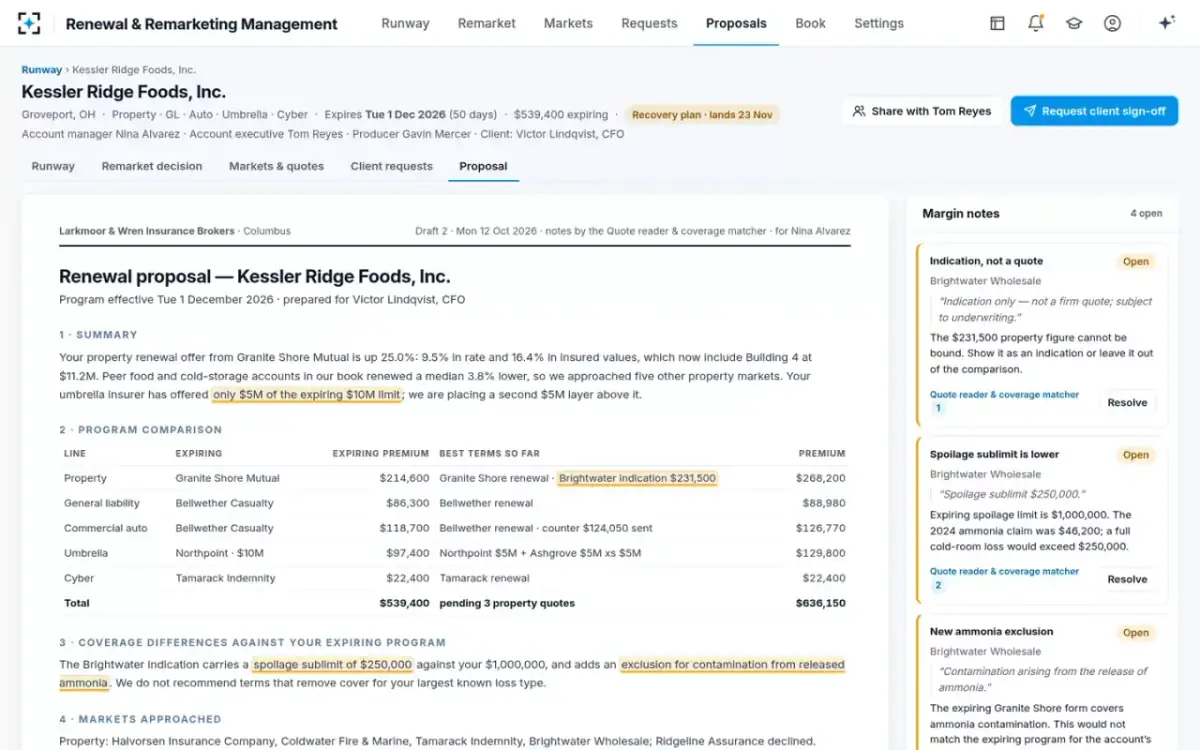
The stewardship report explains the past year and sets up the renewal; the proposal presents the renewal's results. A proposal sets the expiring program against the best terms so far, line by line, and has to explain every difference in cover, not only in price. The two documents share evidence and should never contradict each other: a coverage gap the report flagged in August should be closed, or explained again, in the proposal in November.
The proposal: expiring program against best terms, and every difference in cover
Who prepares the stewardship report?
The account executive owns it and presents it; the account manager assembles it. The hard part of assembly is the year's evidence: what was placed, what was decided and why, which claims the agency pushed and what came back. In many agencies that evidence is scattered across emails, notes and the management system, which is why reports drift towards boilerplate.
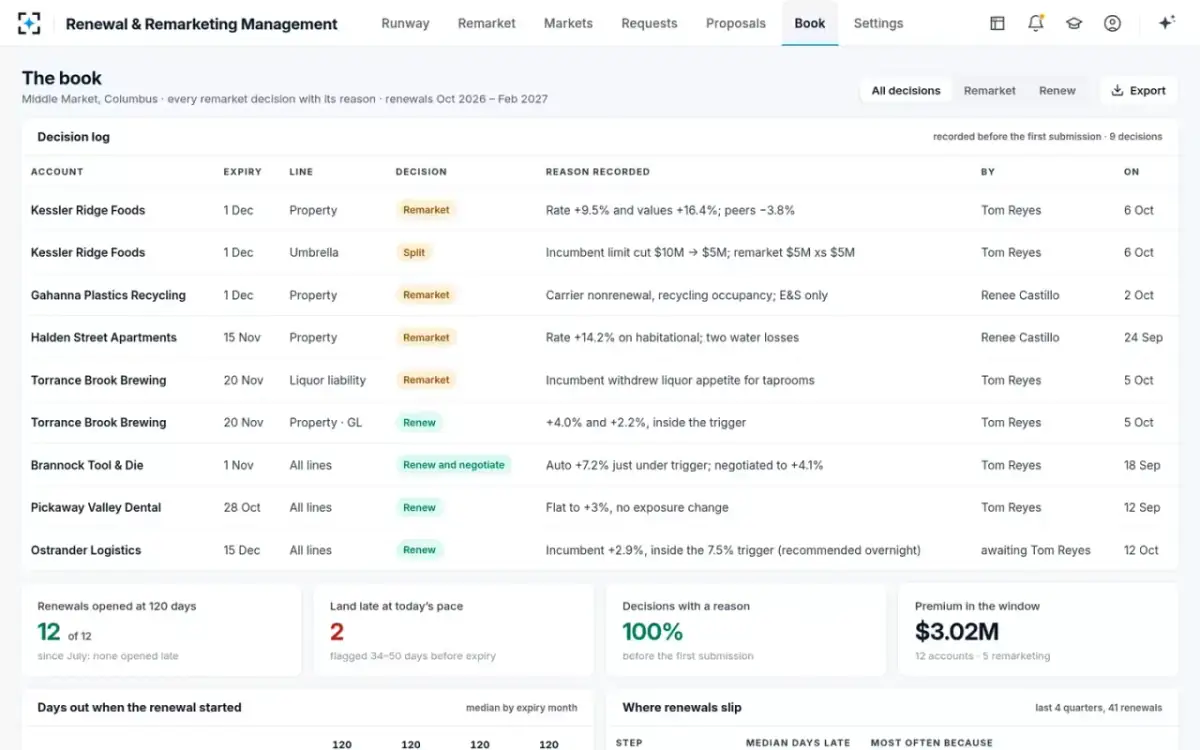
That is where Renewal & Remarketing Management helps, and where it stops. It keeps every remarket decision with its reason, who made it and when; every market reply read as a declination, information request, indication or firm quote; every client request and its lateness; and every coverage difference against the expiring program with both wordings quoted. Those are sections 2, 4, 5 and 8 of the template, already sourced. It does not write the client's story or decide what to recommend; the account executive does.
A year of decisions, each with its reason, ready for the report's evidence pages
Should the report say how the broker is paid?
Yes, plainly, because the disclosure rules already point that way. In New York a producer must give every purchaser an initial disclosure, and must give compensation details if the purchaser asks; for renewals, a request made within 30 days either side of the renewal must be answered in writing within five business days (DFS, Regulation 194 FAQ). In the UK an intermediary must disclose its commission to a commercial customer on request, including profit-share and volume payments (FCA, ICOBS 4.4). A report that states compensation before anyone asks answers the question once, in the broker's own words.
Do small accounts need a stewardship report?
They need the first page. A small account renewing without change does not need twenty pages, but it does need the decisions, the losses in a line or two, the market for its lines and the renewal dates. One page, sent before the data request, often gets the client's information back faster, because the client can see why it is being asked.
Before a stewardship report goes to the client
- Page one stands alone
Decisions, recommendations, costs and dates, readable without the rest.
- Every exposure change has a source
The schedule, payroll report or contract it came from, and the date.
- The market section is about this client's lines
With a public source per line, and the incumbent's own signal.
- Open claims show reserves
And a sentence on each large loss.
- Coverage gaps are priced
What it would cost to close each one, so the client can decide.
- Compensation is stated
Commission or fee by line, and any other insurer payments.
- Nothing contradicts the proposal to come
A gap flagged now is closed or explained again later.
Questions people ask
Is there a stewardship report template for insurance brokers?
The eight-section table on this page is one: decisions needed, what changed in the risk, losses, the market by line, coverage review, what the broker did, how the broker is paid, and the renewal plan. Put the decisions on page one and keep everything else as evidence for them.
What is a stewardship meeting in insurance?
It is the meeting at which the broker presents the stewardship report, usually 75 to 90 days before renewal. Its purpose is to agree the renewal's decisions, such as which lines to remarket and which limits to test, before submissions go out.
Should a stewardship report include market forecasts?
Include what public data shows for the client's lines, with a source, and what the incumbent has signalled. Avoid predicting a percentage for the renewal before the offer is in; say what would move it instead.
What service metrics belong in a stewardship report?
The ones a client values: claims the broker advocated on and what was recovered, coverage gaps found and closed, and renewal dates met. Counts of certificates issued belong in an appendix if anywhere.
How is a stewardship report different from a renewal summary?
A renewal summary reports the result of a renewal after it is bound: what was placed, at what price, with what changes. A stewardship report comes before, explains the year and asks for the decisions that shape the renewal.