Renewal retention rate is the share of the policies or accounts due to renew in a period that the agency renewed: retained accounts divided by accounts up for renewal, or retained premium divided by expiring premium. It is the number principals quote and buyers of agencies ask for, and it is also the last number in the chain. By the time a client leaves, the reasons were set weeks earlier: a renewal opened late, a client's data that arrived late, quotes that came in days before expiry when the better terms were gone. Botminds' Renewal & Remarketing Management tracks those earlier measures on every commercial renewal, from the day a renewal opens 120 days out. This guide gives the retention formulas, shows why premium retention moves with market prices even when no client leaves, and sets out seven renewal KPIs that move retention before it is measured.
Premium retention moves with prices: commercial insurance premiums, change over 12 months to September 2026
What is renewal retention in insurance?
Renewal retention is keeping a client's business through its renewal date, with the same insurer or a new one placed by the same agency. For a broker, an account remarketed to a new insurer and kept is retained; an account lost to another broker is not. That is different from an insurer's retention, which counts policies renewed with the insurer itself, and the two numbers should never be compared directly.
For a commercial book the unit matters. Counting policies overstates retention when a client keeps its small lines and moves its property program. Counting accounts understates it when a large account trims a line. Most agencies need both, and a third that strips out price.
How do you calculate renewal retention rate?
Three ways, each answering a different question. Account retention asks whether clients stayed. Premium retention asks whether revenue stayed. Like-for-like premium retention asks whether revenue stayed for reasons other than price, and it is the one that tells a principal whether the renewal desk is working.
Three retention rates for the same renewal period
Account retention
Accounts renewed ÷ accounts up for renewal
Count an account as up for renewal on its expiry date in the period. Exclude only accounts that closed or were sold, and report them separately.
Did clients stay?
Premium retention
Renewal premium of retained accounts ÷ expiring premium of all accounts up for renewal
Rises with rate and exposure on the accounts kept, even if some clients leave.
Did revenue stay?
Like-for-like premium retention
Expiring premium of retained accounts ÷ expiring premium of all accounts up for renewal
The same premium base before and after, so price and exposure changes drop out.
Did revenue stay, net of price?
What is premium retention vs account retention?
Account retention counts clients; premium retention counts dollars, and in a rising market the dollars hide lost clients. Take an illustrative book with 120 commercial accounts due in a quarter and $6.0 million of expiring premium. Twelve accounts leave, with $540,000 of expiring premium between them. The 108 that stay renew at $5.82 million, because rates and exposures rose about 6.6% on their $5.46 million.
One illustrative quarter, measured three ways
90%
account retention: 108 of 120 accounts renewed
97%
premium retention: $5.82M of renewal premium on $6.0M expiring
91%
like-for-like premium retention: $5.46M of $6.0M, before price
The gap between 97% and 91% is the market, not the agency. Premiums for comparable commercial cover move by line and by year: over the twelve months to September 2026, the federal producer price index for non-auto liability premiums rose 5.3% while workers' compensation premiums fell 0.9% (BLS). The Bureau of Labor Statistics describes its price indexes as measuring "the average change over time in the selling prices received by domestic producers for their output" (BLS PPI), which is the right yardstick for separating price from performance. An agency heavy in liability lines saw premium retention flattered; one heavy in workers' compensation saw it understated. Splitting each renewal's change into rate and exposure, the premium bridge, does the same account by account.
What is a good retention rate for an insurance agency?
There is no public benchmark from a government, academic or non-profit source; the figures that circulate come from industry surveys with their own samples and definitions. A good rate is therefore one that is measured consistently and improves against your own history, split by line, account size and producer. A single agency-wide number hides almost everything useful.
What you can benchmark is the market around you. The Federal Insurance Office reports that direct premiums written for commercial lines rose 4.7% in 2025 (FIO annual report, September 2026). An agency that kept the same clients but whose renewal premium grew much less than that deserves a closer look: either its clients bought less cover, or some of their lines went to another broker.
Why do commercial clients leave at renewal?
For a handful of reasons, and they are worth recording separately because each points to a different fix: price after a rise the client was not prepared for, a coverage cut, service, a business that closed or was sold, and a competing broker who arrived with options earlier. The last two are partly outside the agency's control. The first three are mostly about time.
A renewal that reaches the client days before expiry leaves no room. The quotes arrive late, the client has a choice between signing what is on the table and going uninsured, and any competitor who started in September looks better prepared. That is why the renewal desk's earlier measures predict retention: they decide whether the client hears about a 15% rise in August with alternatives, or in late November with none. How to frame that conversation is set out in remarketing insurance meaning, and what the client should see each year in the stewardship report.
What renewal KPIs should an agency track?
Track the measures the desk can change this week, and let retention follow. The seven below run in the order a renewal does. Each can be computed from dates the tracker already holds, and each has a target the agency sets for itself.
Seven renewal KPIs that move retention, with their formulas
| KPI | Formula | What it tells you | Example target |
|---|---|---|---|
| 1. Opened on time | Renewals opened by day 120 ÷ renewals due | Whether the season starts early enough to absorb a surprise | 100% |
| 2. Client data lag | Median days late of the exposure update | Which clients need earlier, narrower requests | Falling season on season |
| 3. Decision before submission | Remarket decisions written down with a reason before the first submission ÷ decisions | Whether the remarket call is deliberate | 100% |
| 4. Quotes by day 45 | Markets that quoted or declined by day 45 ÷ markets approached | Market plan quality and submission completeness | Set from your history |
| 5. Days to spare at day 45 | Share of renewals projected to bind 7 or more days before expiry | The late renewals to work on now | Rising |
| 6. Differences explained | Proposals with every coverage difference from the expiring program explained ÷ proposals | Whether the client signs knowing what changed | 100% |
| 7. Signed by day 21 | Client sign-offs received by day 21 ÷ renewals | Whether the client has time to decide | Set from your history |
| Result: retention | Account, premium and like-for-like, by line and producer | Whether the six months before expiry worked | Trend, not a single number |
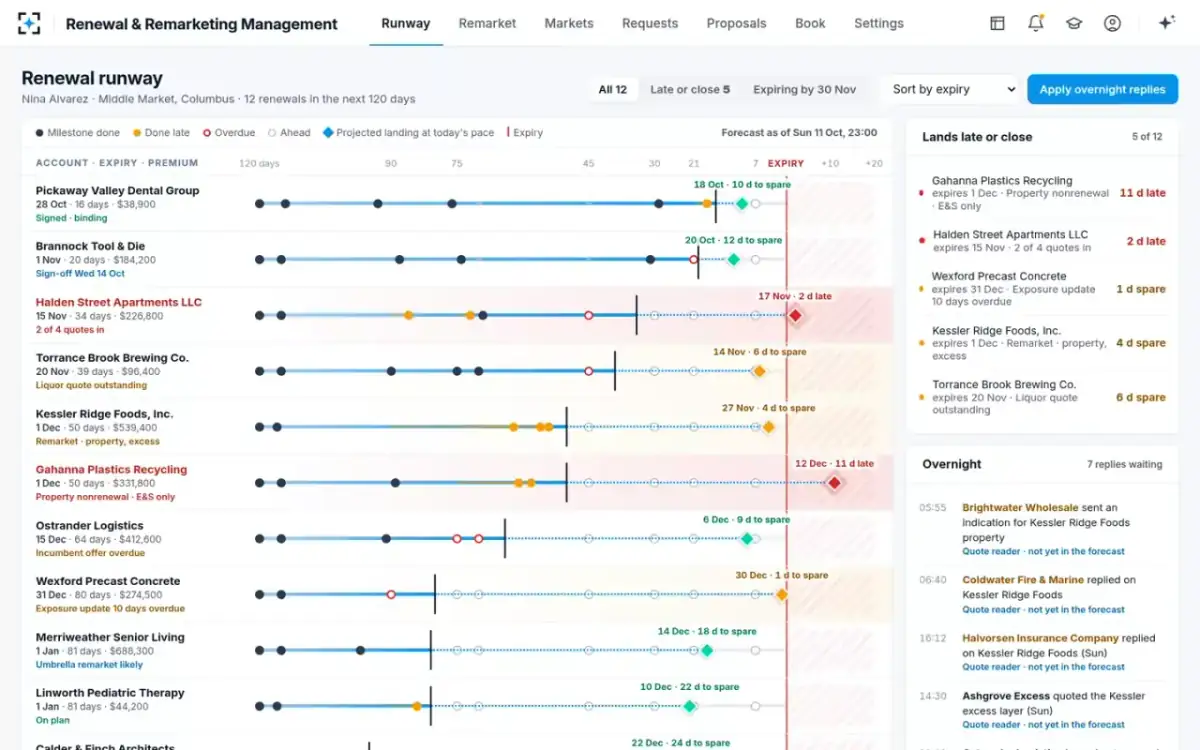
The fifth KPI is the one to watch daily, because it is the only one that looks forward. It needs a projected landing for every renewal, which a reminder list cannot give.
Days to spare, renewal by renewal: the KPI that looks forward
Test the link between timing and retention on your own book
The claim that late renewals lose clients is testable with one season of your own dates, and worth testing before you spend money on it. Take every commercial renewal that expired in the last twelve months. For each, find the date the client first saw its renewal terms, whether a proposal, an incumbent offer forwarded with comment, or a call note, and count the days left before expiry. Then group the renewals and compare retention between the groups.
A one-season test: does retention fall when clients see their terms late?
| Client first saw terms | Renewals | Accounts retained | Account retention | Like-for-like premium retention |
|---|---|---|---|---|
| 45 or more days before expiry | Your count | Your count | Retained ÷ renewals | Expiring premium kept ÷ expiring premium |
| 30 to 44 days | Your count | Your count | … | … |
| 15 to 29 days | Your count | Your count | … | … |
| Under 15 days, or after expiry | Your count | Your count | … | … |
Read the result with care. Late renewals are not a random sample: an account with a nonrenewal notice or a hard-to-place class is both later and likelier to leave. Compare within lines and size bands where the book is big enough, and look at the recorded reasons for each loss. If retention in the latest band is clearly lower even then, every day the renewal desk gains at the start of the season has a value you can put a number on with the commission yardstick below.
How far ahead should renewals be tracked?
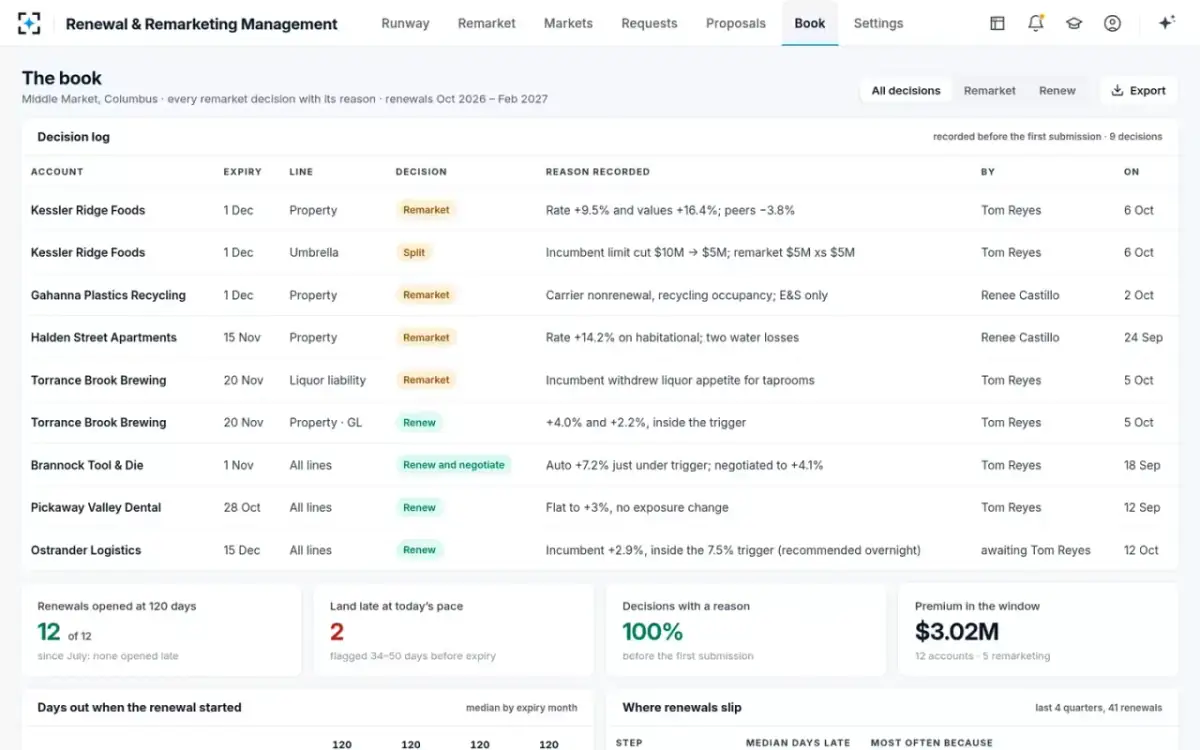
At least 120 days for middle-market commercial accounts, and the tracking that counts starts on day one. The first KPI, renewals opened on time, is the cheapest to fix and the one most agencies do not measure, because a renewal that was never opened leaves no trace until it is late. In the sample book every one of the twelve renewals in the window was opened at 120 days, and the two still landing late at today's pace were flagged between 34 and 50 days before expiry.
The book: opened on time, landing late, decided with a reason
What retention is worth: putting a dollar figure on a lost account
The value of retention is the agency's income on the premium kept, year after year. A public yardstick for that income exists: across all property and casualty lines in 2024, insurers writing in Texas reported commission and brokerage expense of 11.11% of earned premium on their direct business (Texas Department of Insurance, Insurance Expense Exhibit 2024). That is what insurers paid out, not any one agency's pay, and commercial lines vary around it.
On the illustrative quarter above, the $540,000 of premium that left would carry about $60,000 a year at that ratio. Replace the ratio with your own commission by line and the lost premium with your own, and the cost of each late renewal becomes concrete enough to set against the time it takes to start renewals earlier. The arithmetic also shows where to look first: in most books a few large accounts carry most of the premium, and losing one moves premium retention more than losing ten small ones.
Setting up retention reporting that tells you something
- Define the period by expiry date
An account is up for renewal when its policy expires in the period, whatever happened before.
- Report closed and sold businesses separately
They are not retention failures, and mixing them in hides real losses.
- Show account, premium and like-for-like retention side by side
The gaps between them are the market and the account mix.
- Record a reason for every loss
Price, coverage, service, business change or competing broker; each points to a different fix.
- Put the seven earlier KPIs on the same page
Retention explains last quarter; the KPIs explain next quarter.
- Compare like with like
An insurer's retention counts its own renewals; a broker's counts clients kept on any insurer.
Questions people ask
How do you calculate renewal retention rate?
Divide the accounts (or policies) renewed by the accounts that were up for renewal in the period, by expiry date. For premium retention, divide the renewal premium of the retained accounts by the expiring premium of all accounts up for renewal. Strip out price by comparing expiring premium with expiring premium.
Is there a renewal retention rate calculator?
The three formulas on this page are the calculator: they need only the list of accounts due in the period, which renewed, and their expiring and renewal premiums. Keep the definition constant from period to period, and exclude businesses that closed or were sold.
Why is my premium retention higher than my account retention?
Because rate and exposure rose on the accounts you kept. In the illustrative quarter, 90% account retention became 97% premium retention after a 6.6% rise on the retained accounts. Like-for-like retention, 91% there, removes the price effect.
What is client retention rate in insurance?
It is account retention counted by client rather than by policy: the share of clients due to renew in a period who renewed through the agency. For commercial books it is the more honest headline, because a client that moves its largest line but keeps three small ones would still count as mostly retained by policy.
Does remarketing hurt retention?
Not when it is decided early and explained. A remarket that finds better terms keeps the client; the risk is a remarket started late, when the alternatives arrive days before expiry. Recording the decision and its reason before the first submission makes the conversation with the client easier either way.