An insurance renewal tracker is the list an agency uses to see every policy coming up for renewal and where each one stands: the expiry date, the premium, who owns it, which stage it has reached and what is still outstanding. Most agencies build it from an expiration report out of the agency management system, copied into a spreadsheet and kept up to date by hand. That covers the dates. What it does not cover is the content: a tracker reports what people type into it, and the renewal data that goes wrong is the data nobody asked for, payroll, vehicles, a new building, carried forward from last year because the column was already filled. Botminds' Renewal & Remarketing Management keeps the tracker, and adds agents that notice a stale or changed figure and draft a specific question to the client, with last year's answer attached.
This guide gives the columns a commercial renewal tracker needs, which of them a spreadsheet can compute, and what to look for in renewal tracking software. Examples use a fictional sample agency and client; every person, company and figure in them is invented.
Ask, don't roll forward: what a tracker that asks does with a stale field
Agent
Spot the stale fieldCompares each exposure field with the expiring policy and last year's answer: unchanged for too long, or changed by 10% or more.
Never: edits an exposure on the policy record.
Agent
Draft one questionWrites a specific question for the person who holds the answer, with last year's figure and the date the underwriter needs it by.
A person decides
Account manager approvesReads and sends the first message to each client contact, or rewrites it; no first message goes out without this step.
Agent
Chase on a clockReminds every 14 days and records each reply, so the client's pace feeds the renewal's forecast.
A person decides
Escalate or acceptWhen an answer is late enough to move the landing, the account manager decides: call, meet, or plan around it.
What is an insurance renewal tracker?
It is the agency's single list of upcoming renewals, ordered by expiry, with enough columns to answer three questions every morning: what is due, what is stuck and what will land late. The first two are bookkeeping. The third is a forecast, and it is the one a plain list cannot answer, because a renewal that is on time today can still run past expiry at its client's usual pace.
The tracker is not the agency management system. The management system holds the policy, the premium and the documents. The tracker holds the work: who was asked for what, when it came back, what the incumbent offered, what was decided and why. In many agencies that work lives in the commercial insurance renewal process as a set of emails and a column of dates, and the tracker is only as good as the last person who updated it.
What columns should a renewal tracker have?
A commercial renewal tracker needs a date for every milestone, the person each one waits on, and a projected landing. The table below is a working template. Copy the columns into a spreadsheet, one row per account and line, and it will run a small book; the last three columns are the ones most trackers lack.
A renewal tracker template: the columns, and which ones a spreadsheet can compute
| Column | What goes in it | Typed or computed |
|---|---|---|
| Account, line, insurer | One row per line of business, so a split decision has somewhere to live | Typed, from the management system |
| Expiry and expiring premium | The date and the premium the client pays now | Typed, from the expiration report |
| Account manager, account executive | Who runs the calendar, who makes the remarket call | Typed |
| Opened, data requested | The date the renewal started and the date the client was asked | Typed; plan dates computed from expiry |
| Exposures received, loss runs received | One date per item and per carrier, with days late | Typed; days late computed |
| Incumbent offer: date and change | When the offer came and the change by line, split into rate and exposure where possible | Typed |
| Remarket decision, reason, by whom, when | Renew, remarket or split, with the reason written before any submission | Typed |
| Submissions out, quotes in, declined | Per market, with indications marked as not firm | Typed |
| Proposal sent, client sign-off, bound | The last three dates before expiry | Typed; plan dates computed |
| Client lag | How much slower than planned this client has answered before (1.0 = on time) | Computed from past renewals |
| Projected landing | Last done date plus the planned days still ahead, stretched by client lag and market turnaround | Computed |
| Days to spare | Expiry minus projected landing; negative means it lands after expiry | Computed |
The computed columns are where a spreadsheet starts to strain. Client lag needs each account's history from earlier seasons. The projected landing needs the planned days for each remaining stage, stretched by that lag and by how long the markets on the plan have taken to quote a risk of this class and size. Each piece is simple. Keeping them current on every reply, across a hundred renewals, is what fails by hand.
How do agencies track commercial renewals?
Most track them with an expiration report, a spreadsheet and reminders set on fixed dates. The report gives the list, the spreadsheet holds the stage, and the reminders fire at 90, 60 and 30 days whether or not anything is wrong. The weakness is that the reminder date is the same for a client that answers in a week and one that took six weeks last year.
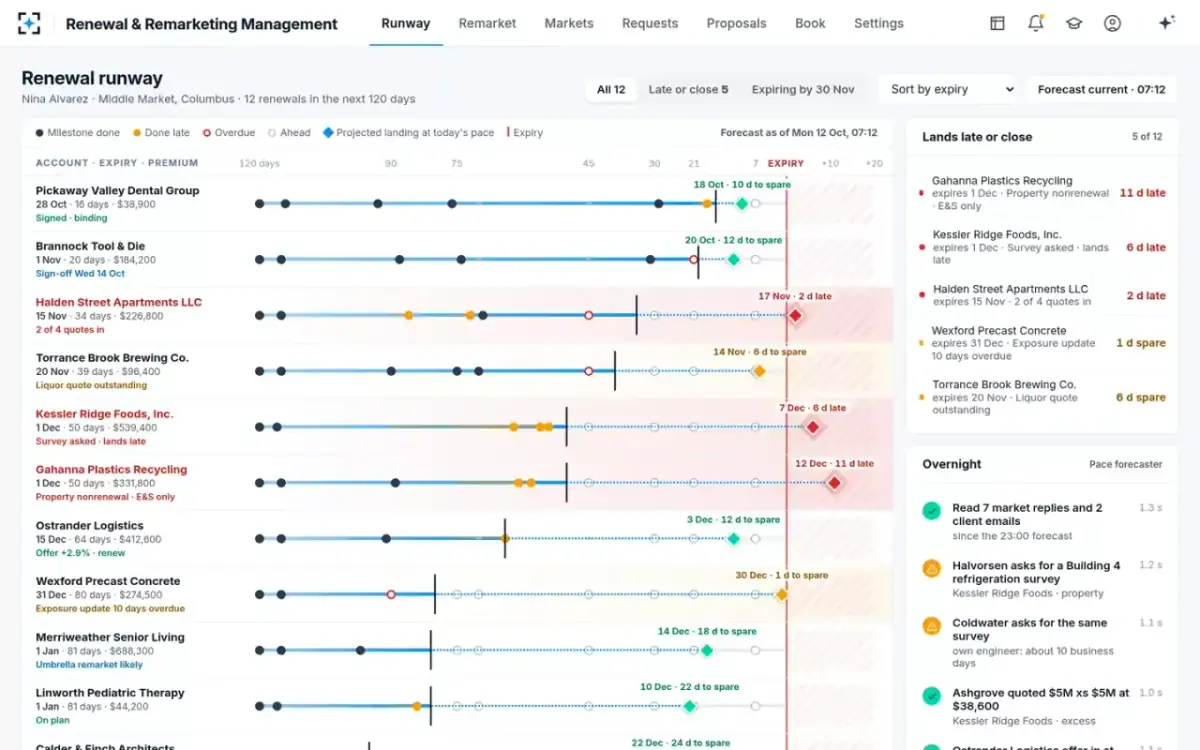
The fix is not more reminders. It is a forecast per renewal that moves when a reply comes in. On the sample agency's runway the overnight replies moved one account from four days to spare to six days past expiry in a single update, seven weeks before the expiry date, because two markets had asked for a survey and the client's exposure update had arrived 28 days late.
The same tracker after seven market replies and two client emails were read
How do you know if exposure data is out of date?
Compare it with two things: the figure on the expiring policy, and the date the client last confirmed it. A payroll, sales or values figure that matches last year exactly is either a stable business or a copied cell, and the tracker cannot tell which. A figure that moved by 10% or more needs a reason before it reaches an underwriter. A new address on an invoice, a building on the website or a vehicle on a fuel card that is not on the schedule needs a question.
The reason to care is not tidiness. The NAIC's examination standards for property and casualty files expect underwriting, rating and classification to rest on adequate information gathered at or near the start of coverage, not near expiry or after a claim (NAIC Market Regulation Handbook, chapter 21). And the client's answers are the client's representations. In New York a misrepresentation voids cover only if it is material, meaning the insurer would have refused the contract had it known the truth (Insurance Law § 3105). A figure the broker rolled forward was never the client's statement at all, which is a harder conversation after a loss. How a carrier's underwriter tests the same changes is the subject of exposure change in insurance.
Six stale fields, and the question a tracker should send instead of last year's answer
Payroll by class code
Stale whenLast year's figure, or any class up or down 10% or more
Ask"Last year you reported $4.1M of production payroll and $0.6M of clerical payroll. What are the figures for the twelve months to 30 June, and has anyone moved between the two?"
Statement of values
Stale whenValues unchanged for two renewals, or a new building, addition or major equipment
Ask"Building 4 is not on last year's schedule. What did it cost to build, what does it hold, and is it sprinklered?"
Vehicle schedule
Stale whenCount or values changed, or no update since last renewal
Ask"The schedule shows 22 power units. Have any been sold, added or leased since 1 December, and who drives the two new ones?"
Locations
Stale whenNew address on invoices or the website not on the schedule
Ask"Your new cold-storage lease in Canal Winchester is not insured on the property schedule. When did you take possession?"
Sales or receipts
Stale whenLast year's figure, or a change of 10% or more
Ask"Last year's sales were $134M. What are the twelve months to date and the forecast for next year?"
Contracts that require insurance
Stale whenAny new customer, landlord or lender contract
Ask"Do any new contracts this year require you to add someone as an additional insured, waive subrogation or carry higher limits?"
Can software collect renewal information from clients?
Yes, if it asks narrow questions and a person stays in charge of the relationship. A renewal questionnaire sent as a twelve-page form returns late and half complete, because it asks the controller to retype what the agency already holds. A question that quotes last year's figure and asks only what changed can be answered in a reply email.
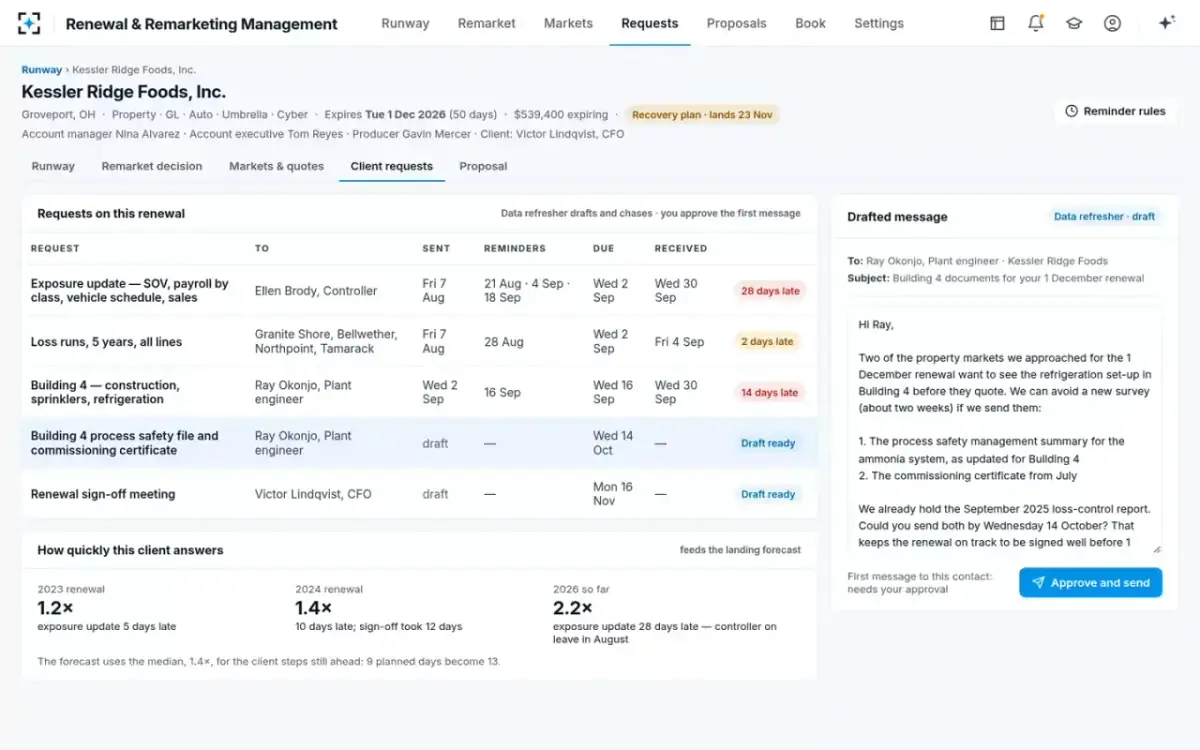
In the solution, the Data refresher drafts the exposure-update request, asks each carrier for five years of loss runs, chases every 14 days, and reads the statement of values, payroll by class, vehicle schedule and sales against the expiring exposures, flagging changes over 10%. Its limits are part of the design: the first message to any client contact waits for the account manager, and it never edits exposures on the policy record.
Every request to the client in one place, with how quickly this client answers
How do you get clients to return renewal information?
Ask fewer, sharper questions, tie each to a date the client can see matters, and send each to the person who holds the answer. The controller does not know whether Building 4 is sprinklered; the plant engineer does. A request that says "the two property markets need this by 14 October to quote before your 1 December renewal" gets a different response from "please complete the attached".
Signatures are the other bottleneck. Federal law expressly applies electronic signatures and records to the business of insurance, and shields an agent or broker from liability for a deficiency in an electronic procedure the parties agreed, provided the agent was not negligent, had no part in designing the procedure and did not depart from it (15 U.S.C. § 7001). An e-signed application is a normal application. In the UK the duty runs the other way: the insured must make a fair presentation of the risk, disclosing what it knows or ought to know (Insurance Act 2015, s.3), which makes the broker's questions part of how the client meets its own duty.
Finally, measure the client's pace. If an account answered 20% and 40% slower than planned in its last two renewals, start its requests earlier this year, or plan its later stages with that lag built in. That is what the renewal pipeline stages forecast does with the same history.
Spreadsheet or renewal tracking software: what to look for
A spreadsheet is enough while one person can hold every renewal in mind; software earns its place when the book is large enough that late renewals are found by accident. The difference that matters is not the grid. It is whether the tool reads replies, asks questions and forecasts, or only stores what people type.
A spreadsheet tracker against a renewal tracker that asks
Spreadsheet tracker: A form sent at a fixed date; replies filed by hand.
Renewal & Remarketing Management: A drafted question per stale field, approved by the account manager, chased every 14 days.
Spreadsheet tracker: Last year's values stay in the cells until someone notices.
Renewal & Remarketing Management: Changes of 10% or more, and figures nobody confirmed, are flagged against the expiring policy.
Spreadsheet tracker: Read in the inbox and typed into a status column.
Renewal & Remarketing Management: Each reply read as a declination, request, indication or firm quote; indications cannot be bound.
Spreadsheet tracker: Overdue cells turn red after the date has passed.
Renewal & Remarketing Management: A projected landing, re-forecast nightly and on every reply, with the arithmetic shown.
Spreadsheet tracker: A note in a comment, if anyone writes one.
Renewal & Remarketing Management: The remarket decision, its reason, who made it and when, before the first submission.
Where the solution fits is specific. It sits beside the agency management system, reading the policy and renewal list, carrier offers, loss runs, client exposure updates, market replies and the agency's market plan; it does not replace the system of record. It sends only to markets on the approved plan, never signs an application for a client and never binds. Agencies that want a spreadsheet template, not software, can use the columns above as they stand. How to put the software live before the next January season is covered in renewal management software.
Questions to ask any renewal tracking software before you buy it
- Does it forecast a landing date per renewal, and show how?
A status color is not a forecast. Ask to see the steps, the days each was given and where each number came from.
- Does it learn each client's pace and each market's turnaround?
A forecast built on the plan alone repeats the plan's optimism.
- Does it ask the client, or only remind the account manager?
The useful output is a drafted question with last year's answer, not another alert.
- Who approves the first message to a client contact?
It should be a named person at the agency, every time.
- Can it change an exposure, a date or a decision on its own?
It should not. It proposes; people change the record.
- Does it read your management system's expiration list and your market history?
A tool that needs every renewal retyped will not be kept current.
Questions people ask
What is renewal tracking software?
It is software that lists every upcoming renewal with its dates, owners and status, and in the better tools forecasts whether each will land before expiry. In insurance it sits beside the agency management system, which holds the policies, and tracks the work of the renewal: data requests, offers, decisions, submissions, quotes and sign-off.
Can I track insurance renewals in Excel?
Yes, for a small book. Use one row per account and line, a column for every milestone date, and computed columns for days late and days to spare. It strains when the book is large, because client lag, market turnaround and re-forecasting on every reply all have to be updated by hand.
How far ahead should renewals be tracked?
At least 120 days for middle-market commercial accounts, so that data requests go out before the underwriter needs them and a late answer still leaves room. Track the projected landing from the day a renewal opens, not only the expiry date.
What renewal data changes most often?
There is no published measure across agencies. The fields that drive premium and move with the business are the usual suspects: payroll by class, sales, the statement of values, the vehicle schedule, locations and contracts that require insurance. Your own tracker can measure it by counting which fields changed by 10% or more last season.
What is a renewal questionnaire for an insurance agency?
It is the form an agency sends a client before renewal to update its exposures and changes in the business. It works best short and specific: last year's figure in each field, a request only for what changed, and a named person and due date for each item.