Insurance renewal requirements, for a broker, are the checks that must be true again on each renewal date rather than only at the first sale: every insured party screened against current sanctions lists; the producer licensed for each line in the client's state, and appointed by the insurer where the producer acts as its agent; the disclosures your state requires, including compensation details when a client asks; the client's confirmation of what changed, signed where the insurer needs it; and the file kept for as long as your state requires. The insurer has its own renewal requirements, chiefly notice deadlines, and the broker is often a named recipient of those notices. None of this is new law at renewal. It is old law applied again to a new policy period, which is why it slips. Botminds' Renewal & Remarketing Management keeps the evidence for most of it on each renewal: the approved market plan, every decision with its reason, every message a person approved. It never signs an application for the client. This guide is about renewing clients' policies; renewing a producer's own license is a different subject, touched on below.
A renewal compliance screen: five checks before the renewal is bound
Agent
Screen the partiesRun the named insured, owners, new subsidiaries, additional insureds and loss payees against current sanctions lists; flag anything new since last year.
Never: clears a potential match on its own.
Agent
Check license and appointmentFor each line, state and market on the plan: is the producer licensed today, and appointed where the market requires it?
A person decides
Disclose and confirmThe account manager sends required disclosures and answers any compensation request in time; the client confirms the exposure changes.
A person decides
Client instruction to bindThe client signs the application or bind instruction; the broker never signs for the client.
Never: binds without the client's written instruction.
Agent
Keep the fileStore the screen results, disclosures, decisions, signed documents and dates with the renewal, for the state's retention period.
What are insurance renewal requirements for brokers?
They are the duties that attach to placing or servicing a policy, applied again because a renewal starts a new policy period, often with changed parties, lines or insurers. Five matter in nearly every state: sanctions screening, licensing and appointment, disclosure, the client's own statements and signature, and records. A sixth, the insurer's notice rules, is the insurer's duty, but a broker that ignores it misses the earliest warning that a renewal is in trouble.
The reason they slip is that renewals feel like continuity. The client is the same, the account manager is the same, last year's file is on the screen. But a remarketed line goes to an insurer the producer may never have been appointed with; a new subsidiary appears on the schedule; the owner sold a stake; the client asks, three weeks before renewal, how much the agency is paid. Each of those is a fresh check.
Do you need to run OFAC checks at renewal?
Yes, in practice. The Treasury's Office of Foreign Assets Control says insurance industry participants, including underwriters, brokers and agents, are responsible for sanctions compliance throughout their involvement with a policy, and recommends a risk-based approach to how often to screen (OFAC, insurance FAQs, updated 13 November 2024). Its guidance on frequency is direct about why issuance alone is not enough:
"Screening only at the point of policy issuance may expose insurers to sanctions risk, for example, providing financial benefit to subsequently blocked persons."
U.S. Treasury, Office of Foreign Assets Control, FAQ 65
The same answer notes that "OFAC's sanctions programs and lists are updated frequently." A commercial renewal is also when new names arrive: an acquired company added as a named insured, a new owner, an additional insured required by a new contract, a loss payee on new equipment. Screen those parties, not only the name on last year's policy, and keep the result. If a policyholder turns out to be blocked, OFAC expects the insurer to block the policy and report within 10 business days, so a broker's early flag matters to the insurer too.
Does a producer need to be licensed at renewal?
Yes: licensed for the line in the state on the date the renewal is sold, and appointed by the insurer where the producer acts as that insurer's agent. The NAIC's model law forbids selling, soliciting or negotiating a line without a license for it, and lets renewal commissions be paid on business sold while the producer was licensed at the time of that sale (NAIC Producer Licensing Model Act, §§ 3 and 13). Placing next year's policy, especially with a new insurer, is a sale of its own.
Two renewal events make this live. A remarket to a new insurer may need a new appointment, and under the model law the insurer files notice of appointment within 15 days of the agency contract or the first application, a rule several states vary; the just-in-time appointment states guide compares them. And a client that opened a location in another state needs a producer licensed there, often a nonresident license. Regulators test exactly this: the NAIC's examination standards check that producers are properly licensed and appointed, with continuing education where required, in the jurisdiction where the application was taken (NAIC Market Regulation Handbook, examination standards).
The producer's own license renewal, continuing education and late-renewal penalties are a separate set of requirements, handled by the agency's licensing function rather than at each client renewal; they are compared state by state in insurance CE requirements by state. What matters here is the daily check: on the date this client's renewal is bound, is everyone who touched it licensed and, where needed, appointed?
Are disclosures required at renewal?
Some are, and New York shows how the rules can be narrower and sharper at renewal than at first sale. Its producer compensation rule, Regulation 194, requires an initial disclosure on every sale, but the Department of Financial Services says it "generally does not apply to renewals", with one exception: if the purchaser asks for more information about the producer's compensation less than 30 days before or after a renewal, the producer must answer in a prominent writing within five business days (DFS, Regulation 194 FAQ). Five business days is a short clock in renewal week.
Fees are stricter. A New York licensee may charge a fee for advice or review only under a written memorandum signed by the client that specifies the compensation, kept for at least three years (Insurance Law § 2119), so a fee agreement that has lapsed or changed needs renewing too. The NAIC model, where a state has adopted it, adds that a producer paid by the client may not also take insurer compensation without the client's documented acknowledgment before purchase.
Privacy notices are the disclosure brokers most often over-apply to commercial books. The NAIC's privacy model, on which state rules are based, is explicit about its scope:
"This regulation does not apply to information about companies or about individuals who obtain products or services for business, commercial or agricultural purposes"
NAIC Privacy of Consumer Financial and Health Information Regulation (#672), scope
The same scope line keeps all nonpublic personal health information in, which matters for workers' compensation claim files. For most commercial accounts, then, the annual privacy notice is not a renewal step; for the owner's personal lines, written alongside, it may be.
Does the client have to sign a new application at renewal?
It depends on the insurer and on what changed. An incumbent may renew by certificate or endorsement with no new application; a new insurer will want its own application, and many renewals need a signed supplement or a statement that nothing material has changed. Whatever form it takes, the statements are the client's. In New York a misrepresentation avoids a policy only if it is material, meaning the insurer would have refused the contract had it known the facts (Insurance Law § 3105), and that test is applied to what the client said.
Electronic signature is fine: the federal E-SIGN Act applies expressly to the business of insurance (15 U.S.C. § 7001). Signing on the client's behalf is not. In Renewal & Remarketing Management the Submission builder builds each market's submission but never signs an application for the client, and the first message to any client contact waits for the account manager.
Who signs off a commercial renewal?
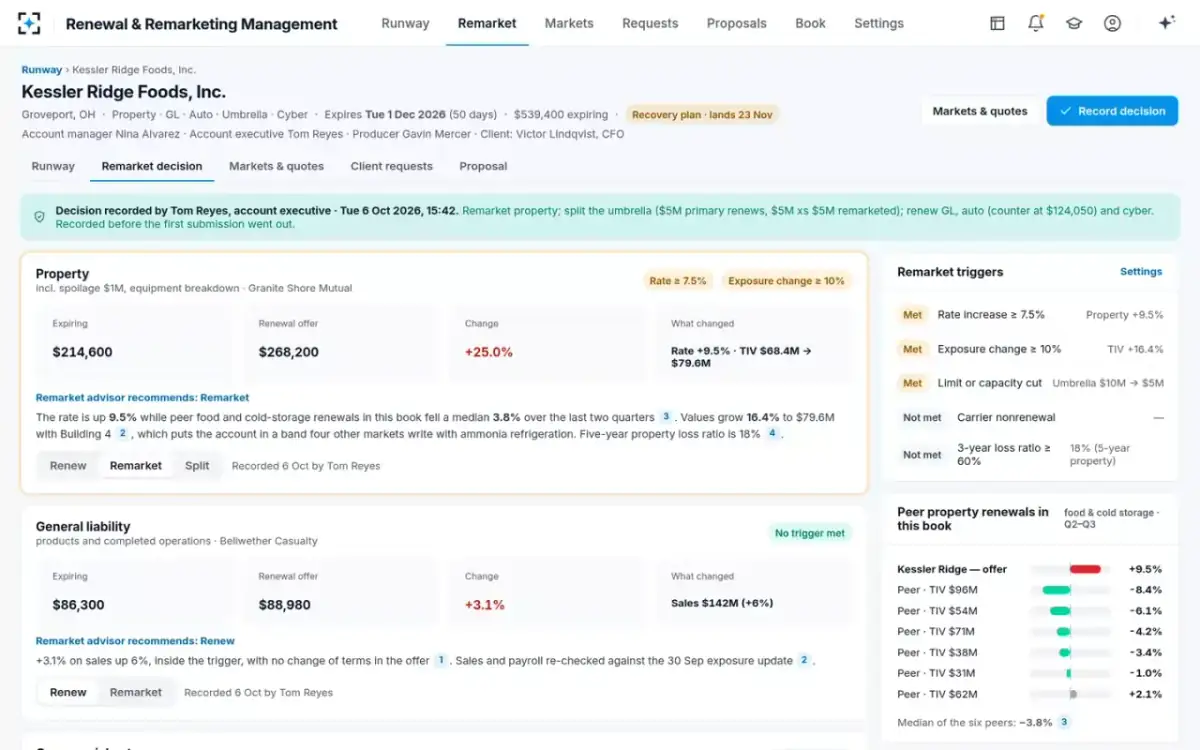
The client instructs the broker to bind, in writing; the insurer binds; the broker records who decided what. Inside the agency, the remarket decision belongs to a named account executive, written down with its reason before the first submission, and any binder extension to a named approver. The sign-off is also the broker's evidence of what the client asked for: in New York the broker's duty is to obtain the coverage specifically requested within a reasonable time, or say it cannot (New York Court of Appeals, 2012).
Who decided, what, when and why: written before the first submission
What records should be kept for a renewal?
Everything that shows what was asked, decided, disclosed and signed, for at least your state's longest applicable period. Florida's is a useful benchmark: every agent must keep records of policies transacted, including applications, change endorsements and documents signed or initialed by the insured, for at least five years after the policy expires (Fla. Stat. § 626.748). New York keeps Regulation 194 disclosures and § 2119 fee memoranda for three years. Each renewal starts its own clock.
Renewal requirements, the rule behind each, and the evidence to keep
| Check | Rule (examples) | Evidence on the renewal file |
|---|---|---|
| Sanctions screening of all parties | OFAC insurance FAQs 62 and 65 | Names screened, list date, result, who cleared any match |
| License for each line and state | NAIC Model #218 § 3; state law | License status on the bind date |
| Appointment with each new market | NAIC Model #218 § 14; state filing windows | Appointment filed or the market's confirmation |
| Compensation disclosure on request | NY Regulation 194 (30 days either side of renewal; reply within 5 business days) | Request date, written reply date |
| Fee agreement | NY Insurance Law § 2119 | Current signed memorandum |
| Client statements and signature | Insurer's application; NY § 3105 materiality; E-SIGN | Signed application or confirmation of changes |
| Client instruction to bind | Agency practice; the broker's duty to the client | Written instruction, dated |
| Insurer notices received | NY Insurance Law § 3426 and other states' notice laws | Notice, date received, action taken |
| Retention | Fla. Stat. § 626.748 (5 years after expiry); NY 3-year rules | The whole file, indexed by renewal |
The insurer's renewal requirements a broker should track
Insurers must give notice before they decline to renew or renew on worse terms, and the broker is often entitled to a copy. In New York, a covered commercial policy continues on the same terms unless the insurer mails a nonrenewal or conditional-renewal notice to the insured and its broker between 60 and 120 days before expiry; a notice that leaves out a required provision is not effective (Insurance Law § 3426). The broker's interest is practical: the notice date is the last day the incumbent can lawfully change the terms, and a notice that arrives is the strongest trigger for a remarket. State-by-state windows are in insurance cancellation notice requirements by state; what to do when a renewal will run past expiry anyway is in insurance renewal extension.
A renewal compliance checklist for the account file
- Every party screened this season
Named insureds, owners, new subsidiaries, additional insureds and loss payees, against current lists.
- Licensed for each line and state on the bind date
Including nonresident licenses for new locations.
- Appointed with every new market where required
Filed within the state's window after the first application.
- Disclosures sent and requests answered in time
In New York, a compensation request near renewal gets a written answer within five business days.
- Fee agreements current and signed
Where the agency charges a fee as well as, or instead of, commission.
- Client statements confirmed by the client
Changes in exposure confirmed in writing; nothing signed on the client's behalf.
- Remarket decision written before submissions
Who decided, when and why, line by line.
- Written instruction to bind
Dated, from someone with authority at the client.
- File kept for the longest applicable period
Five years after expiry in Florida for policy records; three years for New York disclosures and fee memoranda.
Where Renewal & Remarketing Management fits
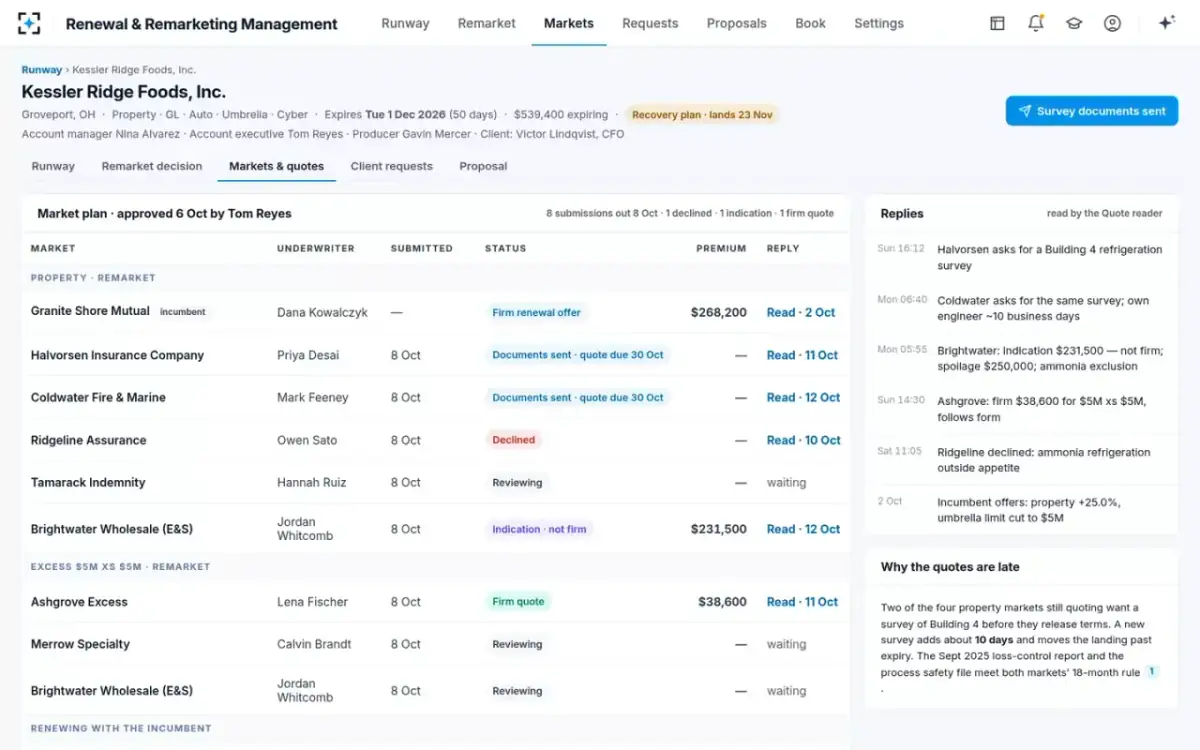
It covers the evidence half of the screen and leaves the authority half with people. Agents contact only the markets on the approved market plan; every reply is classed as a declination, information request, indication or firm quote, and indications cannot be bound; each remarket decision is kept with its reason, who made it and when; every agent step and human decision is on the account's history. The first message to any client contact waits for the account manager, and the solution never signs an application for the client or binds.
Only approved markets, every reply classed, indications never bindable
It does not replace a sanctions screening system or the agency's licensing records. Those checks belong in the agency's own tools; what the solution adds is the renewal's timeline, so each check has a date it must be done by, and a file where its result sits next to the decision it supports. For the triggers that send a renewal to new markets, and so to new appointment checks, see remarketing insurance meaning.
Questions people ask
Do insurance renewals need a new OFAC check?
OFAC recommends a risk-based approach and says insurers should consider screening at renewal, amendment and claim, as well as at issuance, because sanctions lists change frequently. At a commercial renewal, screen any party added since last year as well as the existing insureds.
Can a broker place a renewal with a carrier it is not appointed with?
Where the producer acts as the insurer's agent, it needs an appointment, filed within the state's window; the NAIC model allows 15 days from the agency contract or the first application. Brokers acting for the client are not appointed, and some renewals reach a new insurer through a wholesaler that holds the appointment.
Are privacy notices required for commercial insurance renewals?
Usually not. The NAIC privacy model, on which state rules are based, does not apply to information about companies or about individuals who buy insurance for business purposes, though it does cover nonpublic personal health information. Personal lines written for the owner are a different matter.
How long should a broker keep renewal records?
For your state's longest applicable period. Florida requires agents to keep policy records, including applications and documents the insured signed, for at least five years after the policy expires; New York requires three years for producer disclosures and fee memoranda.
What are insurance license renewal requirements?
That is the producer's own license, not the client's policy. The NAIC's Uniform Licensing Standards call for 24 credits of continuing education in each two-year period, three of them in ethics, and the NAIC model lets a lapsed individual license be reinstated within 12 months without a new exam, at double the renewal fee. States vary, so check your home state's rules.