Renewal pipeline stages are the steps every commercial insurance renewal passes through on its way to bind: opened, data requested, exposures and loss runs in, incumbent offer and remarket decision, submissions out, quotes in, proposal, client sign-off and bound. A pipeline report that counts renewals per stage shows where the work sits. It does not show which renewals will bind after their policies expire, and that is the question an operations manager actually has. Answering it means forecasting each renewal's landing date, and a forecast is a model: it should say what it rests on, how wrong it has been and who can overrule it. Botminds' Renewal & Remarketing Management forecasts every renewal's landing nightly and on every reply, and shows the arithmetic; this guide sets out the stages, the arithmetic and the tests.
Six questions to put to any renewal forecast, and what a good answer looks like
1What does each stage's duration rest on?
For every remaining step, the number of days used and where it came from: a setting, this client's history, or the markets' history for this class and size.
Every number traceable to its source on the screen; no unexplained constant.
2How much history is behind each estimate?
The count of past renewals or quotes behind each median, and the window they cover.
A stated minimum, with a fallback to the plan, and a flag, when there is too little history.
3How wrong was it last season, and in which direction?
A replay: what it forecast at 90, 60, 45 and 30 days out against the date each renewal actually bound.
Average error and its sign by checkpoint; a bias towards optimism is the one to fix first.
4Which late renewals did it miss?
Renewals that bound after expiry, or needed an extension, that the forecast showed as on time.
Each miss explained; none from a cause the model already had.
5What happens when a reply arrives?
The time from a market or client reply to an updated landing.
Re-forecast on every reply and at least nightly.
6Who can override it, and is that kept?
Who may move a milestone or accept a plan, and the history of each change.
Only named people change dates; the forecast proposes and its arithmetic is kept.
What are the stages of a renewal pipeline?
Nine stages cover most commercial renewals, and each should end on something you can point to, not on someone's sense that it is done. A stage defined by evidence can be counted and timed; a stage defined by a status someone picks from a list cannot. The table gives the stages as the sample agency in this guide runs them, with the day each should be finished and the evidence that closes it.
Renewal pipeline stages, the day each should close, and the evidence that closes it
| Stage | Due (days before expiry) | Closed when | Waits on |
|---|---|---|---|
| Opened | 120 | A dated plan exists for the account, with owners | Account manager |
| Data requested | 115 | Exposure update and loss-run requests sent | Account manager |
| Exposures and loss runs in | 90 | Values, payroll, vehicles, sales and five years of losses received | Client, every carrier |
| Offer and decision | 75 | Incumbent offer read; renew, remarket or split decided and written down | Incumbent, account executive |
| Submissions out | 70 | Every market on the approved plan has a complete submission | Account manager |
| Quotes in | 45 | Each market has quoted, declined or asked for more | Markets |
| Proposal | 30 | Proposal sent, with every coverage difference explained | Account manager, producer |
| Client sign-off | 21 | Client's written instruction to bind | Client |
| Bound | 7 | Bind confirmed and binders issued | Insurer |
What is a renewal milestone?
A milestone is the latest date by which a stage must close for the renewal to stay on plan, counted back from expiry. The stage is the work; the milestone is its deadline. On a 1 December renewal, quotes are due on 17 October (45 days out) and client sign-off on 10 November (21 days out). A renewal can sit in the right stage and still be behind every milestone.
Milestones on their own make a lagging signal: the renewal turns red once a date has passed, and every stage after it inherits the delay. The commercial insurance renewal process sets out why the dates fall where they do. What follows is how to turn them into a leading signal.
How do you forecast when a renewal will close?
Take the date the last stage actually closed, add the days each remaining stage will really take on this account, and compare the result with expiry. The trick is the word "really". Plan durations are settings; real durations come from history: how slowly this client has answered before, and how long these markets have taken to quote this kind of risk.
A renewal's projected landing, term by term
Start
Date the last stage actually closed
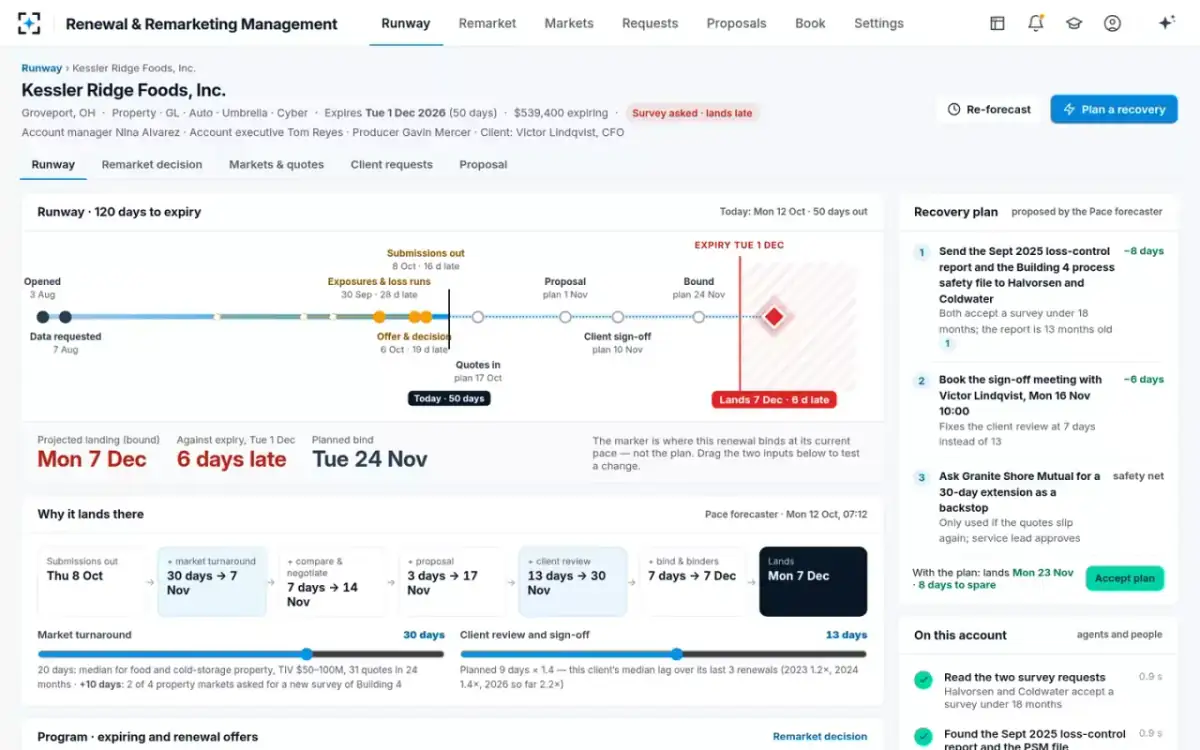
Kessler Ridge Foods: submissions out Thursday 8 October.
Read from the account
Market steps
Median turnaround, this class and value band + known delays
20-day median from 31 quotes in 24 months, plus 10 days for two survey requests: 30 days.
Markets' history
Agency steps
Planned days to compare, propose and bind
7 + 3 + 7 = 17 days.
Agency settings
Client steps
Planned days × the client's usual lag
9 planned days × 1.4 = 13 days of client review.
This client's history
Two design choices matter. The first is that each remaining stage is stretched by its own cause, not by one fudge factor: a slow client does not make the markets slower. The second is that known delays are added as they arrive. When two of the four property markets still quoting on the Kessler account asked overnight for a survey of a refrigerated building, the forecast added the ten days a new survey takes, which is what moved the landing past expiry.
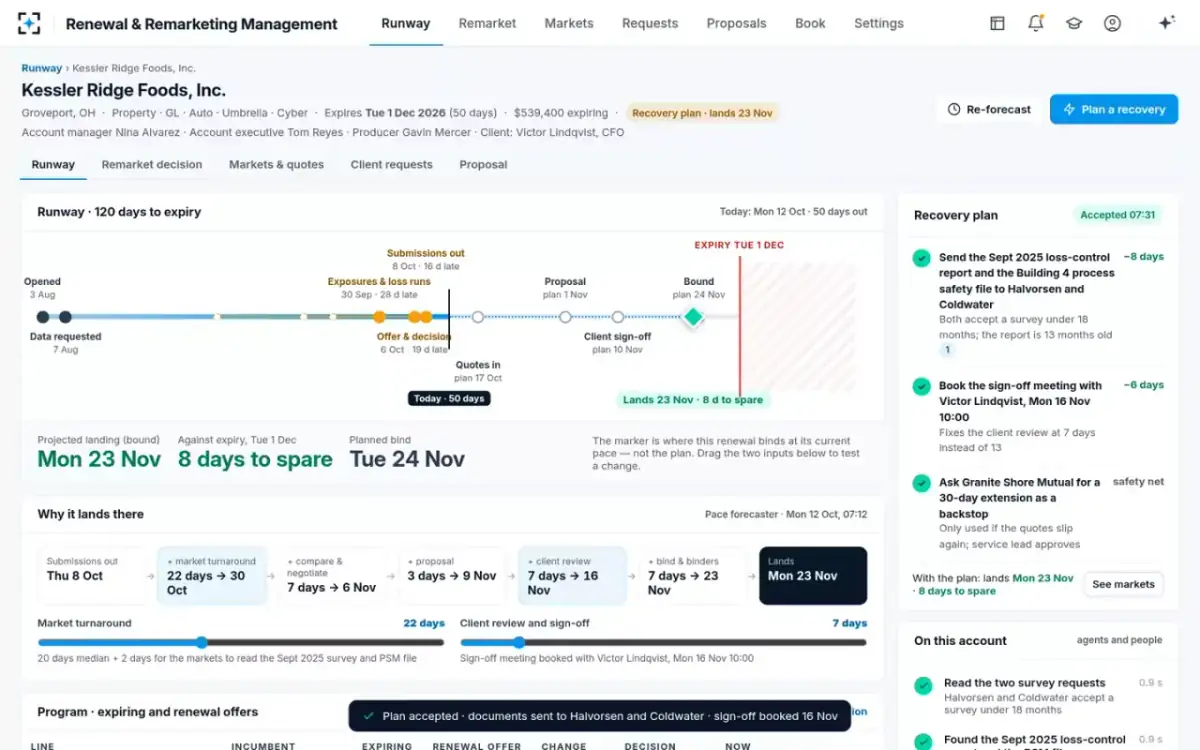
One renewal's remaining stages, before and after a recovery plan
- Market quotes30 d
- Compare7 d
- Proposal3 d
- Client review13 d
- Bind7 d
- Market quotes22 d
- Compare7 d
- Proposal3 d
- Client review7 d
- Bind7 d
Why plan dates run early
Because people plan from the plan. The best-known study of the effect asked honors students in their final semester when they would hand in their theses: on average they predicted 33.9 days and took 55.5, and "Fewer than one third of the respondents (29.7%) finished in the time they reported as their most accurate prediction" (Buehler, Griffin and Ross, Journal of Personality and Social Psychology, 1994). Even their worst-case estimates, 48.6 days on average, came in short, though that gap was not statistically significant.
Predicted against actual: the planning fallacy in one study
The paper's fourth study is the useful one for a renewal desk: the bias "was eliminated" for participants instructed to connect relevant past experiences with their predictions. A renewal forecast that stretches each stage by this client's and these markets' history is that instruction, written into arithmetic. A forecast that uses the plan's durations, however carefully set, will be early in the same way the students were.
How do you know a renewal is running late?
When its projected landing comes within a set margin of expiry, not when a milestone is missed. The sample agency leans a renewal amber at seven days to spare and red past expiry. On its book, the two renewals still landing late were flagged between 34 and 50 days before expiry, early enough to change the plan rather than ask for an extension.
What causes commercial renewals to run late?
Mostly waits outside the agency, and each needs its own treatment in the forecast. A client's late exposure update delays everything after it, so it is the cause to forecast from the client's own history. A market that asks for a survey or more information adds a known number of days the night the request arrives. An incumbent that releases its offer late delays the remarket decision, and in New York a conditional-renewal or nonrenewal notice can lawfully arrive as late as 60 days before expiry (Insurance Law § 3426(e)). A declination shrinks the market plan and can force a new submission. A signatory who is away at sign-off is the most predictable of all, because the calendar shows it weeks ahead.
Some of these the agency can shorten and some it can only see coming. On the sample account the agents could not make the client's controller faster, but they could replace a ten-day survey with a report the markets already accept, and book the client's sign-off meeting before the proposal was written. A forecast that names its causes makes those moves visible; one that only says "late" does not. How those causes turn into an uninsured gap when nothing is done is traced in insurance renewal extension.
The forecast proposes a plan, each change tested against the same arithmetic
How accurate are renewal forecasts?
No public source measures it, so measure your own. Replay last season: for every renewal, take what the forecast said at fixed checkpoints, 90, 60, 45 and 30 days out, and compare it with the date the renewal actually bound. Two numbers come out of each checkpoint. The average error with its sign shows bias, and a forecast that is on average early is repeating the planning fallacy. The average size of the error, ignoring sign, shows how far to trust a single landing date.
Then count the misses that matter: renewals that bound after expiry, or needed a binder extension, that the forecast showed as on time at 45 days out. Each one should have a cause the model did not have, such as an underwriter's illness, rather than a cause it did have and ignored, such as a client that was late the year before. A forecast with a small average error but several silent misses is worse than a cruder one that flags them.
Hold a forecast to the standard of its use. It drives where an account manager spends the morning, not a decision about a client, and Renewal & Remarketing Management's forecaster never changes a milestone or expiry date. Regulators have not written rules for an agency's internal workload forecasts; the UK's FCA says its rules do not usually mandate or prohibit specific technologies (FCA AI Update, 2024), and the NAIC's model bulletin on artificial intelligence is addressed to insurers, as the NAIC AI bulletin requirements guide explains.
Who should see renewal pipeline reports?
Three readers, each with a different cut. The account manager needs every open renewal with its landing, every morning. The service team lead needs the book: which renewals lean late, whose desk they are on and which need an extension decision. The principal needs the trend: how many renewals landed after expiry last quarter, how early each was flagged, and whether the forecast's bias is shrinking.
Accepted by the account manager: the landing back inside the expiry line
Before you trust a renewal pipeline report
- Every stage closes on evidence
A document received, a decision written, a quote read; not a status chosen from a list.
- The landing is shown with its arithmetic
Start date, each remaining stage, the days given to it and where they came from.
- Client and market history stretch the plan
Separately, because a slow client does not make markets slower.
- Known delays are added the day they arrive
A survey request, a declination or a late offer moves the landing that night.
- Last season has been replayed
Bias and average error by checkpoint, and every silent miss explained.
- Only people move dates
The forecast proposes; an account manager accepts a plan and a named lead approves any extension.
The forecast is one part of the tracker; the columns behind it are in the insurance renewal tracker guide.
Questions people ask
What is renewal pace?
Renewal pace is how fast a renewal is moving through its stages compared with its plan. On a commercial account it is driven by the client's speed in answering and the markets' speed in quoting. Expressed as a projected landing date, it tells you whether the renewal will bind before expiry.
How many stages should a renewal pipeline have?
As many as you can close on evidence, usually seven to ten for commercial lines. Fewer than that hides the waits that cause late renewals, especially the client's exposure update and the incumbent's offer. More than that becomes a status list nobody keeps current.
What is the difference between a sales pipeline and a renewal pipeline?
A sales pipeline forecasts whether a deal will close; a renewal pipeline mostly forecasts when, against a fixed expiry date. A renewal that closes a week late can leave a client uninsured, so the useful renewal measure is days to spare before expiry, not the probability of winning.
Can a renewal forecast be wrong because of the client?
Yes, and that is the most common reason. A forecast that plans client steps at their planned length will be early for clients that answered slowly before. Stretching client steps by each client's own past lag, as the sample account's 1.4 times does, corrects much of it.
When should a late renewal be escalated?
When its projected landing comes within your margin of expiry, and early enough that a plan can still work: weeks, not days. In the sample book, the two renewals still landing late were flagged 34 to 50 days before expiry.