Renewal management software runs each commercial renewal as a project with dates: it opens the renewal months before expiry, chases the client's exposure update and the carriers' loss runs, reads the incumbent's offer, records the remarket decision, tracks submissions and quotes, and shows whether the renewal will be bound before the policy expires. For an insurance broker the hard part of buying it is not the feature list. It is timing, because the software has to be running before the busiest renewals open, and for a 1 January expiry that is early September. Botminds' Renewal & Remarketing Management opens every renewal 120 days out and has six agents do the chasing, reading and drafting. This guide gives a ten-week plan that ends the week before the season's first 1 January renewal opens, the data it needs, the tests that decide go or no-go, and what the software must never do.
Ten weeks to live before the 1 January season: deliverable, owner and go/no-go test
| Weeks | Deliverable | Owner | Go/no-go test |
|---|---|---|---|
| 1–2 | Book imported from the agency management system: every policy, line, expiry, premium, account manager and account executive | Operations lead | Every policy expiring in the next 12 months is present, once; spot-check 25 against the system |
| 1–2 | Settings agreed: milestone days, remarket triggers, amber margin, who approves extensions | Service team lead with account executives | Signed off in writing; a holiday rule for milestones in late December |
| 3–4 | History loaded: two or three seasons of renewal dates per account, and 24 months of quotes by market, class and value band | Operations lead | Client lag computed for most accounts with history; any account without history falls back to the plan and says so |
| 3–4 | Market plan and contacts: approved markets by class, underwriters, survey rules; client contacts per data item | Account executives | No submission can go to a market not on the plan; every data request has a named recipient |
| 5–6 | Shadow run on every renewal now inside 120 days: the software forecasts, people work as before | Account managers | Each landing explained step by step; disagreements with the account manager logged |
| 5–6 | Replay of last season: what the forecast would have said at 90, 60 and 45 days, against actual bind dates | Operations lead | Bias and average error stated; every renewal that bound late was flagged or the miss explained |
| 7–8 | Drafted client messages and quote reading reviewed side by side with the team's own | Account managers | No message sends without approval; indications never shown as bindable |
| 9 | Go/no-go meeting | Principal | All tests above met, or a dated fix for each that is not |
| 10 | Live on the cohort opening that week; weekly review through the season | Service team lead | Every renewal opened on its 120-day date from week 10 onwards |
What is renewal management software?
It is the system that holds the work of each renewal, as distinct from the agency management system, which holds the policy. The policy system knows the expiry date, premium and documents. Renewal management software knows who was asked for what and when, what the incumbent offered, what was decided and why, which markets have quoted, and whether the remaining steps will finish before expiry.
The category is broad. At one end are reminder lists and renewal reports inside agency systems; at the other, tools that read replies and forecast. What a broker should look for is set out stage by stage in insurance renewal tracker; this guide assumes you have chosen and need it running.
When is the best time to switch renewal systems?
In early summer, so that the software is live before the 1 January renewals open in September, and the October to December renewals already in flight can be the shadow run. Count back: a 1 January renewal on a 120-day runway opens on 3 September; ten weeks before that is the last week of June. Switching in October, when the season starts to hurt, means changing the tool in the middle of the work it is meant to protect.
Why the plan starts in June: the software's ten weeks against the renewals it must catch
- Import, settings, historywk 1–4
- Shadow, replaywk 5–6
- Review, go/no-go, livewk 7–10
- Live through the seasonSep–Dec
- Not yet openJul–Aug
- Data, offer, submissionsSep–Oct
- Quotes, proposal, sign-off, bindOct–Dec
An agency deciding now, in late autumn, has a better option than a mid-season switch. Run the ten weeks from November, keep the shadow fortnight clear of the holiday weeks, and go live for renewals that open in January, which expire in May. That gives a full season of the agency's own history, client lag and market turnaround, before the next 1 January.
How long does renewal software take to implement?
Plan on about ten weeks for a commercial lines team, of which only the first two are installation. The rest is the agency's own work: agreeing settings that people will actually follow, loading the history the forecast needs, and proving the forecast on renewals already in flight before anyone relies on it. Software that is switched on in a fortnight but never trusted is not implemented.
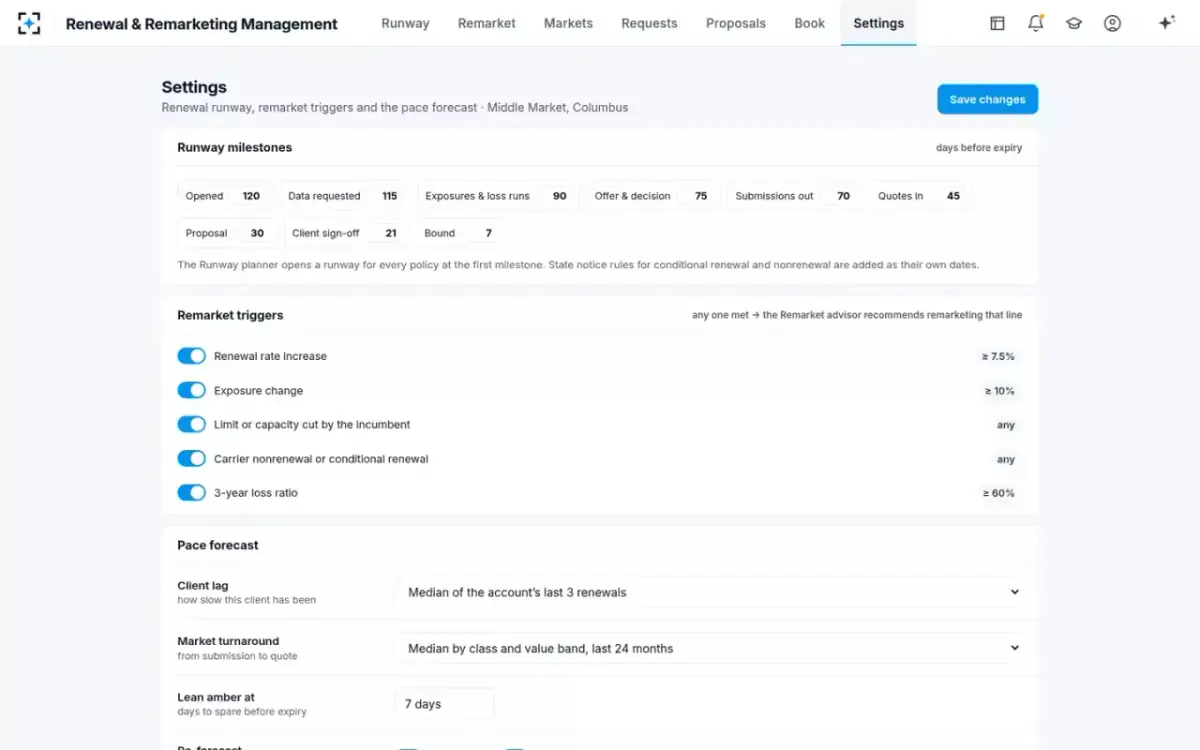
Two of those weeks are worth protecting even under pressure. The settings fortnight decides the agency's renewal rules, written down: when a renewal opens, which triggers recommend a remarket, who records the decision, who approves a binder extension. The shadow fortnight is where account managers see the forecast disagree with their instincts and find out which was right.
The agency's renewal rules, as settings: milestones, triggers and the forecast
What data is needed to set up renewal software?
Less than most agencies fear, and almost all of it already exists. The book comes from the agency management system's expiration list. The history comes from last season's emails and files, which is why the replay matters: it is where the agency finds out how complete its own dates are.
The data a renewal system needs on day one
- The expiration list
Every policy with account, line, insurer, expiry, premium, account manager and account executive.
- Client contacts by data item
Who holds the statement of values, payroll, vehicles and sales at each client. One name per item.
- Last two or three seasons of renewal dates
When each client was asked and when it answered, to measure its usual lag.
- Quotes and declinations by market for 24 months
With class and value band, to measure each market's turnaround.
- The market plan
Approved markets by class, underwriters, and rules such as how old a survey a market will accept.
- State notice rules for the states you write
So the insurer's nonrenewal and conditional-renewal deadlines appear as dates on each renewal.
- Templates
The agency's own exposure request, loss-run request and proposal, so drafts sound like the agency.
The state notice rules deserve a word. In New York an insurer's nonrenewal or conditional-renewal notice on most commercial policies must be mailed or delivered 60 to 120 days before expiry, to the insured and its broker (Insurance Law § 3426); other states set other windows, compared in insurance cancellation notice requirements by state. Renewal & Remarketing Management's Runway planner adds those dates to each renewal so the account manager knows the last date the incumbent can lawfully say no.
Can renewal software import from my agency system?
It should, and it should not try to replace it. The agency management system stays the system of record for policies, premiums and documents; renewal software reads from it and writes the work of the renewal alongside. Ask any vendor three things: which export it reads and how often, what happens when a policy is rewritten or cancelled mid-season, and whether anything it does changes the policy record. In the solution, agents read the policy and renewal list, carrier offers, loss runs, client exposure updates, market replies by portal and email, and the market plan; they never edit exposures on the policy record.
Electronic signatures need no special handling. The federal E-SIGN Act applies expressly to the business of insurance, and an agent or broker is not liable for a deficiency in electronic procedures the parties agreed, if it was not negligent, had no part in designing them and followed them (15 U.S.C. § 7001).
How do you test renewal software before going live?
Run it in the shadow of the real season and replay the last one. The shadow run puts every renewal now inside 120 days into the software while people keep working as before; for a fortnight, the account managers compare its forecast and its drafts with what they would have done. The replay takes last season's renewals and asks what the forecast would have said at 90, 60 and 45 days out, against the date each was actually bound.
The go/no-go tests follow from that. Every renewal must be present and opened on its date. Every landing must be explainable step by step. The replay's bias must be stated, and every late renewal last season either flagged in time or its miss explained. No message may leave without a person's approval. The detail of testing a forecast, and the questions to put to it, are in the renewal pipeline stages guide.
Who should own renewal software at an agency?
The service team lead or operations lead should own it, because they own the season: the settings, the weekly review and the decisions about extensions and workload. Account executives own the remarket triggers and the market plan; account managers own their renewals; the principal owns the go/no-go. A tool owned by IT alone tends to be configured once and then worked around.
Ownership includes the data it touches. The NAIC's Insurance Data Security Model Law, adopted in some states, expects licensees, a term that includes producers, to use due diligence in choosing third-party service providers and to require them to protect the information they hold; licensees with fewer than ten employees are exempt from its information security program section (NAIC Model #668). Check your own state's version before you sign.
People are the other part. The Bureau of Labor Statistics projects about 43,100 openings a year for insurance sales agents over the decade (BLS), so many agencies start a season with new account managers. One field study of an AI assistant, in customer support rather than insurance, found the largest gains among newer and less skilled workers: productivity rose 14% on average and 34% for them (NBER working paper 31161). Whether that carries over to renewals is untested; it is a reason to include new staff in the shadow run.
What should renewal management software never do?
It should never take a decision that carries the agency's liability. It may read, draft, forecast and propose. It should not bind, sign an application for a client, contact a market that is not on the approved plan, send a first message to a client contact without the account manager, or move a milestone or expiry date. Each of those is a person's act, and each should be kept with who did it and when.
What the agents do in Renewal & Remarketing Management, and what stays with people
Agents do: Open a runway for every policy 120 days out, with nine milestones and the state notice dates.
People do: Set the milestones; move a date when the client agrees a new one.
Agents do: Draft requests, chase every 14 days, flag exposure changes of 10% or more.
People do: Approve the first message to each client contact; decide what to do about a late answer.
Agents do: Recommend renew, remarket or split per line, with every reason sourced.
People do: The account executive records the decision and its reason before any submission.
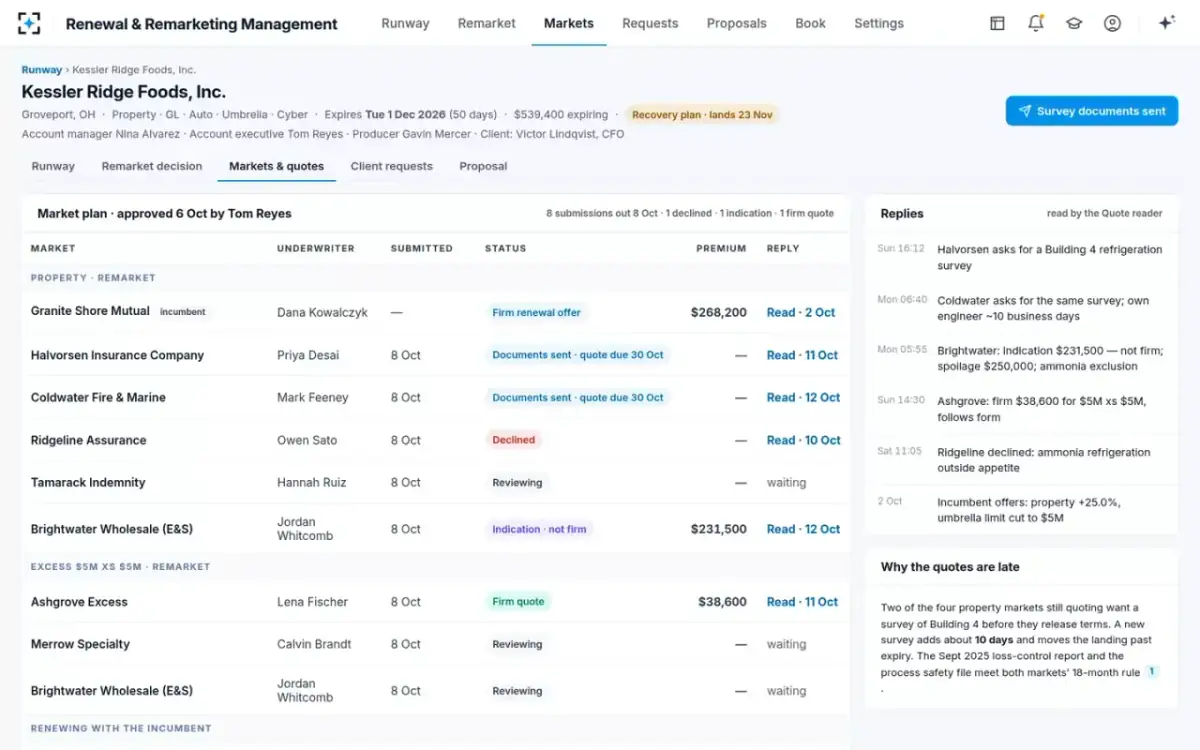
Agents do: Build submissions for markets on the approved plan; read every reply.
People do: Approve the market plan; bind.
Agents do: Re-forecast nightly and on every reply; propose the smallest recovery plan.
People do: Accept a plan; the service team lead approves any binder extension.
Only markets on the approved plan, and every reply read for what it is
Questions people ask
What does renewal management software cost?
Prices vary by vendor, book size and how much reading and drafting the software does, so ask for a price on your own book. Set it against the cost of the late renewals it would have caught last season, which the replay in weeks 5 and 6 will show you.
Can we go live in the middle of the renewal season?
You can, but it is the riskiest time: the team learns a new tool while the busiest renewals are in flight. A better path is to finish setup and the shadow run, then go live on the next cohort to open, so no renewal changes system halfway through.
Do we need to clean our data first?
Only the expiration list must be right on day one. The history the forecast uses improves as it is used, and the replay of last season shows where dates are missing. Accounts without history fall back to the plan's durations until a season of their own exists.
Will renewal management software replace our agency management system?
No. The agency management system stays the record of policies, premiums and documents. Renewal software reads from it and holds the work of each renewal: requests, offers, decisions, submissions, quotes and the forecast.
What compliance checks belong in renewal software?
The ones a renewal repeats every year: the insurer's notice dates, sanctions screening of new parties, producer licensing and appointment on the renewal date, and disclosures. They are set out in insurance renewal requirements.