A commercial insurance renewal questionnaire is the broker's request to each client for the exposure data and changes the markets will price the renewal on: an updated statement of values, payroll by class, the vehicle and driver schedule, sales or receipts, contracts that set insurance requirements, changes in operations, and authority to request five years of loss runs. A brokerage should send it about 120 days before expiry and have it back by about 90, because every later step, the decision whether to remarket, the submissions, the quotes and the proposal, waits on it. It is hard because the answers sit with different people at the client, the form usually asks them to retype last year's figures, and a reply that arrives four weeks late squeezes every step behind it into the final days. Botminds' Renewal & Remarketing Management sends the questionnaire as targeted requests, each with last year's answer attached and addressed to the person who holds it, and re-forecasts the renewal's landing date every time a reply is late.
This guide is written for brokerage account management and service leaders who own renewal quality across a book. The worked examples come from the fictional sample agency and accounts in the solution; the rules are quoted from state regulators, the NAIC and federal law, linked where they appear.
What a broker must collect from each commercial client before renewal, and by when
- Statement of values: buildings, contents, stock, equipment (by 90 days out)
Sets the property limits and premium. Ask for new buildings, additions, major equipment and the year’s peak stock, not the average.
- Payroll by class for the last 12 months, and next year’s estimate (by 90 days out)
Workers’ compensation and often general liability are rated on it. Office staff, drivers and outside sales split out.
- Vehicle and driver schedule (by 90 days out)
Every vehicle added, sold or leased, and every new driver; commercial auto is rated unit by unit.
- Sales or receipts, actual and forecast (by 90 days out)
The premium base for many liability policies, and a figure underwriters check for change.
- Contracts, leases and loan agreements with insurance clauses (by 90 days out)
Required limits, additional insureds and waivers that the expiring program may not give.
- Changes in operations (by 90 days out)
New products, locations, processes, renovations, safety upgrades, acquisitions, work stopped.
- Authority and contacts for loss runs (at the start)
Five years from each insurer; some insurers need the insured’s written request.
- The sign-off meeting (booked at the start)
The decision-maker’s hour, about three weeks before expiry, so quotes are not waiting on a calendar.
What should a commercial renewal questionnaire collect?
Current figures for every exposure base the markets rate on, a list of what changed, and the documents that set the client's insurance requirements. Insurers price commercial policies on exposure bases, values for property, payroll for workers' compensation, units for auto, sales or payroll for much liability, so a figure copied from last year either undercharges, which a premium audit later corrects with a bill, or describes a business that no longer exists, which is worse at claim time.
Regulators expect underwriting to rest on information gathered at the start of cover. One of the NAIC's examination standards for property and casualty insurers tests that underwriting, rating and classification rest on adequate information developed at or near the policy's inception, not near expiry or after a claim (NAIC Market Regulation Handbook, chapter 21). For a brokerage, the questionnaire is how that information reaches the insurer; a submission built on last year's figures is the broker's error before it is anyone else's.
The regulator's own guide for business owners shows what insurers will ask. Wisconsin's asks owners whether rebuilding would trigger required upgrades, "e.g., fire sprinklers may need to be installed," what it would cost to replace inventory, noting the "minimum and maximum values during the year," and to check "your lease and other legal contracts you have signed to see what and how much liability coverage the contracts require you to carry" (Wisconsin OCI, PI-085). A questionnaire that does not ask those questions leaves them for the underwriter to ask later, when there are fewer days.
Who at the client holds each answer
Most of the answers already exist in the client's business, held by different people, and the fastest renewals send each request to the person who holds the item rather than to one overloaded office manager or controller.
Renewal items, who at the client usually holds them, and what the underwriter does with them
| Item | Who usually holds it | What the underwriter uses it for |
|---|---|---|
| Statement of values | Facilities or finance | Property limits and premium; checks values against the cost to rebuild |
| Payroll by class | Payroll or HR | Workers’ compensation premium by classification; some liability premium |
| Vehicle and driver list | Fleet or operations | Auto premium per unit; driver checks |
| Sales or receipts | Finance | Liability premium base; growth since last year |
| Contracts, leases, loan covenants | Legal, finance or the owner | Required limits, additional insureds, waivers of subrogation |
| Building and safety details | Plant engineer or facilities | Construction, sprinklers, alarms, roof and wiring age; survey requirements |
| Loss runs, five years | The client’s insurers, requested by the broker | Claims history by year, open claims and reserves |
Loss runs are the one item the client may not hold. The broker requests them from each insurer, and several states put a clock on the reply: in New York an insurer must supply closed and open claim information within ten days of a written request from the insured or its broker (Insurance Law § 3426(g)). Other states' clocks are compared in loss run requirements by state.
When should a broker send the renewal questionnaire?
About 120 days before expiry, with the information due back by about 90. The reason is what has to happen after it arrives. On the sample agency's runway a third of the 120 days belong to the client: gathering information at the start, and review and sign-off at the end. The broker's own steps and the markets' turnaround fill the rest, with a week spare.
Whose turn it is: a 120-day commercial renewal by who it waits on
Planned 120 days
- Client: information · 25%
- Insurers: loss runs, renewal offer · 12.5%
- Broker: decide, submit · 4%
- Markets: quotes · 21%
- Broker: proposal · 12.5%
- Client: review, sign off · 7.5%
- Bind, binders · 11.5%
- Spare · 6%
Starting late is the commonest failure, and it is measurable. In the sample book, all 12 renewals in the window were opened at 120 days; before the solution, renewals there started a median 64 days out, which leaves the markets' turnaround and the client's sign-off to share less than half the planned runway.
Why late questionnaires make late renewals
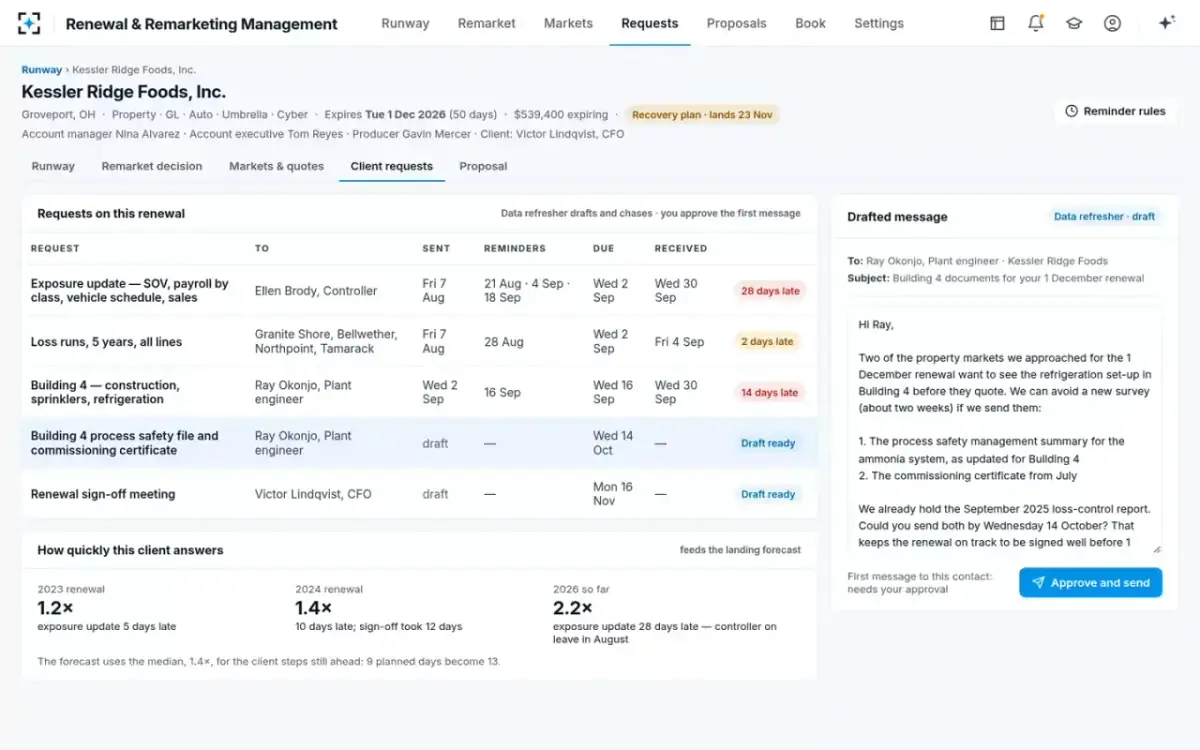
A late answer does not delay one step; it delays every step after it, and the squeeze lands at the end, where the client has least room to choose. On the sample renewal, a mid-sized food manufacturer's exposure update arrived 28 days late because the controller was on leave, and the incumbent's renewal offer two days after that. The decision whether to remarket the property, the submissions and the quotes all moved, and the forecast landing slid from four days to spare to six days past expiry, seven weeks out.
One sample client's renewal requests, and how late each came back
28days
late: the exposure update from the controller, after three reminders
14days
late: the new building’s construction and sprinkler details from the plant engineer
2days
late: loss runs from four insurers
2.2×
this year’s answer time against the client’s usual pace; past renewals ran at 1.2× and 1.4×
It was recovered by sending the markets that had asked for surveys a loss-control report they already accepted, and by booking the sign-off meeting a month ahead; the renewal landed with eight days to spare. What a late renewal turns into when no such plan is made is set out in insurance renewal extension.
How should a renewal questionnaire be designed?
Short, pre-filled and addressed. A good questionnaire is short because the broker already holds last year's answers: it quotes last year's figure and asks only for this year's, "Last year you reported sales of $134 million. What are the twelve months to date and the forecast?" It sends each question to the person who holds the answer, says when the markets need it, and records who answered, so follow-ups go to the right person.
Questionnaire design choices, and what each does to the reply
| Design choice | Common practice | What works better |
|---|---|---|
| Format | A long form that asks for every figure again | Last year’s answer quoted; the client confirms or updates |
| Addressee | One contact for every item | Each item to the person who holds it, by name |
| Deadline | One date for everything | Each item dated to when the next step needs it |
| Reminders | Fixed intervals regardless of risk | Chased against the renewal’s forecast landing |
| Unchanged answers | Accepted without comment | Accepted with a reason, especially for values |
| Signatures | Wet-ink application at the end | Electronic signature on the application or supplement |
Two items deserve extra scrutiny. Values that have not changed since last year should come with a reason, because building costs move and a schedule copied forward falls behind; on the sample renewal, a new refrigerated building raised the client's insured values from $68.4 million to $79.6 million, and two markets asked for a survey of it before they would quote. And losses must be reported in full; the regulator's guide tells owners plainly why.
"Failure to accurately report past losses could allow an insurance company to legally deny your claim and not pay you for the loss."
Wisconsin Office of the Commissioner of Insurance, Consumer's Guide to Insurance for Small Business Owners (PI-085)
The signature need not wait for paper. Under federal law a signature, contract or record relating to a transaction "may not be denied legal effect, validity, or enforceability solely because it is in electronic form" (15 U.S.C. § 7001), so a renewal application or supplement can usually be signed electronically, subject to the insurer's own requirements.
What to ask for, line by line
Each line of business rates on a different exposure base, so the questionnaire should be built from the client's program, not from one master form. The table sets out the core questions by line; a contractor, a manufacturer and a property owner will each need supplements for their own hazards.
Renewal questionnaire items by line of business, and why each is asked
| Line | Ask for | Why the market needs it |
|---|---|---|
| Property | Values by location at replacement cost; construction, occupancy, protection and exposure; roof, wiring, heating and plumbing updates; peak stock | Limits, rate and survey decisions; code-upgrade and peak-season exposure |
| Workers’ compensation | Payroll by class for the last 12 months and the coming year; officers and their inclusion; subcontractor spend and certificates | Premium by class; the audit later tests the estimate |
| Commercial auto | Units added, sold or leased with VINs and garaging; drivers added, with licence details; radius and use | Rating unit by unit; driver eligibility |
| General liability | Sales or payroll by class; new products, services or locations; contracts with additional insured or waiver requirements | Premium base and the endorsements the client’s contracts require |
| Umbrella and excess | Underlying limits as renewed; contract limit requirements; large losses | Attachment and capacity; whether the tower still fits the contracts |
| All lines | Losses not yet on the loss runs; changes in ownership or operations; the signatory and sign-off date | Full disclosure and a decision date the runway can rely on |
Contracts deserve a question of their own on every line. A new customer contract that asks for a $5 million limit, or to be named as an additional insured with primary and noncontributory wording, is a renewal change even if nothing else in the business moved, and it is the change clients most often forget to mention.
What the questionnaire's answers decide downstream
The answers decide whether the renewal is remarketed and on what terms. On the sample account, the incumbent's property offer came back up 25.0%, from higher rates and higher insured values with a new building, and six peer food and cold-storage renewals in the book fell a median 3.8%; the umbrella carrier offered only $5 million of the expiring $10 million. Those figures only meant something because the values and the new building were in the file. How a brokerage decides line by line whether to renew or shop is set out in remarketing insurance meaning.
They also decide what the client pays after the policy year. Workers' compensation renewal payroll is an estimate the insurer audits afterwards, billing or refunding the difference; an estimate that is too low is not a saving, only a later bill, and payroll put in the wrong class costs money until the audit. What the carrier's auditor will verify is set out in the premium audit process.
Renewal & Remarketing Management shows every request, who it went to, and how late it is
Where Renewal & Remarketing Management fits in the questionnaire
The data refresher sends the questionnaire as targeted requests, each with last year's answer and addressed to the holder, chases each one against the renewal's forecast rather than on fixed dates, and records every reply. The Pace forecaster re-lands every renewal nightly and on every reply, stretching the remaining steps by this client's usual lag and the markets' turnaround for this class and size, so a late questionnaire shows up as a landing date moving toward expiry, not as an overdue task.
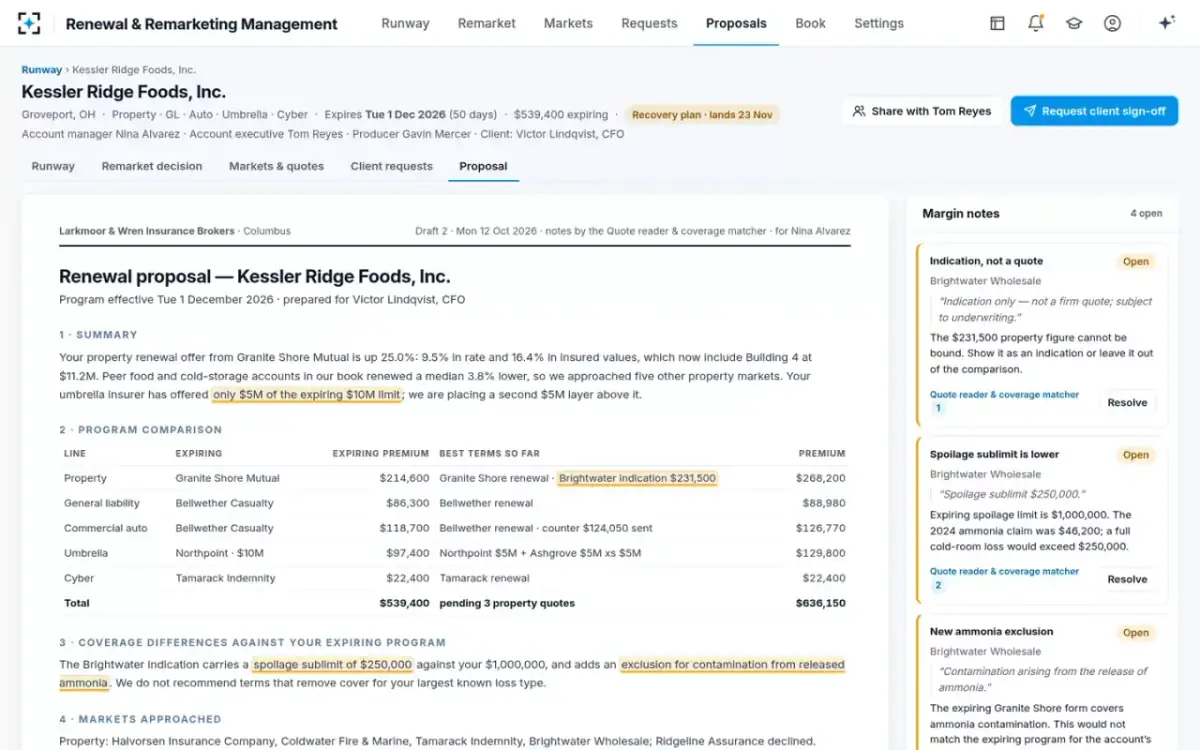
People keep the decisions: the account manager sends requests and accepts recovery plans, the account executive decides what to remarket, and the service team lead approves any extension request. A proposal built from the questionnaire's answers shows every difference from the expiring program in writing; on the sample, an alternative property quote carried a spoilage sublimit of $250,000 against an expiring $1,000,000 and a new exclusion, each flagged with its wording. The broker's whole calendar is set out in the commercial insurance renewal process, and the series starts from Renewal & Remarketing Management.
A proposal built on the questionnaire: every difference from the expiring program
Questions people ask
What is a commercial insurance renewal questionnaire?
The broker's request to a commercial client for updated exposure data and changes before renewal: values, payroll by class, vehicles and drivers, sales, contracts with insurance clauses, operational changes and authority for loss runs. The markets price the renewal on the answers.
How far before expiry should a broker send it?
About 120 days, with answers due by about 90 for a mid-sized account. On the sample agency's runway the client's information and sign-off take 39 of the 120 days, and the markets need weeks to quote after submissions go out.
Should the questionnaire be pre-filled with last year's answers?
Yes. Quoting last year's figure and asking only for this year's makes the form short, shows the client what the markets saw last time, and makes an unchanged answer a deliberate one. Unchanged property values should come with a reason.
Can the renewal application be signed electronically?
Usually. Federal law says a signature or record relating to a transaction may not be denied legal effect solely because it is electronic (15 U.S.C. § 7001), subject to the insurer's own requirements for the application or supplement.
How quickly must an insurer send loss runs for a renewal?
It depends on the state. In New York an insurer must supply closed and open claim information within ten days of a written request from the insured or its broker, under Insurance Law § 3426(g); other states set their own clocks.
What happens if the client returns the questionnaire late?
Every later step is squeezed: the remarket decision, submissions, quotes and proposal. On the sample account a 28-day delay moved the forecast landing six days past expiry, seven weeks out, until a recovery plan brought it back to eight days to spare.