An insurance renewal extension is an agreement by the expiring insurer to keep a commercial policy in force for a short period past its expiry date, usually at pro rata premium, so that a renewal still being placed does not leave the client uninsured. Its alternatives are a binder from the new insurer, which carries the usual terms of the policy it anticipates and in states such as Arizona and West Virginia cannot run past 90 days without the regulator's approval, or binding on the terms available. Every option needs an insurer to agree before 12:01 a.m. on the expiry date; after that there is nothing to extend, and the days without cover are the client's loss and, often, the broker's errors and omissions claim. The hard part is seeing the need in time, because a commercial renewal rarely fails through one mistake: it runs out of days through a string of ordinary delays. Botminds' Renewal & Remarketing Management forecasts every renewal's landing date from the day it opens, so a renewal heading past expiry shows weeks before the bridge is needed, and an extension request can be held in reserve instead of begged for on the last afternoon.
This guide is written for brokerage service leaders, account executives and agency principals. The worked examples are fictional, from the sample agency and accounts in the solution; the rules are quoted from state statutes, regulators and the New York Court of Appeals, linked where they appear.
What is an insurance renewal extension?
It is a short continuation of the expiring policy, agreed by the expiring insurer, to cover the days between expiry and the bind of the renewal or replacement. It is a request, not a right: the insurer may agree, agree on conditions, or refuse, and an insurer that has already sent a nonrenewal notice is the least likely to agree. Extensions are commonly measured in days or a month; on the sample renewal in the solution, the recovery plan held a 30-day extension request to the incumbent in reserve.
An extension is not a grace period. A grace period, where one exists, concerns paying an instalment on a policy that is still in force; in New York, cancelling a covered commercial policy for non-payment needs written notice at least 15 days before the cancellation takes effect (Insurance Law § 3426(c)). At expiry, the statute protects the client from a silent insurer: if the insurer fails to give timely notice that it will not renew, or will renew only on changed terms, cover continues. It does nothing for a renewal the client and broker simply did not finish; New York's notice rules are set out in New York's nonrenewal notice requirements.
The broker's bridging options, compared
A broker facing a renewal that will not bind by expiry has three bridges, and each depends on a different insurer and carries a different risk. The choice should be made weeks out, when all three are still available.
Three ways to bridge a late commercial renewal
Extension of the expiring policy: The expiring insurer.
Binder from the new insurer: The new insurer, or an agent with authority to bind for it.
Extension of the expiring policy: The expiring policy’s terms, for the extra days, usually at pro rata premium.
Binder from the new insurer: The usual terms of the policy it anticipates, except as the binder says otherwise (A.R.S. § 20-1120(A)).
Extension of the expiring policy: Whatever the insurer agrees.
Binder from the new insurer: 90 days from its effective date in Arizona and West Virginia, or until the policy issues, unless the regulator approves longer.
Extension of the expiring policy: The incumbent has nonrenewed, or is leaving the class.
Binder from the new insurer: The new insurer’s conditions, such as a signed application, deposit or certificates, are not met by expiry.
Extension of the expiring policy: As soon as the forecast landing approaches expiry.
Binder from the new insurer: When a firm quote is accepted, with its conditions read on arrival.
How long can a binder bridge a commercial renewal?
Not past the policy's issue, and in some states not past 90 days. Arizona's statute says "No binder shall be valid beyond the issuance of the policy" or "beyond ninety days from its effective date, whichever period is the shorter," and that a binder may be extended past 90 days only "with the written approval of the director" or under the director's rules (A.R.S. § 20-1120). West Virginia provides that "no agent or insurer shall issue a binder covering a period in excess of ninety days from its effective date," extendable only with the commissioner's written approval or under the commissioner's rules (W. Va. Code § 33-6-18).
The catch is the insurer's agreement. A binder is issued by an insurer or an agent with its authority, and a market that has quoted with conditions may refuse to bind until they are met. A broker who reads a quote's conditions only in the last week has no time to meet them or to find another bridge; how conditions on a quote are tracked is part of the insurance renewal requirements a broker rechecks every year.
How a late renewal runs out of days
A commercial lapse is almost never one mistake. It is a run of small delays, each reasonable on its own, that leaves no days at the end. The fictional example below follows one renewal from its opening to a three-day gap.
One commercial renewal, planned and as it happened: three days past expiry
- Client information30
- Offer, decision, submit20
- Markets quote25
- Proposal15
- Client signs9
- Bind14
- Spare7
- Client information64
- Submit7
- Markets quote39
- Proposal, sign, pay, bind13
The renewal that ran out of days, and the last day each bridge was available
| Date | Days to expiry | What happened |
|---|---|---|
| Sun 1 Nov 2026 | 120 | Renewal opened; payroll, vehicle schedule and contracts requested |
| Tue 29 Dec | 62 | The incumbent mails a nonrenewal: it is leaving contractors’ business in the state. Timely under New York’s 60-day rule; an extension from it is now unlikely |
| Mon 4 Jan 2027 | 56 | Payroll and the vehicle schedule arrive, 34 days late |
| Mon 11 Jan | 49 | Submissions to five markets. A forecast at this point lands past 1 March |
| Fri 19 Feb | 10 | One firm quote, with conditions: a signed application, a 25% deposit and certificates from every subcontractor |
| Mon 22 Feb | 7 | Proposal sent. The owner, who signs, is abroad until 28 February. Last practical day to ask the new market to bind with conditions to follow |
| Mon 1 Mar | 0 | Expiry, 12:01 a.m. Nothing in force. Application signed that evening |
| Thu 4 Mar | −3 | New policy bound from 4 March. Three days uninsured on property, liability and auto |
Seven weeks before expiry, with the client's information a month late and a nonrenewal in hand, the landing could have been forecast past 1 March. That was the day to plan the bridge: ask the market that would eventually quote how it would treat conditions, book the owner's signature around the trip, and decide who would ask for a binder if the quote came late. Renewal pipeline stages shows how the landing arithmetic works.
What a coverage gap costs the client, line by line
Any loss during the gap is uninsured, and some lines bring penalties on top whether or not anything happens. New York's Workers' Compensation Board monitors the coverage of more than 800,000 employers, and its penalties "can be as high as $2,000 for every 10-day period without coverage"; by the time an employer receives the first notice, "the penalty may be more than $12,000" (New York Workers' Compensation Board). The rate per ten days depends on headcount, from $500 for five employees or fewer to $2,000 for 25 or more (WCB penalty calculation).
Workers' compensation gaps are priced by the day, not by the claim
$2,000
New York maximum per 10-day period without coverage, 25 or more employees
$500
New York rate per 10-day period, five employees or fewer
$750
Wisconsin minimum penalty, or twice the unpaid premium if greater
$100
Wisconsin, per uninsured day, for a first lapse of seven days or less with no injury
Wisconsin adds personal exposure: "Officers and directors of uninsured corporations are personally liable for benefits owed by the corporation" (Wisconsin OCI, PI-085). Commercial auto brings registration consequences; New York's motor vehicle department defines a lapse as a period when "there is no liability insurance coverage for a vehicle registered in New York State" (New York DMV). Property and general liability carry no state penalty as such, but contracts and leases that require continuous cover may be breached, and certificates already issued describe a policy no longer in force.
What is the broker's exposure when a renewal lands late?
The broker owes the client reasonable diligence in placing the cover the client asked for, and a late renewal tests it. New York's highest court has described the duty as obtaining the coverage a client requested within a reasonable time, or telling the client that it cannot (New York Court of Appeals, 2012). A broker who sees a renewal heading past expiry and says nothing has a harder conversation ahead than one who warned in writing seven weeks out and offered a bridge.
Two practices protect both client and broker. Warn early and in writing, with the forecast date, what is late and who holds it, and the bridging options. And never backdate: a broker cannot create cover for days already past, only an insurer can agree a policy's start date, and presenting a backdated policy to a regulator, lender or customer as if cover had been continuous is a misrepresentation. The honest route after a gap is to bind as soon as possible, record the gap and tell anyone who relies on continuous cover.
Who held each of the three uninsured days
Today
Sent payroll and the vehicle schedule 34 days late, during year-end payroll.
With agents
Gets one narrow request per item, with last year’s figure and the date the markets need it.
Still theirs: The client’s records.
Today
Sent reminders on fixed dates and saw the landing only when quotes arrived ten days out.
With agents
Sees the landing move past expiry the night the information is late, and asks for a plan.
Still theirs: The calendar and the client relationship.
Today
Learned of the conditions on the only firm quote a week before expiry, while abroad.
With agents
Has the sign-off meeting booked at the start of the renewal, around the trip.
Still theirs: The decision and the signature.
Today
Heard about the lapse after it happened.
With agents
Sees which renewals lean late across the book, and approves an extension request before expiry when a plan needs one.
Still theirs: Extensions and workload.
When to ask for an extension: the forecast, not the calendar
Ask when the forecast landing comes within a week of expiry, not when the calendar does. Renewal & Remarketing Management's Pace forecaster re-lands every renewal nightly and on every reply, stretching the remaining steps by the client's usual lag and the markets' turnaround for this class and size. When a landing comes within seven days of expiry, or past it, it proposes the smallest set of changes that brings it back, with each change's effect in days, and an extension request can be one of them.
Three renewals in Renewal & Remarketing Management already past their expiry line, weeks before expiry
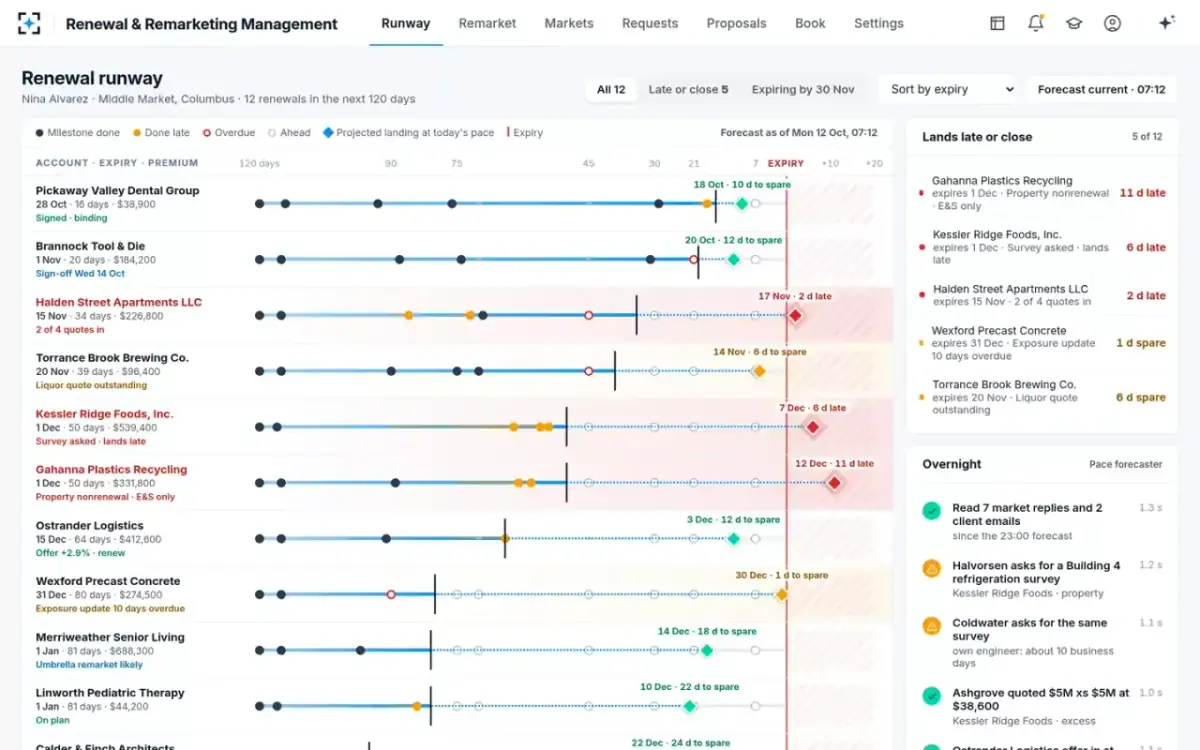
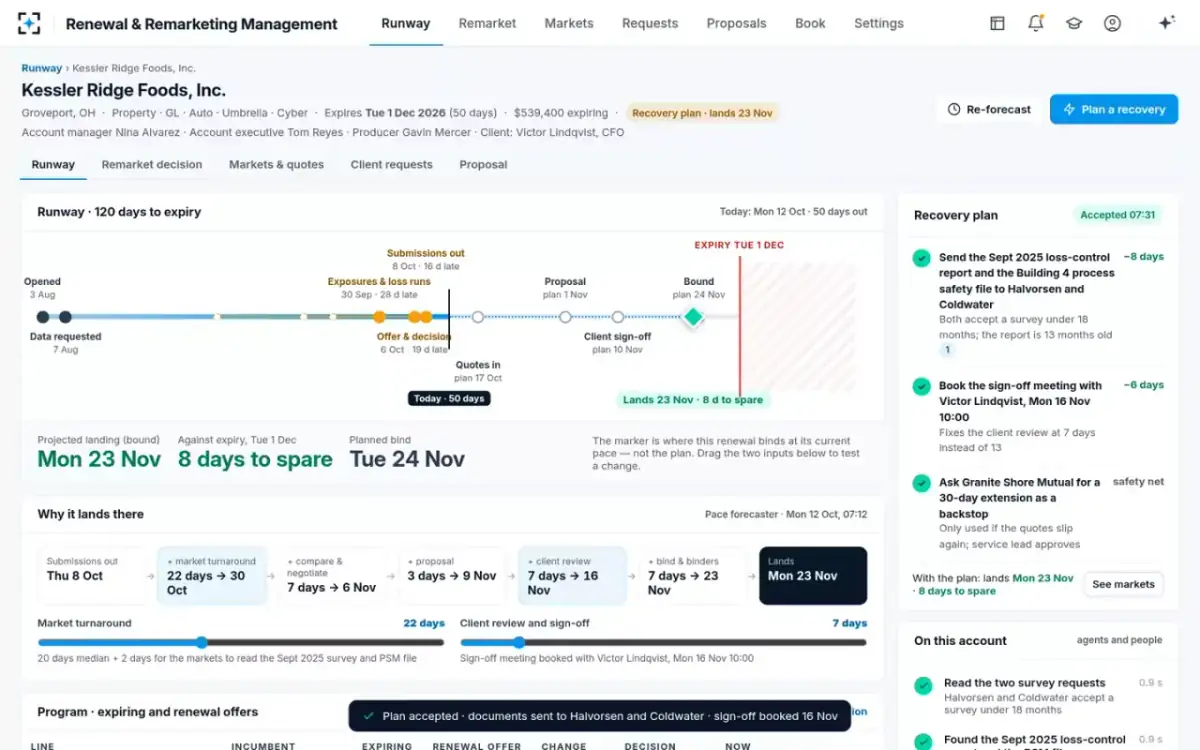
On the sample book, a food manufacturer's renewal was forecast six days past expiry, seven weeks out, after its exposure update came back 28 days late. The plan that pulled it back cost nothing but attention: a loss-control report the markets already accepted in place of a new survey, and a sign-off meeting booked a month ahead. It landed with eight days to spare. Its third step, a 30-day extension request to the incumbent, stayed in reserve, to be used only if the quotes slipped again and only with the service team lead's approval.
The same arithmetic, back inside the line with eight days to spare
A late-renewal protocol for the book
A brokerage that wants fewer gaps writes down when each bridge is requested and by whom, and measures how early late renewals are seen. In the sample book, two renewals still land late at today's pace, and both were flagged 34 to 50 days before expiry; before the solution, renewals there started a median 64 days out, against a planned 120.
Eight controls that stop a late renewal becoming a gap
- Open every renewal at 120 days
A renewal that starts 64 days out has already spent its spare time.
- Forecast each renewal’s landing, nightly
Add up the remaining steps at this client’s and these markets’ real pace.
- Treat a nonrenewal notice as a restart
Recompute the landing the day it arrives; an extension from that insurer is now unlikely.
- Book the signatory at the start
Many final-week delays are a person who is away.
- Read every quote’s conditions on arrival
Signed applications, deposits, certificates and surveys that must come before binding.
- Decide the bridge weeks out
Extension from the incumbent, or binder from the new market, named with who asks and when.
- Approve extensions at service-lead level
One person sees every bridge request across the book.
- Warn the client in writing
The forecast date, what is late, who holds it and the bridging options, as soon as the landing passes expiry.
Most bridges are never needed when the client's information arrives on time; what a brokerage should collect from each client, and when, is set out in the commercial insurance renewal questionnaire. The whole series starts from Renewal & Remarketing Management.
Questions people ask
Can an expiring commercial policy be extended?
Only if the expiring insurer agrees before the policy ends. An extension is a request, often for days or a month at pro rata premium, and an insurer that has sent a nonrenewal notice is the least likely to agree. After 12:01 a.m. on the expiry date there is nothing left to extend.
How long can a binder last?
In Arizona and West Virginia, no more than 90 days from its effective date, and never past the issue of the policy, unless the regulator approves an extension in writing or under its rules. Other states set their own rules, and a binder always needs an insurer, or an agent with its authority, to agree.
Is there a grace period at commercial insurance renewal?
Not for an expiry. A grace period concerns paying an instalment on a policy still in force; in New York, cancelling a covered commercial policy for non-payment needs at least 15 days' written notice. A renewal that is not bound by expiry leaves a gap.
Can a broker backdate a policy to cover a lapse?
No. Only an insurer can agree a policy's start date, and an insurer asked to cover past days would be insuring a period whose losses are already known. Presenting a backdated policy as continuous cover to a regulator, lender or customer is a misrepresentation.
What does a workers' compensation gap cost in New York?
Penalties of up to $2,000 for every 10-day period without coverage for an employer with 25 or more employees, and $500 per 10-day period for five or fewer, according to the Workers' Compensation Board, plus liability for any injured worker's benefits. The board warns that by the first notice the penalty may exceed $12,000.
Who is responsible if a commercial renewal lapses?
Responsibility is shared: the client supplies information, signs and pays; the broker must place requested cover within a reasonable time or tell the client it cannot, as New York's Court of Appeals described the duty in 2012. A written warning with bridging options, sent when the forecast first passes expiry, is the broker's best evidence of diligence.