The premium audit process is how a carrier settles a workers' compensation or general liability premium written on an estimate: after the policy year ends, the auditor obtains the insured's records, reconciles payroll to independent sources such as the quarterly Form 941, assigns each person's pay to its class code, lists officers, matches every subcontractor payment to evidence of coverage, and issues a bill that explains each change. State rules set the floor for each step; Oregon's, for example, require the auditor to contact someone familiar with the operation, reconcile total payroll "with records not used in the original tabulation," and investigate "all possible sources of earnings, including those for uninsured contract employment." The process is hard because most audits are now done virtually and depend on records that arrive in pieces over weeks, then are re-keyed and tied out by hand. Botminds' Premium Audit Automation reads the records, ties them out and drafts each finding with its citation, so the auditor's time goes on the classification decisions and the signature.
This guide is written for premium audit managers, audit directors and the underwriting and finance leaders who rely on audited premium. The worked example is a fictional sample audit of a framing contractor run through the solution; its people and figures are sample data. The rules are quoted from state statutes, regulations and bulletins, linked where they appear.
The premium audit process, step by step, and who does each
Agent
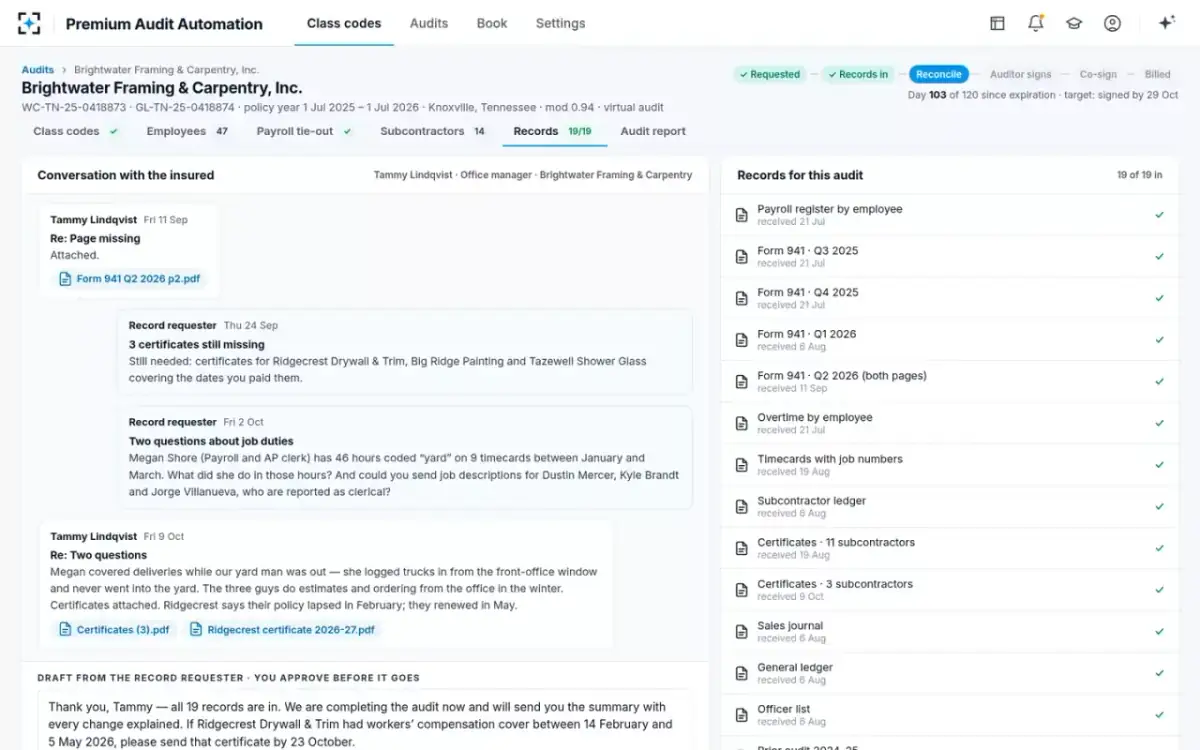
Record requesterSends the audit notice with the records the insured’s classes need, logs reminders as documented attempts and asks targeted questions.
Never: deciding what a missing record means for the premium
Agent
Payroll register readerReads the register and ties gross wages to line 2 of each quarter’s Form 941, then walks to reportable payroll: overtime premium, deferrals, officers.
Agent
Job title classifierReads titles, duties and hours on job numbers against the class codes, and flags people whose work does not match their reported class.
Never: moving payroll between class codes
Agent
Subcontractor certificate checkerMatches each subcontractor payment to a certificate or exemption in force on the payment date and separates labour from materials.
A person decides
Premium auditorDecides every class move and every added exposure, with the reason logged, and signs.
A person decides
Audit managerCo-signs any audit whose premium change exceeds the auditor’s limit: $25,000 in the sample.
What is the premium audit process for workers' compensation?
It is the post-term verification of the premium basis. The policy is written on estimated payroll by class; the audit replaces the estimate with actual payroll and the classes that properly apply, and the difference becomes additional or return premium. Regulators set how often it must happen. Oregon requires a field audit at least once a year on any policy "producing an annual standard premium of $10,000 or more," relaxed only once "the audit premium difference is less than five percent for each of two consecutive policy years" (OAR 836-043-0110(2)). Florida requires annual audits of construction-class employers above the experience-rating premium threshold (Fla. Stat. § 440.381).
The stakes are in both directions. An audit that closes on the estimate because the records never arrived gives earned premium away when payroll grew; one that reclassifies without evidence produces a bill the insured can dispute and a regulator can fault. On the sample book before the agents, 11.5% of audits closed on the estimate. Premium audit tracking sets out the measures that show where premium leaks.
One sample audit, from estimate to signed premium
$257,490
deposit premium, on $3,005,000 of estimated payroll
$3,486,400
reportable payroll after $61,800 of overtime premium came out
+$60,563
additional premium: payroll growth, a class move and an uninsured subcontractor
19 of 19
records received before reconciliation began
Step 1: obtain the records, and document every attempt
The auditor's first job is to get records complete enough to verify payroll from more than one source. A typical list is the payroll register, each quarter's Form 941, state unemployment reports, W-2 and 1099 totals, a subcontractor list with amounts and certificates, timecards or job costing, and the officer list. Florida's rule for physical audits adds cash disbursement journals and independent contractor documents (Fla. Admin. Code 69O-189.003), which is where payments that never passed through payroll show up.
Documenting the chase matters as much as the list, because a non-responding insured is billed on a rule, and the rule needs evidence. Florida's statute gives the carrier $500 "to defray the costs of the audits" when the employer fails to provide access and the audit cannot be completed, and a premium "not to exceed three times the most recent estimated annual premium" for failing to provide reasonable access to payroll records (Fla. Stat. § 440.381). In the sample, the notice went out with the records the insured's classes needed, and reminders on day 14 and day 28 were logged as documented attempts 1 and 2. Whether a noncompliance charge is allowed depends on the state; the audit noncompliance charge sets out where it was refused.
Targeted asks to the insured, and every reply kept on the audit
Step 2: reconcile payroll to records not used to add it up
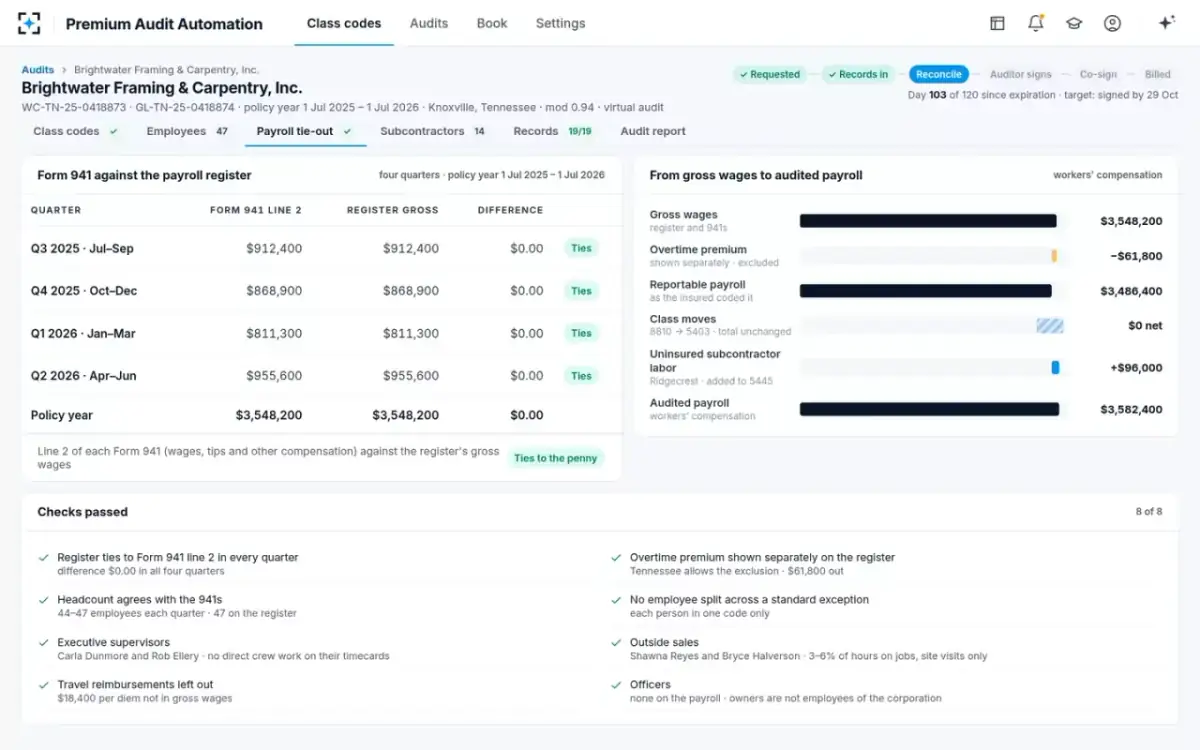
The tie-out is the step that makes the payroll figure defensible. Oregon's rule names it: the audit includes "reconciling the total payroll with records not used in the original tabulation" (OAR 836-043-0115(3)(d)). In practice that means the register against line 2 of each quarter's Form 941 and the state unemployment returns, quarter by quarter, with every difference explained.
Differences are normal; the auditor's job is to name them. The commonest is retirement deferrals: the IRS tells employers to report on line 2 amounts that "would also be included in box 1 of your employees' Forms W-2" (IRS, Instructions for Form 941), and box 1 does "not include elective deferrals (such as employee contributions to a section 401(k) or 403(b) plan)" (IRS, Instructions for Forms W-2 and W-3). Others are quarters that straddle the policy dates, expense reimbursements in the register, and officers' pay subject to state minimums or caps.
In the sample, 47 employees and 1,224 pay lines were read, and line 2 of the four 941s matched the register's gross wages to the penny, $3,548,200 on both sides. Overtime premium of $61,800 was shown separately and the state allows the exclusion, so reportable payroll was $3,486,400. Oregon's rule asks the auditor to record whether overtime was paid and whether the records permit "the exclusion of overtime remuneration from total payroll, as allowed by Basic Manual rules" (OAR 836-043-0115(4)(d)); a register that pays a blended rate cannot, and the auditor should say so.
Form 941 line 2 against the register, quarter by quarter
Step 3: classify from duties, not titles
Classification is where most of an audit's premium moves, and the rules require it to rest on the operation as it is, not as reported. Oregon's auditor "must contact a principal or designated representative of the insured who is familiar with the insured's operation, in order to ensure that the insured is properly classified," and determine payroll classifications "substantiated by a written description of the insured's operations" (OAR 836-043-0115). Officers are listed with name, title, classification and remuneration, and a brief description of each covered officer's duties.
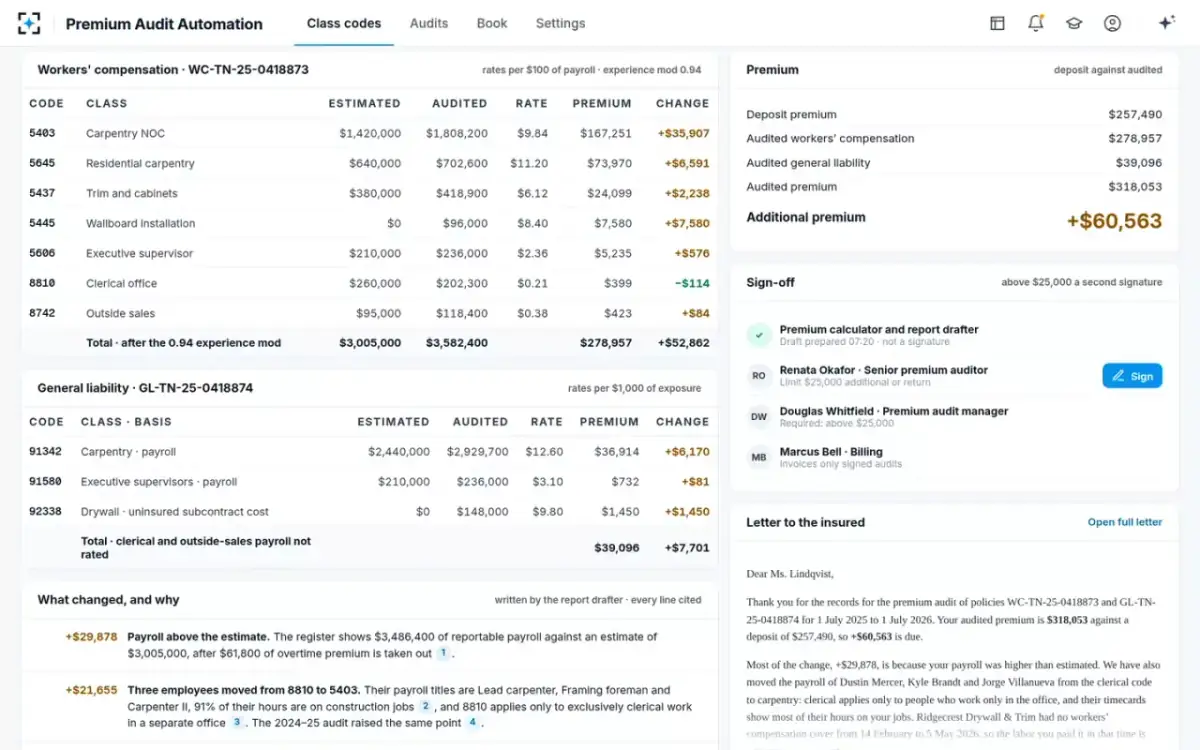
The standard exceptions are the most common misclassification. In the sample, three employees reported in clerical 8810, a lead carpenter at $78,400, a framing foreman at $74,200 and a Carpenter II at $57,400, had 93%, 91% and 89% of their hours on job numbers and overtime on site days, and the prior year's audit had already noted it. At the sample's illustrative rates of $0.21 and $9.84 per $100, moving their $210,000 to carpentry 5403 added $19,009 of workers' compensation and $2,646 of general liability. A fourth employee, with 46 hours coded to the yard, stayed in 8810 on the insured's reply that the deliveries were logged from the front-office window. The tests themselves are set out in class code 8810 vs 8742.
Classification findings on the sample audit, and the evidence behind each
| Employee as reported | Evidence | Auditor’s decision | Premium effect |
|---|---|---|---|
| Lead carpenter, 8810, $78,400 | 93% of hours on job numbers; overtime on site days | Moved to 5403 | Part of +$21,655 |
| Framing foreman, 8810, $74,200 | 91% of hours on job numbers; prior-year audit note | Moved to 5403 | Part of +$21,655 |
| Carpenter II, 8810, $57,400 | 89% of hours on job numbers | Moved to 5403 | Part of +$21,655 |
| Payroll clerk, 8810 | 46 hours coded to the yard; insured’s written reply on file | Kept in 8810 | $0 |
Step 4: investigate every source of earnings, including subcontractors
The auditor must look beyond payroll. Oregon's rule is direct: "The insurer shall investigate all possible sources of earnings, including those for uninsured contract employment" (OAR 836-043-0115(4)(c)). For contractors, that means matching every subcontractor payment to evidence of coverage in force on the payment date.
"For each subcontractor not providing such evidence of workers' compensation insurance, additional premium must be charged on the contractor's policy for the uninsured contractor's employees."
NCCI Basic Manual Rule 2(H)(2), as quoted in Alaska Division of Insurance Bulletin B 18-06
Dates decide it. A certificate that lapsed mid-year covers only the payments made before it lapsed. In the sample, fourteen subcontractors were paid 57 times; thirteen were covered on every payment, a painting subcontractor was a sole proprietor with a verified state exemption, and a drywall and trim subcontractor's certificate lapsed and was renewed later in the year. In the gap the insured paid it $148,000, $96,000 of it for labour, so the auditor added $96,000 to wallboard 5445 and the $148,000 cost to general liability: +$9,030 in all. The date-by-date method is in uninsured subcontractors in workers compensation.
What must the audit bill include?
Enough for the insured to verify every change, and in some states specific elements without which the bill is incomplete. Oregon lists them: the results of the audit, the difference from the estimated premium, and, where the bill rests on treating people as employees rather than independent contractors, "the name of each person, a description of the positions or tasks of each named person, and the basis for the determination"; the front page must read "Final Premium Audit Billing," and "failure by the insurer to include any of the elements renders the billing incomplete" (OAR 836-043-0170(6)). The insured then has until the 60th day after receiving the bill to request a hearing.
Delaware set the same expectation in a February 2026 bulletin: carriers "should include all calculations and supporting documentation necessary to justify the audited premium amount with the audit bill," including "a transparent summary of the payroll reviewed, the class codes applied, any adjustments made, the basis for any reclassification or added exposure, and the complete premium calculation," and "must retain the full audit worksheet internally for regulatory review" (Delaware Bulletin No. 159). Where an audit produces a return premium, the same bulletin requires a direct refund rather than a credit on future bills.
The audit report Premium Audit Automation drafts: one line per change, with its citation
The carrier's premium audit checklist
The checklist below collects what the rules above require of the auditor, step by step. Each item is something an audit manager can test on a sample of signed audits.
Workers' compensation premium audit checklist for the carrier's auditor
- Notice with the records each class needs
Register, quarterly 941s and state returns, W-2/1099 totals, subcontractor list and certificates, timecards, officer list; disbursement journals where cash is paid.
- Every request and reminder dated
Documented attempts are the evidence for an estimated bill, a statutory charge or a cancellation.
- A contact who knows the operation
A principal or designated representative, and a written description of the operations (OAR 836-043-0115).
- Payroll tied to independent records
Register to Form 941 line 2 and state unemployment returns, quarter by quarter; every difference named.
- Overtime treated as the rules allow
Record whether overtime was paid and whether the records permit its exclusion; tell the insured how to keep them if not.
- Officers listed with duties
Name, title, class, remuneration, and inclusion or exclusion under the state’s rules.
- Classes from duties and hours
Titles checked against duties and hours on job numbers; standard exceptions tested strictly; every move logged with its reason.
- Every subcontractor payment matched by date
To a certificate or exemption in force on that date; labour separated from materials for uninsured work.
- A bill that shows its working
Payroll reviewed, classes, adjustments, reasons and the full premium calculation; named persons where contractors were reclassified.
- Signatures within authority, worksheet retained
Auditor signs; a manager co-signs above the limit; the full worksheet kept for regulators.
Who signs, and what the signature stands on
The auditor signs every audit, and above a limit a manager signs too. In the sample the auditor's limit is a $25,000 premium change; the +$60,563 audit therefore went to the audit manager for a second signature, the class moves locked, and billing invoiced it only once both had signed. The underwriter receives the audited class mix for the renewal, which is where a reclassification found at audit stops recurring.
The auditor signs; above $25,000 the manager co-signs
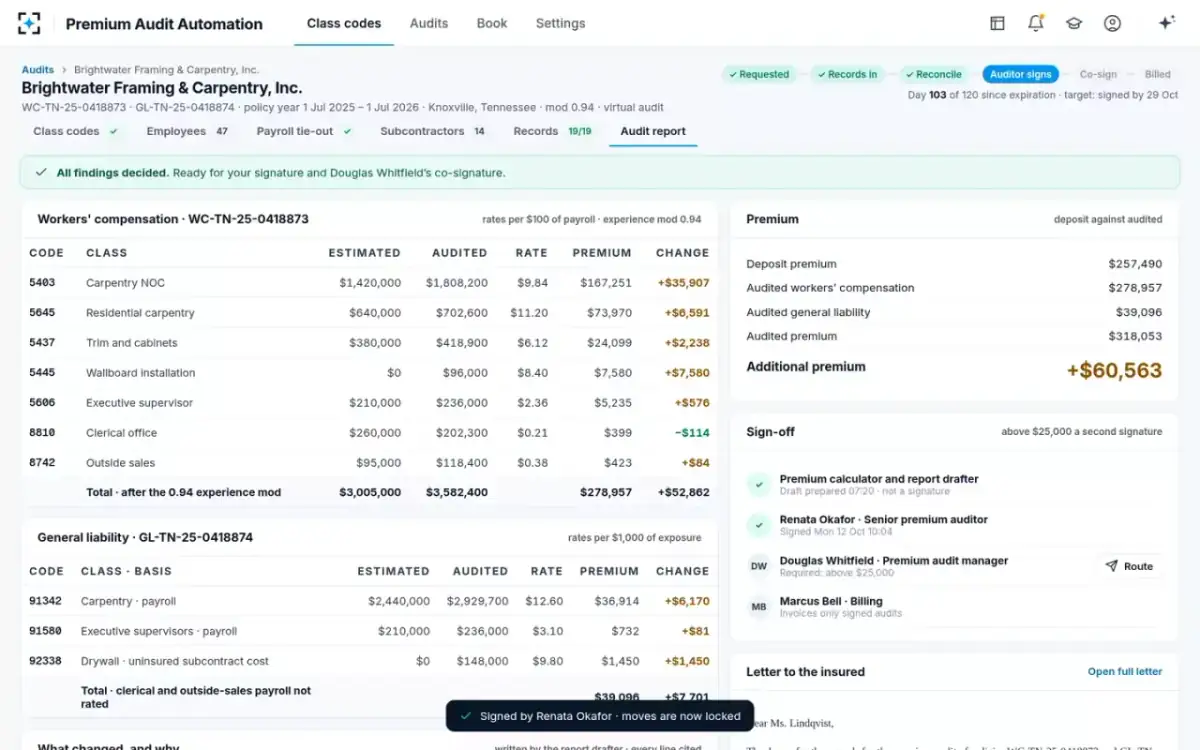
What a signature should stand on is the trail: each figure opening the record it came from, each class move with its evidence and reason, each added exposure with the certificate dates. That trail is what lets a carrier answer an insured's dispute or a regulator's test audit without re-doing the audit. How regulators test audits, and how to test a tool by planting errors in closed audits, is in premium audit standards. The whole series starts from Premium Audit Automation.
Questions people ask
How often must a carrier audit a workers' compensation policy?
It depends on the state and the policy size. Oregon requires a field audit at least annually on policies with $10,000 or more of annual standard premium, until the audit premium difference is under five percent for two consecutive policy years. Florida requires annual audits of construction-class employers above the experience-rating threshold.
What records should a premium auditor request?
The payroll register, each quarter's Form 941 and state unemployment report, W-2, W-3, 940, 1099 and 1096 totals, a subcontractor list with amounts and certificates, timecards or job costing, and the officer list. Florida's physical-audit rule adds cash disbursement journals and independent contractor documents.
Why does the register not match the 941?
Usually because of pre-tax retirement deferrals: Form 941 line 2 carries W-2 box 1 wages, which exclude 401(k) and 403(b) deferrals. Policy dates that straddle quarters, expense reimbursements and officers' pay rules are the other common causes. Each should be named on the worksheet.
When can a carrier charge for an uninsured subcontractor?
When the subcontractor provided no evidence of workers' compensation coverage for the dates it was paid. The NCCI Basic Manual rule quoted in Alaska's 2018 bulletin requires additional premium on the contractor's policy for the uninsured contractor's employees; the auditor should add the labour portion, separated from materials.
What happens if the insured will not provide records?
The carrier can bill on an estimate or cancel, and some states add charges. Florida's statute gives the carrier $500 when the audit cannot be completed and allows a premium of up to three times the most recent estimated annual premium for failing to provide reasonable access. Every request and reminder should be dated.
Must the carrier send the audit worksheet to the insured?
Not in Delaware, whose 2026 bulletin says carriers need not provide internal worksheets but must send all calculations and supporting documentation needed to justify the audited premium, and must retain the full worksheet for regulatory review. Oregon lists the elements without which a final premium audit billing is incomplete.