Expert networks and the SEC meet in two kinds of case. In the first, from 2011 to 2013, the SEC charged experts who moonlighted for networks while working at public companies, and the hedge funds that traded on what they said; the largest, CR Intrinsic, ended in a settlement of more than $600 million. In the second, which continues today, the SEC charges advisers under Section 204A of the Advisers Act because their policies against the misuse of material nonpublic information (MNPI) were inadequate or not enforced, whether or not anyone traded on it. Between them sits the Division of Examinations' April 2022 risk alert, which named the expert-network controls examiners found missing. Botminds' Expert Network Compliance was designed against that record: its agents pre-clear every call, read every transcript, check the trades after it, and keep the evidence an examiner asks for.
Expert networks and the SEC, 2011 to 2026: from tipping cases to control cases
- Tipping cases2011–13
- Tippee law redrawn2014–16
- Policy cases, no trading charge2017–21
- Risk alert, then larger penalties2022–26
What did the SEC say about expert networks?
The SEC's most direct statement is the Division of Examinations' risk alert of April 26, 2022, "Investment Adviser MNPI Compliance Issues". Staff observed advisers that did not appear to have, or to implement, adequate policies on expert network discussions with consultants "who may be related to publicly traded companies or have access to MNPI", and named three gaps: tracking and logging the calls, reviewing detailed notes of the calls, and reviewing supervised persons' trading in companies in industries similar to those discussed (SEC risk alert, April 26, 2022). The alert is staff guidance, says so, and has no legal force of its own; it is still the list an examiner brings.
The same alert reported code of ethics failures that touch expert calls directly: access persons who bought into initial public offerings and limited offerings without the required pre-approval, holdings and transaction reports that were missing or late, and employees who traded securities on the adviser's own restricted list. The Investment Research guide to expert network compliance quotes the expert-network findings in full.
What the SEC's 2022 MNPI risk alert asked of expert network programs
3
expert-network controls named: log the calls, review detailed notes, review related trading
3
sources of MNPI the alert covered under Section 204A: alternative data, value-add investors, expert networks
4
code of ethics findings: who is an access person, IPO and limited-offering pre-approval, personal trading reports, acknowledging the code
Are expert networks legal?
Yes. Paying an industry expert for knowledge and analysis is lawful, and none of the SEC's cases treats the network model itself as the violation. The charges were insider trading by people who passed or used confidential information, and later, policy failures by advisers. The SEC said in adopting Regulation FD that an issuer is not prohibited from disclosing a non-material piece of information to an analyst "even if, unbeknownst to the issuer, that piece helps the analyst complete a “mosaic” of information that, taken together, is material" (65 FR 51716, Aug. 24, 2000). Expert calls are one of the ways analysts assemble that mosaic.
The legal risk lies in who the expert is and what he or she says. A former employee who left years ago and speaks about how an industry works is building the mosaic. A current employee, or a consultant still advising the company, who speaks about this quarter's orders is passing information the analyst may not use. The guide to material nonpublic information examples sorts the cases.
2011: the network as the conduit
The first wave of cases came out of a single network. On February 3, 2011 the SEC brought insider trading charges against technology company employees who were moonlighting as consultants or "experts" to Primary Global Research LLC "without the knowledge of their employers", and against two of its employees, for passing inside information about companies including AMD, Apple, Dell, Flextronics and Marvell to its clients (SEC press release 2011-38). The release put a price on the calls: one consultant received more than $130,000 from January 2008 to March 2010 "for talking to PGR and its clients", and another more than $200,000 for consultations with select clients from 2006 to 2008.
Two features of that case still shape policies. The experts' employers did not know, so an attestation from the expert was the only check, and it failed. And the calls were paid for by funds that could not see the expert's current employment except through the network, which is why today's policies test the expert's employers themselves rather than relying on the network's profile.
2012: CR Intrinsic and the $1,000-an-hour consultant
The case that defined the risk for a generation of compliance officers was filed on November 20, 2012. The SEC alleged that a doctor working on a clinical trial of an Alzheimer's drug tipped a portfolio manager "with safety data and eventually details about negative results in the trial" in calls arranged by an expert network for which he worked as a consultant, and that the funds avoided losses and made profits worth about $276 million (SEC press release 2012-237).
"They coordinated their expert network consultations around scheduled safety monitoring committee meetings," and the doctor "was generally paid $1,000 per hour as a consultant for the expert network firm."
SEC press release 2012-237, Nov. 20, 2012 (allegations at filing)
The firm settled four months later. CR Intrinsic agreed to pay more than $600 million, in what the SEC called "the largest ever in an insider trading case" (SEC press release 2013-41). For a policy author, the lesson was not about the fee; it was about timing. Calls scheduled around a trial's committee meetings are a pattern a pre-clearance check can see, if it looks at the expert's current role and the issuer's calendar rather than only at the topic on the request form.
Expert networks and insider trading: how far down the chain liability runs
Insider trading liability for someone who did not get the information from the insider depends on what the courts call tippee liability, and between 2014 and 2016 its boundary moved twice. In United States v. Newman the Second Circuit reversed the convictions of two portfolio managers who, as the Supreme Court later summarized, were "several steps removed from the corporate insiders" and of whom "there was no evidence that either was aware of the source of the inside information" (Salman v. United States, 580 U.S. ___ (2016)). In Salman the Supreme Court rejected Newman's added requirement that a tipper gain something of "a pecuniary or similarly valuable nature" from a gift of information to a trading relative or friend, holding that the gift itself is the benefit.
Research on actual tipping networks shows why the chain matters to an expert program. In a hand-collected study of illegal insider trading tips, Kenneth Ahern found that tips on average start with corporate executives and travel through family, friends and people who live nearby, reaching buy-side investors after about three links on average (Ahern, Journal of Financial Economics, 2017). An expert call is a short chain by design: the insider, or former insider, is one link from the analyst. A policy cannot rely on the analyst's knowing where the information came from; it has to test the expert. How the same chain looks from the trading side is traced in insider dealing examples, three links to a fund.
From trading cases to policy cases
The second kind of case charges the adviser's controls. In each order below the SEC found a violation of Section 204A or the code of ethics rule; none is an insider trading charge. The firms settled without admitting or denying the findings.
Section 204A and code of ethics orders: what failed, and what it cost
| Order | What the SEC found | Penalty |
|---|---|---|
| Cannell Capital, Feb. 2020 | Failed to follow its written MNPI procedures; policies not reasonably designed to prevent misuse of MNPI | $150,000 |
| OEP Capital Advisors, Dec. 2023 | Failed to maintain and enforce written policies reasonably designed to prevent misuse of MNPI | $4,000,000 |
| Sound Point Capital, Aug. 2024 | Failed to establish, maintain and enforce MNPI policies for trading CLOs that held loans of companies it had MNPI about | $1,800,000 |
| Foundations Investment Advisors, June 2026 | Failed to enforce its code of ethics on pre-clearance; the chief executive traded an ETF without pre-clearing | $1,200,000 (firm); $354,675 (chief executive) |
The 2026 order is the one an expert-network program should read most closely, because it is about the code of ethics rather than about a lender group or a deal. The SEC found that the adviser's chief executive "personally traded the ETF" while aware that it sat in a model portfolio the firm recommended to clients, and "failed to pre-clear this trading as required by Foundations' policies", and that the firm had not enforced the pre-clearance part of its code of ethics (SEC, June 8, 2026). A pre-clearance rule that the most senior person can skip is not enforced. The Sound Point order and the earlier Deerfield and Marathon cases are set out in the guide to restricted-list compliance.
Mosaic theory and insider trading: where the SEC draws the line
Mosaic theory is the analyst's defence that a material conclusion was assembled from public information and non-material nonpublic pieces, none of which was itself MNPI. The SEC accepted the idea in Regulation FD, as quoted above, and in the same release warned that an issuer cannot make material information immaterial by splitting it into pieces that each look harmless, so the defence holds only for pieces that were genuinely immaterial.
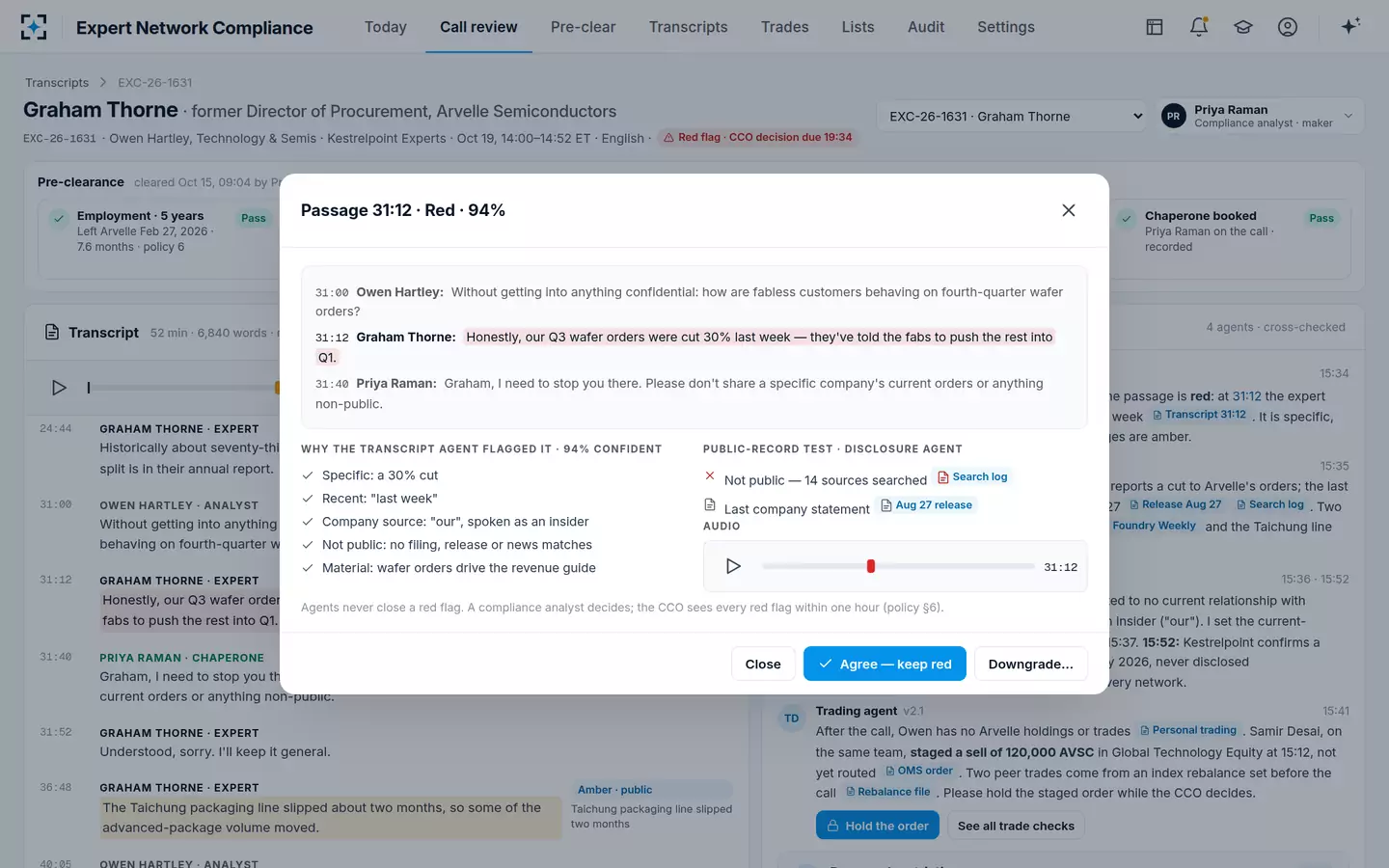
Expert calls test the theory in practice. An expert describing how procurement teams commit foundry capacity two to three quarters ahead is giving a mosaic piece. The same expert saying his former employer's orders were cut 30% last week is not, however the analyst combines it with other facts. The difference is precise, recent and company-specific information, and it is what a transcript review looks for; a policy that only checks the topic on the request form cannot see it.
The line in one sentence: a passage flagged as possible MNPI in Expert Network Compliance
What an examiner asks for now
After the policy cases and the 2022 alert, an examination of an adviser that uses expert networks is a request for evidence, not for the policy alone. Expect requests for the expert-network policy in force during the period and its changes; the list of approved networks and their due diligence; a log of calls; for a sample of calls, the clearance, the notes or transcript and who reviewed them; trading by access persons and funds in the issuers and industries discussed; and any restrictions placed as a result. The Division of Examinations' priorities for fiscal 2027 add that it will look at registrants' use of "emerging technologies and alternative data sources", and they note that firms now use what the Division calls super intelligence (SI) tools for compliance monitoring and surveillance (SEC Division of Examinations, FY2027 examination priorities, Oct. 23, 2026).
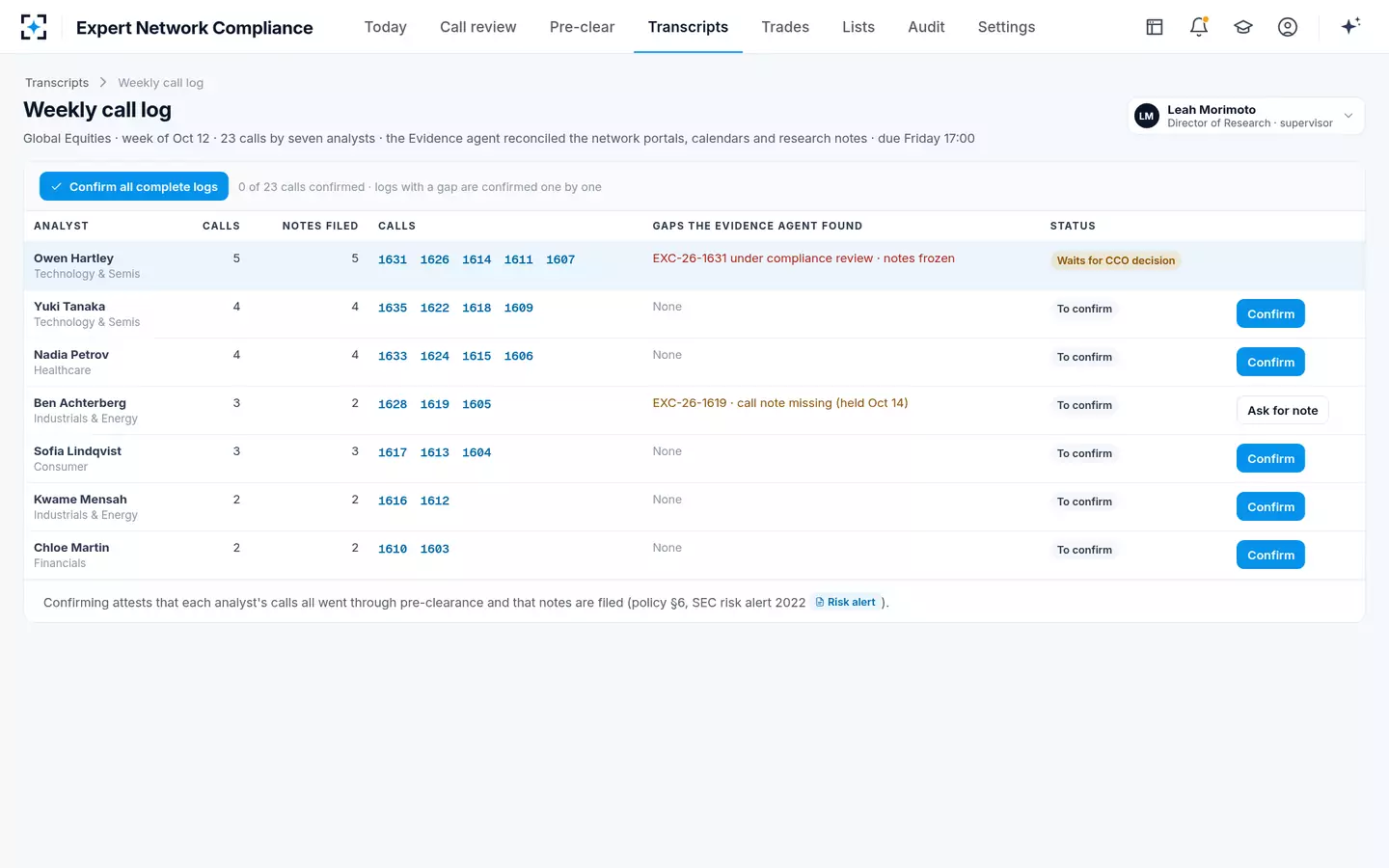
The hard part of that request is the join. Calls live in the networks' portals, notes in the research system, transcripts in email, trades in the order management system and the personal-trading system. A firm that can produce each piece separately may still be unable to show, for one issuer, that the call was cleared, read and followed by a trade check.
The weekly call log: every call reconciled, with the gaps shown before anyone signs
Where Expert Network Compliance fits the SEC record
The solution answers each part of the record with something an examiner can see. Against the moonlighting cases, the Pre-clear agent tests five years of the expert's employers against the restricted list, watch list and holdings, and re-opens a clearance when a transcript contradicts the expert's attestation. Against the 2022 findings, the Evidence agent reconciles a call log, the Transcript agent reads every call in its own language, and the Trading agent checks personal and fund trades in the issuer and its peers for 30 days after each call. Against the policy cases, every clearance, flag and restriction carries the name of the person who decided it and the reason.
On the sample firm's data, that is 1,512 transcripts read in full this year and 4,936 trades checked after calls, with 11 checks escalated to the chief compliance officer and two orders held before they executed. The agents never clear, restrict or hold anything themselves. The policy those agents run is annotated clause by clause in a sibling guide.
Questions people ask
What was the biggest expert network lawsuit?
The SEC's case against CR Intrinsic and others, filed in November 2012, involved calls arranged by an expert network with a doctor working on an Alzheimer's drug trial. CR Intrinsic agreed in March 2013 to pay more than $600 million, which the SEC called the largest settlement ever in an insider trading case.
Do expert networks lead to insider trading?
They can, when an expert discloses confidential information and someone trades on it; the 2011 Primary Global Research cases and CR Intrinsic were both of that kind. The network model itself is lawful. The SEC's later cases charge advisers whose controls were inadequate, which is why policies now test the expert before the call and read what was said after it.
What is the SEC's MNPI risk alert?
It is the Division of Examinations' April 26, 2022 risk alert, "Investment Adviser MNPI Compliance Issues". It reported that deficiencies under Section 204A and the code of ethics rule were among the most common in its examinations, and listed gaps around alternative data, value-add investors and expert networks, plus failures in identifying access persons, pre-approval and personal trading reports.
Did the SEC ban expert networks after 2011?
No. The SEC charged the individuals and firms involved and has since examined how advisers control expert calls, but it has not prohibited the use of expert networks. Its 2022 risk alert assumes advisers use them and asks for policies that log the calls, review the notes and check related trading.
Can the SEC charge an adviser if nobody traded on MNPI?
Yes. Section 204A requires advisers to establish, maintain and enforce policies reasonably designed to prevent the misuse of MNPI, so a failure of the policy is itself a violation. The SEC's orders against Cannell Capital in 2020 and OEP Capital Advisors in 2023 were Section 204A cases, with penalties of $150,000 and $4,000,000.
How much do expert network consultants get paid?
The SEC's releases give historical examples rather than market rates: in its 2012 complaint the doctor in the CR Intrinsic case was generally paid $1,000 per hour, and in 2011 one Primary Global Research consultant received more than $130,000 over about two years. No regulator or independent study publishes current rates; networks set them per call and per expert.