Insider dealing examples have a common shape: someone with access to inside information, about a takeover, a share placing or a set of results, passes it to someone else, who passes it again, and a person at the end of the chain trades before the news. Peer-reviewed research on US prosecutions found that tips typically "reach buy-side investors after three links in the network", through family, friends and neighbours. For an asset manager this cuts both ways: its own people sit at the start of chains, because fund managers are routinely brought inside on placings and deals, and its trades can sit at the end of one. Surveillance on a manager's trades sees only the last link, which is why a trading-before-news alert needs the communications, the research contacts and the wall-crossing records beside it. Botminds' Trade Surveillance puts them in the same case file, so the analyst can see what a single trade cannot show.
The examples are from the FCA's press releases, a US Supreme Court judgment and peer-reviewed research. Product examples use sample data on a fictional manager, Quillfield Capital.
What the record shows about insider dealing
3 links
average distance from a corporate executive to the buy-side investor who trades, in US insider trading networks
35%
returns earned by inside traders over 21 days, in the same study
82%
of the 3,806 suspicious transaction and order reports the FCA received in 2025 were for suspected insider dealing
What is insider dealing?
Insider dealing is using inside information to buy or sell the financial instruments it relates to. Under the Market Abuse Regulation, it "arises where a person possesses inside information and uses that information by acquiring or disposing of, for its own account or for the account of a third party, directly or indirectly, financial instruments to which that information relates", and cancelling or amending an order because of inside information counts too (UK MAR, Article 8). Article 14 prohibits it, along with recommending or inducing someone else to do it and unlawfully disclosing inside information (Article 14).
In the UK it is also a crime. Under section 52 of the Criminal Justice Act 1993, an individual "who has information as an insider is guilty of insider dealing" if they deal in price-affected securities on a regulated market or through a professional intermediary, and also if they encourage another person to deal or disclose the information "otherwise than in the proper performance of the functions of his employment, office or profession" (Criminal Justice Act 1993, section 52). Both regimes reach the tipper and the person tipped.
Insider dealing vs insider trading
They describe the same conduct in different legal systems. "Insider dealing" is the term in UK and EU law, both the civil regime of the Market Abuse Regulation and the UK criminal offence; "insider trading" is the US term, for conduct prosecuted under Section 10(b) of the Securities Exchange Act and Rule 10b-5. Everyday usage treats them as synonyms.
The legal tests differ in one way that matters for tips. The UK and EU civil test turns on possessing and using inside information; for someone outside the issuer's circle, it applies where the person "knows or ought to know" that it is inside information. The US test turns on a breach of duty: a tippee is liable when the tipper breached a duty by disclosing for a personal benefit and the tippee knew it. The Supreme Court held in 2016 that the benefit can be inferred when the tipper makes "a gift of confidential information to a trading relative or friend" (Salman v. United States, 2016), the third example below.
How do insider tips reach hedge funds and asset managers?
Mostly through close personal ties, and usually not directly. The most detailed published study built the networks behind US insider trading prosecutions from case documents and traced who told whom:
I find that inside information flows through strong social ties based on family, friends, and geographic proximity. On average, inside tips originate from corporate executives and reach buy-side investors after three links in the network.
Kenneth R. Ahern, 'Information networks: Evidence from illegal insider trading tips', Journal of Financial Economics 125(1): 26–47, 2017
Two implications follow for surveillance at a fund. First, the person who trades is rarely the person who knew; the information has usually changed hands at least once, outside any system the fund controls. Second, the relationships that carry tips are personal, not professional, so the fund's records of meetings and calls will show the professional link at most. A trading-before-news alert on a fund account therefore sees the end of a chain whose start is invisible to it, and the analyst's question is not "did this trader know?" but "could anyone who influenced this order have known?"
Insider dealing examples from inside asset managers
Two UK criminal cases show the buy side at the start of the chain rather than the end. In both, a person at an asset manager received inside information legitimately through the job, and traded on it through other people's accounts.
Three insider dealing chains, link by link
UK, convicted 2025
A research analyst at an asset manager
- 1Companies sound out investors by email on share placings and block sales
- 2The analyst, who sees those emails as part of the job
- 3Accounts held by his sister and others, traded within minutes through contracts for difference
13 stocks, profit of more than £960,000; sentences of six and five years. Found by the FCA's market monitoring.
UK, sentenced 2016
An equity portfolio manager at a large asset manager
- 1An issuer's adviser brings a colleague inside on a takeover; the stock goes on the restricted list
- 2The portfolio manager, who held the stock and heard about the deal from colleagues
- 3A Swiss asset manager trading for an offshore company in his wife's maiden name
Profit of £44,125 on one trade; 12 months' imprisonment. The account was never declared under the firm's personal dealing policy.
US, Supreme Court 2016
An investment banker and his family
- 1An investment banker learns of deals at work
- 2His brother, given the information to benefit him
- 3The brother's relative by marriage, who knew where it came from and traded
Conviction upheld: a gift of inside information to a trading relative is enough to prove the tipper's personal benefit.
In the 2025 case, a research analyst at an asset manager "regularly saw emails from companies gauging investor interest on plans to raise equity in the markets or sell large blocks of shares owned by existing shareholders. Within minutes" he traded in those companies' shares across several accounts, including his sister's. The case covered 13 stocks between December 2019 and March 2021 and profits of more than £960,000; he was sentenced to six years and his sister to five (FCA, 4 July 2025). The trades were contracts for difference betting on falls, closed after the announcements, and "The suspicious trading was detected by the FCA's market monitoring systems despite their arrangements" (FCA, 19 June 2025).
In the 2016 case, an equity portfolio manager at a large asset manager learned of a takeover and of drilling results through colleagues who had been brought inside; both stocks were on the firm's restricted list. He traded through a Swiss asset manager for a Panamanian company he had placed in his wife's maiden name, contacted it on unregistered mobile phones, and paid it in cash. His employer's personal dealing policy required him to declare accounts; he did not declare that one or seek pre-clearance. The FCA's enforcement director called it "a gross abuse of the trust placed in him as a senior fund manager" (FCA, 21 December 2016).
The restricted list worked as designed in the 2016 case: it stopped the firm's funds from trading. It did nothing about an account the firm did not know existed. That gap, between the firm's controls and its people's private trading, is where buy-side insider dealing usually sits, and why market soundings need careful handling: the FCA has also reported investors trading after being approached for a sounding but before consenting to receive the information, a pattern covered in the guide to MAR Article 16 (Market Watch 75).
Insider trading examples in real life: the US gift case
The leading modern US case is a family chain of exactly three links. According to the Supreme Court's syllabus, an investment banker at Citigroup shared inside information with his brother "to benefit him and expected him to trade on it"; the brother shared it with a relative by marriage, who knew it came from the banker and traded. The Court unanimously upheld the trader's conviction, holding that the jury "could infer that the tipper here personally benefited from making a gift of confidential information to a trading relative" (Salman v. United States, 580 U.S. ___ (2016)).
The case matters to a fund's surveillance because it confirms that the law follows the chain as far as knowledge goes. A portfolio manager who receives a tip from a friend at a bank, knowing where it came from, is in the same position as the brother-in-law. For the research side of the problem, where tips arrive dressed as expert insight, see the expert network compliance method in the investment research series, and the SEC's expert network cases, which follow the same chain from consultant to fund.
Insider trading examples in the UK: what the STOR data shows
Most suspected market abuse reported to the FCA is insider dealing in equities. In 2025 the FCA received 3,806 suspicious transaction and order reports; 3,124 were for suspected insider dealing, and almost all of those concerned shares (FCA, Number of STORs received: 2025).
Insider dealing reports to the FCA in 2025, by asset class
The FCA has also said where the most serious harm comes from. In April 2025 its enforcement director said organised crime groups accounted "for around 25% of all STORs", and cited the National Crime Agency's assessment that the most serious harm is likely to come from insider trading groups who "recruit and reward information sources employed across the financial services sector" (FCA speech, 28 April 2025). For an asset manager, that is a reminder that its own staff with access to soundings, deal teams and research are the information sources such groups look for.
Insider dealing penalties in the UK and the US
Prison and unlimited fines in the UK; prison, fines and penalties of up to three times the profit in the US. The table sets out the main sanctions an individual faces.
Insider dealing penalties for individuals, UK and US
| Regime | Maximum sanction | Source |
|---|---|---|
| UK criminal offence | On indictment, a fine or up to ten years' imprisonment, or both (the ten-year term in force from 1 November 2021). | Criminal Justice Act 1993, section 61, as amended by the Financial Services Act 2021 |
| UK civil regime (MAR) | FCA financial penalties, public censure and prohibition from regulated work, applied under its own powers. | UK MAR Articles 8 and 14 with the FCA's enforcement powers |
| US civil penalty | Up to three times the profit gained or loss avoided, ordered by a court in an SEC action. | 15 U.S.C. 78u-1 (Exchange Act section 21A) |
| US criminal penalty | For an individual, a fine of up to $5,000,000, up to 20 years in prison, or both, for wilful violations. | 15 U.S.C. 78ff (Exchange Act section 32) |
What surveillance at the end of the chain can see
A trading-before-news alert sees the last link: an order placed before an announcement. Whether that order was informed depends on facts the alert does not contain, and the FCA's guidance recognises it: a trade that looks innocent alone can point to abuse once it is read alongside other trades, behaviour or information (FCA, SUP 15.10.4G). The perspective comes from four places: who influenced the order, who among them could have been inside, what they said, and whether the order fits their usual behaviour.
An information barrier case: a sale thirteen minutes after a call with a wall-crossed PM
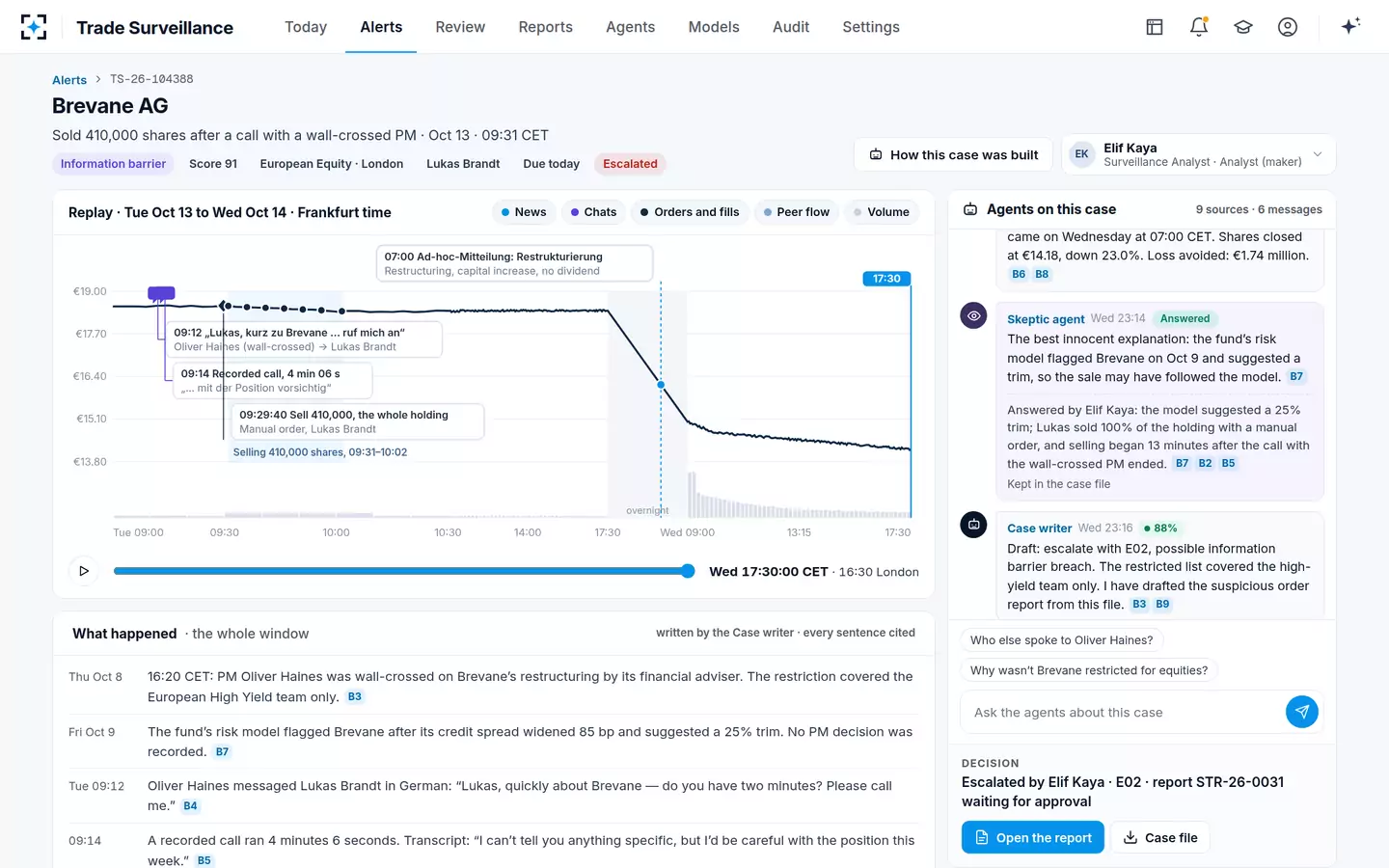
In the sample case, the alert alone said only that a fund sold a German stock the day before bad news. The case file showed the rest: a high-yield portfolio manager had been brought inside on the issuer's restructuring five days earlier; he messaged the equity trader in German and spoke to him on a recorded line for four minutes ("I can't tell you anything specific, but I'd be careful with the position this week"); and the sale of the whole holding began thirteen minutes after the call ended. The fund's risk model had suggested a 25% trim, the best innocent explanation, which the analyst answered from the record. She escalated, a report was drafted from the cited case, and the agents proposed a barrier rule so that a wall-crossing restricts every desk trading the issuer, for the chief compliance officer to approve.
That is what surveillance at the end of the chain can do: put the last link next to the links the firm can see, and write down why the gap is or is not suspicious. It cannot see the brother-in-law. How the resulting report is written is in FCA STOR reporting; to see the case files on your own alerts, start at Trade Surveillance.
Questions people ask
What is an example of insider dealing?
A research analyst at an asset manager who sees confidential emails about a company's planned share placing, then bets on the share price through a relative's account before the announcement. That is the pattern in the FCA case concluded in 2025, which led to prison sentences of six and five years.
Is insider dealing a criminal offence in the UK?
Yes. Under section 52 of the Criminal Justice Act 1993 it carries up to ten years' imprisonment on indictment since 1 November 2021, and the FCA prosecutes it. Separately, the FCA can impose civil sanctions under the Market Abuse Regulation without a criminal trial.
Can you be guilty of insider dealing if someone else made the trade?
Yes. Both MAR and the UK criminal law cover encouraging or inducing another person to deal and disclosing inside information other than in the proper course of your work. In the US, the Salman case confirmed that a tipper who gifts information to a trading relative can be liable along with the trader.
What is the FCA's role in insider dealing?
The FCA receives suspicious transaction and order reports from firms, analyses trading data, investigates, and prosecutes insider dealing as a crime or sanctions it under the civil regime. Its enforcement director said in April 2025 that over 70% of its live market abuse investigations started from a STOR.
How do firms prevent insider dealing by their own staff?
With wall-crossing records and restricted lists, personal account dealing rules with declared accounts and pre-clearance, recorded communications, and surveillance that links staff trading and fund orders to who was inside. The 2016 case shows the limit: controls work on what the firm knows exists, which is why undeclared accounts and phones are the usual route around them.