Front running in a mutual fund is when someone who knows that the fund is about to buy or sell a large amount of a stock trades that stock first, for themselves or for an accomplice, and profits from the price move the fund's own order then causes. The person is usually inside the fund house, a dealer, trader or analyst who sees the fund's pending orders, and the information they misuse is the stock, the quantity and the timing. The cost falls on the fund's investors, because the front runner's trades push the price against the fund. It is hard to catch because the front runner's trades are small, placed through other people's accounts and other brokers, and look like ordinary investing until they are lined up against the fund's order book. Botminds' Trade Surveillance helps an asset manager do that lining up: its front-running alerts arrive as cases that put the fund's order, the connected accounts' trades, the lists and the messages of everyone who knew the order on one timeline, so an analyst can decide.
The cases below come from the published orders of SEBI, India's securities regulator, and the US SEC. Product examples use sample data on a fictional manager, Quillfield Capital.
Two recent cases of front running a fund house's own orders
₹30.56 cr
ordered disgorged in SEBI's July 2026 final order on front running of a mutual fund's trades
7 yrs
market ban SEBI imposed on the fund house's chief dealer, with a ₹3 crore penalty
70 mo
prison sentence for a US asset manager's equity trader who passed on the firm's upcoming trades
What is front running in a mutual fund?
It is the misuse of a fund's own order information. A fund that buys or sells in size moves prices; anyone who knows the order before the market does can buy before a large buy and sell into it, or sell before a large sale. SEBI's orders describe the information involved precisely: the fund house's chief dealer "had access to NPI about the impending orders (stock name, quantity and timing)" of the fund "in his official capacity" (SEBI, final order, 24 July 2026). NPI here means non-public information.
The same order makes a point that shapes how surveillance must look. A large fund order is usually executed in tranches, and SEBI held that "An order of Big Client remains impending until its entire demand is exhausted": a front runner who knows the remaining size can profit "at any time before the last or substantial tranche", because "the market is not aware of the full residual demand, whereas the front runner is". The window to examine is the whole parent order, not the minutes before the first fill.
What is front running in finance, and of client orders?
In finance generally, front running means trading ahead of an order you know about but the market does not. The classic case is a broker who trades ahead of a client's large order; in US broker rules it is defined around block trades. FINRA Rule 5270 prohibits a member or its associated person from trading a security, or a related option or derivative, while holding "material, non-public market information concerning an imminent block transaction in that security" until the information is public or "stale or obsolete", and treats an equity trade of "10,000 shares or more" as generally a block (FINRA Rule 5270).
Front running client orders and front running a fund's orders are the same abuse seen from two sides. For a broker, the fund is the client. For the fund house, the fund is the client of its own portfolio managers and dealers, and the front runner is one of its own people or someone they tip. That is why the fund manager's own surveillance, not just its brokers', has to look for it.
Front running vs trading ahead
They overlap but are not the same. Trading ahead, in FINRA's rules, is a broker holding a customer's order and trading the same security on the same side for its own account first. Rule 5320 prohibits a member that "accepts and holds an order in an equity security" from trading that security "on the same side of the market for its own account at a price that would satisfy the customer order, unless it immediately thereafter executes the customer order up to the size and at the same or better price" (FINRA Rule 5320). Front running is broader: it is about using knowledge of an imminent large order, by anyone, in the security or in its derivatives.
Front running, trading ahead and insider trading: whose information, and which rule
Front running: That a large order is about to be executed: stock, size, timing.
Insider trading: News about the issuer: results, a deal, a rating change, a drilling result.
Front running: Inside the fund house, the broker or the trading desk.
Insider trading: Inside the company or its advisers, often passed on through others.
Front running: A narrower broker rule: FINRA 5320 bars trading ahead of a held customer order on the same side.
Insider trading: Not applicable.
Front running: Information about a client's pending orders is inside information for those executing them (MAR Article 7(1)(d)), so using it is insider dealing.
Insider trading: Inside information about issuers or instruments (MAR Article 7(1)(a)); using it is insider dealing under Article 8.
Front running: Charged as securities fraud by misappropriation of the employer's information, and for fund staff under Investment Company Act Section 17(j).
Insider trading: Securities fraud under Section 10(b) and Rule 10b-5, on classical or misappropriation theories.
Front running vs insider trading
The difference is the source of the information, and in Europe the law treats the first as a form of the second. The Market Abuse Regulation defines inside information to include, "for persons charged with the execution of orders concerning financial instruments", "information conveyed by a client and relating to the client's pending orders", when it is precise and price-sensitive (UK MAR, Article 7(1)(d)). A dealer who uses the fund's pending orders is therefore dealing on inside information, and the firm's surveillance obligation under Article 16 covers it.
In the US, the employee who front runs the fund misappropriates the employer's confidential information. In the case below, the trader "pleaded guilty to one count of securities fraud", and the civil judgment against him included the anti-fraud provisions of the Investment Company Act's Section 17(j) and Rule 17j-1, the rule that requires funds and their advisers to have a code of ethics (SEC Release IA-7024).
Front running at Axis Mutual Fund, and a US asset manager's trader
Two published cases show how it is done and how it is found. In India, SEBI's alert system flagged trading ahead of Axis Mutual Fund's orders. Its final order found that the fund house's chief dealer shared non-public information about the fund's impending orders with an external associate, who placed orders from Dubai in accounts of relatives and other "conduit / mule accounts", using brokers' trading terminals. The period examined ran from 1 September 2021 to 31 March 2022; SEBI relied on a whistleblower complaint, phone records and chats, and its interim order, recited in the final order, noted that the "private work environment created due to COVID-19 situation and the use of undisclosed mobile phone" enabled the dealer to pass the information. It ordered INR 30,55,89,668.96 disgorged, banned the dealer from the market for seven years and fined him ₹3 crore (SEBI final order).
In the US, the SEC charged an equity trader at a major asset manager whose trades were so large that they moved prices "in a predictable way". According to the SEC's 2026 order, he was an equity trader there from at least September 2016 to December 2022, and the count he pleaded guilty to alleged that he passed confidential information about "large, upcoming securities trades" to an associate who traded on it, receiving at least $10 million in return; the SEC's December 2022 complaint alleged the scheme generated "at least $47 million in illegal trading profits", found by staff analysis of the Consolidated Audit Trail (SEC press release 2022-228; SEC Release IA-7024).
Six years undetected, four to resolve: the US case from first trade to industry bar
- The scheme, as allegedSep 2016
- Charged, plea and 70-month sentenceDec 2022
- Civil case to final judgment and barJun 2024
In both cases the regulator, not the firm, found the trading: SEBI through its own alerts, the SEC through the audit trail. Both front runners traded through other people's accounts at other brokers, so the fund house's view of its own staff's declared accounts would not have shown them. That is the design problem a fund house's surveillance has to solve.
How front running hurts the fund's investors
The front runner takes liquidity the fund needed and leaves it a worse price. SEBI's order puts it plainly: "When a front runner trades ahead of a large buy or sell order of the Big Client, the front runner uses the Big Client's demand or supply for the purpose of liquidity and may worsen the price at which the Big Client is able to trade. The economic consequence is borne by the mutual fund / scheme itself, and therefore, passed on to the unit holders through reduced portfolio value or diminished returns" (SEBI final order, paragraph 182).
That cost shows up in places a manager already measures. A pattern of worse execution on large orders in one dealer's names, or price drift starting before the fund's first tranche, is visible in transaction cost analysis, and best-execution reviews are a natural second line of sight. Best-execution monitoring belongs to the trading desk's controls; front-running surveillance asks the question that review cannot: who knew.
What the rules ask of the fund house
Every major regime requires the fund house to prevent and detect it, and India now spells out how. SEBI's August 2024 circular requires asset management companies to put in place "an institutional mechanism for identification and deterrence of potential market abuse including front-running", consisting of "enhanced surveillance systems, internal control procedures, and escalation processes" (SEBI circular SEBI/HO/IMD/IMD-PoD-1/P/CIR/2024/107, 5 August 2024). The circular makes the chief executive and the chief compliance officer "responsible and accountable"; requires alerts generated and processed "in a timely manner"; requires the review of "all recorded communications including chats, emails, access logs of dealing room and CCTV footage (if available)"; requires escalation to the board and trustees; and requires every examined alert to be reported to SEBI with the action taken.
In the US, Rule 17j-1 makes it unlawful for people affiliated with a fund or its adviser to defraud the fund in connection with "a Security Held or to be Acquired by the Fund", which includes any security the fund held or that "is being or has been considered by the Fund or its investment adviser for purchase" within the most recent 15 days (17 CFR 270.17j-1). That 15-day definition is a ready-made surveillance window. In the UK and EU, Article 16 of MAR requires the manager to detect and report suspicious orders and transactions, and Article 7(1)(d) makes pending order information inside information.
How is front running detected?
By lining up every order the fund placed against every trade by anyone who could have known about it, and reading the communications of those people around the matches. The steps below are the ones a fund house controls; regulators add their own market-wide view.
How a fund house tests for front running of its own orders
Agent
Fund order bookEvery parent order with its creation time, who could see it, its tranches and the time the last tranche executed.
Never: Treats the first fill as the end of the window
Agent
Watch windowSecurities held or considered for purchase in the last 15 days, plus derivatives on them; for each, the period from decision to last tranche.
Agent
Connected tradesTrades by access persons, their households and declared accounts from broker feeds, and the firm's other accounts managed by the same team.
Never: Waits for quarterly reports
Agent
Pattern matchSame-side trades before the fund's order and reversals into it, sized against the account's usual trading.
Agent
ContextMessages and calls of everyone who knew the order in the window, dealing-room access, lists and pre-clearance records.
A person decides
AnalystDecides: close with a reason, or escalate for a STOR and an internal investigation, without tipping off the subject.
A person decides
CCO and boardAct on confirmed cases, including suspension or termination, and report as each regime requires.
The hard part is the third step. A front runner who uses relatives' or friends' accounts at other brokers is invisible to a test that looks only at employees' declared accounts. What the firm can see is the people who knew the order, their communications and their behaviour; what regulators can see, as both cases show, is the market's trades. The firm's test is strongest where those meet: in the communications of the people who knew, around orders that someone else seems to have known about too.
Why quarterly personal trading reports are too slow
Because they arrive weeks after the trade. US code-of-ethics rules give access persons until 30 days after each quarter ends to report their transactions (17 CFR 275.204A-1), so a trade on the first day of a quarter can surface four months later. Rule 17j-1 lets a firm use broker trade confirmations or account statements instead of separate reports when they contain the required information "in the time period required" (17 CFR 270.17j-1(d)(2)(v)). Daily duplicate confirmations or broker feeds for declared accounts turn a quarterly paper check into a daily test; how to measure whether that test works is set out in employee personal trading compliance software.
Even daily feeds cover only declared accounts, which is why the other evidence matters: communications, access to the dealing room, and pre-clearance requests that coincide with fund orders. SEBI's circular names the same sources for exactly that reason. How tips travel through other people shows why the account that trades is rarely the account of the person who knew.
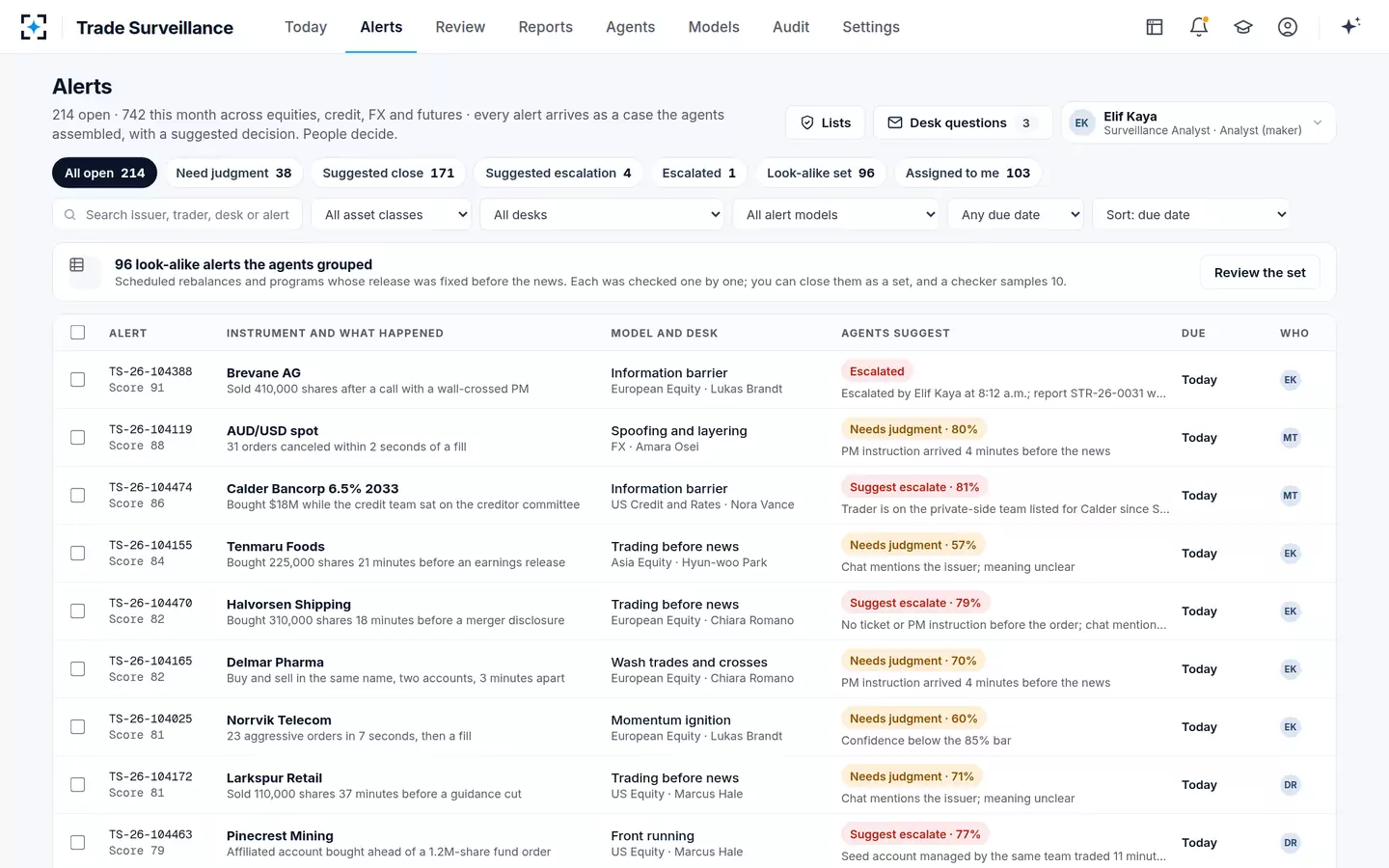
A front-running alert in the queue: an affiliated account bought ahead of a fund order
Testing a front-running model
Test it the way the FCA reviewed banks' models: calibration, logic, code and data. In 2023 the FCA examined how nine investment banks tested their client order front-running models and found approaches that varied in "the breadth of the testing", "its frequency", "the degree to which it constituted a formalised process" and "the governance arrangements around it"; about half focused mainly on parameter calibration (FCA, Market Watch 79). The review was of banks, but the test applies to any front-running model.
A front-running test plan for a fund house
- Seed the obvious case
A synthetic account buys a stock an hour before a large fund buy in the same stock and sells into it. It must alert.
- Seed the tranche case
The synthetic trade comes after the first tranche but before the last. The window must run to the last tranche.
- Seed the derivative case
Call options or a contract for difference on the stock instead of shares. FINRA Rule 5270 and MAR both reach related instruments.
- Seed the split case
Small trades across three connected accounts, each below the threshold. The model should aggregate by person and household.
- Check the data
Every fund order system and every declared account feed reaches the model; reconcile counts daily.
- Check the window
Securities held or considered in the last 15 days are watched, not only those with an order today.
- Replay real cases
Past internal findings, or public cases translated into your data, still alert at current thresholds.
- Record and repeat
Document results, re-test after any change to the order system or the model, and at least yearly.
In Trade Surveillance the agents measure each model's productive rate and the Tuning agent proposes threshold changes only with a six-month backtest showing past true positives still alert; the Head of Surveillance approves. The cases themselves arrive with the order, the connected trades and the communications already assembled, so the analyst's time goes on the question only a person can answer. To see it on your own alerts, start at Trade Surveillance; for the people who decide, see the trade surveillance analyst.
Questions people ask
Is front running illegal in mutual funds?
Yes. In India SEBI treats it as a fraudulent and unfair trade practice and now requires fund houses to run surveillance against it; in the US it is prosecuted as securities fraud and, for fund staff, under Section 17(j) of the Investment Company Act; in the UK and EU, using a client's pending order information is insider dealing under MAR.
Who usually front runs a mutual fund?
Someone who sees the fund's orders before the market does: a dealer or trader, sometimes a portfolio manager, analyst or broker. In both recent cases, an insider passed the information to an outside associate who traded through other accounts.
How do investors know if their fund was front run?
Usually they cannot tell from outside. The harm appears as slightly worse execution prices on the fund's large orders, spread across many trades. That is why regulators require the fund house itself to detect it, and why SEBI requires every examined alert to be reported with the action taken.
Can a fund manager front run its own fund?
A portfolio manager who trades personally ahead of the fund's orders is front running, and US code-of-ethics rules and UK personal account dealing rules exist partly to stop it. Trades for the firm's other accounts ahead of the fund raise conflict and allocation questions that surveillance should also catch.
How long does a front-running case take?
Years. In the US case, the trading ran from at least September 2016 to December 2022, the trader pleaded guilty in November 2023, and the SEC's civil case ended with a final judgment and an industry bar in October 2026.