Employee personal trading compliance software runs an adviser's code of ethics: it collects access persons' holdings and transaction reports, pre-clears their trades, checks them against restricted lists and blackout periods, and keeps the evidence that compliance reviewed them. Rule 204A-1 sets the minimum: reports on fixed clocks, review by the adviser, and approval before any access person buys into an IPO or a limited offering. The SEC's examiners keep finding the same failures, and a purchase decision should be judged on whether those failures fall. Six measures, each taken from a deficiency the SEC has published, do that job before and after any purchase. One more matters for firms that use expert networks: the trades that follow an expert call are mostly fund orders, which a personal-trading system does not see. Botminds' Expert Network Compliance reads the personal-trading system and the order management system together for exactly that measure.
Most trades checked after expert calls were fund orders, not personal trades
Trades checked after expert calls this year, sample firm
- Personal trades, 1,184 · 24%
- Fund orders, 3,752 · 76%
What should employee personal trading compliance software do?
It should make the code of ethics run on time and leave evidence of review. Under Rule 204A-1, access persons submit an initial holdings report no later than 10 days after becoming access persons, with information current within 45 days; a holdings report at least once every 12 months; and transaction reports no later than 30 days after each calendar quarter, unless the adviser receives broker confirmations or statements within that time instead. The code must make every access person get approval before buying into an IPO or a limited offering, directly or indirectly (17 CFR 275.204A-1(b)–(c)). And the adviser must keep the reports, the names of everyone who was an access person in the past five years, and every IPO and limited-offering approval with its reasons (17 CFR 275.204-2(a)(13)).
Beyond the minimum, most firms add pre-clearance of all personal trades, holding periods and blackout periods. The SEC described these practices when it adopted the rule in 2004, and recorded that pre-clearance was already "mandated to some degree in most advisory firms that have adopted a code of ethics" (69 FR 41696, July 9, 2004). Software is how a firm with more than a handful of access persons applies them consistently.
The clocks in Rule 204A-1, and what software has to chase
| Requirement | Deadline in the rule | What to measure |
|---|---|---|
| Initial holdings report | No later than 10 days after becoming an access person; information no more than 45 days old | New joiners and role changes reported on time |
| Annual holdings report | At least once each 12-month period; information no more than 45 days old | Share of access persons with a complete, current report |
| Quarterly transaction report | No later than 30 days after the end of each calendar quarter (or broker statements received in that time) | Late or missing reports per quarter |
| IPO and limited-offering purchases | Approval before acquiring beneficial ownership | Purchases found without a prior approval |
| Review by the adviser | Reports reviewed; records kept five years | Reports with evidence of review by someone other than the reporter |
What the SEC's examiners found in codes of ethics
The Division of Examinations' April 2022 risk alert on MNPI compliance gave a list of code of ethics deficiencies that reads like a requirements document. Staff saw advisers that "could not produce evidence of supervisory review of holdings and transaction reports"; situations in which reports "were not submitted within the timeframes reflected in the Code of Ethics Rule"; codes that did not require the content the rule specifies, "including instances in which access persons did not include their investments in private placements"; access persons who bought into IPOs and limited offerings without the required pre-approval; and advisers whose procedures let the chief compliance officer review his or her own reports (SEC risk alert, April 26, 2022). It also reported employees trading names on the adviser's own restricted list, which the guide to restricted-list compliance covers.
Each of those findings can be counted. That is what makes them useful for a purchase: a firm can measure where it stands on each today, set a target, and check the same measures after the software is live.
Six measures of a code of ethics program
Personal trading compliance: six measures to take before and after buying software
- 1. Pre-clearance turnaround
Median and slowest time from request to decision, per quarter. Slow approvals push people to trade first and ask later.
- 2. Complete, current holdings reports
Share of access persons whose latest holdings report is within 12 months, no more than 45 days stale at submission, and lists every broker account.
- 3. Late or missing transaction reports
Reports, or broker statements in lieu, received more than 30 days after quarter end, as a share of access persons.
- 4. IPO and limited-offering buys without prior approval
Found by comparing holdings and private-placement disclosures with the approval log. The target is zero.
- 5. Trades in restricted names
Personal trades in issuers on the restricted list at the trade date, whether pre-cleared in error or not pre-cleared at all.
- 6. Independent review
Share of reports reviewed with evidence, and confirmation that the chief compliance officer's own reports are reviewed by someone else.
Three cautions keep the measures honest. Count from the source data, not from the software's own dashboard, the first time; a system that does not know about an account cannot report it late. Count role changes, not just new joiners, because a person who moves into an investment role becomes an access person and owes an initial report. And keep the denominator stable: if the access-person list changes during the measurement, say so, or the share of complete reports will move for the wrong reason. Who belongs on the access-person list is the subject of its own guide.
How long should pre-clearance take?
Long enough to check the trade against the lists, the blackout periods and the firm's own trading, and no longer; for most requests that is minutes, not days. No rule sets a time. The 2004 release noted that pre-clearance procedures may state "the length of time an approval is valid", and a short validity window, such as the same trading day, keeps an approval tied to the lists as they stood when it was given. A firm should publish its target, measure the median and the slowest decile, and look at the requests that sat longest: they are usually the ones that needed judgment, and the queue should send them to a person first.
Speed matters because delay creates its own breaches. The UK regulator's 2025 review of corporate finance firms found "Staff trading before receiving approval" and "Compliance not undertaking sufficient checks before granting approval" (FCA Market Watch 83, September 2025), the two failures a slow, manual queue invites at once.
What a review of personal trading should compare
A review that only checks that reports arrived is not a review. When it adopted Rule 204A-1, the SEC described what review should include and doubted that larger firms could do it by hand.
"However, we question seriously whether a larger investment advisory firm will be able adequately to review such reports manually or on paper."
SEC, Investment Adviser Codes of Ethics, Release IA-2256 (July 2, 2004), 69 FR 41696
The same passage lists what the review should do: assess whether the access person followed internal procedures such as pre-clearance, "compare the personal trading to any restricted lists", check whether the person trades the same securities for clients and on what terms, "periodically analyze the access person's trading for patterns that may indicate abuse", and investigate large gaps between how the person's own account and the clients' accounts perform. Software makes those comparisons routine; the measures above show whether they happen.
The measure most personal-trading systems cannot take
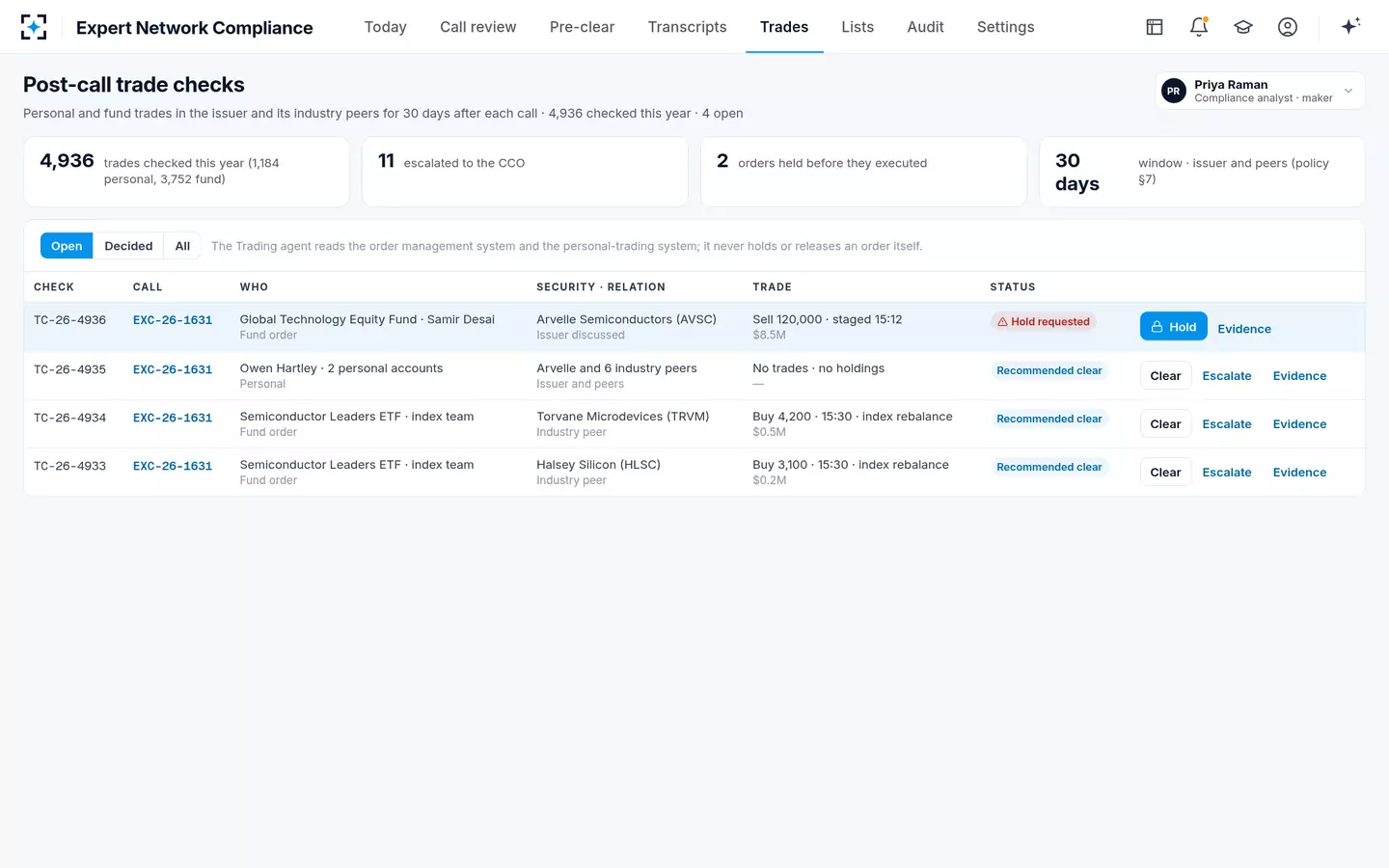
A personal-trading system sees access persons' accounts. It does not see the funds' order management system, and it does not know which expert calls happened, when, or about which companies. For a firm whose analysts talk to experts, that leaves out most of the trading that matters. At the sample firm, three-quarters of the trades checked after expert calls this year were fund orders, which sit in the order management system and never reach the personal-trading system.
The measure to add is simple to state: for each expert call, were the personal and fund trades in the issuer and its industry peers checked within the policy's window, and how soon after the call did the check start? The SEC's examiners asked for review of trading in companies in similar industries to those discussed on calls, and a monthly personal-trading report cannot provide it.
Post-call trade checks in Expert Network Compliance: personal and fund, in one view
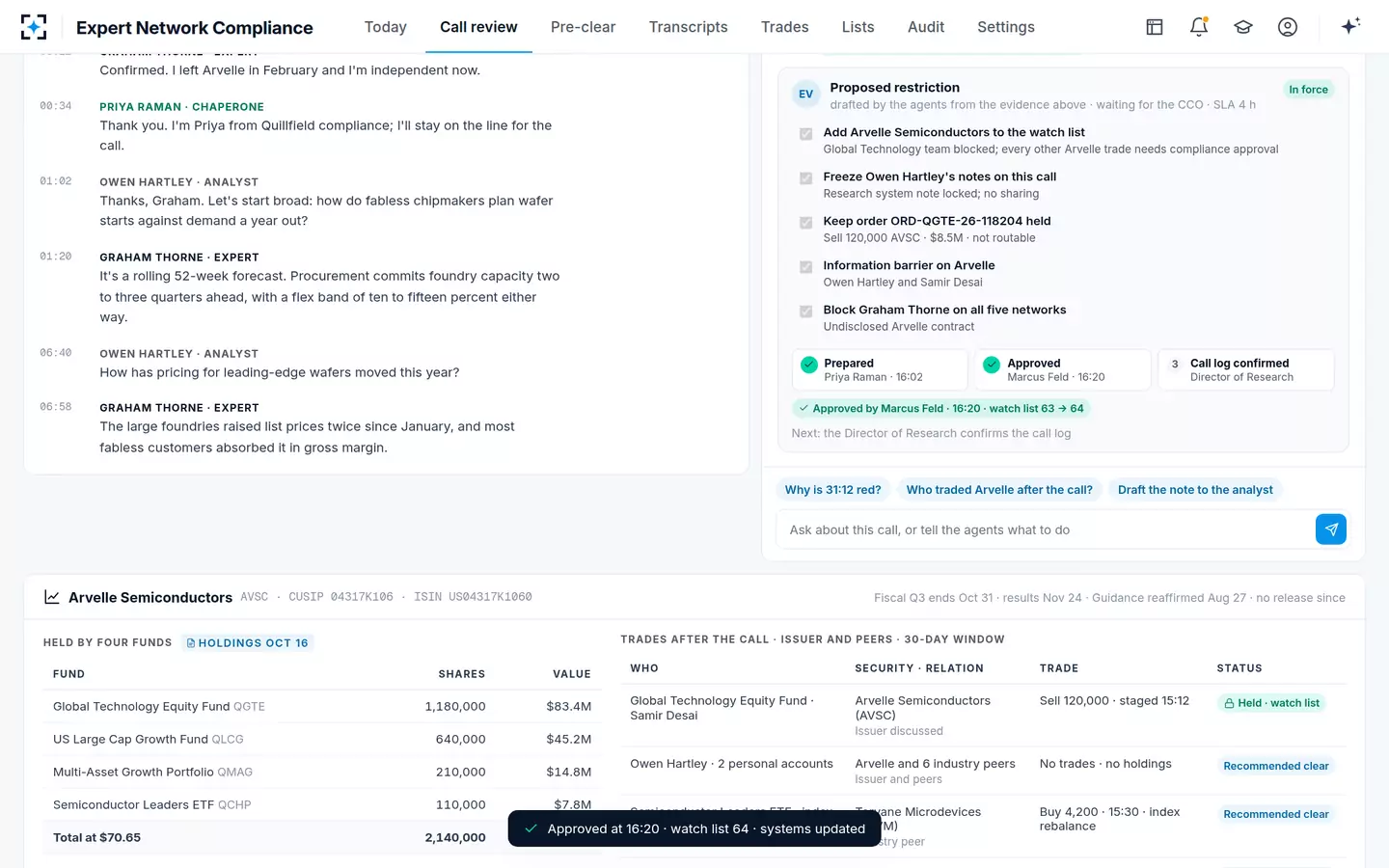
Trades in restricted names, prevented: a watch-list restriction after an expert call
A 2026 order shows what an unenforced pre-clearance rule costs
The SEC's June 8, 2026 settled order against Foundations Investment Advisors is a code of ethics case in its simplest form. The SEC found that the firm's chief executive personally traded an exchange-traded fund held in a model portfolio the firm recommended to clients, without pre-clearing the trades as the firm's policies required, and that the firm "failed to enforce its code of ethics relating to pre-clearance of trades" (SEC, File No. 3-22647). The firm agreed to a civil penalty of $1,200,000 and the chief executive to $354,675, with disgorgement and interest, without admitting or denying the findings; the order also covered conflicts disclosure and annual review failures.
What personal trading compliance looks like in SEC numbers
$1.2M
civil penalty on an adviser whose chief executive traded without pre-clearance (June 2026)
30days
after quarter end: the deadline for access persons' transaction reports under Rule 204A-1
6hours
the SEC's 2004 estimate of annual time per adviser to document a code of ethics
48,114hours
the same estimate across 8,019 advisers
The 2004 estimate is a reminder of how the rule was imagined: a document written once and revised occasionally. The work that costs time is running the code every day, and that cost is the firm's to measure. No regulator or independent study publishes what it costs a firm to administer personal trading compliance; the honest economic case for software is the firm's own hours per access person per quarter, before and after.
Building the before-and-after case
A purchase case for employee personal trading compliance software rests on two kinds of evidence. The first is the six measures, taken for the four quarters before the purchase and every quarter after: turnaround, completeness, lateness, unapproved IPO and private-placement buys, restricted-name trades, independent review. The second is hours: compliance time spent chasing reports, keying broker statements, answering pre-clearance requests and assembling an examination response, recorded for a month before the pilot and a month after go-live.
Vendors' claims fit into that frame or not at all. A product that promises faster pre-clearance should move measure one; one that promises broker feeds should move measures two and three. If the measures do not move, the software is running the old process faster. The role of the compliance officer who owns these numbers is described in a sibling guide.
Where Expert Network Compliance fits in personal trading compliance
Expert Network Compliance is not a personal-trading system, and a firm buying one should not expect it to collect broker feeds or administer holdings reports. It sits beside the personal-trading system and reads it. What it adds is the expert-call side of the code: it knows which access persons took which calls about which issuers, checks their personal trades and the funds' orders in those issuers and their peers from the end of each call, and asks compliance to hold a staged order linked to a flagged call. On the sample firm's data it checked 4,936 trades after calls this year, escalated 11 to the chief compliance officer and saw two orders held before they executed.
For a firm that does not use expert networks, a personal-trading system and the six measures are enough. For a firm that does, the measure in the split above is the one to add. The transcript agent behind the trade checks is described in a sibling guide.
Questions people ask
What is a personal trading compliance system?
It is the software an adviser or broker-dealer uses to run its code of ethics for employees' own trading: collecting holdings and transaction reports or broker feeds, pre-clearing trades, applying restricted lists, blackout and holding periods, and keeping evidence of review. Under Rule 204A-1 the adviser must review access persons' reports, and Rule 204-2 requires the reports and approvals to be kept.
Does every employee have to pre-clear personal trades?
Rule 204A-1 requires pre-approval only for IPOs and limited offerings by access persons. Many firms go further and require access persons, or all staff, to pre-clear all trades in reportable securities. The SEC noted in 2004 that some organizations require all personnel to pre-clear, while others limit it to access persons or to certain types of transaction.
Do family members' trades count under a personal trading policy?
Usually yes. Rule 204A-1 covers securities in which the access person has direct or indirect beneficial ownership, interpreted as under Section 16, and the SEC's 2004 release said an access person is presumed to be a beneficial owner of securities held by immediate family members sharing the household. Accounts over which the person has no direct or indirect influence or control are excepted from reporting.
How long must personal trading records be kept?
Rule 204-2 requires an adviser to keep access persons' reports and a list of everyone who was an access person in the past five years, and to keep each IPO or limited-offering approval, with its reasons, for at least five years after the end of the fiscal year in which it was granted. Most other adviser records run on the same five-year clock, counted from the year of the last entry, with the two most recent years kept on site.
What is a holding period in a personal trading policy?
A minimum time an employee must hold a security before selling it, set by the firm's own policy rather than by an SEC rule. Its purpose is to discourage short-term trading on information gained at work. The FCA reported in 2025 that it had found staff not complying with their firms' holding periods.
Can personal trading compliance software replace review by compliance?
No. It can make the comparisons the SEC described in 2004, such as against restricted lists and clients' trades, and surface exceptions; the decision on each exception and the evidence of review remain compliance's. The SEC's 2022 alert faulted advisers that could not show supervisory review of reports, which software helps evidence but cannot perform on its own.