Expert call transcripts are the written account of a paid call between an analyst and an industry expert, usually produced by the expert network or a transcription service within hours of the call. They are the best evidence a firm has of what was said, and the SEC's examiners have faulted advisers for not reviewing detailed notes of expert network calls. The open question is how good the review is. A team that samples one transcript in ten and reads it from the top cannot say how much material nonpublic information (MNPI) it misses, because it never knows what was there. The way to find out is to plant known MNPI passages in a set of transcripts and count what each reviewer catches. Botminds' Expert Network Compliance reads every transcript in full, in its own language, and should be held to the same test as any person.
The test design below is ours; the regulatory points are the SEC's, linked where they appear. Where the solution appears, the calls are its fictional sample data at an adviser called Quillfield Capital.
A seeded test set for expert call transcripts: 40 planted passages in 200 calls
Current-employer data
Planted10
Example“Our Q3 wafer orders were cut 30% last week.”
Why it is or isn't MNPISpecific, recent, from a company source, not public
A good reviewerFlag red; check the expert's attestation
Results or guidance before release
Planted6
Example“We'll miss the quarter; the CFO told the sales team Friday.”
Why it is or isn't MNPIPrecise, material, ahead of the issuer's release
A good reviewerFlag red
Trial or regulatory outcome
Planted6
Example“The interim safety read was bad; the board saw it Tuesday.”
Why it is or isn't MNPIThe pattern in the 2012 CR Intrinsic complaint
A good reviewerFlag red
Deal or financing
Planted6
Example“They're in exclusivity with a buyer, signing next month.”
Why it is or isn't MNPIAn unannounced transaction
A good reviewerFlag red
Public facts that sound private
Planted8
Example“The Taichung line slipped two months.” (in the last 10-Q)
Why it is or isn't MNPIAlready disclosed; a decoy
A good reviewerFlag, then clear with the dated source
Mosaic pieces
Planted4
Example“Procurement commits capacity two to three quarters ahead.”
Why it is or isn't MNPIHow an industry works; not company-specific
A good reviewerLeave unflagged
What are expert call transcripts, and why do they matter to compliance?
An expert call transcript is a verbatim, speaker-labelled text of the call, often with timestamps and sometimes with the audio. For the analyst it is research. For compliance it is the only complete account of what the expert said, as opposed to what the analyst chose to write down. That difference is the point of review: the passage that matters is usually one sentence in a long call, and analysts' notes summarise the industry view, not the sentence they should not have heard.
The SEC's Division of Examinations listed review of detailed notes from expert network calls among the controls advisers lacked in its April 2022 risk alert, alongside logging the calls and reviewing related trading (SEC risk alert, April 26, 2022). The Investment Research guide to expert network compliance quotes those findings; this page is about measuring whether a review that answers them works.
Do expert calls have to be recorded and transcribed?
No rule requires an adviser to record or transcribe an expert call. What the rules require is a policy reasonably designed to prevent the misuse of MNPI under Section 204A, and the examiners' benchmark is review of detailed notes. A transcript meets that benchmark better than anything else, which is why many firms ask the network for one on every call and say so in the policy. Where a transcript is received and relied on for advice, Rule 204-2 may require it to be kept as a written communication relating to that advice (17 CFR 275.204-2); firms usually keep transcripts with their research for at least five years.
A recorded call has a second use: it makes the review testable. Without a transcript there is no fixed text to plant a passage in, and no way to score a reviewer except by asking whether he or she remembers anything worrying.
Why sampling transcripts tells you little
Sampling measures effort, not detection. If compliance reads a random tenth of transcripts, each passage that matters has a one-in-ten chance of being read at all, however skilled the reader. A clean sample therefore says almost nothing about the other nine-tenths, and the call the firm later has to explain is rarely one it sampled. Sampling by rule, such as all healthcare calls or all calls about held issuers, improves the odds for those groups and leaves the rest unread.
Reading in full has its own failure: fatigue. The sample firm's red passage came 31 minutes into a 52-minute, 6,840-word call, after half an hour of legitimate industry talk. A reviewer reading dozens of such calls a week will miss sentences, and nobody will know which, unless the firm plants some and counts.
How often a planted MNPI passage is even read, by review coverage
How to plant MNPI in an expert call transcript set
A seeded test takes real transcripts from the firm's own archive and inserts passages whose answer is known. The insertions must look natural: placed where the conversation would plausibly reach them, in the expert's register, sometimes hedged ("I probably shouldn't say this, but…") and sometimes not. A set of 200 calls with 40 planted passages is enough to show differences between reviewers; the 40 should be spread across the call, not bunched at the start.
Three design rules keep the test honest. Keep the answer key with someone who does not review. Include decoys, because a reviewer who flags everything will score perfectly on recall and be useless in practice. And include the firm's real languages: a test set in English only measures an English-only review.
Six kinds of passage to plant, two of them decoys
The four true kinds follow the way MNPI actually reaches expert calls. Current-employer data is the commonest risk, from experts who still work at, or still advise, the company: orders, pricing, customers, capacity. Results and guidance before release are the classic material fact. Trial or regulatory outcomes are the pattern the SEC alleged in 2012, when, it alleged, a doctor on a drug trial passed a portfolio manager safety data and then the trial's negative results during calls an expert network had arranged (SEC press release 2012-237; the case is told in the SEC's expert network history). Deals and financings are the fourth.
The two decoys test judgment. A public fact that sounds private, such as a production delay disclosed in the last 10-Q, should be flagged and then cleared with the dated public source, not left red and not ignored. A mosaic piece, such as how procurement teams plan capacity, should not be flagged at all: the SEC said in adopting Regulation FD that analysts add value by turning details an ordinary investor would think insignificant into material conclusions (65 FR 51716, 2000), and a review that flags the mosaic trains analysts to stop writing things down. The guide to MNPI examples sorts real cases into the same groups.
Expert call transcript review, measured two ways
Sampling and reading: How many transcripts were read.
A seeded test on the same transcripts: How many known passages each reviewer found, and how many decoys it left red.
Sampling and reading: Unknown: nobody knows what the unread calls held.
A seeded test on the same transcripts: Known: the answer key.
Sampling and reading: Usually the transcripts in English.
A seeded test on the same transcripts: Every language the firm's analysts call in.
Sampling and reading: No: each reads different calls.
A seeded test on the same transcripts: Yes: every reviewer reads the same set.
Sampling and reading: A sampling log.
A seeded test on the same transcripts: A measured detection rate, dated, with the method.
How many transcripts should compliance review?
Compliance should review every transcript the firm receives, either in person or through a screen it controls and has tested, and spend its human reading time on what the screen flags. The argument is the arithmetic above: any sampling rate below 100% leaves the same share of risky passages unread, and the SEC's examiners asked for review of call notes, not of a sample of them. Firms that cannot read everything by hand should say so in the policy and say how the rest is covered.
The seeded test is how a firm decides whether a screen deserves that trust. A screen that finds 27 of the 28 true passages and leaves one of the 12 decoys red is a better first reader than a person sampling a tenth of calls; one that finds 20 of 28 is not yet.
Scoring the reviewer: recall, false alarms, time and reasons
Score each reviewer, human or agent, on the same sheet. Recall is the share of the 28 true passages flagged. False alarms are the decoys left red after the reviewer's own public-record check. Time is how long from transcript arrival to flag. And reasons matter: a flag that says why a passage looks like MNPI, and quotes it with its timestamp, is something the chief compliance officer can decide on; a score without a reason is not.
The scoring sheet for an expert call transcript review test
- Recall on true passages
Flagged of 28 planted MNPI passages, reported by kind, so a reviewer weak on deal talk shows up.
- Decoys left red
Public facts not cleared with a dated source, and mosaic pieces flagged. Both cost reviewer time.
- Recall by language
The same score on the non-English part of the set; a gap here is a gap in the program.
- Recall by position
Passages late in long calls are where fatigue shows; report the last third separately.
- Time to flag
From transcript arrival to flag, median and slowest, because a staged order may not wait.
- Quality of the reason
Does the flag quote the passage, give its timestamp and say why it is specific, recent, non-public and material?
- Re-run after any change
Repeat with fresh plants after a threshold, model or staffing change, and keep each dated result.
Expert call transcripts in other languages
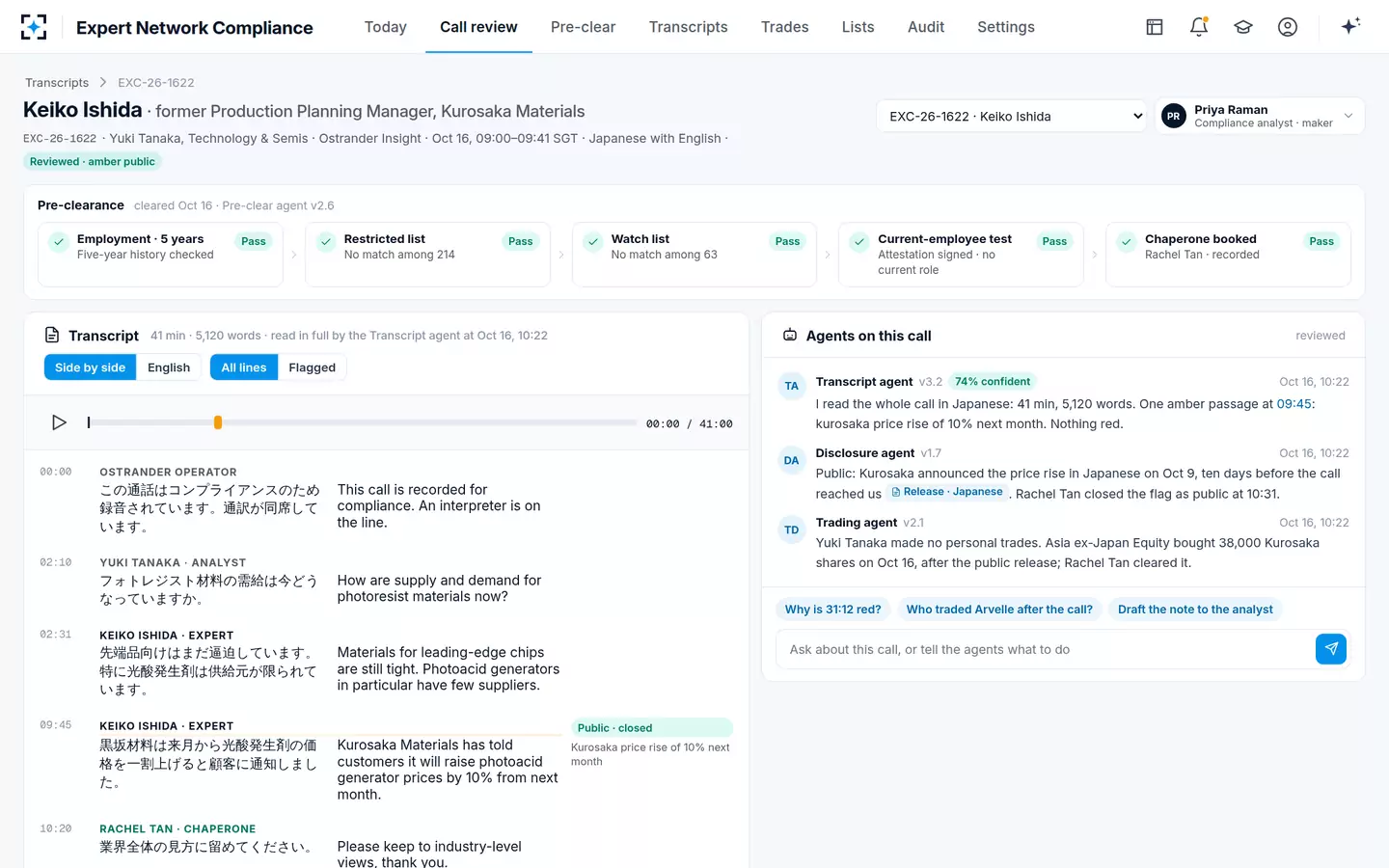
A firm whose analysts call experts in Tokyo, Taipei or Frankfurt receives transcripts in Japanese, Chinese or German, or translations of uncertain quality. A review that reads only the English, or only the translation, measures less than it claims. The test set should include planted passages in each language the firm calls in, and the score should be reported per language.
A Japanese expert call in Expert Network Compliance, read in the original with English beside it
Who should review expert call notes: the analyst, compliance or an agent?
Not the analyst. The analyst who took the call has the information already and wants to use it, so he or she is the least independent reviewer available. Compliance should own the review, and an agent can be the first reader if compliance has tested it and keeps every decision. That division also matches research on how inside information actually moves: in a peer-reviewed study of illegal tipping networks, tips typically began with corporate executives and passed through close personal ties before reaching buy-side investors (Ahern, Journal of Financial Economics, 2017). An expert call shortens that path to one link, which is why someone outside it should read what came through.
Two practical rules follow. The analyst should not see what was flagged, only that the call is under review and what to do meanwhile, so the review does not spread the information it is meant to contain. And a missing transcript is itself a finding: the call log should show it until the transcript or the notes arrive.
Running the test on Expert Network Compliance
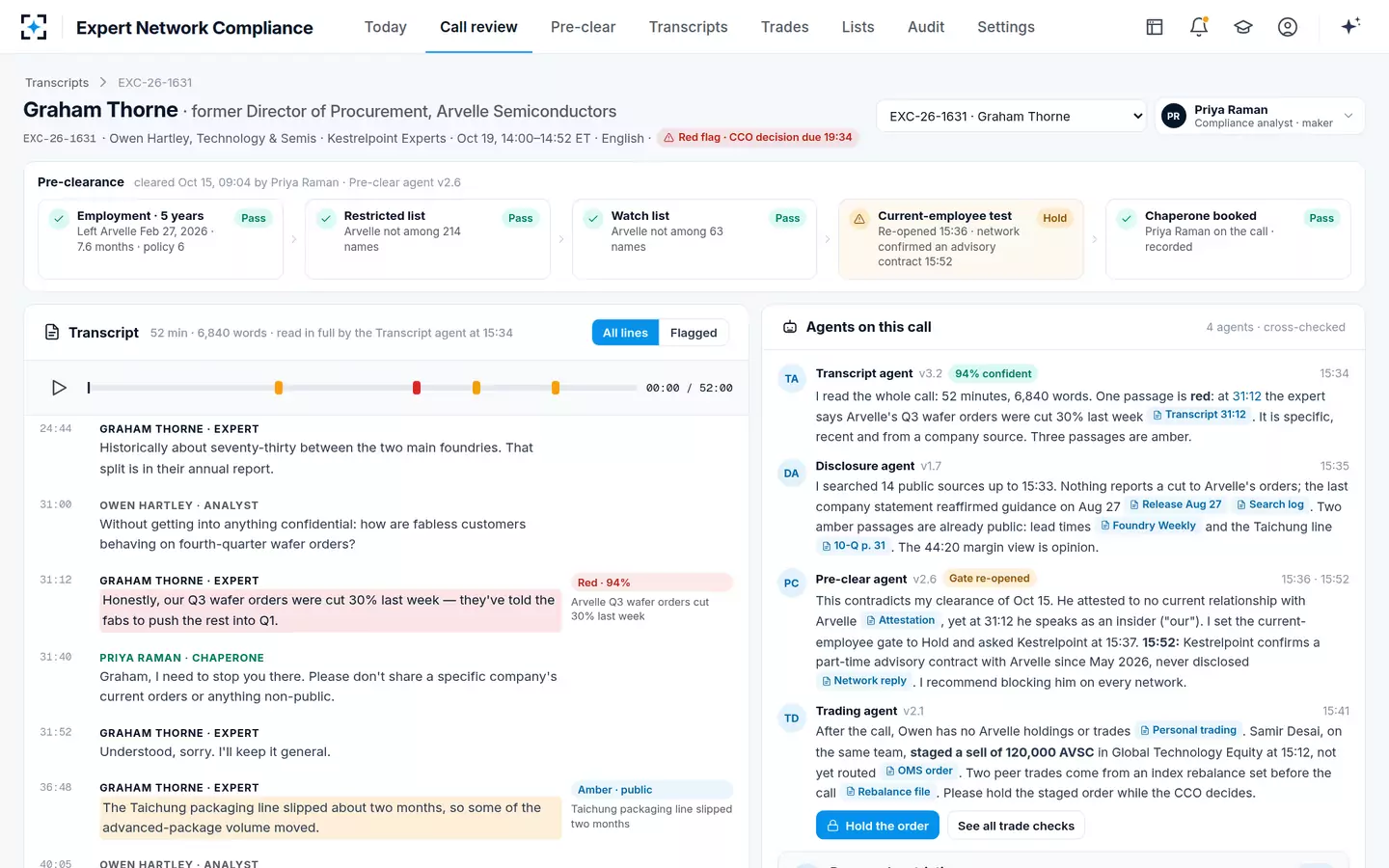
Expert Network Compliance is built to be scored this way. Its Transcript agent reads each transcript in full, in the original language with the English beside it, and marks passages it judges specific, recent, from a company source, non-public and material, each with its quote, timestamp, reasons and a confidence. At the sample firm's settings a passage is red at 85% confidence or more and amber from 60%; below 60% it is logged, not flagged. The Disclosure agent then tests each flag against filings, releases and news, and downgrades only with a dated public source. On the sample firm's data the agents read 1,512 transcripts in full this year, with a median of four minutes from transcript to review.
Those thresholds are the firm's to set, and the seeded test is how to set them: run the planted set at several thresholds and choose the one whose recall and decoy rate the chief compliance officer will sign. The agents never close a red flag; a compliance analyst decides each one.
The call view: the whole transcript, possible MNPI marked in the margin
A firm that wants to see the agent and its own reviewers scored on the same calls can run the test during a pilot: the transcript agent's design and the three ways to supervise calls are covered in sibling guides.
Questions people ask
What is an expert network call transcript?
It is a verbatim, speaker-labelled text of a paid call between an investor and an industry expert, usually supplied by the network or a transcription service soon after the call. Compliance uses it to review what the expert actually said; the SEC's 2022 risk alert faulted advisers that did not review detailed notes of expert calls.
Are expert transcript libraries safe from MNPI?
Not automatically. A library transcript was a call between an expert and someone else, and the same tests apply: who the expert is, what was said, and whether it was public. A firm that buys library transcripts should apply its own review and restricted-list checks to them as it does to its own calls.
Can AI detect MNPI in expert call transcripts?
An agent can read every transcript and flag passages that look specific, recent, company-sourced, non-public and material, with the quote and its reasons. Whether a given agent does it well is an empirical question, which is why the firm should plant known passages and measure recall and false alarms before relying on it, and keep the decision with compliance.
How long should expert call transcripts be kept?
Where a transcript is relied on for advice, Rule 204-2 points to keeping it as a written communication, which means five years after the year it was made, two of them in the adviser's office. Many firms keep transcripts with their research for the same period or longer, and keep flagged transcripts restricted to compliance.
What confidence threshold should flag MNPI in a transcript?
The one the firm's own seeded test supports. Run the planted set at several thresholds and pick the point where recall is high enough and decoys left red are few enough for the team's reading time. The solution's sample policy flags red at 85% and amber from 60%, and logs everything below.
Does a transcript replace the analyst's notes?
No. The transcript shows what was said; the notes show what the analyst took from it and where it went. Compliance needs both, and a review that finds a flagged passage should also freeze the notes and research built on that call until the decision is made.