Expert network chaperoning means a compliance officer joins an expert call live, listens, and stops the expert if the conversation strays toward material nonpublic information (MNPI). It is the oldest way to supervise expert calls, and it has one strength nothing else has: it can interrupt. It also has two limits. A chaperone can attend only a fraction of a busy research team's calls, and can stop a sentence only after it has been spoken. The alternatives are sampling transcripts after the call, or reading every transcript and sending only the risky passages to a person. Compared on one quarter's calls, they differ sharply in coverage, compliance hours and the evidence each leaves for an examiner. Botminds' Expert Network Compliance keeps chaperones for the calls a policy names and reads every call afterwards, chaperoned or not.
Expert network chaperoning, sampling and reading every call, compared
Chaperone or sample: Chaperone: the calls someone can attend. Sample: the share of transcripts read, often a tenth or less.
Read every call, people decide the flags: Every call with a transcript; calls without one show as gaps in the log.
Chaperone or sample: Chaperone: yes, live. Sample: no.
Read every call, people decide the flags: No, unless a chaperone is also on the call; it reads in minutes after the transcript arrives.
Chaperone or sample: Chaperone: during the call. Sample: days or weeks later, if the call is in the sample.
Read every call, people decide the flags: Minutes after the transcript, before most follow-on research or trading.
Chaperone or sample: Chaperone: about the length of every attended call. Sample: reading time per sampled transcript.
Read every call, people decide the flags: Decision time on flagged passages only.
Chaperone or sample: A chaperone note per attended call; a sampling log.
Read every call, people decide the flags: Every call, its flags with reasons, each decision and who made it.
Chaperone or sample: Not by itself.
Read every call, people decide the flags: Flags feed a trade check in the issuer and its peers from the end of the call.
What does an expert call chaperone do?
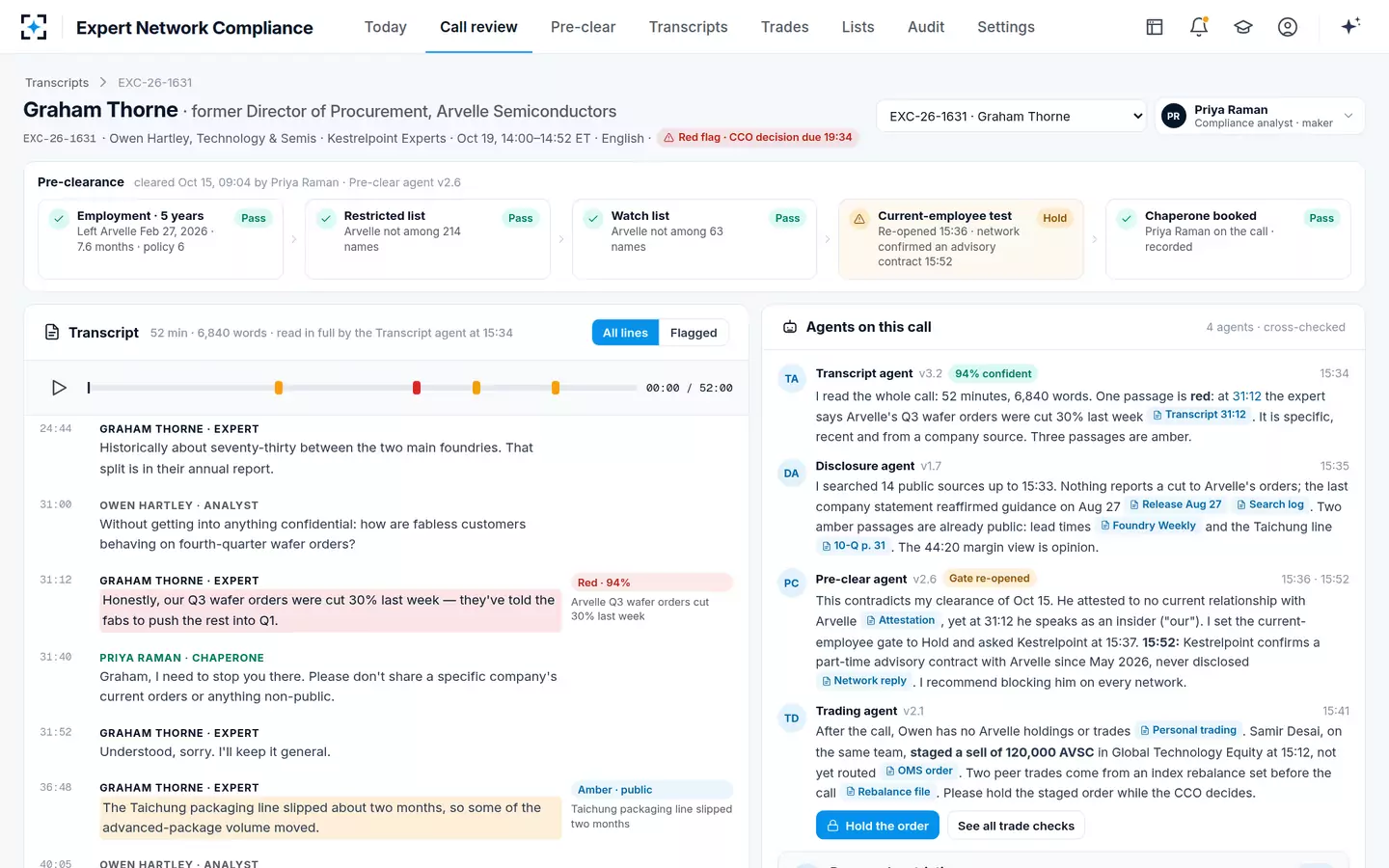
An expert call chaperone is a compliance officer, or someone acting for compliance, who joins the call to hear what is said and intervene if needed. A good chaperone introduces themselves at the start, so the expert knows compliance is on the line; listens for anything specific, recent and company-sourced; stops the expert politely but at once when a passage crosses the line; and writes a short note afterwards of what was said and what they did. In the solution's fictional sample data, the chaperone opened the call by saying she was from compliance and would stay on the line, and at 31:40 told the expert: "I need to stop you there. Please don't share a specific company's current orders or anything non-public."
What an expert call chaperone does, before, during and after
- Before: read the clearance
The expert's employers, any cooling-off, the topics the analyst must avoid, and why the policy asked for a chaperone.
- At the start: say who you are
The expert should know compliance is listening and that the call is recorded.
- During: listen for the pattern
A number, a date, a named customer, "our", "last week": specific, recent, from an insider.
- Stop the call at once
Interrupt politely, restate the limit, and end the call if the expert continues.
- After: write the note
What was said, at what time, what you did, and whether the call should be reviewed or restricted.
- Hand over
A chaperone note is evidence for the reviewer, not a substitute for reading the transcript.
What a chaperone can stop, and what it cannot
A chaperone stops the rest of a sentence, not the sentence. On the sample call, the expert said his former employer's third-quarter wafer orders "were cut 30% last week" at 31:12; the chaperone stopped him 28 seconds later. The words had reached the analyst. What the chaperone's intervention did was prevent more, and create a timestamped account of the moment, which is valuable. What it could not do was un-hear the passage, and the policy still needed someone to decide whether the analyst's notes, the research and any trades should be frozen.
One chaperoned expert call: 28 seconds between the passage and the stop
- Analyst asks, 31:0012 s
- Expert: “our Q3 wafer orders were cut 30%”, 31:1228 s
- Stopped, 31:4012 s
The 28 seconds matter less than what happened while everyone waited for the transcript. The chaperone's note would have reached compliance at some point that afternoon; a staged sell order in the company reached the order management system twenty minutes after the call. A chaperone protects the call. Something else has to protect the trades.
Should compliance chaperone every expert call?
No, and few firms could. Nothing in Section 204A, Rule 204A-1 or the SEC's April 2022 risk alert requires a chaperone; the alert's expert-network findings concern logging calls, reviewing detailed notes of them and reviewing related trading (SEC risk alert, April 26, 2022). A chaperone on every call would put a compliance officer on the phone for as many hours as the analysts spend with experts. The policy should name the calls where live supervision is worth that cost, and cover the rest another way.
The sample firm's analyst describes the problem from compliance's side: "I can sit in on one call in ten. The other nine I only see on paper." That is a fictional compliance analyst, but the arithmetic is general. Section 204A asks for policies reasonably designed for the firm's business (15 U.S.C. 80b-4a), and a design that supervises a tenth of calls and says nothing about the rest is hard to call reasonable.
How many expert calls should be chaperoned?
As many as the policy's risk criteria select, and the criteria should be specific enough that anyone could apply them. The solution's sample policy requires a chaperone for three groups: a former employee of an issuer within 24 months of leaving, any healthcare expert, and any issuer the firm holds above $50 million. Each is a reason the SEC's cases make plain. Recent former employees are closest to current information; healthcare experts may sit near trial results, the pattern alleged in the 2012 CR Intrinsic complaint, where consultations were coordinated around a trial's safety committee meetings (SEC press release 2012-237); and large holdings are where a trade would matter most.
Whatever the criteria, measure the result: the share of calls that met them, the share actually chaperoned, and the calls that met them but went ahead without a chaperone. The last number is the one an examiner will ask about.
Expert network chaperoning at the sample firm, in its own numbers
3
chaperone criteria in the sample policy: recent former employee, healthcare expert, holding over $50M
1 in 10
calls the sample firm's compliance analyst says she can attend by hand
28sec
from the red passage to the chaperone's stop on the sample call
1,512
transcripts read in full this year, chaperoned or not
The cost of each method on one quarter's calls
Compliance hours are the honest unit of comparison, and a firm can compute them from its own logs. Take the sample firm's estimate of about 2,000 expert calls a year, or 500 a quarter, and assume an hour of a chaperone's time per attended call and half an hour to read a transcript properly by hand. Both assumptions are ours; replace them with your own measurements.
Compliance hours per quarter to supervise 500 expert calls, by method
The bars show the trade-off any manual program faces: full coverage costs hundreds of hours a quarter, and affordable coverage leaves nine calls in ten unsupervised. The third method changes the unit. When an agent reads every transcript first, compliance hours depend on how many passages it flags and how long each decision takes, which the firm controls through its thresholds and can measure with a seeded transcript test.
Can transcripts replace chaperones?
Not entirely. A transcript reviewed afterwards covers every call and leaves better evidence, but it cannot stop an expert mid-sentence, and an expert who knows compliance is listening may never start the sentence. Chaperones remain worth their cost on the calls a policy names as higher risk. What transcripts replace is the pretence that chaperoning a few calls supervises the program: with every call read, a chaperone becomes a targeted control rather than the only one.
The reverse also holds. A chaperoned call still needs its transcript read, because a chaperone listening in real time misses things a careful reader catches, and because the chaperone's note is not the full account. The solution reads chaperoned calls exactly as it reads the rest.
The evidence each method leaves for an examiner
An examiner testing an expert network program asks for a sample of calls and, for each, what the firm did. Chaperoning answers well for the calls it covered and not at all for the rest. Sampling answers with a sampling log, which shows effort, not outcome. Reading every call answers for each call: whether it was read, what was flagged, what a person decided and when, and what happened to the trades. The Investment Research guide to expert network compliance sets out what that file should hold.
The expert network compliance risk none of the three catches alone
None of the three methods, by itself, looks at the trades. The SEC's 2022 alert listed review of trading in companies in similar industries to those discussed as a separate control, and the sample call shows why: the risk had become an order before any of the three methods had finished. Chaperoning, sampling and reading are ways to find the passage; a trade check from the end of the call is what turns a found passage into a held order. Who waits on whom around a call sets out that gap in detail.
Running chaperones and full reading together in Expert Network Compliance
Expert Network Compliance books a chaperone wherever the firm's criteria require one, as part of pre-clearance, and records it with the clearance. After every call, chaperoned or not, the Transcript agent reads the whole transcript in its original language and flags possible MNPI with the quote and reasons; the Disclosure agent tests each flag against the public record; and the Trading agent checks trades in the issuer and its peers from the end of the call. A compliance analyst decides every flag, and the design target is that the chief compliance officer sees every red flag within an hour of the transcript.
A chaperoned call in Expert Network Compliance, read in full afterwards: the chaperone's stop and the agents' flags on one page
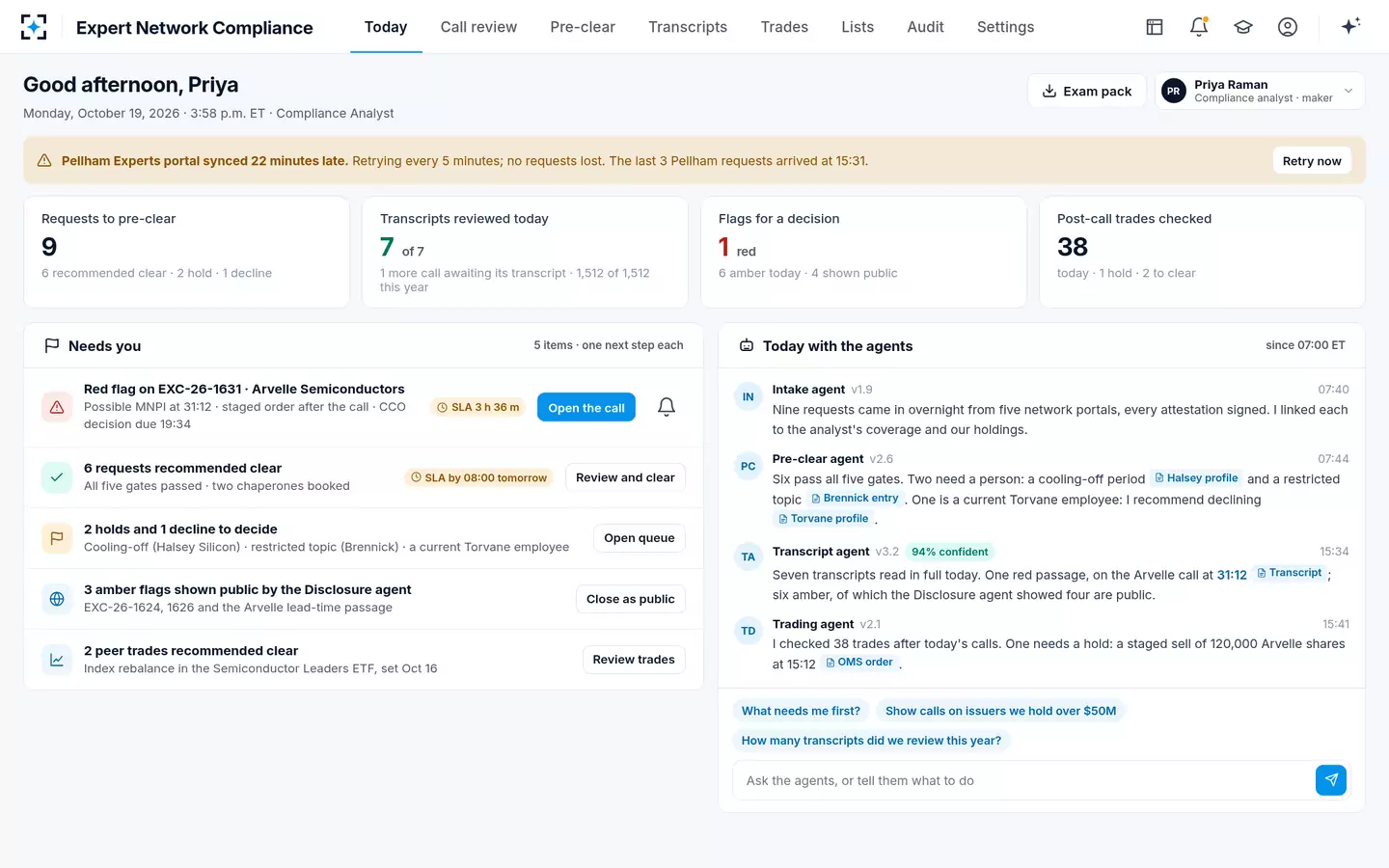
The compliance analyst's day: chaperones booked, every transcript reviewed, one red flag
Questions people ask
What is an expert network chaperone?
A compliance officer, or someone acting for compliance, who joins an expert call live to listen and stop the expert if the conversation turns to confidential or nonpublic information. The chaperone usually writes a note afterwards. No SEC rule requires one; firms use chaperones for calls their policy names as higher risk.
What is the main expert network compliance risk a chaperone addresses?
That an expert discloses MNPI during the call. A chaperone can stop the disclosure from going further and record when it happened. It does not cover calls without a chaperone, and it does not check what anyone trades afterwards, which the SEC's 2022 alert treated as a separate control.
Do expert networks provide chaperones?
On some calls a network operator opens the line with a compliance announcement, as on one of the sample firm's calls in Japanese, and networks can host a firm's compliance officer on the line. The chaperone who matters is the firm's own, because the firm's policy, lists and holdings decide what the expert must not discuss.
Should chaperoned calls still be reviewed afterwards?
Yes. A chaperone listening live can miss a passage that a reader would catch, and the chaperone's note is a summary, not the full account. Reading the transcript of a chaperoned call also tests the chaperone: did they stop the call at the right moment, and did the note match what was said?
Can someone outside compliance act as a chaperone?
A firm's policy can allow it, for example a senior analyst or a research supervisor trained for the role, but the chaperone should be independent of the trade the call might inform. An analyst's own team lead has an interest in the call's content, which is the reason compliance usually holds the role and why the chaperone's note goes to compliance, not to the research team.
How should chaperone criteria be reviewed?
At least once a year with the expert network policy, using the firm's own data: which calls met the criteria, which were chaperoned, and where flagged passages actually occurred. If most red flags come from calls outside the criteria, the criteria are in the wrong place.