Expert network calls are paid conversations, usually an hour long, between an investment analyst and an industry expert recruited by an expert network: a former executive, a supplier, a customer, a doctor. The network finds the expert, checks and contracts with them, schedules the call and pays the expert; the investment firm pays the network. Around that simple transaction sits a chain of people with their own steps and deadlines, and an adviser's compliance program has to fit into it without stopping research. Most of the delay sits before the call, in pre-clearance. Most of the risk sits after it, when a trade can be placed before anyone has reviewed what the expert said. Botminds' Expert Network Compliance puts agents on the mechanical steps in that chain and leaves each decision with the person who owns it.
The people and times below follow one call in the solution's fictional sample data: an analyst at an adviser called Quillfield Capital, booking an hour with a former procurement director of a semiconductor company the firm holds.
Seven people on and around one expert network call, and what each waits for
Today
Requests the call on the network's portal, then waits for compliance before the network will book it.
With agents
Sees the clearance, the topics to avoid, and later only whether the call is under review.
Still theirs: Asking the questions, and stopping an expert who strays
Today
Recruits the expert, collects an employment history and a signed attestation, schedules and pays.
With agents
Answers the firm's questions about the expert, sometimes the same afternoon.
Still theirs: Its own vetting and contract with the expert
Today
Signs the network's terms, takes the call, is paid by the network.
With agents
Is blocked across networks if a call shows an undisclosed conflict.
Still theirs: Responsibility for what he or she discloses
Today
Pre-clears from portal forms, samples transcripts, checks trades in another system.
With agents
Clears from reasons and evidence, decides every flag, prepares any restriction.
Still theirs: Clear, hold or decline on every request and flag
Today
Attends the calls the policy names, if available.
With agents
Attends the same calls; every call is also read in full afterwards.
Still theirs: Stopping the call in real time
Today
Trades the name, unaware a call is under review unless told.
With agents
Sees that an order is held by compliance, not why.
Still theirs: The investment decision, once released
Today
Sign the weekly call log and answer the examiner from email and spreadsheets.
With agents
Sign a reconciled log with the gaps shown; the CCO decides each restriction.
Still theirs: The signature on the log, and the final decision
How do expert networks work?
An expert network is an intermediary: it keeps a pool of people who know an industry, matches them to an investor's question, and arranges a consultation for a fee. The investor's analyst describes the topic; the network proposes experts with their recent employment; the analyst picks one; the network checks availability, collects the expert's attestation that he or she may speak and will not disclose confidential information, and books the call. After the call the network pays the expert, invoices the firm and may supply a transcript.
The SEC's examiners define an expert network simply as a group of professionals paid for their specialized information and research services, and their 2022 risk alert concerns the consultants among them who may be connected to public companies or have access to MNPI (SEC risk alert, April 26, 2022). The network is the first filter on who those consultants are. It is not the last: the 2011 cases involved employees of technology companies who were moonlighting for a network while their employers did not know (SEC press release 2011-38).
Who is on an expert network call?
On the line are the analyst and the expert, sometimes a network operator who opens the call, and at some firms a compliance chaperone. Around the call are the compliance analyst who cleared it, the director of research who will sign the log, the portfolio managers and traders who may act on the analyst's view, and the chief compliance officer who decides if something goes wrong. Each step a firm adds to protect the call creates a dependency: the analyst waits for the clearance, the network waits for the analyst, the chaperone's calendar sets the time, and the review waits for the transcript.
One expert network call, step by step: who acts and who waits
A person decides
AnalystRequests the call on the network's portal with the topic and the expert chosen.
Agent
Intake agentPulls the request from the portal, links it to the analyst's coverage and the firm's holdings, and checks the expert's attestation is signed.
Never: Books a call
Agent
Pre-clear agentTests five years of the expert's employers against the lists and holdings, applies the cooling-off rules and books a chaperone where the policy asks.
Never: Clears or declines a call
A person decides
Compliance analystClears, holds or declines with a reason; the network books the call only after clearance.
A person decides
Analyst, expert and chaperoneHold the call; the chaperone can stop it.
Agent
Transcript and Trading agentsRead the transcript in full when it arrives, and check trades in the issuer and its peers from the end of the call.
Never: Hold or release an order
A person decides
Compliance analyst and CCODecide every flag; the CCO approves any restriction prepared by compliance.
How much do expert networks charge?
Networks do not publish their prices, and no regulator or independent study publishes market rates for expert calls. The public record gives historical points from enforcement cases. In its 2012 complaint against CR Intrinsic and others, the SEC said the network generally paid the doctor at the centre of the case $1,000 an hour (SEC press release 2012-237). In the 2011 cases, one consultant received more than $130,000 from a single network between January 2008 and March 2010 for talking to it and its clients (SEC press release 2011-38).
Those figures are what experts were paid, not what funds paid the network, and they are more than a decade old. For a compliance budget the more useful unit is internal: how many calls a year, how many hours of compliance time each one takes before and after, and what share of calls the firm can actually review. Those numbers a firm can measure from its own logs.
Expert network calls in numbers, from the SEC's cases and one sample week
$1,000/hour
what the expert in the 2012 CR Intrinsic complaint was generally paid by the network
$130K+
paid to one consultant by one network, Jan. 2008 to Mar. 2010, in the 2011 cases
23calls
in one week by seven analysts at the fictional sample firm
1day
the sample firm's pre-clearance deadline: one business day per request
Before the call: where the days go
Pre-clearance is where analysts feel compliance most, because the network will not book the call until compliance clears it. The work is matching: the expert's employers over a lookback period against the restricted list, the watch list and the firm's holdings; how long ago the expert left each one; whether the expert is a current employee anywhere relevant; whether the topic names a restricted issuer. Done by hand from network profiles arriving on several portals, that takes a compliance analyst a large part of the week, and every hour spent on a clean request is an hour not spent on a risky one.
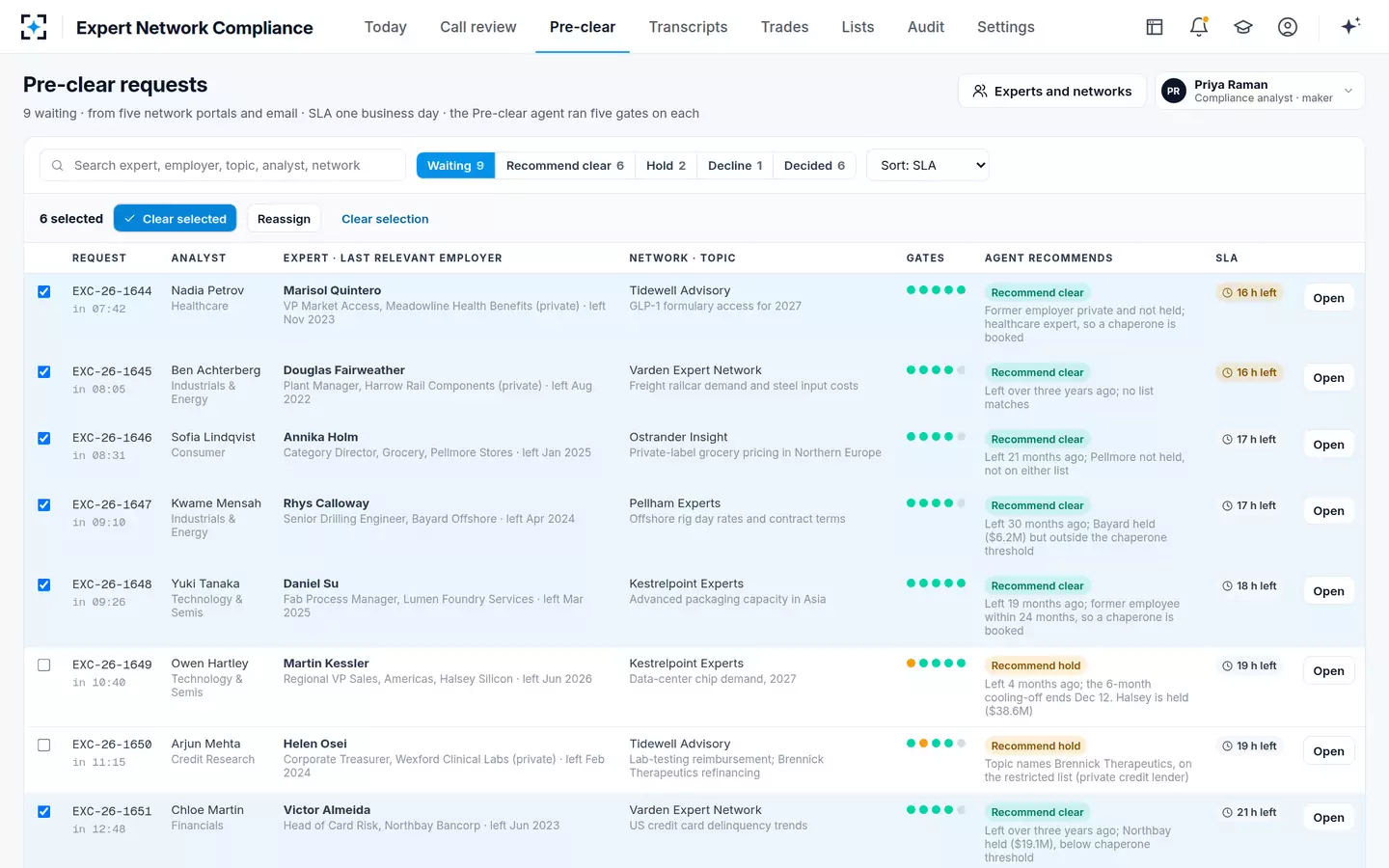
In the sample week, nine requests arrived overnight from five network portals and email against a one-business-day deadline. Six were recommended for clearance and cleared together; two were held, one because the expert's cooling-off period ran until December 12 and one because its topic named a company on the restricted list; and the agent recommended declining one because the expert was a current employee of a covered company. The holds and the decline were decided one by one, with reasons.
The pre-clear queue in Expert Network Compliance: nine call requests, each with a reason
Who listens to expert network calls?
The analyst and the expert, and whoever else the firm and the network put on the line. Some calls open with a network operator: on one of the sample firm's calls in Japanese, the operator announced that the call was recorded for compliance and that an interpreter was on the line. Many firms send a compliance chaperone to the calls their policy names as higher risk, and record and transcribe calls so that someone can listen or read afterwards. Pre-approval and reporting rules for the people involved come from the firm's code of ethics under Rule 204A-1, not from the network.
Listening live and reading afterwards do different jobs. A chaperone can stop an expert mid-sentence; in the sample call the chaperone did exactly that, at 31:40, but only after the expert had already said that his former employer's orders were cut 30% the week before. Reading afterwards cannot stop the sentence, but it covers every call and leaves evidence. The comparison is worked through in chaperoning, sampling or reading every call.
After the call: the gap between the words and the trade
The most important dependency is the one most programs never draw: the portfolio team does not wait for compliance. An analyst who hears something on a call can share a view with colleagues within minutes; a portfolio manager can stage an order before the transcript exists. Programs that review transcripts in a weekly batch, or check trades in a monthly report, find that order after it has executed. The examiners' 2022 finding about reviewing trading in the issuers and industries discussed was a finding about this gap.
One expert network call's afternoon, to scale: the order came before the transcript
- The call14:00 · 52 min
- Order staged15:12 · 20 min
- Transcript15:31 · 19 min
- Read10 min
- Prepared16:02 · 21 min
- Approved16:20 · 18 min
Twenty minutes separated the end of the call from the staged order, and the transcript arrived nineteen minutes after that. Nothing in the timeline is unusual; it is simply faster than a batch review. The control that works is the one that starts when the call ends: the trade check runs from that moment, and the transcript review runs the moment the text arrives.
The signature at the end of the week
Someone signs that the week's calls all went through the process. At the sample firm that is the director of research, who confirms each analyst's call log: 23 calls by seven analysts in the sample week, each reconciled against the network portals, calendars and research notes. The log showed two gaps: one call under compliance review with its notes frozen, and one call held on October 14 whose note was never filed. A director who signs a log typed by the analysts is attesting to something nobody checked; one who signs a reconciled log with the gaps shown is attesting to evidence.
The SEC raised the same problem of scale in 2004, when it adopted the code of ethics rule: it doubted that a larger adviser could review access persons' personal trading reports adequately by hand or on paper (69 FR 41696, July 9, 2004). Call logs reach the same point at a few dozen calls a week.
What the analyst sees behind the information barrier
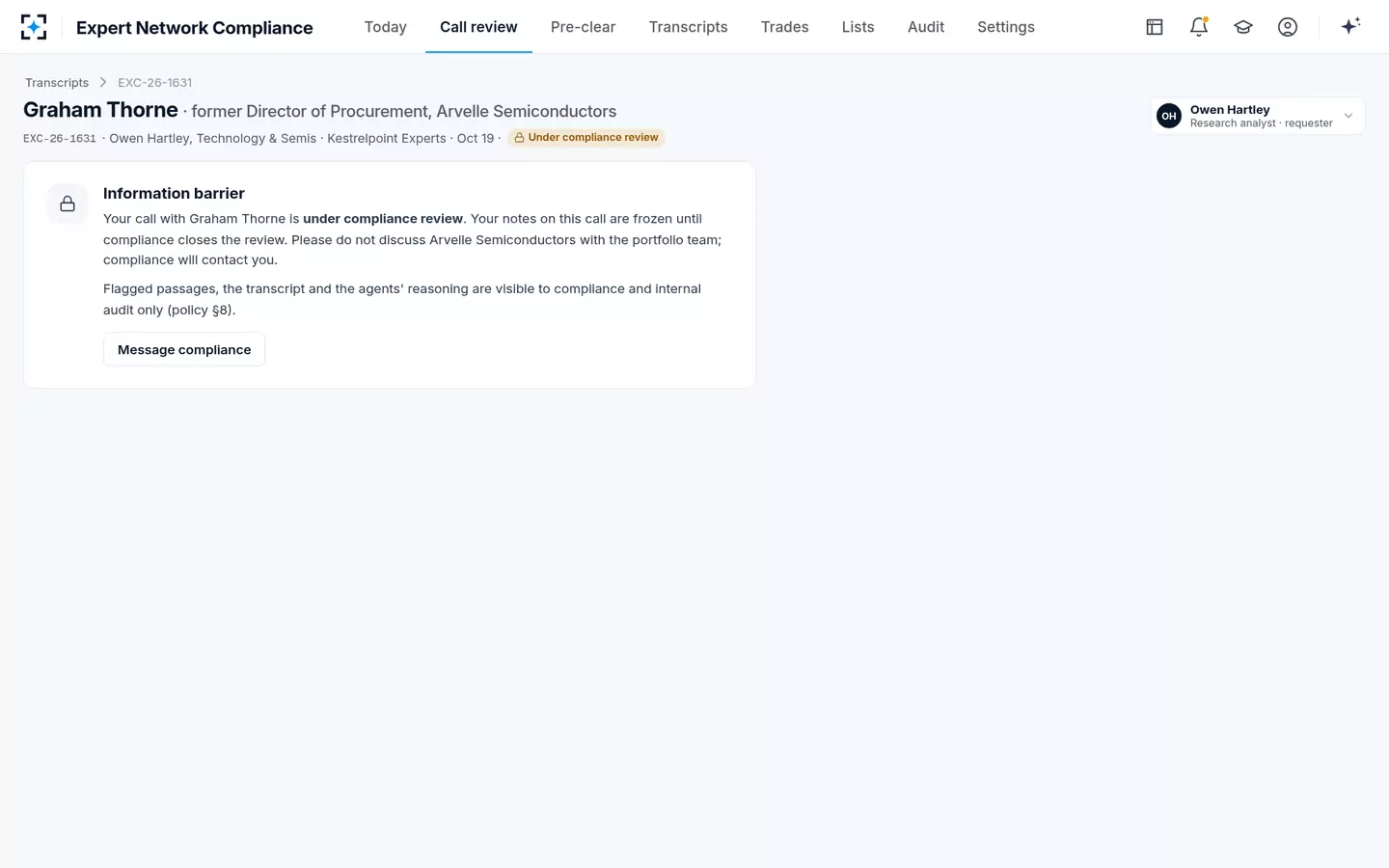
When a call goes under review, the analyst needs to know what to do, not what was flagged. Telling the analyst which sentence was the problem spreads it further; telling him nothing leaves him to discuss the company with the portfolio team. The sample firm's analyst sees that the call is under compliance review, that his notes are frozen, and that he should not discuss the company with the portfolio team until compliance contacts him.
What the analyst sees: the status of the call, never the flag
Where Expert Network Compliance shortens the waits
The solution removes waiting where waiting adds nothing and adds speed where speed protects the firm. Before the call, the Pre-clear agent does the matching and recommends; clean requests are cleared together and holds go to a person with the reason. After the call, the Transcript agent reads each transcript as it arrives, the Disclosure agent tests each flagged passage against the public record, and the Trading agent checks personal and fund trades in the issuer and its peers, asking compliance to hold a staged order linked to a flagged call. On the sample firm's data the median from transcript to review this year was four minutes; the design target is that the chief compliance officer sees every red flag within an hour of the transcript.
The Investment Research guide to expert network compliance sets out the method behind log, read, hold and decide; the questions to ask a network cover the part of the chain the firm does not run.
Questions people ask
What is an expert network firm?
It is a company that recruits industry experts and arranges paid consultations between them and investors, consultants or corporate clients. The network vets and contracts with each expert, schedules the call, pays the expert and invoices the client. The SEC's examiners describe an expert network as a group of professionals paid for specialized information and research services.
Who are the experts on expert network calls?
Usually former executives and employees of companies in an industry, plus suppliers, customers, distributors, doctors and other practitioners. Recent former employees and anyone still working for or advising a company the investor covers carry the most MNPI risk, which is why policies test employment over a lookback period and set cooling-off periods.
How long does expert call pre-clearance take?
It depends on the firm's policy and staffing; many firms aim for a business day, as the fictional sample firm does. The time goes on matching the expert's employers against the restricted list, the watch list and holdings. Automating the matching lets compliance spend its time on the holds rather than on clean requests.
Can expert networks arrange calls with current employees?
Some will, for some companies; many investment firms forbid calls with current employees of public companies they cover or hold, and some forbid current employees altogether. A current employee owes the company a duty of confidence and is the expert most likely to hold MNPI, as the 2011 cases involving moonlighting employees showed.
What happens if an expert discloses MNPI on a call?
The analyst or chaperone should stop the call, and the analyst should tell compliance and not trade or share the information. Compliance then decides whether to restrict the issuer, freeze the notes, hold any related orders and report the expert to the network. At the sample firm the restriction is prepared by a compliance analyst and approved by the chief compliance officer.
Do analysts pay expert network experts directly?
Normally not. The firm pays the network under its contract, and the network pays the expert. Direct payments outside the network bypass the network's vetting and the firm's own pre-clearance, which is why many policies require every expert consultation to go through an approved network.