An expert network policy is the part of an investment adviser's written procedures that governs paid calls with industry experts: which networks may be used, who may be called, what the call may cover, how compliance approves it, and what happens to the notes and the trades afterwards. The law behind it is Section 204A of the Advisers Act, which asks every adviser for written policies, fitted to its business, that prevent the misuse of material nonpublic information (MNPI), and asks that the adviser enforce them. Most policies are long; the SEC's examiners have judged them by a short list of things the firm can show it did, call by call. Botminds' Expert Network Compliance is built around that list: its agents pre-clear each call, read every transcript and check the trades after it, and leave each decision to compliance.
The annotations below separate the clauses that produce evidence from the clauses that only state an intention. Where the solution appears, the people, firms and calls are its fictional sample data, at an adviser called Quillfield Capital.
An expert network policy is judged by what it enforces, not what it says
3
expert-network controls the SEC's examiners found missing in 2022: logging calls, reviewing call notes, reviewing related trading
$4.0M
penalty for an adviser that failed to maintain and enforce its MNPI policies (OEP Capital, Dec. 2023)
$150K
penalty for an adviser that did not follow its own written MNPI procedures (Cannell Capital, Feb. 2020)
1988
year Section 204A was added to the Advisers Act
What should an expert network policy include?
An expert network policy should include eight working clauses: approved networks, pre-clearance of each call, the expert's employment and attestation, topics that are off limits, a call log, review of what was said, a look at trading after the call, and a written decision whenever something goes wrong. Everything else in the document, such as definitions, training and the statement of purpose, supports those eight. The test for each is the same: can compliance produce, for any call the examiner names, the evidence that the clause was applied?
That test comes from how the SEC examines. The Division of Examinations' April 2022 risk alert on MNPI compliance did not fault advisers for the wording of their expert network policies. It faulted them for not having, or not implementing, three controls: tracking and logging the calls, reviewing the notes from the calls, and reviewing their people's trading in companies in the same industries as those discussed (SEC risk alert, April 26, 2022). The Investment Research guide on expert network compliance as a method sets out those findings in the alert's own words; this page applies them to the policy text.
The expert network policy, annotated: clauses that produce evidence
- 1. Approved networks only, under written terms
Runs if every call arrives from a network on the approved list. Evidence: the network's due-diligence file and the terms it signed, renewed on a set cycle.
- 2. Pre-clearance before the call
Runs if no call can be booked without a clearance. Evidence: the request, the checks applied, who cleared it and when, for every call.
- 3. The expert's employers, tested against the lists
Runs if current and recent employers are matched against the restricted list, the watch list and the firm's holdings. Evidence: the match result per employer, not a tick box.
- 4. Off-limits topics sent to the analyst
Runs if the clearance names what must not be discussed for this expert. Evidence: the topics attached to the clearance.
- 5. A log of every call
Runs if the log is reconciled to the networks' own records, not typed by the analyst. Evidence: a log with gaps shown, and who confirmed it.
- 6. A reading of what was said
Runs if someone other than the analyst reviews the notes or transcript of each call. Evidence: who reviewed which call, and what they found.
- 7. A look at trading after the call
Runs if personal and client trades in the company and its industry are compared with the call date. Evidence: the trades checked and the result.
- 8. A written decision when something goes wrong
Runs if every restriction, hold or exception has a preparer, an approver and a reason. Evidence: the decision with both names.
Section 204A asks for a policy that fits the business, and is enforced
Section 204A requires every adviser to establish, maintain and enforce written policies reasonably designed, given the nature of its business, to prevent the misuse of MNPI by the adviser or anyone associated with it (15 U.S.C. 80b-4a). Three of its words carry the weight. "Written" means the clause exists. "Reasonably designed" means it fits how information actually reaches this firm, which is why a firm that takes expert calls needs expert-call clauses and a firm that never does may not. "Enforce" means someone applies it, and can show it.
The statute also exposes whoever is in control. Section 21A of the Exchange Act lets the SEC seek a civil penalty from a controlling person whose failure to put the required policies in place contributed to someone else's insider trading.
A controlling person may be penalized if it "knowingly or recklessly failed to establish, maintain, or enforce any policy or procedure required under section 78o(f) of this title or section 80b–4a of this title and such failure substantially contributed to or permitted the occurrence of the act or acts constituting the violation."
15 U.S.C. 78u-1(b)(1)(B), Exchange Act Section 21A
The ceiling on that penalty is written into the same section: the greater of $1,000,000 or three times the profit gained or loss avoided as a result of the controlled person's violation (15 U.S.C. 78u-1(a)(3)). A policy that exists on paper but was never enforced is exactly the failure the subsection describes.
The clauses that are decoration
A clause is decoration when it states a standard that nobody applies call by call. Four are common. "Analysts must not solicit MNPI" is a rule of conduct, not a control: it tells the analyst what not to do but gives compliance nothing to check. "Experts must confirm they will not disclose confidential information" is an attestation, and attestations are only as good as the expert who signs them. "Compliance may attend calls" describes a right, not a practice, unless the policy says which calls. And "the firm will review expert network usage periodically" sets no frequency, no reviewer and no output.
None of these clauses is wrong. Each becomes a control when the policy adds who applies it, to which calls, and what record that leaves. The attestation, for instance, runs when compliance tests it: in the solution's sample call, the expert's signed attestation of no current tie to his former employer was contradicted by his own words on the call, and the clearance was re-opened the same afternoon.
An expert network policy clause as written, and as a control
Clause as it often reads: Analysts must not solicit material nonpublic information from experts.
Clause written so it runs: The clearance lists the topics the analyst must not raise with this expert, and the transcript is read against them.
Clause as it often reads: Experts must confirm in writing that they will not disclose confidential information.
Clause written so it runs: The attestation is kept with the clearance, and a clearance is re-opened when anything said on the call contradicts it.
Clause as it often reads: Compliance may attend expert calls at its discretion.
Clause written so it runs: A chaperone attends calls that meet named criteria, such as a recent former employee or a large holding, and the call is recorded.
Clause as it often reads: Compliance will periodically review expert network usage.
Clause written so it runs: Each call's notes or transcript are reviewed within a set time, and the weekly call log is reconciled to the networks and signed.
Clause as it often reads: Employees must comply with the code of ethics.
Clause written so it runs: Personal and client trades in the issuer and its industry peers are checked for a set number of days after each call.
Do expert calls need pre-clearance?
No rule names expert-call pre-clearance, but a policy without it cannot answer the first question an examiner asks: did compliance know about this call before it happened? Section 204A requires policies fitted to the business, and for a firm whose analysts call former executives, suppliers and customers, approval before the call is the point at which the riskiest calls can still be stopped. The SEC has long treated pre-clearance as ordinary practice for personal trading: when it adopted the code of ethics rule in 2004, it described advisers' codes that commonly require prior written approval before an access person trades, and among the practices it said every adviser should consider were restricted lists of issuers on which the firm holds inside information (SEC, Investment Adviser Codes of Ethics, 69 FR 41696, July 9, 2004). The same logic applies to a call.
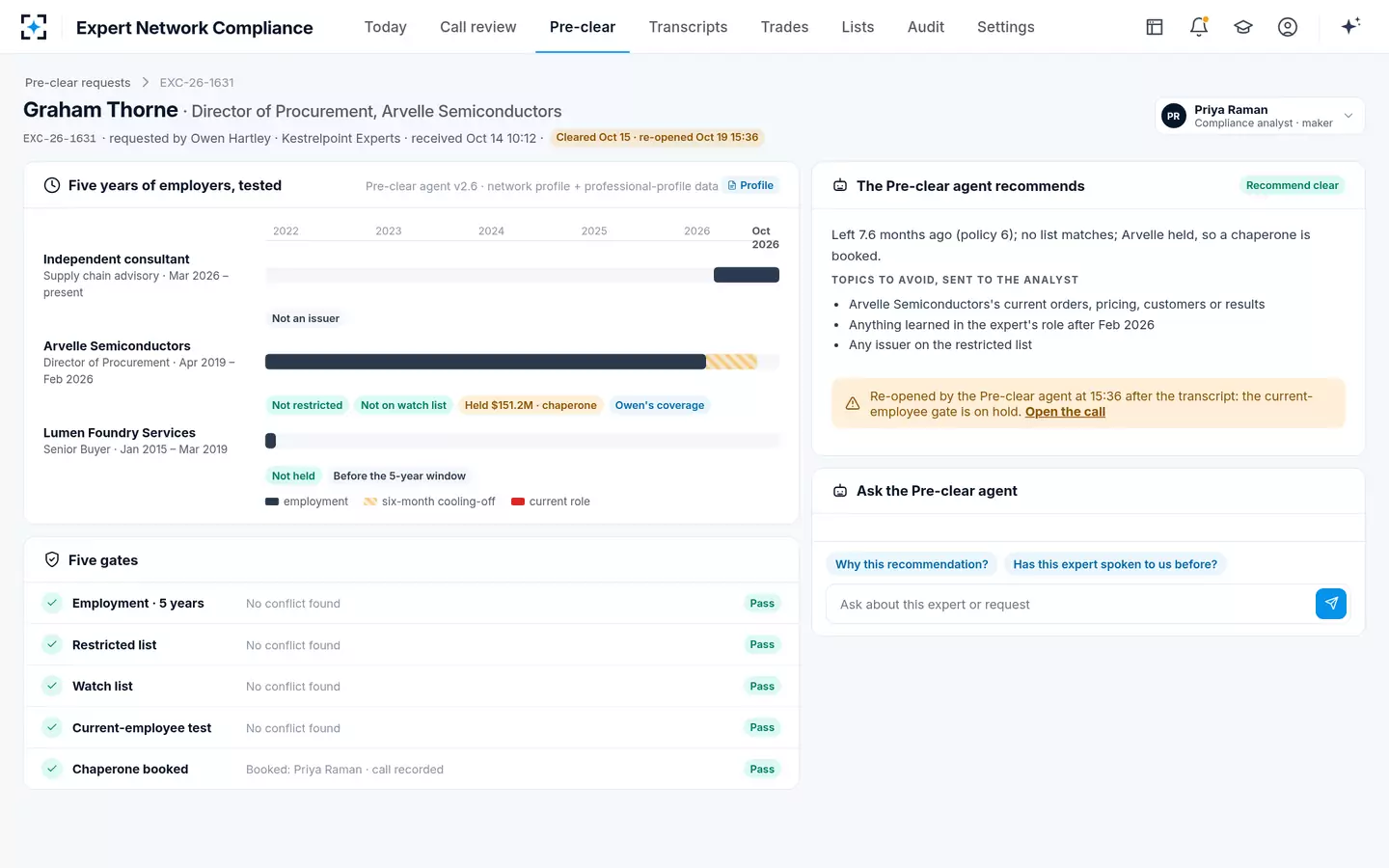
A pre-clearance clause runs when it tests the expert, not just the form. That means the expert's current and recent employers, over a stated lookback, against the restricted list, the watch list and the firm's holdings; a cooling-off period after the expert leaves an issuer; a flat ban on current employees of public companies, or a narrow exception with its own approval; and stricter treatment of former government officials. Each of those is a parameter, and the policy should state its value.
Pre-clearance in Expert Network Compliance: five years of employers, tested against the lists
Should compliance chaperone expert calls?
Compliance should chaperone the calls the policy can name in advance as higher risk, and should not treat chaperoning as a substitute for reading the calls. Nothing in Section 204A, Rule 204A-1 or the SEC's 2022 risk alert mentions chaperones; the alert's expert-network findings are about logging, reviewing notes and reviewing trades. A chaperone is a control during the call: he or she can stop an expert who strays. It is not a review of every call, because one person can attend only so many.
The policy clause that runs names the criteria. The solution's sample policy, for instance, requires a chaperone for a former employee of an issuer within 24 months, for any healthcare expert, and for any issuer the firm holds above $50 million, and records every chaperoned call. Chaperoning, sampling and reading every call are compared on one quarter's calls in a sibling guide.
The review clause: who reads what was said
The review clause is the one most policies under-specify, and it is the one that catches the passage that matters. It should state whether the firm reviews analysts' notes, a transcript or a recording; who reviews; how soon after the call; and what happens to a call under review. The examiners' phrase was review of detailed notes, which sets a floor: a one-line summary written by the analyst is not detailed, and the analyst is not an independent reviewer of his own call. Where calls run on Teams or another recorded platform, the recording itself falls under the firm's Teams compliance recording policy.
Firms that receive transcripts should say so in the policy, and should say what happens when one is missing. A transcript that arrives late, or never, is a gap in the log; a policy that does not track gaps will report full coverage it does not have. How to measure what a transcript review actually catches is the subject of its own guide.
What the policy owes the trading desk: the look-back and the hold
The trading clause connects what was said to what was done. It should define the window, the people and the securities: for how many days after a call, whose trades (the analyst's personal accounts, colleagues on the same team, the funds), and which securities (the issuer discussed and, as the 2022 alert put it, companies in similar industries). It should also say what compliance may do when a staged order follows a call under review, because the order may reach the market before anyone has read the transcript.
The solution's sample call shows the timing problem. The call ended at 14:52; a portfolio manager on the analyst's team staged a sell order in the company at 15:12; the transcript arrived at 15:31. The Trading agent asked compliance to hold the staged order at 15:41, and compliance held it. A trading clause that runs on a monthly report would have found the order weeks after it executed.
Enforcement is the clause examiners test
The SEC has brought Section 204A cases where the charge was the policy, not insider trading. In February 2020 it settled with Cannell Capital, finding that the firm "failed to follow its written policies and procedures" and that its policies were not reasonably designed to prevent misuse of MNPI, for a $150,000 penalty (SEC IA-5441). In December 2023 it settled with OEP Capital Advisors for "failing to maintain and enforce written policies and procedures" reasonably designed to prevent the misuse of MNPI, with a civil penalty of $4,000,000 (SEC IA-6514). Earlier 204A cases against advisers that used political-intelligence consultants or sat in lender groups are set out in the guide to restricted-list compliance.
The lesson for a policy author is that enforcement leaves evidence or it did not happen. A clause that says "compliance will review" is enforced only if the firm can show each review: who, which call, when, and the outcome. Rule 204-2 already requires advisers to keep a copy of the code of ethics in effect, records of any violation and of the action taken, and the access persons' reports (17 CFR 275.204-2(a)(12)–(13)); an expert network policy should ask for the same discipline around calls.
What each expert network policy clause should leave behind for an examiner
| Clause | The evidence | Kept where |
|---|---|---|
| Approved networks | Due-diligence file and signed terms per network, with renewal dates | Compliance files |
| Pre-clearance | Request, checks applied, result, who cleared, timestamp | Pre-clearance log |
| Employment test | Employers over the lookback, matched against restricted list, watch list and holdings | With the clearance |
| Call log | Every call reconciled to network records, with gaps and who confirmed the log | Weekly log |
| Review of the call | Reviewer, transcript or notes reviewed, passages flagged, outcome | With the call |
| Trading look-back | Trades checked by person, security and date, and any hold | With the call |
| Decisions | Restriction, exception or hold, preparer, approver, reason | Decision log |
The mosaic clause: what analysts may still do
A good policy also says what is allowed, so analysts do not route around it. The SEC said in adopting Regulation FD that an issuer may give an analyst a piece of information that is not material on its own, even when that piece lets the analyst finish a "mosaic" that is material as a whole, and that analysts "can provide a valuable service in sifting through and extracting information that would not be significant to the ordinary investor to reach material conclusions" (SEC, Selective Disclosure and Insider Trading, 65 FR 51716, Aug. 24, 2000). Expert calls are one of the ways analysts build that mosaic.
The clause that runs tells analysts which kinds of questions are safe (industry structure, how a supply chain works, how buyers decide) and which are not (a named company's current orders, pricing, results or deals), and asks them to keep their notes so the firm can show where a conclusion came from. The guide to material nonpublic information examples works through where the mosaic ends.
Where Expert Network Compliance runs the policy
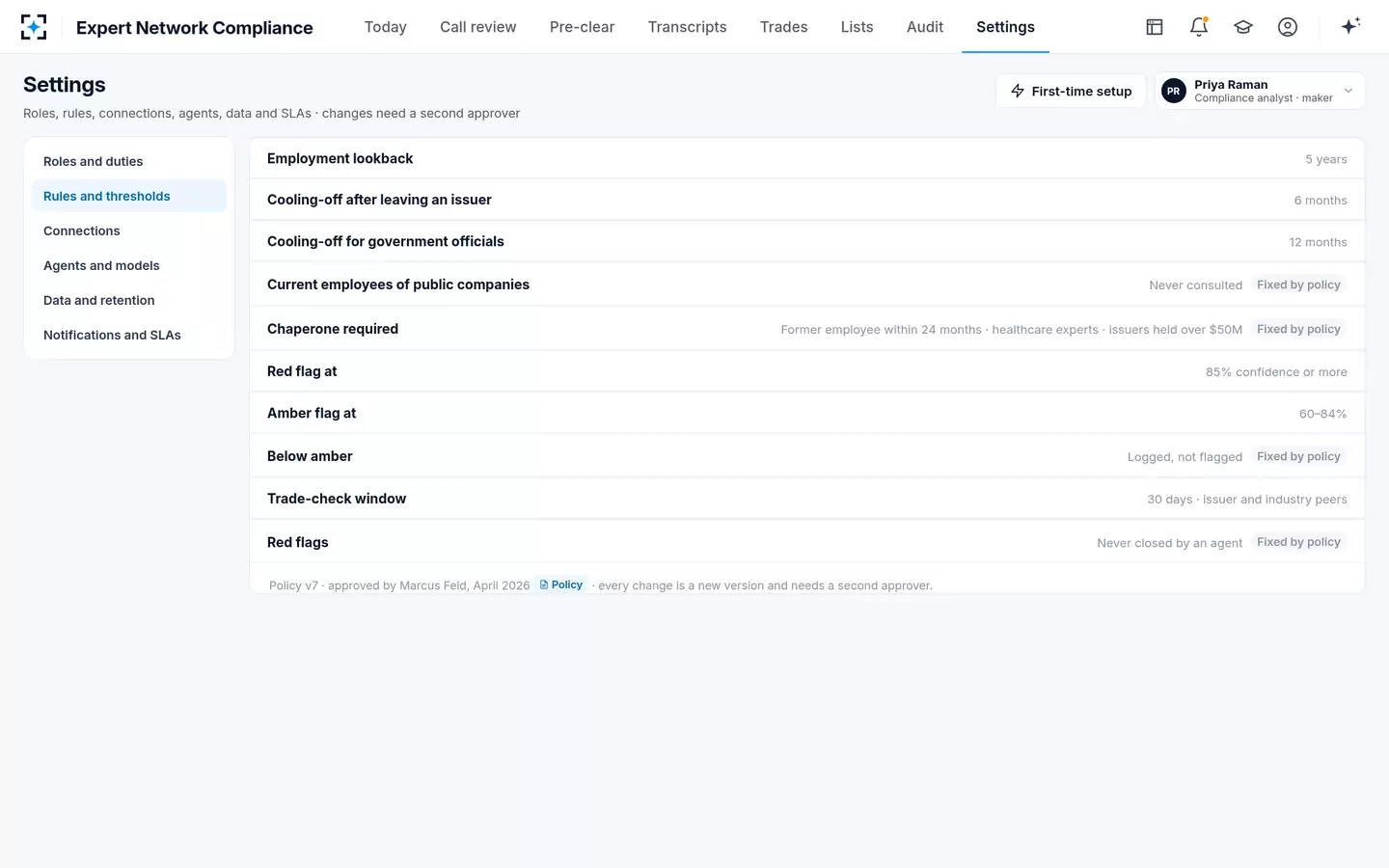
Expert Network Compliance turns the policy's parameters into settings and applies them to every call. The lookback, cooling-off periods, chaperone criteria, flag thresholds and trade window are each a value the chief compliance officer approves; a change becomes a new policy version, live only after a second approver signs. Six agents then do the mechanical running: one takes requests from the network portals, one tests the expert's employers against the lists, one reads every transcript, one tests flagged passages against the public record, one checks trades after the call, and one keeps the evidence.
What the agents do not do is decide. They recommend a clearance, flag a passage or ask for a hold; a compliance analyst clears, holds or prepares a restriction, and the chief compliance officer approves it with a reason. On the sample firm's data, the agents have read 1,512 transcripts in full this year and checked 4,936 trades after calls, and the design target is that every red flag reaches the chief compliance officer within an hour of the transcript.
The policy as settings: every parameter a value, every change a new version
Questions people ask
Is there an SEC expert network regulation?
No rule is written for expert networks. The obligation comes from Section 204A of the Advisers Act, which requires policies reasonably designed to prevent the misuse of MNPI, and from the general antifraud and insider trading law. The SEC's examiners set out what they expect of expert-network controls in their April 2022 risk alert, which is staff guidance rather than a rule.
What is the main expert network compliance risk?
That an expert passes on confidential information from a current or former employer, and the firm trades on it. The risk is highest with recent former employees, consultants who still advise the company, and experts close to a pending result such as a clinical trial. A second risk is regulatory: the SEC has charged advisers under Section 204A because their MNPI policies were inadequate or not enforced, as with OEP Capital's $4,000,000 penalty in 2023.
Does a small adviser need an expert network policy?
Section 204A applies to every adviser, but asks for policies that fit the business. An adviser that never uses expert networks does not need expert-call clauses; one that does needs them however small it is. When it adopted the code of ethics rule in 2004, the SEC noted that 49% of registered advisers reported five or fewer non-clerical employees as of December 2003, which is why many small firms run these clauses by hand (69 FR 41696).
How often should the expert network policy be reviewed?
At least annually, as part of the review of policies and procedures that Rule 206(4)-7 requires of registered advisers, and whenever the firm changes how it uses experts or a network changes its model. A review should test the clauses against evidence, for example by sampling calls and checking that each has a clearance, a review and a trade check.
Can an expert network policy allow calls with current employees?
Some policies forbid them outright; others allow current employees of private companies, or of customers and suppliers, with stricter approval. A current employee of a public company the firm covers or holds is the expert most likely to hold MNPI, which is why the solution's sample policy fixes "never consulted" for that group and lets only the chief compliance officer, with a second approver, grant an exception elsewhere.
Who should approve exceptions to the policy?
Someone other than the person who asked for them. A common design is that a compliance analyst prepares an exception and the chief compliance officer approves it, with a deputy as second approver for the chief compliance officer's own proposals. The SEC's 2022 alert faulted advisers that let the chief compliance officer review his or her own personal trading reports; the same principle applies to exceptions.