A Teams compliance recording policy, in the sense IT uses, is the setting that assigns named users to a compliance recorder so their calls and meetings are captured automatically. In the sense regulators use, it is the written recording policy a firm must keep: in the UK, "an effective recording of telephone conversations and electronic communications policy, set out in writing", identifying what is recorded and what staff do when recording is not possible (FCA Handbook, SYSC 10A.1.15R). The setting can be switched on in an afternoon. The gaps are in the decisions behind it: who is assigned, which call types count, what happens when the recorder fails, and who listens. Botminds' Electronic Communications Surveillance reads Teams chats and recorded calls with the rest of the conversation, and reports a feed that stops, which is how a failure gets noticed.
What should happen when compliance recording fails
Agent
Feed monitorNotices that a recorder or capture feed has stopped or fallen behind, and reports the gap with the time it began.
Never: Never fills a gap with guesses
A person decides
Recording ownerLogs an incident, contacts the vendor and switches staff to the contingency channel set in the policy.
A person decides
Staff on the affected linesUse the contingency channel, or record the conversation in a written note with the order details.
A person decides
ComplianceLists the conversations that went unrecorded, keeps the evidence of the exceptional circumstance, and decides what to follow up.
Never: Does not treat the gap as closed until the record shows it
Agent
SurveillancePauses review clocks on alerts in the affected window and flags alerts whose follow-up call may sit in the gap.
A person decides
Accountable executiveSees the incident, its cause and the remediation in management information, and checks the fix held.
What is a Teams compliance recording policy?
The phrase covers two documents, and confusing them is the commonest gap. The platform policy is configuration: it says which users a recorder captures and, depending on the product, whether a call may continue if the recorder is unavailable. The regulatory policy is a written control: it says which people, conversations and channels the firm must record and why, how long recordings are kept, how the firm checks that recording works, and what happens when it does not.
Two policies with one name
The platform setting: An IT administrator, on request.
The written recording policy: Compliance, approved under the firm’s governance, overseen by the management body.
The platform setting: The users assigned to it, today.
The written recording policy: The roles in scope and the reason for each, with a register of people and approved devices kept up to date.
The platform setting: The call and meeting types the recorder supports.
The written recording policy: Every in-scope conversation and message, internal and external, including those intended to lead to a deal.
The platform setting: Whatever the configuration does.
The written recording policy: A procedure for exceptional circumstances, a contingency channel and evidence kept for the regulator.
The platform setting: A dashboard, if anyone looks.
The written recording policy: Periodic, risk-based monitoring of recordings against orders, and an evaluation whenever a new tool is permitted.
Who must be recorded?
Everyone whose calls and messages relate to in-scope business, and the policy should say who that is by role, with a reason. The AMF called it good practice to set out "the functions of the people whose telephone extensions are recorded, giving reasons for recording for each function", and found one manager slow to apply its own updated procedure: five lines of people likely to speak to clients were registered up to eighteen months later (AMF, September 2026).
The FCA requires a firm to "keep and regularly update a record of those individuals who have firms' devices or privately owned devices that have been approved for use by the firm" (SYSC 10A.1.15R(5)). Reconcile that register with the platform assignment monthly, and on every joiner, leaver and move: a trader who changes desks keeps an account but may drop out of the recorded group. Assign by role, not by name, so a new hire in a recorded role is recorded on their first day.
Which Teams calls, meetings and chats are in scope?
In the UK and EU, calls and electronic communications relating to in-scope activity in financial instruments, on equipment the firm provides or permits, including those intended to lead to a deal and relevant internal ones (SYSC 10A.1.6R, 10A.1.8R and 10A.1.15R). A Teams call from a portfolio manager to the dealing desk with an order is in scope; so is a client meeting on Teams where an order is discussed. If the meeting is in a room instead, the record is a written note with the date, time, place, attendees, who called the meeting and the order details (SYSC 10A.1.16R).
Chats are electronic communications and are kept like email. In the US, broker-dealers keep all business communications, including inter-office ones (17 CFR 240.17a-4(b)(4)); advisers keep written communications about advice, orders, funds and securities and performance (17 CFR 275.204-2(a)(7)). The SEC's recordkeeping rules do not generally require advisers or broker-dealers to record calls, but a firm that records them should decide in its policy how the recordings are kept and reviewed.
Two Teams features need explicit decisions. Meeting chat and channel posts are easy to forget because they sit outside the one-to-one chat users think of as messages. And a feature the firm has not evaluated, a new app inside Teams or a new kind of message, should be off until it is: the FCA expects new communication tools to be approved "before being used by employees to conduct business activities" (FCA, Market Watch 66), and SYSC 10A requires the policy to be re-evaluated "when a new medium of communication is accepted or permitted".
What happens when compliance recording fails?
Recording fails more often, and more quietly, than most policies assume. The AMF found one manager that recorded no lines for more than a year after an incident it identified only afterwards, and another that discovered incoming calls to a manager's line had not been recorded for several years (AMF, September 2026). The FCA's review of eleven banks heard of recording vendors' service outages, data that could not be reconciled to show the right communications had been captured, and delayed or missing data (FCA, August 2025).
The rule assumes failure will happen and asks for a plan. Since October 2025, the UK policy must specify "the procedures to be followed and measures to be adopted" when exceptional circumstances arise and a conversation cannot be recorded on approved devices, and the firm "must retain the evidence of such circumstances and make it accessible to the FCA" (SYSC 10A.1.15R(1)(b)). The banks in the FCA's sample had added contingency plans to record and archive communications when primary systems are down. Only one of the five French managers had put a telephone outage in its business continuity plan.
How recording fails at firms that have a recording policy
13months
with no lines recorded at one manager, July 2022 to August 2023, found only afterwards
47
voice orders left without a recording in that period
1 of 5
managers covered a telephone outage in their continuity plan
2 of 5
played callers a message that the call was recorded
Configuration choices matter here. Some recording set-ups let a call proceed if the recorder cannot join; others block it. Blocking protects the record and stops business; allowing protects business and creates a gap that must be logged and evidenced. Either can be right, but the written policy, not a default, should choose, and the choice should differ by role: a dealer's order line is not a back-office help desk.
Teams compliance recording solutions and partners: what to ask
Most firms record Teams through a third-party recording product, and the regulators are clear that the responsibility stays with the firm. The FCA reminded firms in August 2025 that "regulatory responsibilities in relation to SYSC 10A cannot be transferred to third parties", and reported that one transcription service had been "largely inaccurate" (FCA, August 2025). FINRA's 2026 findings include firms not verifying vendors' ability to meet recordkeeping requirements, and its effective practice is to test them by "simulating a regulator's examinations" (FINRA, 2026 report). Transcript accuracy matters most where the transcript is itself the control, as with paid expert calls; testing an expert call transcript review with seeded MNPI shows how to measure it.
Questions for a Teams compliance recording partner
- What happens to a call when the recorder is unavailable, and can we choose by user group?
Block or allow should be the firm’s decision, per role.
- How do you prove completeness?
A daily reconciliation of calls placed against calls recorded, by user, that the firm can see.
- How fast do you report an outage, and to whom?
The firm needs the start time of every gap to evidence exceptional circumstances.
- How are recordings stored?
Unalterable or with a full audit trail, replayable and copyable, under the retention rule that applies.
- Can our compliance team reach recordings directly?
The AMF faulted firms that had to go through a technical team.
- How are holds and extensions applied?
Five years with an extension to seven in the UK and EU; legal holds override deletion.
- How is erasure at the end of retention controlled and logged?
None of the AMF’s five managers had written the erasure process down.
- How accurate are your transcripts, by language, and how do you measure it?
Reviewers will read transcripts; a weak one hides a risk.
- Will you take part in a simulated regulator request?
Ask for a named person’s calls for a past quarter and time the answer.
The recorder is not the review
Recording keeps the evidence; nobody has reviewed it yet. The UK rule requires the firm to "monitor compliance with the recording and record-keeping requirements" by periodically monitoring the records of orders and transactions, including relevant conversations, "in a proportionate and risk-based manner" (SYSC 10A.1.15R(7)). In the US, FINRA members must review internal communications and correspondence under Rule 3110, and the guide to FINRA's email review rule covers what that review must leave behind.
The simplest monitoring test for a Teams recording set-up is the one the AMF recommends for voice: take a sample of orders, find the conversation behind each, and check that it was recorded and matches. FINRA's 2007 guidance made the equivalent point for blocked tools: a firm that blocks access to unapproved email platforms should periodically test that the block works as intended (FINRA, Regulatory Notice 07-59).
Telling people they are recorded
Clients must be told before the firm provides investment services that calls and communications which result or may result in transactions are recorded, and, since October 2025 in the UK, that a copy will be available on request for five years to them and seven to the FCA (SYSC 10A.1.11R and 10A.1.12AR). Employees must be trained in the recording procedures (10A.1.15R(6)).
The AMF found only two of five managers playing a message warning callers that the conversation was recorded, and one doing so only for incoming calls. It also found a manager whose code of ethics did not refer to the recording procedure. In Europe, recordings carry personal data and must meet data protection law; the AMF notes the French authority's view that systematic recording needs a clear legal obligation behind it, so each recorded role's reason in the policy does double duty.
How Electronic Communications Surveillance reads Teams
Electronic Communications Surveillance reads Teams chat, channel posts and meeting chat alongside the email archive, dealer chat, turret transcripts and mobile capture, so a Teams message is reviewed in the conversation it belongs to. When a chat says "I'll call you", the Off-channel agent searches the recorded lines for the call between the same people inside the window the firm sets, and when there is none, every system it searched is listed for the reviewer.
Every recorded source searched, and what each returned
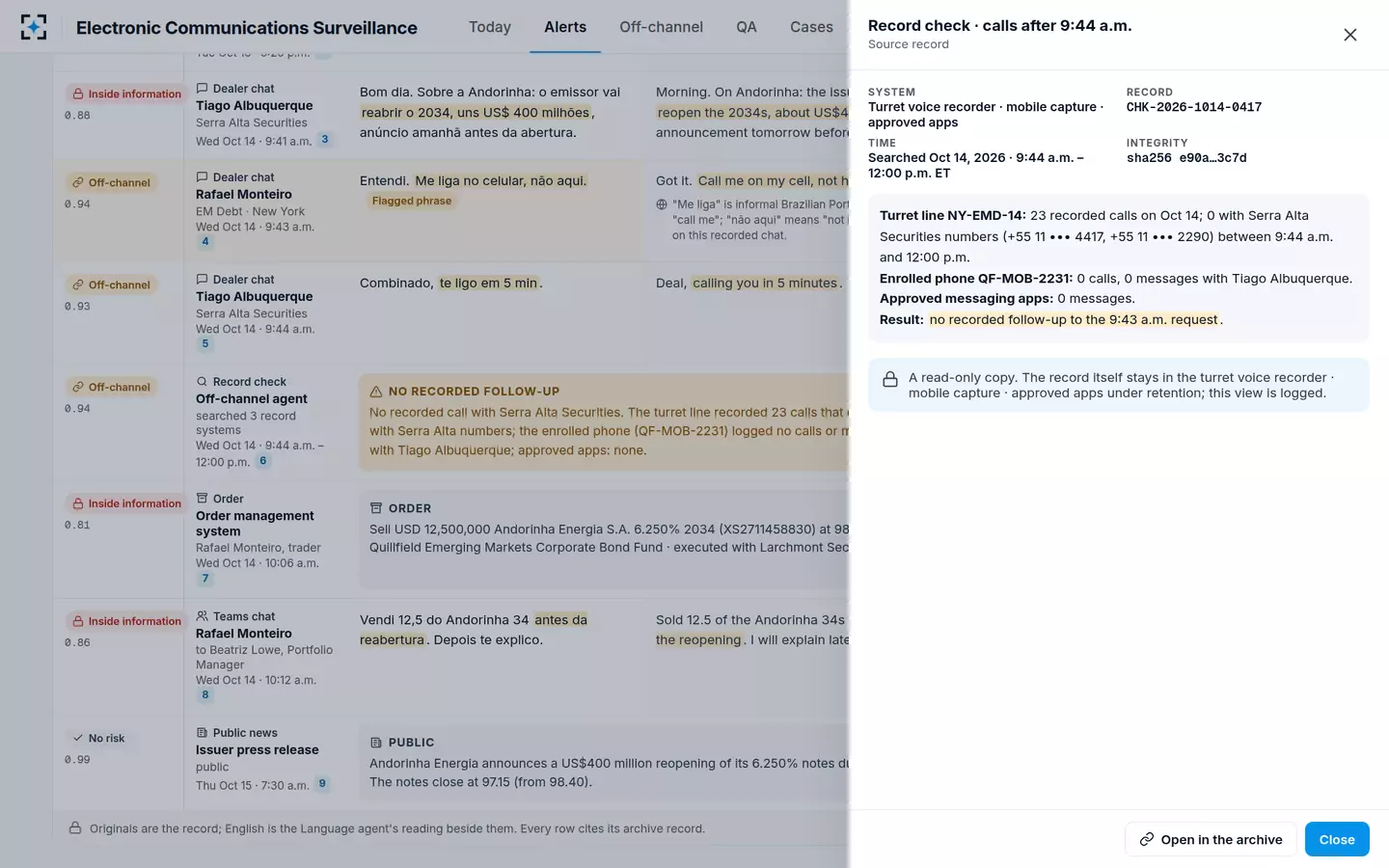
The Capture agent watches each feed and reports a late or broken one rather than filling the gap, and the alerts in the affected window have their review clocks paused instead of silently aging. In the sample firm's September report, the coverage line records one feed delay, the Singapore mobile capture, with its clocks paused and no deadline missed. That line is the management information an accountable executive needs to see a recording failure in the month it happened.
A recording gap in the month's report, not in next year's audit
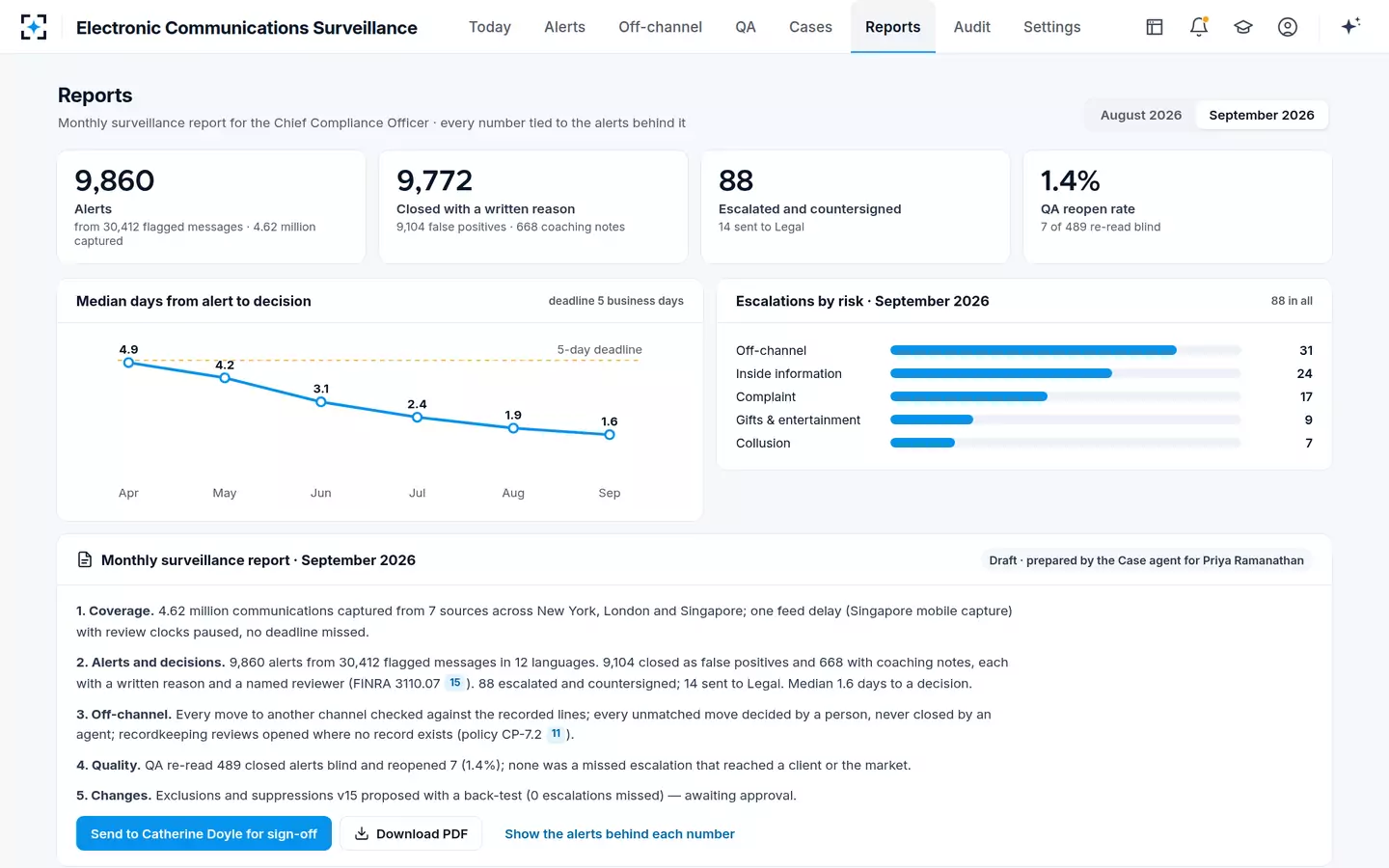
The solution does not record calls; the recording product does, and the firm remains responsible for it. Pairing the two is how the firm shows the FCA, on request, that its "policies, procedures and management oversight" meet the recording rules (SYSC 10A.1.15R(8)). The guide to the FCA's recording rule covers the rest of SYSC 10A.
Questions people ask
Do Teams chats need to be recorded?
Chats are electronic communications, so they are kept rather than recorded. Under the UK and EU rules, in-scope chats, internal ones included, must be kept for five years; in the US, broker-dealers keep business chats for at least three years and advisers keep chats about advice, orders, funds and performance for five.
What is the difference between Teams compliance recording and ordinary meeting recording?
Ordinary recording is started by a participant and can be skipped. Compliance recording is applied by policy to assigned users, without their choosing, so that in-scope conversations are captured whether or not anyone remembers. Only the second meets a duty to record.
Can staff turn off compliance recording?
They should not be able to. The AMF found a manager whose staff could stop recording at the start of a call for personal conversations, and warned that this leaves no proof of an order if the button is pressed.
Who should own the Teams compliance recording policy?
Compliance should own the written policy and IT the configuration that implements it. The FCA requires the management body to have effective oversight of recording policies and procedures, and the AMF found policies approved by a senior manager or committee at all five managers it inspected.
How long must Teams call recordings be kept?
In the UK and EU, five years from creation, up to seven at the regulator's request, where the call is in scope. In the US, keep any recordings the firm makes under the retention period its policy sets for the records they support, and apply legal holds when litigation or an investigation is expected.
Do internal Teams calls between colleagues need recording?
Where they relate to in-scope business, yes: the UK recording policy must identify relevant internal calls and messages. A portfolio manager's order to the dealing desk is in scope; a discussion of holiday cover is not.