MiFID II voice recording requirements oblige an investment firm to record telephone conversations relating to dealing on own account and to receiving, transmitting and executing client orders, including calls intended to lead to such business even if no deal follows, and to keep the recordings for five years, up to seven where the regulator asks (Directive 2014/65/EU, Article 16(7)). At most asset managers the phone is now the exception: only 19% of responding French management companies said in 2025 that they still placed orders by voice (AMF, September 2026). The exception is where recording breaks without anyone noticing, because nobody listens. Botminds' Electronic Communications Surveillance reads recorded calls beside the emails and chats around them, which is the cheapest way to notice that a call that should exist does not.
The AMF inspected five French asset managers' recording systems over 2023 to 2025 and published what it found in September 2026. Its findings are specific enough to be used as a test plan, which is how this guide uses them.
A test plan for MiFID II voice recording, built from the AMF's findings
- Pull a sample of voice orders each quarter and listen to the call behind each one
The AMF lists quarterly listening to a sample of voice orders as good practice; one manager sampled 35 a quarter.
- Reconcile the list of recorded lines with the people in scope
One manager recorded no lines for over a year after an incident; another took up to eighteen months to register five client-facing lines.
- Test incoming calls as well as outgoing
One manager found that incoming calls to a manager’s line had not been recorded for several years.
- Check that mobile users actually call through the recording app
No manager inspected had checked; one survey found five people calling clients without it.
- Remove any button that lets staff stop the recording
A manual stop for personal calls leaves no proof of an order if someone presses it.
- Write the retention period, the extension and the erasure process into one policy
Three managers had not defined a period at all; none had written down how recordings are erased.
- Give compliance direct access to recordings
Going through an IT or telephony team delays investigations and risks partial selection.
- Put a telephone-system outage in the continuity plan
Only one of five managers had.
- Train staff on the recording rules at joining and every year
None of the five provided regular training.
What are the MiFID II voice recording requirements?
The core requirement is Article 16(7) of MiFID II. Records must include telephone conversations and electronic communications relating to, at least, transactions concluded when dealing on own account and client order services: reception, transmission and execution of client orders. They also include conversations intended to result in those transactions or services, "even if those conversations or communications do not result in the conclusion of such transactions" (Article 16(7)).
The firm must take all reasonable steps to record calls made on equipment it provides or permits, and to prevent staff using private equipment it cannot record or copy. It must notify clients once, in advance, that calls are recorded, and it may not take orders by phone from a client who has not been notified. Orders that arrive another way must be captured in a durable medium, and the content of relevant face-to-face conversations may be recorded in written minutes or notes.
The detail sits in Article 76 of the MiFID II delegated regulation, Regulation (EU) 2017/565, which the AMF quotes in its 2026 summary: a written recording policy, a register of people with approved devices, staff training, periodic monitoring of the records, and storage that cannot be altered (AMF, September 2026). In the UK the same content now sits in the FCA's SYSC 10A, set out in the guide to the FCA's recording rule.
Which calls must be recorded under MiFID II?
Calls that relate to or are intended to lead to in-scope orders and deals, made on equipment the firm provides or permits. For an asset manager that usually means three kinds of call: a portfolio manager giving an order to the trading desk, the desk dealing with a broker, and, where the manager provides investment services, a client giving or discussing an order.
The AMF's inspection shows where the line blurs. Investment advice is not named in the French recording provision, but a call about advice that is aimed at leading to a transaction falls inside it, so a manager that both advises and takes orders must record any conversation likely to include both. The AMF expects a risk-based approach that separates the advice calls that must be recorded from those that need not, "justified and formalised" in the policy, with its implementation documented (AMF, September 2026).
For collective management the AMF applied the AIFM and UCITS texts rather than MiFID II, and they differ: in France, recordings for UCITS management are kept between six months and five years, for AIF management at least five years. The AMF called a single five-year period, extendable to seven at the regulator's request, good practice for a manager doing several activities.
Do internal calls need to be recorded under MiFID II?
Yes, where they are relevant. Article 76(1)(a) requires the recording policy to identify the calls and messages subject to recording, "including relevant internal telephone conversations and electronic communications", as the AMF's summary quotes it. The portfolio manager's call to the trading desk with an order is the obvious case, and one of the managers the AMF inspected listened to a sample of 35 such orders every quarter.
That manager's sampling had its own gap. Orders telephoned from the trading desk to the market were not checked, because they were rare and specialised, mostly new bond issues. Rare calls of a specialised kind are exactly the ones a periodic sample misses, which is the argument of this guide in one example.
Phone orders are now the exception at asset managers
The AMF's questionnaire to all French asset managers in summer 2025 found that only 19% still used voice order placement, and that where it is used the channel is marginal in volume and "can, therefore, appear as secondary in control systems" (AMF, September 2026). The five managers it inspected show how small the voice share is, even among firms that still use it.
Voice is a sliver of order flow, even where it is still used
Low volume cuts both ways. It makes listening cheap: a quarterly sample of a few dozen voice orders is a day's work. It also makes failures invisible, because a recording system that captures nothing on a line used ten times a year produces no complaint, no gap in a report and no alert.
Why the exception channel is the riskier one
The AMF's answer is that voice recording is harder to run than electronic trading, where "time-stamping, archiving and audit trail functionalities are natively integrated", and that a rarely used channel gets less attention. Its news release put the conclusion in one line.
The exceptional nature of this channel can contribute to less operational control and an increase in the risk of non-compliance.
AMF, telephone conversation recording at asset management companies (15 September 2026)
The inspection bore that out. One manager recorded no telephone lines at all between July 2022 and August 2023 after an incident it found only afterwards, leaving 47 voice orders without an audit trail; four further recording incidents followed. Another found in August 2025 that incoming calls to one manager's line had not been recorded for several years. A third let staff stop the recording at the start of a call to protect personal conversations.
What the AMF found when it asked for the recordings
19%
of responding French asset managers still placed orders by phone in 2025
47
voice orders with no recording at one manager, after a year with no lines recorded
5 of 15
sampled voice orders with no recording at each of two managers
0 of 5
managers had run controls on whether mobile users called through the recording app
The sample test is the finding that matters most. The AMF picked fifteen voice orders at each manager and asked for the calls. Two could not produce five each. One of them had to ask its brokers for their recordings, because a manager allowed to work from home two days a week had placed orders from an unrecorded mobile, against a rule that he use a landline. That manager's own order-processing controls had not noticed.
MiFID II record keeping requirements: how long, and from when?
Five years from the date the recording is made, extendable to seven at the competent authority's request, in a durable medium that allows replay or copying but not alteration or deletion. Article 76(11) of the delegated regulation fixes the start: "The period of time for the retention of a record shall begin on the date when the record is created", as the AMF's summary quotes it.
The start date creates a trap the AMF raised with one manager. A client can give a stop order by phone with no expiry, and it may rest for years before it executes. If the recording is erased five years after the call, the evidence of the instruction can be gone before, or soon after, the trade it authorised. The AMF expects managers to adjust their systems for such cases.
The retention clock starts at the call, not at the trade
- Recording kept5 y
- Standard period5 y
- Extension on request+2 y
- Recording kept while the order rests5 y
- Order still live, recording erased1 y
Erasure is part of retention. The AMF found that none of the five managers had written down how recordings are erased at the end of the period, though three had tools that did it automatically, and two kept ten years of history against a five-year policy. Recordings hold personal data, so keeping them too long is a data protection problem, and the French data protection authority, the CNIL, accepts systematic recording only where a legal obligation clearly requires it.
The policy: one document, every line justified
Article 76(1) requires "an effective recording of telephone conversations and electronic communications policy, set out in writing", identifying the calls and messages to be recorded and the procedure for exceptional circumstances when a call cannot be recorded on approved devices. The AMF's poor practice was "not collating all the provisions applicable to the telephone conversation recording system into a single policy": one manager's rules had been spread across order placement, data retention, the IT charter and the code of ethics until October 2025.
The AMF's good practice is to list, in the policy, the functions whose extensions are recorded and the reason for each. That turns the policy into something a compliance officer can test against the phone system's configuration, line by line, and it answers the data protection question at the same time: each recorded line has a stated purpose. One manager's policy still said voice orders were prohibited months after the prohibition had been lifted in practice.
Recording is not monitoring: listening is the control
Article 76(6) requires firms to "periodically monitor the records of transactions and orders subject to these requirements, including relevant conversations", on a risk-based and proportionate basis. That is the duty the exception channel most often fails, because a control that waits for a reason to listen never listens. One manager told the AMF that its compliance officer needed a triggering event before listening to calls; it had tested the existence of voice recordings once in three years.
The sample is cheap and the reasons to run it are plain. Pick voice orders at random from the order system, find the call behind each, and check that it exists, that it is complete and that it matches the order: instrument, size, price, time. Each missing or mismatched recording is an incident with an owner. In the UK the FCA's August 2025 review found recording vendors with outages and data that could not be reconciled, which a sample of this kind catches early (FCA, August 2025).
A blind sample that reopens what it disagrees with
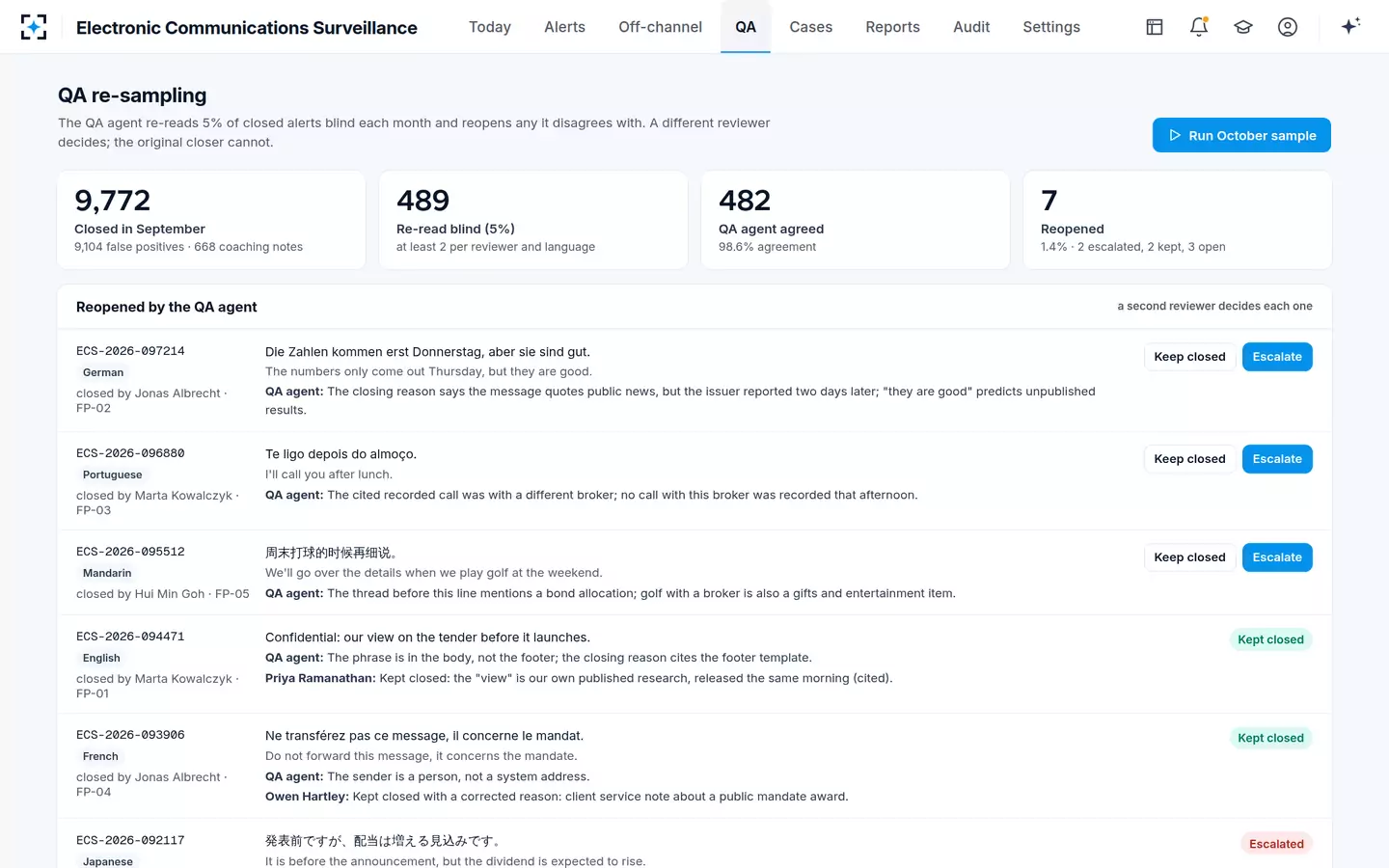
How Electronic Communications Surveillance handles voice
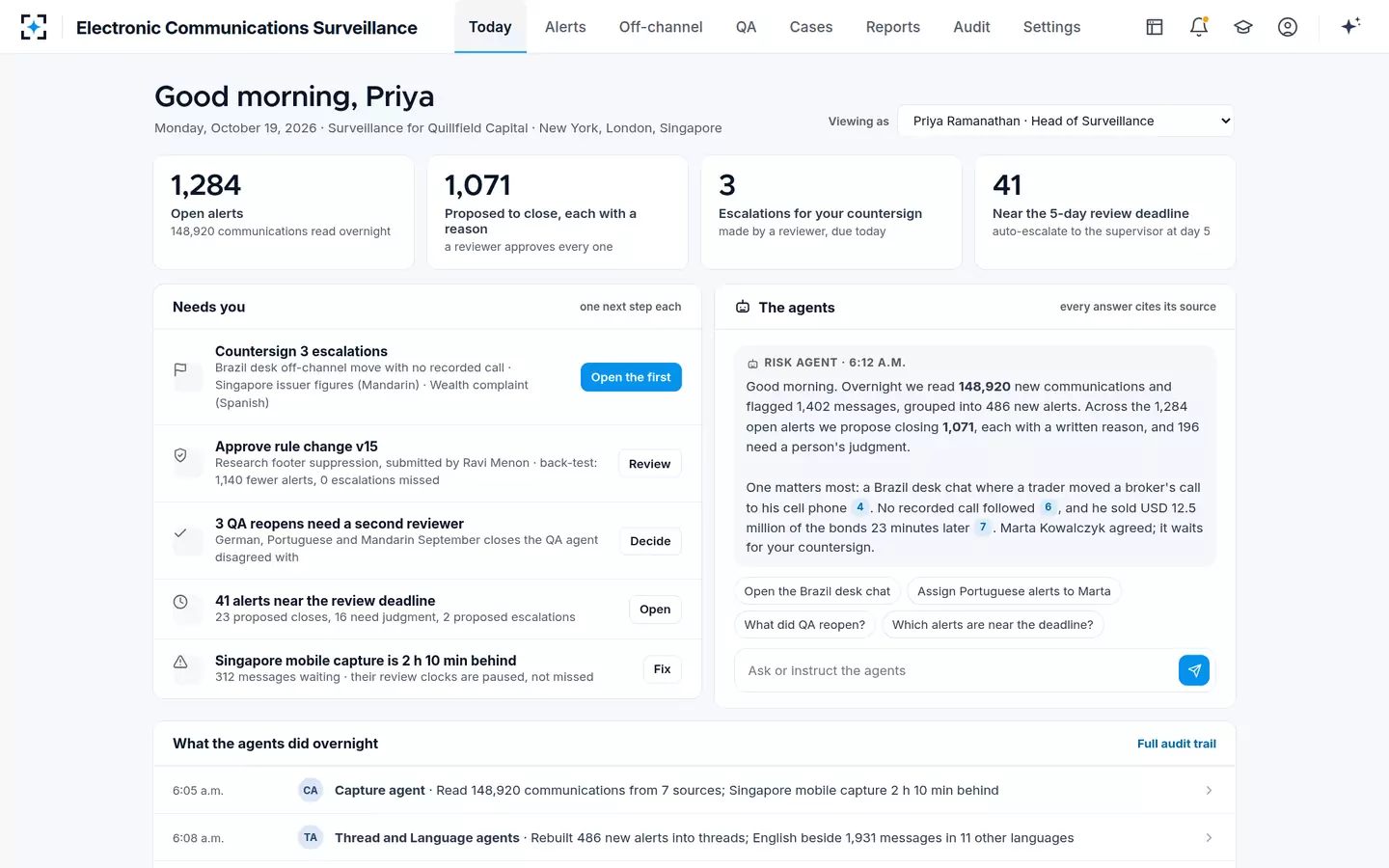
Electronic Communications Surveillance reads the turret voice recorder's transcripts and mobile call recordings alongside email, dealer chat and Teams, so a call is part of the conversation it belongs to rather than a file in another system. When a chat says "I'll call you", its Off-channel agent looks for the recorded call between the same people within the window the firm sets; when the call is missing, the alert goes to a person with every system searched listed.
It also watches the feeds. Its Capture agent reports a late or broken feed rather than filling it, and pauses the review clocks on the affected alerts until the data arrives. In the sample firm on the morning shown below, the Singapore mobile capture was 2 hours 10 minutes behind, with 312 messages waiting.
A late recording feed, reported and its clocks paused
What it does not do is record calls. Recording is the job of the turret, the telephony platform or the mobile capture provider, and the regulatory responsibility stays with the firm whichever vendor it uses. The solution makes the recordings that exist useful, and makes the ones that should exist and do not visible. A day around those alerts is described in a communications surveillance analyst's day.
Questions people ask
How long must call recordings be kept under MiFID II?
Five years from the date the recording is created, and up to seven years where the competent authority asks, under Article 16(7) of MiFID II and Article 76 of Regulation (EU) 2017/565. Clients must be able to get a copy on request during that period.
Does MiFID II require recording of mobile phone calls?
Yes, on any equipment the firm provides or permits for in-scope business, and the firm must take reasonable steps to stop staff using private phones it cannot record. All five managers the AMF inspected recorded mobiles through an app linked to their phone system, and none had checked that staff used it.
Do asset managers have to record calls under MiFID II?
Where they provide MiFID investment services, such as portfolio management for clients or order reception and transmission, yes. For collective management the AIFM and UCITS rules apply instead; the AMF treats a single five-year period, extendable to seven, as good practice across all of a manager's activities.
Can clients ask for their call recordings?
Yes. Article 16(7) requires that records be provided to the client involved on request, and clients must be told before the service begins that a copy will be available. The AMF recommends a register of access requests made by the employees who were recorded as well.
Is a written note enough instead of a recording?
For face-to-face conversations, yes: the content may be recorded in written minutes or notes. For phone calls, a note replaces a recording only in narrow cases, such as the UK's optional exemption firms serving mainly retail clients under SYSC 10A.1.9R, and the note must carry the date, time, participants and order details.
How often should compliance listen to recorded calls?
MiFID II requires periodic, risk-based monitoring without fixing a frequency. The AMF named a quarterly sample of voice orders as good practice, and faulted a manager whose compliance officer listened only after a triggering event.