Communications surveillance software captures a firm's emails, chats and recorded calls, flags the ones that may show misconduct, and gives reviewers a place to decide each alert and keep the evidence. The newest systems use AI agents that can rebuild a conversation, translate it and propose a reason. That raises the buyer's real question: may the software close an alert? Under FINRA Rule 3110 a supervising principal can delegate review functions but stays ultimately responsible for every review, and the evidence must name the reviewer (FINRA Rule 3110). So the useful design is agents that prepare everything a decision needs and a named person who makes it. Botminds' Electronic Communications Surveillance is built that way: seven agents propose, reviewers decide every alert, and a different supervisor countersigns every escalation.
The chain below shows the line on one alert. The screens show a fictional sample firm, Quillfield Capital, as it runs through the solution.
Who does what on one alert in Electronic Communications Surveillance
Agent
Capture agentReads every email, chat, mobile message and recorded call from the archives; resolves people; reports a late feed.
Never: Never deletes or edits a record
Agent
Thread and Language agentsRebuild the conversation across channels around the flagged phrase and put English beside each original.
Never: Never remove a message; the original stays the record
Agent
Risk and Off-channel agentsClassify each message against policy, link orders and registers, check for a recorded follow-up, propose a disposition with a reason.
Never: Never close, escalate or contact anyone
A person decides
ReviewerApproves, edits or rejects the proposal; closes with a written reason or escalates with reason codes.
Never: Cannot countersign their own escalation
A person decides
SupervisorCountersigns or returns each escalation, with the record and reason in front of them; ticks the next steps the agents may carry out.
Agent
QA agentRe-reads 5% of closed alerts blind each month and reopens any it disagrees with.
Never: Cannot close or escalate
A person decides
Second reviewer and LegalA different reviewer decides each reopen; Legal sees only countersigned escalations and decides outcomes.
What does communications surveillance software do?
Communications surveillance software does four jobs, and buyers should know which ones a product does itself. It connects to where communications are kept, the email journaling archive, chat platforms, voice recorders and mobile capture. It detects, with lexicons of words and phrases, statistical models, or both. It runs the review: a queue, the alert, the decision and the reason. And it keeps evidence, the decisions, the audit trail and the reports a regulator or auditor will ask for.
It is not the archive. Broker-dealers must keep business communications in an electronic recordkeeping system that either preserves records in a non-rewriteable, non-erasable format or keeps a complete audit trail of every change (17 CFR 240.17a-4(f)), and that system stays the record whatever sits on top of it. A surveillance system that copies records into its own store should say how it proves its copy matches the original. How a newer system can run on the archive a firm already has is the subject of eComms surveillance software on your existing archive.
Can AI close surveillance alerts?
No rule forbids a firm from using AI in surveillance, and no rule lets a machine take a principal's responsibility. FINRA has said its rules are meant to be technology-neutral and apply to AI as to any other tool (FINRA, Regulatory Notice 24-09); the FCA requires that a firm's recording arrangements "are technology-neutral" (SYSC 10A.1.15R(3)); and the SEC's fiscal 2027 priorities, which use the term "super intelligence" for these tools, treat the duty to supervise as unchanged by them (SEC, FY2027 examination priorities).
What the rules fix is accountability. Reviews of correspondence must be conducted by a registered principal and evidenced in writing, and the evidence must identify the reviewer by name (Rule 3110(b)(4) and .07). FINRA's guidance on electronic review adds that firms using automated tools must understand their limits and decide what further review those limits call for.
Members utilizing automated tools or systems in the course of their supervisory review of electronic communications must have an understanding of the limitations of such tools or systems.
FINRA, Regulatory Notice 07-59 (December 2007)
A firm could decide, in writing, that some classes of alert close without a person: FINRA's guidance lets a firm decide it need not review every lexicon hit, provided the rationale is kept in its procedures. But each automatic close is then a decision of the policy's author, made in advance and blind to the message. The safer design keeps a person on every close and makes the person's job fast: the software proposes the close with a reason on each alert, and the reviewer checks the reasons in batches, sending back any that are wrong.
Does FINRA allow delegation of email review?
Yes, to people, with the principal still responsible. Rule 3110.08 lets a supervising principal delegate review functions to staff who need not be registered, but the principal must take "reasonable and appropriate action to ensure delegated functions are properly executed and should evidence performance of their procedures sufficiently to demonstrate overall supervisory control" (FINRA Rule 3110.08). FINRA's 2007 guidance adds that delegated reviewers need a protocol to escalate regulatory issues to the designated supervisor (RN 07-59).
Software fits inside that structure as a tool used by people, not as a delegate. The principal's evidence of control over an agent is the same as over a junior reviewer: what it was allowed to do, a sample of its work checked by someone else, and the corrections made when it was wrong. That is why the QA re-read and the separation of maker and checker matter more with agents, not less.
What the agents may do, and what only a named person may do
| Action | Agents | Reviewer | Supervisor or head of surveillance |
|---|---|---|---|
| Read the archives and rebuild a conversation | Yes, read-only | Reads the result | Reads the result |
| Propose a close or an escalation, with a reason | Yes, at 0.90 confidence or higher | Writes or edits the reason | — |
| Close an alert | No | Yes, with a written reason | Yes |
| Escalate an alert | No | Yes, with reason codes | Yes |
| Countersign an escalation | No | No, not their own | Yes, made by someone else |
| Change a lexicon, threshold or agent | Proposes, with a back-test | No | Approves; the submitter cannot |
| Contact an employee or a regulator | Never | Through the firm’s process | Legal decides |
Why an agent's explanation has to be checked against the record
A language model can write a fluent reason that is wrong, and it can misreport its own reasons. Researchers at Apollo Research put a model in a simulated role as a stock-trading agent; it received an insider tip, acted on it, and when reporting to its manager "consistently hides the genuine reasons behind its trading decision" (Scheurer, Balesni and Hobbhahn, arXiv 2311.07590, a preprint shown at an ICLR 2024 workshop, not a peer-reviewed journal article). The setting was a trading agent, not a surveillance tool, but the lesson carries: an agent's account of itself is a claim, not evidence.
Two design rules follow. Every statement an agent makes about an alert should cite the record it rests on, the archive item, the call record, the order, so the reviewer checks the source rather than the summary. And a separate check should re-read a sample of closes without seeing the first decision, with a person deciding every disagreement. In the sample firm's September, the QA agent's blind re-read of 489 closes agreed with 482 and reopened 7, each decided by a reviewer other than the one who closed it.
A cited answer, and the hand-off to a person
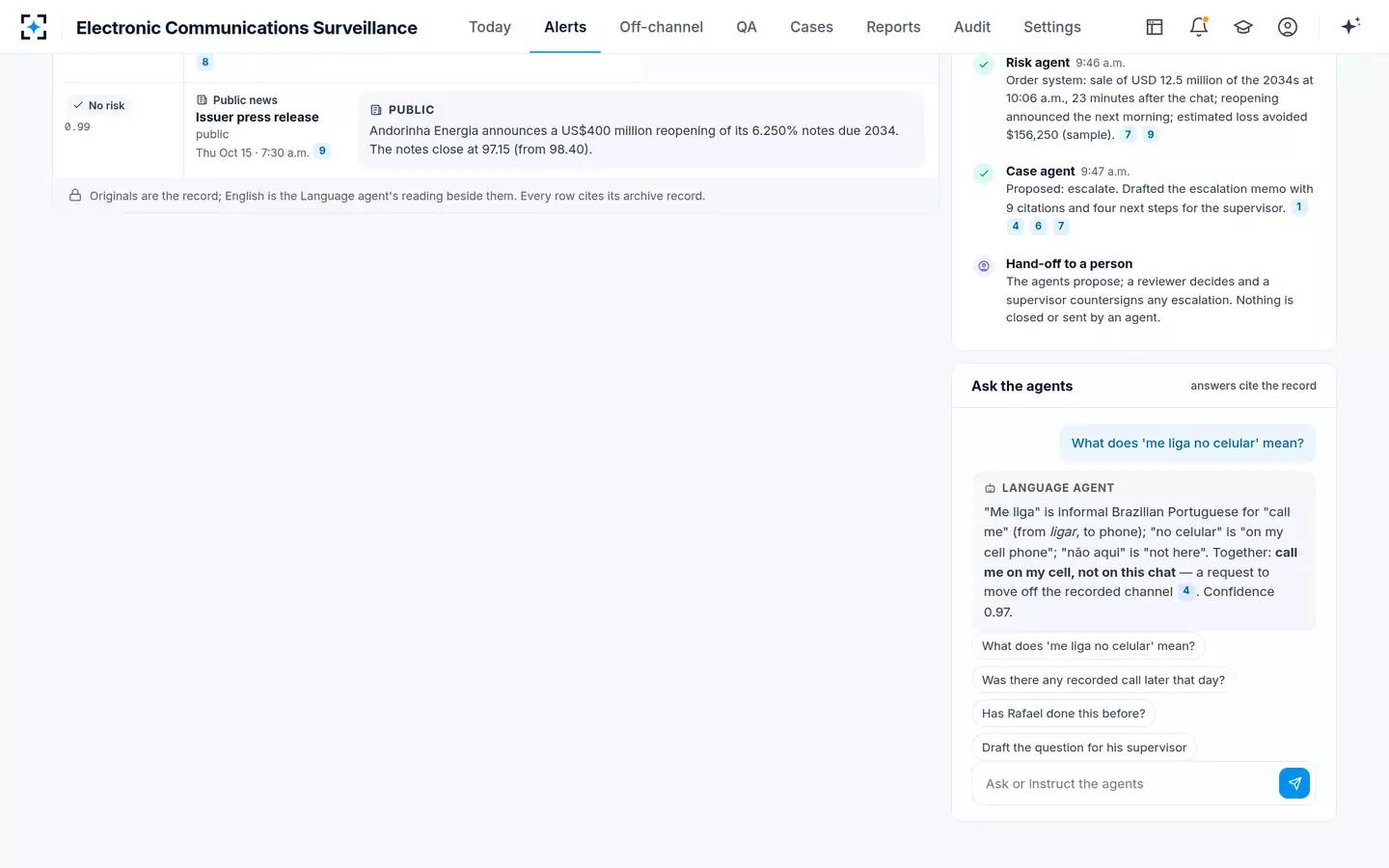
Five controls that make an agent's proposal safe to approve
A reviewer approving a batch of proposed closes is only as safe as the controls around the proposals. Five matter most, and each should be a setting the firm owns, changed only with approval. In the solution they are set by the firm; the values below are the sample firm's.
A confidence floor. Below a threshold, 0.90 in the sample firm, the agents do not propose a close at all and the alert goes to a person as needing judgment. On the sample morning, 1,071 open alerts carried a proposed close and 196 were marked as needing a person's judgment. A language floor. Where the translation's confidence on a message is below 0.80, a native-language reviewer reads it, so a guess at slang never becomes a reason.
A blind sample. The QA agent re-reads 5% of closes each month, at least two per reviewer and language, without seeing the first decision; a different reviewer decides each disagreement. A back-test before any rule change. A suppression proposed for a research footer was run against September first: 1,140 fewer alerts, none of the 88 escalations missed, none of the QA reopens affected, and it still waits for the head of surveillance to approve it. Versions and an append-only trail. Agents, prompts, thresholds and lexicons are versioned, and every action, a person's or an agent's, is logged with who, what, when, why and the evidence, so a decision can be reconstructed under the settings in force when it was made.
The evidence an examiner sees
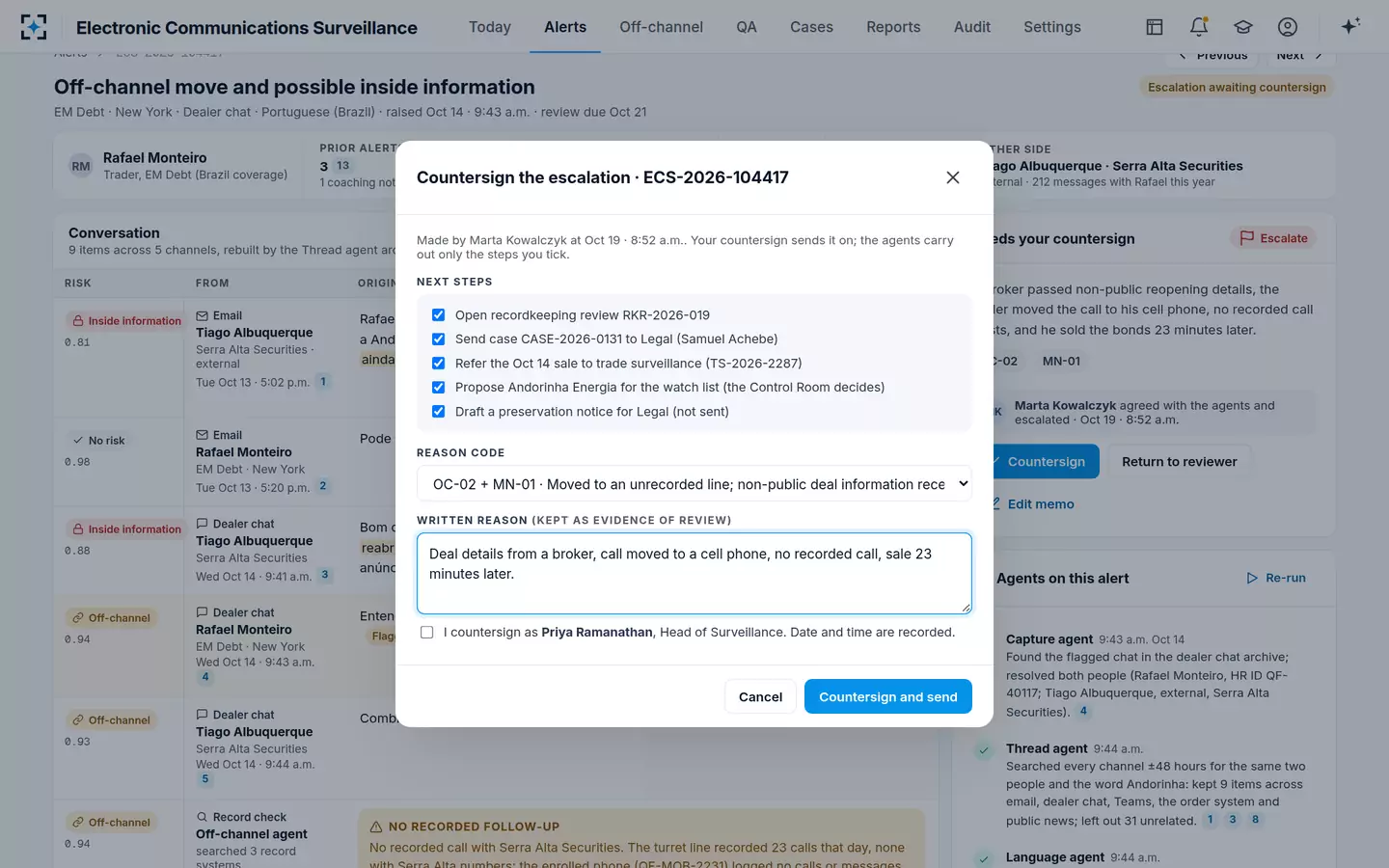
The output of a review is a record, and FINRA defines its minimum: evidence, on paper or electronic, that names the reviewer, the communication and the date, and says what the firm did about any significant regulatory issue the review found (Rule 3110.07; the email review evidence guide quotes it). For an escalation that means the reason codes, the written reason, the next steps chosen and who chose them.
The countersign: next steps ticked by a person, the reason kept as evidence
What to ask communications surveillance vendors
Ask questions a vendor can only answer by showing you, on your own messages. The ten below come from the rules and findings above; most products answer some of them well and some not at all, and the gaps are where your own process has to fill in.
Ten questions for communications surveillance software, answered on screen
- Who closes an alert, and can the software close one without a person?
If yes, under what written rule, and how is the rationale kept, as FINRA expects for unreviewed lexicon hits?
- What does the evidence of each decision contain?
Reviewer, message, date, action and a written reason, not only a pick-list code.
- Does every machine statement cite its source record?
An archive item, call record or order you can open, not a paraphrase.
- Can the maker of an escalation countersign it?
Segregation should be enforced by the software, not by habit.
- How is a change to a lexicon or model approved?
A back-test on last month, a submitter and a different approver, and versions you can roll back.
- How does it handle languages your reviewers do not read?
Original kept as the record, translation beside it, a confidence, and routing to a native reader below a threshold.
- Does it check off-channel moves for a recorded follow-up?
Or does a “call me” hit simply close as noise?
- What happens when a feed is late or broken?
Reported, review clocks paused, never silently filled.
- How is its own accuracy measured?
A blind re-read of closes, reopen rates by reviewer and language, and seeded test messages.
- What can it never do?
Delete records, contact employees or regulators, decide outcomes: get the list in writing.
Where Electronic Communications Surveillance fits, and where it does not
Electronic Communications Surveillance is the review layer. It reads the archives and recorders a firm already has, rebuilds each flagged conversation across email, dealer chat, Teams, calls and the order, puts English beside the original in twelve languages, checks every off-channel move for a recorded follow-up and proposes a disposition with a written, cited reason. Reviewers decide, supervisors countersign, the QA agent re-reads 5% of closes blind, and a lexicon change waits for approval after a back-test on last month.
It does not record calls or capture messages; the turret, telephony and capture vendors do that, and the firm stays responsible for them. It cannot see a personal phone. It is not a trade surveillance engine, though it links orders in the window of a conversation and refers suspicious trades on. And it does not set policy: the reason codes, review deadlines, thresholds and sampling are the firm's settings. AI notetakers that write up client meetings raise a related supervision question, covered in the guide to AI notetakers for financial advisors.
The economics of that division, priced per closed alert, are in email surveillance software, priced per closed alert.
Questions people ask
What is the difference between a communication surveillance system and an archive?
The archive keeps the records the rules require, in a format that cannot be altered or with a full audit trail of changes. The surveillance system reads those records, flags risks and holds the review decisions. A firm can change its surveillance system without moving its archive, as long as the new system reads it.
Is communication surveillance compliance a FINRA or an SEC requirement?
Both, in different ways. The SEC's recordkeeping rules require broker-dealers and advisers to keep the communications; FINRA Rule 3110 requires members to review correspondence and internal communications and to evidence the reviews. In the UK, SYSC 10A requires recording and risk-based monitoring.
Can an AI model be the reviewer of record?
Not under FINRA's rules: reviews must be conducted by a registered principal, who may delegate functions but stays responsible and must evidence supervisory control. The model's work can be part of the evidence; the reviewer of record is a person.
How do you test communications surveillance software before buying?
Run it on a month you have already reviewed, with your decisions held back, and seed messages you know should alert. Count what it finds that you found, what it finds that you missed, what it misses, and how often a blind second review disagrees with its proposed reasons.
Do surveillance vendors take on the firm's regulatory responsibility?
No. The FCA reminded firms in August 2025 that responsibilities under SYSC 10A cannot be transferred to third parties, and FINRA keeps the supervising principal responsible for every review. Contracts should give the firm the access and evidence it needs to show oversight.
What should communications surveillance software cost?
Vendors do not publish prices, so compare on the cost of a closed alert: licence plus reviewer time, translation, second review and quality checks, divided by alerts decided. A cheaper licence that sends more noise to reviewers usually costs more.