The SEC's access person definition sits in Rule 204A-1 under the Advisers Act. An access person is any supervised person of the adviser who has access to nonpublic information about any client's purchase or sale of securities or about the holdings of any reportable fund, or who is involved in making securities recommendations to clients or has access to recommendations that are nonpublic; if advice is the adviser's primary business, all its directors, officers and partners are presumed to be access persons. Access persons are the people the code of ethics watches: they report holdings and trades, and need approval before buying into an IPO or a limited offering. The SEC's examiners keep finding advisers whose list of access persons is wrong, and a wrong list makes every downstream control wrong with it. Botminds' Expert Network Compliance uses the list to decide whose trades to check after each expert call, which is why this guide ends with how to rebuild it.
Is this person an access person? The Rule 204A-1 test, step by step
A person decides
1. Supervised person?Employees, officers, partners, directors and others who give advice on the adviser's behalf under its supervision. If not, the person is not an access person under the rule.
A person decides
2. Nonpublic client trades or fund holdings?Can the person see nonpublic information about any client's purchases or sales, or a reportable fund's portfolio holdings? If yes: access person.
A person decides
3. Recommendations?Is the person involved in making securities recommendations to clients, or able to see recommendations that are nonpublic? If yes: access person.
A person decides
4. Director, officer or partner?If giving advice is the firm's primary business, every director, officer and partner is presumed to be an access person.
Agent
Check against system accessCompare the answers with who can actually open the order management system, the research system and the holdings files.
Never: Removes anyone from the list; compliance decides
What is an access person under the SEC rule?
An access person is a supervised person whose role gives them a view of what the adviser is about to do for clients. The rule's words are precise: an access person is any supervised person "Who has access to nonpublic information regarding any clients' purchase or sale of securities, or nonpublic information regarding the portfolio holdings of any reportable fund", or "Who is involved in making securities recommendations to clients, or who has access to such recommendations that are nonpublic"; and "If providing investment advice is your primary business, all of your directors, officers and partners are presumed to be access persons" (17 CFR 275.204A-1(e)(1)).
The reason is front-running and its cousins (how a manager tests for front running covers the trade side). Someone who knows the firm will buy a stock tomorrow, or that an analyst is about to upgrade it, could trade first. The code of ethics makes those people report and, for the riskiest purchases, ask first. A supervised person, the wider group, is described in the SEC's 2022 risk alert as employees, officers, partners, directors and other persons who provide advice on the adviser's behalf and are subject to its supervision and control (SEC risk alert, April 26, 2022).
Who is considered an access person?
Portfolio managers, research analysts and traders almost always are. Beyond them, the answer depends on what each person can see, not on their title. The SEC said so plainly when it adopted the rule in 2004: access persons include portfolio management staff and, in some firms, client service representatives who communicate advice, and support staff can be access persons too.
"Administrative, technical, and clerical personnel may also be access persons if their functions or duties give them access to nonpublic information. Organizations in which employees have broad responsibilities, and where information barriers are few, may see a larger percentage of their staff subject to the reporting requirements."
SEC, Investment Adviser Codes of Ethics, 69 FR 41696 (July 9, 2004)
The same release added the corollary: firms "that keep strict controls on sensitive information may have fewer access persons". The definition rewards information barriers. A firm whose order management system is open to everyone has made everyone an access person, whether or not its list says so.
Who is considered an access person: roles judged by what they can see
Today
Sees and places client orders; makes recommendations.
With agents
Access person under both limbs of the definition.
Still theirs: Reports, pre-approval, trade checks after expert calls
Today
Makes recommendations, some nonpublic until published internally.
With agents
Access person under the recommendations limb.
Still theirs: The same, plus any expert calls he or she takes
Today
Sees client orders before execution.
With agents
Access person under the client-trades limb.
Still theirs: Reports and pre-approval
Today
May see trades and fund holdings before they are public.
With agents
Access person if the systems show nonpublic trades or holdings.
Still theirs: Depends on entitlements, not title
Today
Can open any system, including the order management system.
With agents
Often an access person by access, rarely listed as one.
Still theirs: Review entitlements with the list
Today
Communicates advice to clients, sometimes before it is acted on.
With agents
Access person in some firms, as the SEC noted in 2004.
Still theirs: Depends on what they see and when
Today
May never see a trade.
With agents
Presumed an access person if advice is the primary business.
Still theirs: Reports and pre-approval regardless
Access person definition under SEC Rule 17j-1: the fund version
Registered funds and their advisers also have Rule 17j-1 under the Investment Company Act, which uses its own vocabulary. There, an access person is any "Advisory Person" of the fund or its adviser, meaning someone who, in their regular duties, "makes, participates in, or obtains information regarding, the purchase or sale of Covered Securities by a Fund", plus the same presumption for directors, officers and general partners where advising funds or clients is the adviser's primary business (17 CFR 270.17j-1(a)). Under 17j-1, IPO and limited-offering pre-approval applies to "Investment Personnel", a narrower group who make or participate in making recommendations for the fund.
Access person definition: Rule 204A-1 next to Rule 17j-1
| Rule 204A-1 (advisers) | Rule 17j-1 (funds and their advisers) | |
|---|---|---|
| Who | Supervised persons with nonpublic access to client trades or reportable fund holdings, or involved in or with access to nonpublic recommendations | Advisory persons who make, participate in or obtain information about the fund's purchases or sales of covered securities, or whose functions relate to recommendations |
| Presumption | All directors, officers and partners, if advice is the primary business | All directors, officers and general partners of the adviser, if advising funds or other clients is its primary business; all of a fund's |
| Securities covered | "Reportable security", with listed exceptions | "Covered security", with listed exceptions |
| IPO and limited-offering approval | Every access person | Investment personnel |
What is a reportable security?
A reportable security is any security under the Advisers Act's definition except the short list Rule 204A-1 carves out: direct obligations of the U.S. government; bankers' acceptances, bank certificates of deposit, commercial paper and high-quality short-term debt, including repurchase agreements; shares of money market funds; shares of open-end funds other than reportable funds; and units of unit investment trusts invested only in open-end funds that are not reportable funds (17 CFR 275.204A-1(e)(10)).
Two consequences catch people out. Shares of mutual funds the adviser itself manages or sub-advises are reportable, because they are reportable funds; the SEC said in 2004 that this was designed to help identify abusive trading by staff with access to a fund's portfolio information. And private placements are reportable, which the SEC's 2022 alert found some access persons leaving out of their reports.
What an access person has to do
An access person submits a holdings report within 10 days of becoming one, with information no more than 45 days old, and again at least every 12 months; submits transaction reports within 30 days after each calendar quarter, unless the adviser already receives broker confirmations or statements in that time; and obtains the adviser's approval before acquiring beneficial ownership in any IPO or limited offering (17 CFR 275.204A-1(b)–(c)). Beneficial ownership is read as under Section 16, and the SEC's 2004 release said an access person is presumed to beneficially own securities held by immediate family members sharing the household. The six measures of a code of ethics show how to tell whether those duties are met.
What examiners found: lists that were wrong
The SEC's examiners put the access person list first among their code of ethics findings in the April 2022 risk alert. Staff "observed advisers that did not identify and supervise certain employees as access persons in accordance with the Code of Ethics Rule", and "also observed adviser codes that did not define “access person” or accurately reflect which employees are considered access persons" (SEC risk alert, April 26, 2022). Every other control in the code runs off that list: whose reports are chased, whose trades are pre-cleared, whose purchases of IPOs need approval.
Rule 204-2 makes the list itself a required record: an adviser must keep "a record of the names of persons who are currently, or within the past five years were, access persons of the investment adviser" (17 CFR 275.204-2(a)(13)(ii)). An examiner can therefore ask who was on the list on a given date, and compare it with who could see the order management system that day.
Rebuild the access person list from system access, not job titles
The usual list is built from the organisation chart: investment staff in, everyone else out. It goes wrong in predictable ways. People change roles and nobody updates it; contractors and administrators have system access their titles do not suggest; a new research platform opens recommendations to people who never saw them before. The fix is to build the list from the systems, the way the definition is written.
Rebuilding the access person list: six checks
- Pull system entitlements
Everyone who can open the order management system, the trade blotter, fund holdings files or the research and recommendation system.
- Match against the list
Each entitled person who is not an access person is either removed from the system or added to the list, with a reason.
- Add the presumed
Every director, officer and partner where advice is the primary business, whatever their access.
- Catch role changes
A move into an investment role starts the 10-day clock for an initial holdings report; trigger it from the HR change, not from the next annual review.
- Record each decision
Who was added or excluded, when, why and by whom, so the list on any past date can be shown.
- Repeat on a schedule
At least quarterly, and whenever a system is added or its access changes.
The most senior people are not exempt from any of this. In June 2026 the SEC found that an adviser's chief executive had personally traded an ETF held in a model portfolio the firm recommended, without pre-clearing as the firm's policies required, and that the firm had failed to enforce its code of ethics on pre-clearance; the firm agreed to a $1,200,000 civil penalty (SEC, File No. 3-22647). The compliance officer's role includes applying the code to the people who hired them.
Expert calls and the access person list
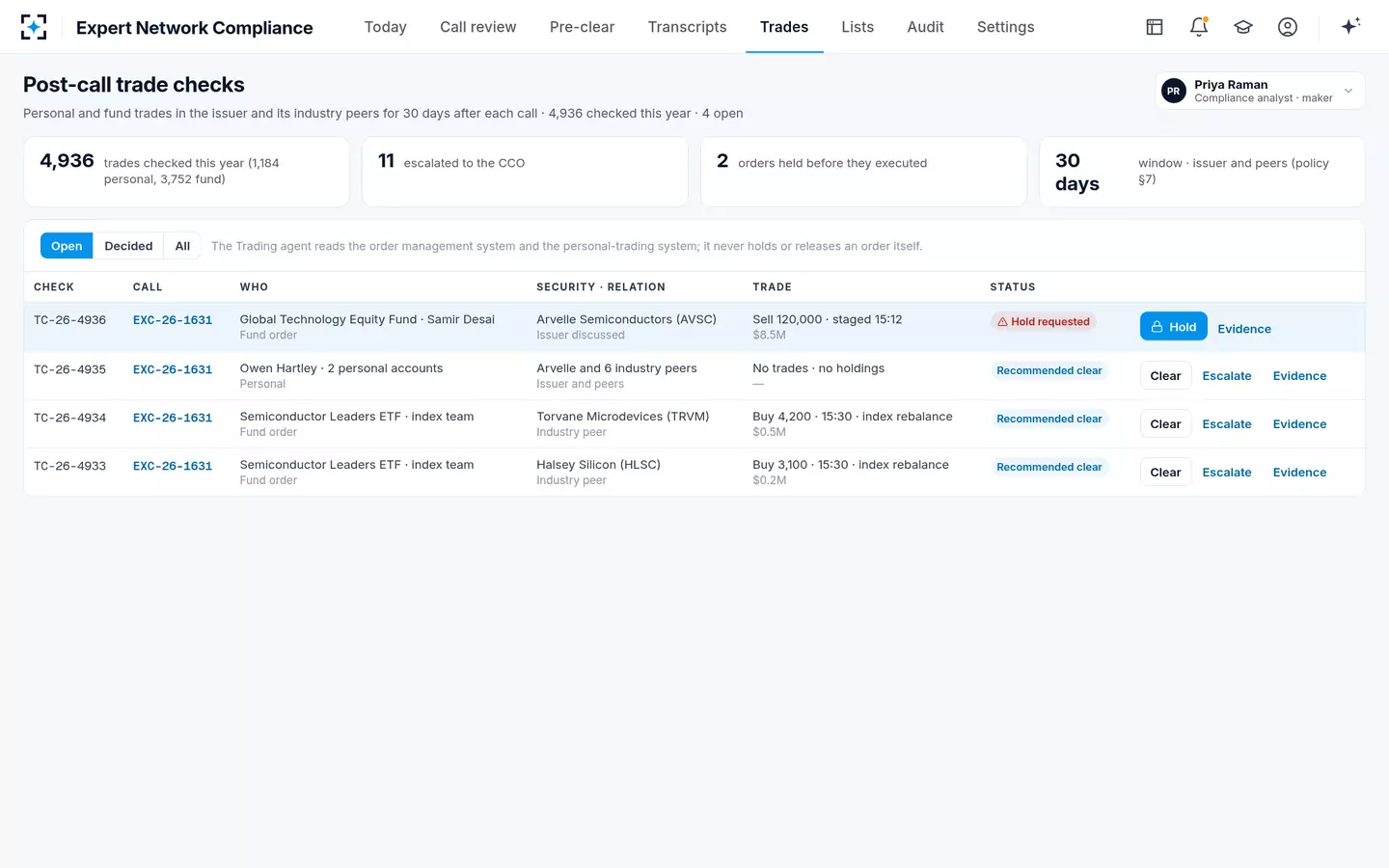
An analyst who takes an expert call is almost always an access person already, because analysts make recommendations. The harder question is who else the call reaches. In the solution's fictional sample data, the analyst who took a call that produced a red flag had no trades in the company; a portfolio manager on the same team staged a sell order in it twenty minutes after the call. The portfolio manager was an access person under the client-trades limb, and his fund order was the trade that mattered, which is why the solution checks colleagues' and funds' trades, not only the caller's.
Behind the information barrier: what an access person sees when a call is under review
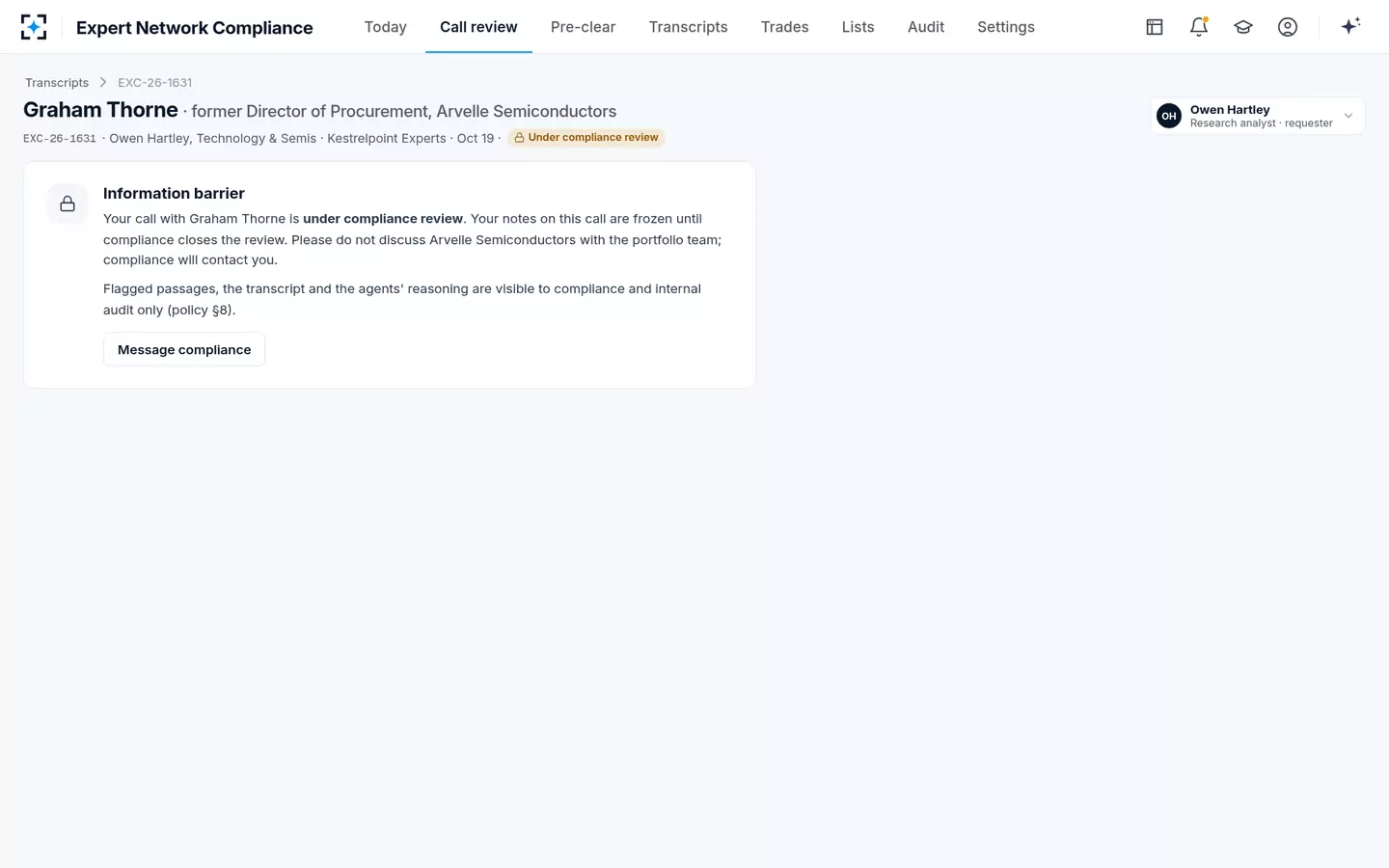
Where Expert Network Compliance uses the access person list
Expert Network Compliance does not decide who is an access person; the firm's code and its chief compliance officer do. It uses the list. After every expert call, the Trading agent checks personal trades by access persons, as the policy allows, and fund orders in the issuer discussed and its industry peers for 30 days at the sample firm's setting. A person missing from the list is a person whose trades nobody checks, so the list's accuracy is a precondition of the trade check, not a detail. On the sample firm's data the agent checked 4,936 trades after calls this year, 1,184 of them personal.
Post-call trade checks in Expert Network Compliance: access persons' accounts and fund orders
Questions people ask
What does access person mean in plain terms?
Someone at an investment adviser who can see what the firm is about to do for clients, or what it is about to recommend, before the market knows. Because they could trade ahead of clients, the code of ethics requires them to report their holdings and trades and to get approval before buying IPOs or private placements.
What is the difference between a supervised person and an access person?
Supervised persons are the wider group: employees, officers, partners, directors and others who give advice for the adviser under its supervision. All must receive and acknowledge the code of ethics. Access persons are the supervised persons with nonpublic access to client trades, fund holdings or recommendations, plus presumed directors, officers and partners; only they have the reporting and pre-approval duties.
Are contractors and interns access persons?
They can be. The question is whether they are supervised persons of the adviser and whether their role gives them nonpublic access to client trades, reportable fund holdings or recommendations. The SEC's 2004 release noted that persons who are not supervised persons are not access persons, so the contract and the system access both matter.
Do all employees have to file personal trading reports?
Only access persons must under Rule 204A-1. The SEC's 2004 release noted that some firms elect to require reports from all personnel, which "offers certainty as to whether reports are required from a given individual", at the cost of more reports to review.
How long must the access person list be kept?
Rule 204-2(a)(13)(ii) requires a record of the names of everyone who is, or within the past five years was, an access person. Keeping the dated history of additions and removals, with reasons, lets the firm show who was on the list on any date an examiner asks about.
Are family members' accounts part of an access person's reports?
Usually. Reports cover securities in which the access person has direct or indirect beneficial ownership, and the SEC's 2004 release said an access person is presumed to beneficially own securities held by immediate family members sharing the household. Accounts over which the access person has no direct or indirect influence or control are excepted.