Insider trading compliance software helps an investment firm prevent and detect the misuse of material nonpublic information (MNPI): it keeps restricted and watch lists, pre-clears personal trades, collects holdings and transaction reports under the code of ethics, and reviews trades for signs of insider trading. For an adviser that uses expert networks, the weak point is elsewhere. The SEC's examiners found advisers with no call log, no review of what was said on the calls and no check of the trading that followed, and compliance systems built around lists and reports were not designed to read a transcript. Botminds' Expert Network Compliance is insider trading compliance software built for that gap: six agents pre-clear each call, read every transcript in its own language, test each flagged passage against the public record and check the trades that follow, while a compliance analyst and the chief compliance officer make every decision.
This page opens the agent that does the reading, the Transcript agent, and the agents around it. The calls and figures from the solution are its fictional sample data at an adviser called Quillfield Capital; the rules are linked where they appear.
Expert Network Compliance: six agents around the transcript, and what each may never do
Agent
Intake agentTakes call requests from the network portals and email, links each to the analyst's coverage and the firm's holdings, checks the expert's attestation is signed.
Never: Books a call or edits a submitted request
Agent
Pre-clear agentTests five years of the expert's employers against the restricted list, watch list, holdings and coverage; applies current-employee, cooling-off and government-official rules; re-opens a clearance when new evidence arrives.
Never: Clears or declines a call
Agent
Transcript agentReads every transcript in full in its original language, with English beside it, and marks possible MNPI with the quote, the reasons and a confidence.
Never: Closes a red flag, or shows flags to analysts
Agent
Disclosure agentTests each flagged passage against filings, releases, earnings calls and news in any language, and downgrades only with a dated public source.
Never: Downgrades without a source
Agent
Trading agentChecks personal trades and fund orders in the issuer and its industry peers for 30 days after the call; asks compliance to hold a staged order linked to a flagged call.
Never: Holds, cancels or releases an order
A person decides
Compliance analystDecides every flag, clears or holds, and prepares any restriction.
A person decides
Chief compliance officerApproves each restriction with a reason; a deputy holds the second key on the CCO's own proposals.
Agent
Evidence agentKeeps the audit trail, reconciles the weekly call logs and assembles what an examiner asks for.
Never: Edits a record or sends anything outside the firm
What does an insider trading compliance program need software to do?
An insider trading compliance program needs software for the steps that are repetitive, frequent and evidence-heavy: matching names against lists, collecting reports, comparing trades with events, and keeping the record of every decision. The law sets the outcomes. Section 204A makes every adviser keep, and enforce, written policies that are reasonably designed to stop MNPI being misused (15 U.S.C. 80b-4a). Rule 204A-1 requires a code of ethics under which access persons report holdings and transactions, which the adviser must review, and obtain approval before buying into IPOs and limited offerings (17 CFR 275.204A-1). Broker-dealers have their own duty under FINRA Rule 3110(d) to review trades in specified accounts with a process "reasonably designed to identify trades that may violate" the insider trading rules, and to "conduct promptly an internal investigation into any such trade" (FINRA Rule 3110).
Software for these duties is not new. When the SEC adopted the code of ethics rule in 2004, it noted that "Some advisers have begun using compliance software to pre-clear personal trades on an automated basis, rather than have compliance personnel process the requests" (69 FR 41696, July 9, 2004). What is new is software that can read language: notes, transcripts and messages, where expert-call MNPI actually appears.
The three gaps the SEC found are all about joining things up
The Division of Examinations' April 2022 risk alert listed three expert-network controls advisers lacked: a record of every call, a review of what was said, and a look at staff trading in the industries the calls covered (SEC risk alert, April 26, 2022). The Investment Research guide to expert network compliance quotes them. Each is a join between two systems that rarely talk: the network portal and the call log, the transcript and the reviewer, the call and the order management and personal-trading systems.
Traditional insider trading compliance tools cover the lists and the personal-trading reports well. They usually do not see the call at all. A watch list entry exists only if someone put the company on it, and nobody puts a company on the watch list because of a sentence nobody read.
Insider trading compliance at the sample firm this year, with every call read
1,512
expert call transcripts read in full, every call held, not a sample
11
languages the calls were held in, each read in the original with English beside it
4,936
personal and fund trades checked after calls, in the issuer and its peers
1hour
design target from transcript to the CCO for every red flag
Inside the transcript agent: what it reads and why it flags
The Transcript agent reads each transcript from first line to last, in the language the call was held in, with an English rendering beside it. It is not a keyword list. For every passage it judges five things: is it specific (a number, a date, a named customer), recent, from a company source speaking as an insider, not public, and material to the issuer? A passage that meets them is marked in the margin with the quote, its timestamp, the reasons and a confidence. At the sample firm's settings a passage is red at 85% confidence or more and amber from 60% to 84%; below 60% it is logged, not flagged, so a reviewer can still find it.
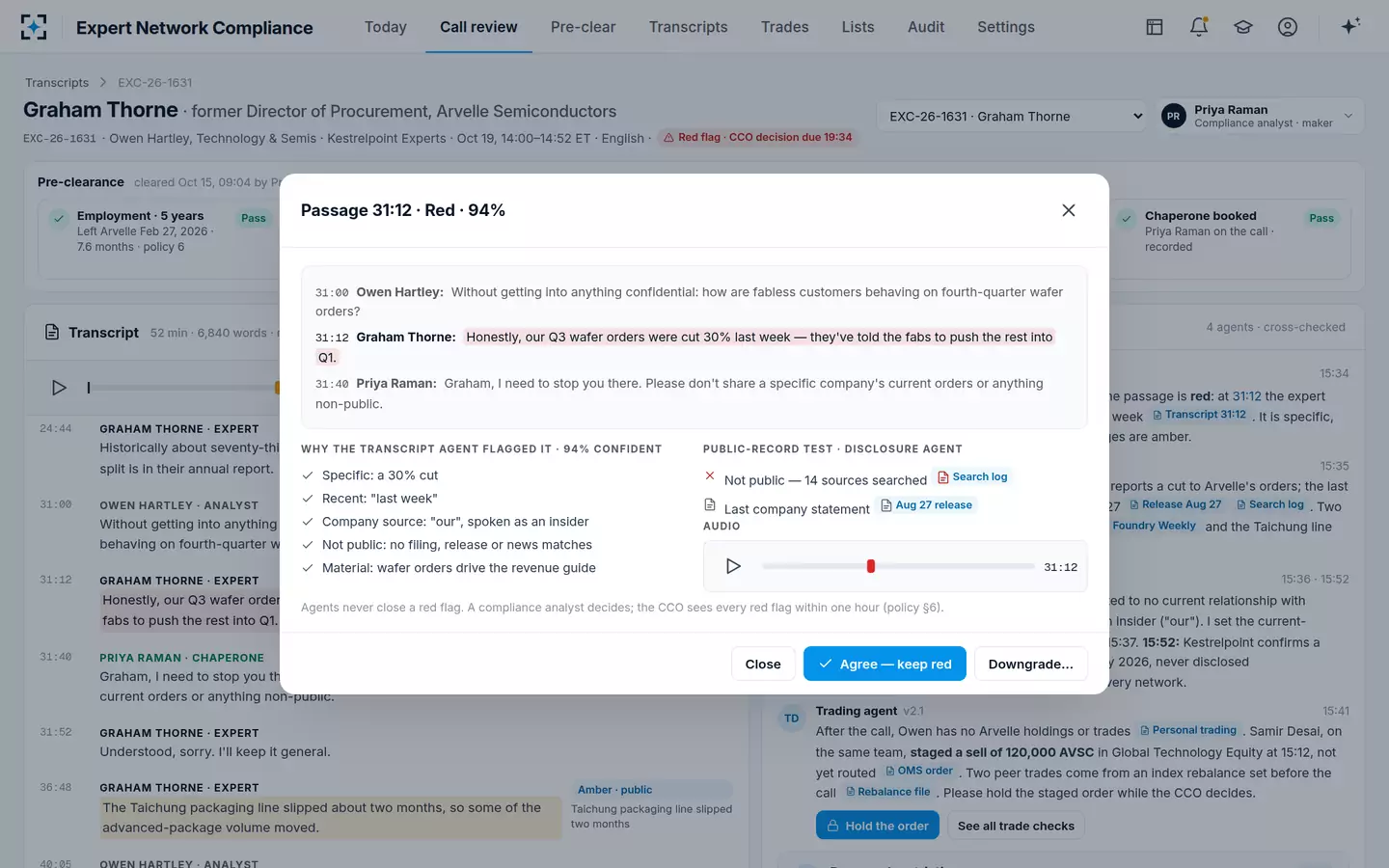
In the sample call, a former procurement director said, 31 minutes in: "Honestly, our Q3 wafer orders were cut 30% last week." The agent flagged it red at 94%, giving each reason: a 30% cut is specific; "last week" is recent; "our" is a company source speaking as an insider; no filing, release or news matched; and wafer orders drive the issuer's revenue guidance. The Disclosure agent searched 14 public sources and found the company's last statement was an August 27 release reaffirming guidance. Two amber passages in the same call were shown public: one in trade press, one in the company's own 10-Q.
A red flag in Expert Network Compliance: the passage, the reasons and the public-record test
What the transcript agent may not do
The limits matter as much as the reading. The Transcript agent never closes a red flag, and red flags can never be closed in bulk. It never shows flagged passages, the transcript or its reasoning to analysts or portfolio managers: they see only that a call is under review and what to do. The Disclosure agent cannot downgrade a flag without a dated public source, and a red flag it cannot match stays red. The Trading agent reads the order management system and the personal-trading system but never holds, cancels or releases an order; it asks compliance to. And no agent clears, declines or restricts anything.
Those limits are the answer to the governance question every chief compliance officer asks of an AI system: who is accountable for the decision? The regulators' answer is that the existing rules still apply. FINRA told member firms in 2024 that its rules are meant to be technologically neutral and apply to generative AI as to any other tool (FINRA Regulatory Notice 24-09), and the SEC's examination priorities for fiscal 2027 which call these tools super intelligence (SI), test firms that use them for surveillance against duties that do not change with the tool (SEC Division of Examinations, FY2027 priorities). A design that keeps every decision with a named person fits both.
Joining the words to the trades
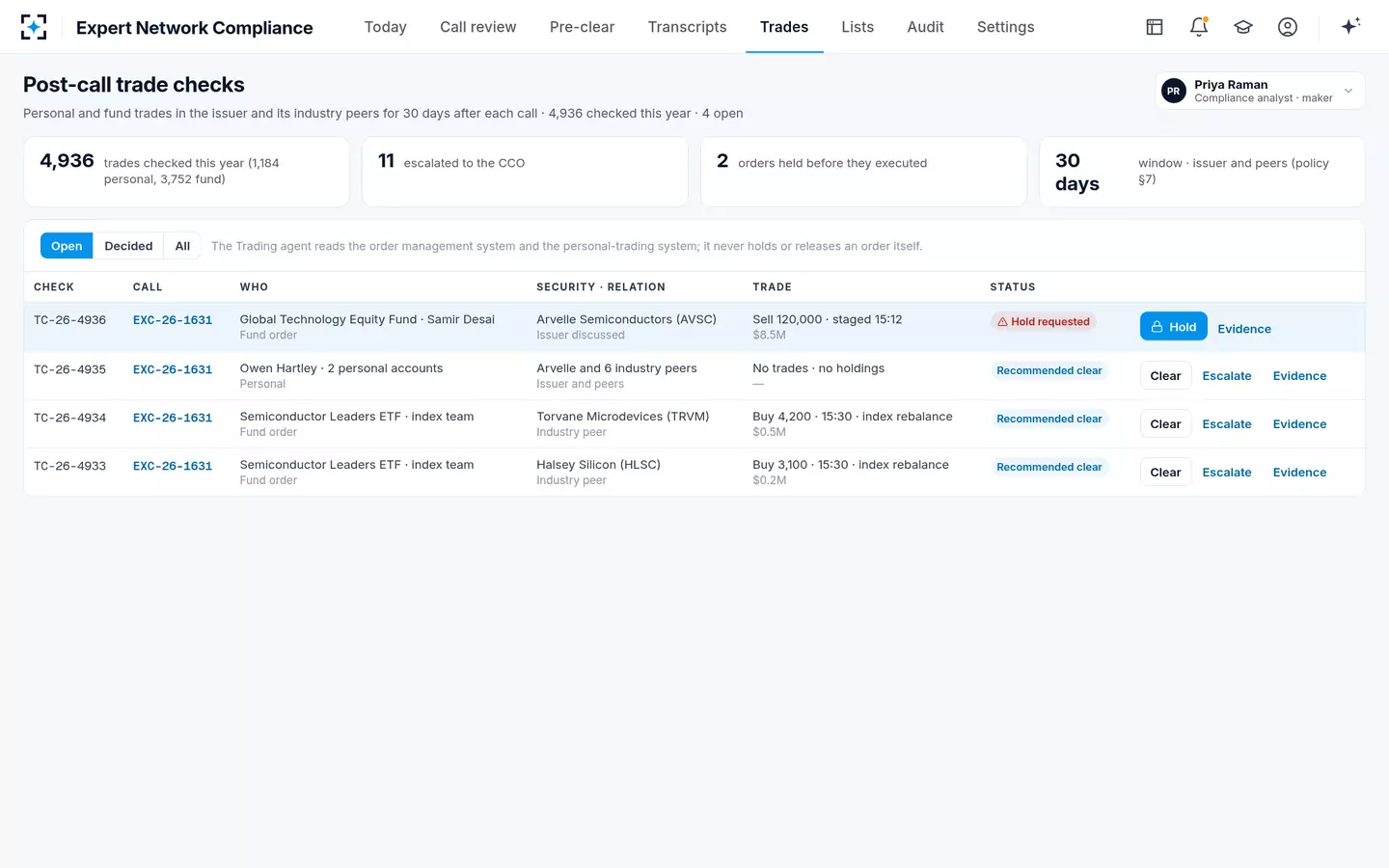
The Trading agent closes the third gap. From the end of each call it checks the analyst's personal accounts, colleagues' accounts where the policy allows, and every fund order in the issuer discussed and its industry peers, for 30 days at the sample firm's setting. A trade in a peer is not suspicious by itself: in the sample call two peer trades came from an index fund's scheduled rebalance and were recommended clear with the rebalance file attached. A staged sell of 120,000 shares of the issuer, placed by a portfolio manager on the analyst's team twenty minutes after the call and not yet routed, was not; the agent asked compliance to hold it, and compliance did.
Post-call trade checks: personal and fund trades in the issuer and its peers
Agents that check each other
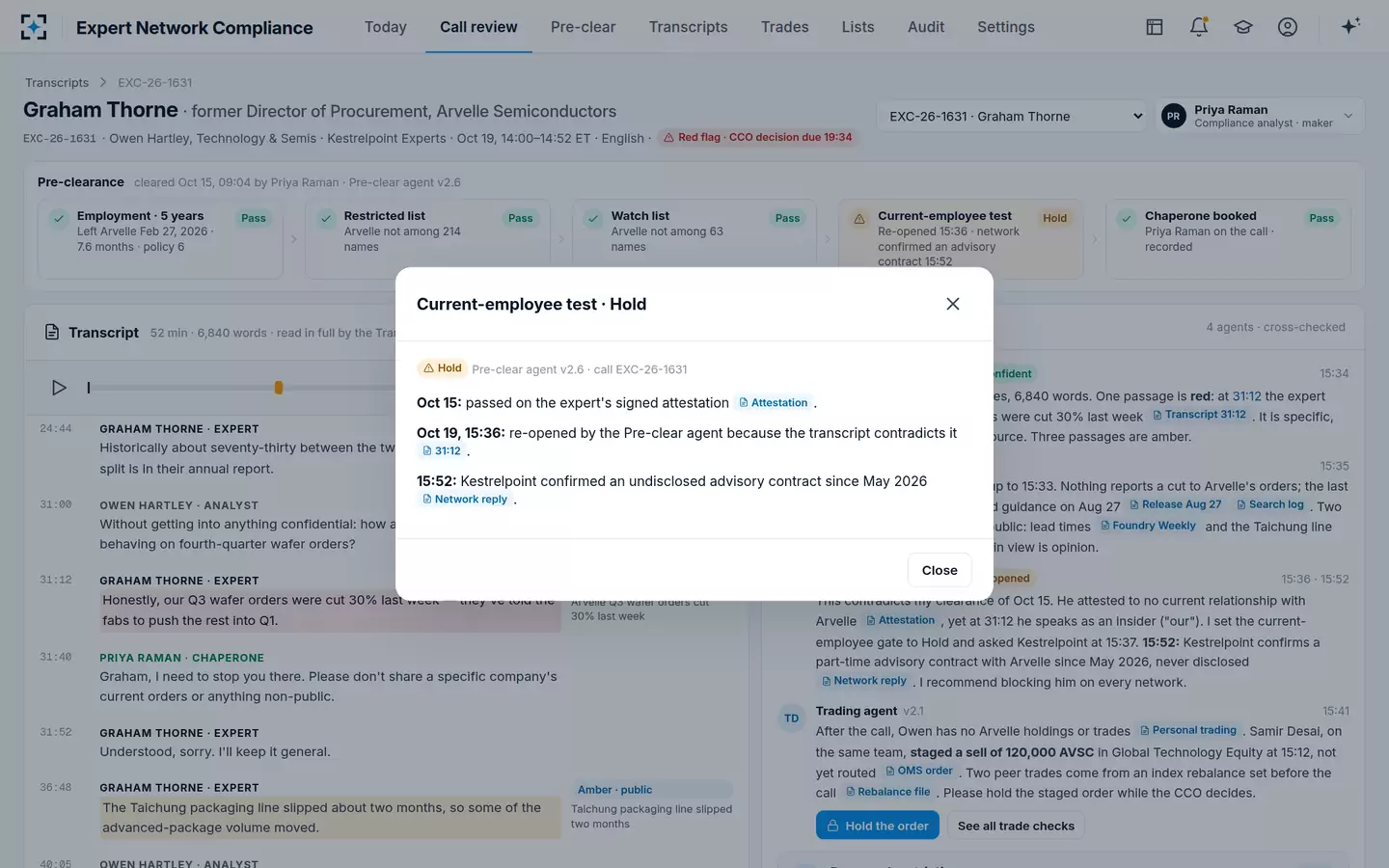
One reason to have several agents rather than one is that they can contradict each other, and a contradiction is evidence. In the sample call the expert had signed an attestation of no current relationship with his former employer, and the Pre-clear agent had relied on it. When the Transcript agent's red passage showed him speaking as an insider, the Pre-clear agent re-opened its own clearance, set the current-employee check to hold, and asked the network to confirm. Sixteen minutes later the network replied that the expert had an undisclosed part-time advisory contract with the company since May 2026, and the agent recommended blocking him on every network.
A clearance re-opened when the transcript contradicts the expert's attestation
Can AI detect MNPI in transcripts?
An agent can read every transcript and flag passages that look like MNPI, with reasons a person can check, which no sampling program can do at volume. Whether a particular agent does it well is a question to answer with a test, not a brochure. The method is to plant known MNPI passages, and decoys that only sound like MNPI, in a set of the firm's own transcripts, in every language its analysts use, and score each reviewer on recall, false alarms, time and the quality of its reasons. The seeded test for expert call transcripts sets out the design.
Two cautions apply to any product. Confidence numbers are only meaningful against a test on the firm's own calls, so thresholds should be set from that test and changed only with the chief compliance officer's approval. And an agent that is never wrong in a demonstration has not been tested; ask to see the decoys it got wrong.
What to ask before you buy insider trading compliance software
The questions below separate tools that read and join from tools that file. Ask for each answer to be shown on your own data in a pilot, not described.
Buying insider trading compliance software for expert calls: ten questions
- Does it read every transcript, or a sample?
Ask what share of last quarter's calls the product would have read, including calls whose transcript arrived late.
- In which languages?
Read in the original, or only a translation? Ask for a call in each language your analysts use.
- What does a flag carry?
The quote, its timestamp, the reasons and a confidence, so the reviewer decides from evidence, not a score.
- How does it treat public information?
Does it test each flag against filings and releases, and downgrade only with a dated source?
- Does it join the call to trades?
Personal and fund, in the issuer and its peers, from the end of the call, with a hold request before execution.
- Does it test the expert, not just the form?
Employers over a lookback against your lists and holdings; re-opening a clearance when new evidence arrives.
- What may it never do?
Clear, restrict, hold or close a red flag. Ask to see the limits in the product, not in a policy document.
- Who sees what?
Analysts and portfolio managers should see status only; flagged passages stay with compliance and audit.
- What does it leave for an examiner?
Every request, check, flag, trade check and decision with who, when, why and the evidence, kept five years.
- How is it measured?
A seeded test on your transcripts before go-live, repeated after any change to thresholds or models.
Where this insider trading compliance software fits, and where it does not
Expert Network Compliance is built for advisers and hedge funds whose analysts use expert networks. It is not a replacement for every part of an insider trading program. It reads the firm's personal-trading system and order management system rather than replacing them; it uses the firm's restricted and watch lists and updates them only through approved restrictions; and it is not a market-wide trade surveillance system looking for manipulation across all of a fund's trading. A broker-dealer's Rule 3110(d) review of all covered accounts, or a firm's full code of ethics administration, sits in those systems.
Insider trading compliance tools compared: where expert-call MNPI is caught
Typical lists and personal-trading tool: Holds the lists and blocks pre-clearance requests in listed names.
Expert Network Compliance beside it: Tests each expert's employers against the same lists, and drafts list changes for approval.
Typical lists and personal-trading tool: Often outside the tool: logged in the network portal or a spreadsheet.
Expert Network Compliance beside it: Every request pre-cleared, every call logged and reconciled to the networks.
Typical lists and personal-trading tool: Not read, or a sample read by hand.
Expert Network Compliance beside it: Every transcript read in full, in its language, with possible MNPI flagged and tested against the public record.
Typical lists and personal-trading tool: Personal trades checked against lists, usually monthly or quarterly.
Expert Network Compliance beside it: Personal and fund trades in the issuer and peers checked from the end of the call, with hold requests.
Typical lists and personal-trading tool: Approval logged in the tool.
Expert Network Compliance beside it: Each flag, hold and restriction prepared by compliance and approved by the CCO, with reasons.
The restricted-list method covers how lists themselves should be run; measuring a code of ethics program covers the personal-trading side.
Questions people ask
What is the difference between an insider trading compliance tool and insider trading monitoring software?
A compliance tool usually runs the controls: lists, pre-clearance, attestations and code of ethics reports. Monitoring software reviews activity after the fact, such as trades compared with news or with the firm's own events. An expert-call program needs both, joined: the call cleared before it happens and the trades checked after it.
What belongs on an insider trading compliance checklist?
Written MNPI policies under Section 204A; a code of ethics under Rule 204A-1 with access persons identified, holdings and transaction reports reviewed, and IPO and limited-offering pre-approval; restricted and watch lists; pre-clearance of expert calls; review of what was said on them; trade checks after calls; information barriers; training; and records of every decision.
Does insider trading compliance training need to be recorded?
Rule 204A-1 requires each supervised person to acknowledge receipt of the code of ethics and any amendments in writing, and Rule 204-2 requires the adviser to keep those acknowledgments. Training itself is not prescribed by the rule, but the SEC's 2004 release described periodic training and annual certification as among best practices, and a firm that trains should be able to show who attended.
Can a controlling person be penalized for insider trading by an employee?
Yes, in some circumstances. Section 21A of the Exchange Act allows a civil penalty against a controlling person who knew or recklessly disregarded that the employee was likely to trade, or who knowingly or recklessly failed to maintain or enforce the policies Section 204A requires, where that failure contributed to the violation. The statute caps the penalty at the greater of $1,000,000 or three times the profit gained or loss avoided.
How much does insider trading compliance software cost?
Vendors do not publish prices, and no regulator or independent study publishes a market rate. A better basis for a decision is the firm's own cost: compliance hours per call for pre-clearance, review and trade checks today, the share of calls actually reviewed, and the time to assemble an exam response, measured before and after a pilot.
How do you pilot insider trading compliance software on expert calls?
Run it on a past quarter's requests and transcripts with the firm's own lists, holdings and trades, plus a seeded set of planted MNPI passages. Compare what it flags, clears and holds with what the team decided at the time, and score it on the seeded set before using it on live calls.