Personal account dealing is trading by a firm's own people, for themselves or for someone connected to them, rather than for clients. The FCA's personal account dealing rules sit in COBS 11.7 of its Handbook for firms carrying on designated investment business, and in COBS 11.7A for MiFID business. They require arrangements that stop relevant people with conflicts or inside information from dealing in breach of the market abuse rules, misusing confidential information or trading against the firm's obligations; that make sure the firm is told promptly of every personal transaction; and that keep a record of each one, with any authorisation or prohibition. The SEC's version for advisers is the code of ethics under Rule 204A-1, built on reports with fixed deadlines and pre-approval of IPOs and limited offerings. A manager with staff in both places needs one process that satisfies both. Botminds' Expert Network Compliance adds the piece both regimes leave to the firm's own design: checking personal and fund trades after every expert call.
Personal account dealing rules: FCA COBS 11.7 beside the SEC's Rule 204A-1
| FCA: COBS 11.7 and 11.7A | SEC: Rule 204A-1 code of ethics | |
|---|---|---|
| Who is covered | Relevant persons involved in activities that may give rise to a conflict, or with access to inside information or other confidential client information | Access persons: supervised persons with nonpublic access to client trades, reportable fund holdings or recommendations; directors, officers and partners presumed |
| What is prohibited | Personal transactions that breach the market abuse rules, misuse confidential information or conflict with the firm's obligations; tipping and procuring others | Set by the firm's code, which must reflect fiduciary duties and require compliance with the securities laws |
| When the firm must know | Promptly, by notification or by other procedures that let the firm identify the transaction | Holdings report within 10 days of becoming an access person and yearly; transaction reports within 30 days after each quarter |
| Approval before dealing | Not prescribed for every trade; the record must include any authorisation or prohibition | Required before acquiring any IPO or limited offering; firms often add pre-clearance of all trades |
| Record | Every personal transaction notified or identified, with any authorisation or prohibition | Reports, the names of access persons for five years, and each IPO or limited-offering approval with reasons |
| Main exemptions | Discretionary management with no prior communication; certain fund units where the person is not involved in managing the fund; life policies | Accounts with no influence or control; automatic investment plans; duplicate broker statements received in time |
What is personal account dealing?
Personal account dealing, or PA dealing, is a personal transaction in a financial instrument by someone working for a regulated firm, for their own account or for a connected person's, outside their work for clients. The UK rules treat it as a conflict to be controlled: someone who knows what the firm's clients are doing, or holds inside information, could profit from it or trade against them. The FCA's Market Watch 62 put it simply, describing PA dealing as "where employees of an authorised firm trade for themselves rather than for clients" (FCA Market Watch 62, October 2019).
The US term is personal trading, and the rules come from the code of ethics rather than a dedicated chapter. The underlying worry is the same on both sides of the Atlantic: front-running, trading on inside information, and personal interests overriding duties to clients.
Personal account dealing rules in the FCA Handbook: COBS 11.7 and 11.7A
The FCA Handbook has two versions. COBS 11.7 applies to a firm that conducts designated investment business and covers any relevant person "who is involved in activities that may give rise to a conflict of interest, or who has access to inside information as defined in the Market Abuse Regulation or to other confidential information relating to clients or transactions with or for clients" (FCA COBS 11.7.1R). COBS 11.7A "applies to a firm in relation to its MiFID, equivalent third country or optional exemption business", and sets out the same arrangements for that business (FCA COBS 11.7A.1). A UK asset manager may need to check which version applies to which activity; the core duties match.
Both versions prohibit three things for a covered person: a personal transaction that breaches the Market Abuse Regulation, misuses or improperly discloses confidential information, or conflicts with an obligation of the firm; advising or procuring someone else to enter such a transaction outside the proper course of their job; and disclosing information when they know or ought to know it will lead someone to trade. A person who is not a director, partner, manager or appointed representative is a relevant person only to the extent they are involved in the regulated business (COBS 11.7.6R).
COBS 11.7 personal account dealing: what the arrangements must ensure
COBS 11.7.4R is the operational heart of the UK rules. The arrangements must ensure that each relevant person knows the restrictions and the firm's measures; that the firm "is informed promptly of any personal transaction entered into by a relevant person, either by notification of that transaction or by other procedures enabling the firm to identify such transactions"; and that "a record is kept of the personal transaction notified to the firm or identified by it, including any authorisation or prohibition in connection with such a transaction" (FCA COBS 11.7.4R).
Three features stand out against the US rule. "Promptly" has no number attached, so the firm sets one and should be able to defend it. "Other procedures enabling the firm to identify" transactions opens the door to broker feeds rather than self-reporting. And the record must show the decision, not just the trade: an authorisation, a prohibition, or neither. COBS 11.7.5R disapplies the rules for discretionary portfolio management with no prior communication about the trade, for units in certain collective funds where the person is not involved in managing them, and for life policies.
The SEC code of ethics on the same trades
Rule 204A-1 takes a calendar approach. An access person submits a holdings report no later than 10 days after becoming one, with information no more than 45 days old, and at least once every 12 months; submits transaction reports no later than 30 days after each calendar quarter; and must obtain approval "before they directly or indirectly acquire beneficial ownership in any security in an initial public offering or in a limited offering" (17 CFR 275.204A-1(b)–(c)). Rule 204-2 requires the adviser to keep those reports, the names of everyone who was an access person in the past five years, and each IPO or limited-offering approval with its reasons (17 CFR 275.204-2(a)(13)).
The US rule says less about what is prohibited and more about when the firm must know. Pre-clearance of all trades, restricted lists and blackout periods are practices the SEC encouraged in 2004 rather than requirements, which is why most firms' codes go well beyond the rule's minimum. Who is an access person is covered in a sibling guide.
Personal account dealing, UK and US: where the two rules pull differently
FCA COBS 11.7: Conflict of interest, or access to inside or confidential client information.
SEC Rule 204A-1: Nonpublic access to client trades, fund holdings or recommendations; senior people presumed.
FCA COBS 11.7: "Promptly", undefined; the firm sets the standard.
SEC Rule 204A-1: 10 days, 30 days after quarter end, every 12 months.
FCA COBS 11.7: Not prescribed; any authorisation or prohibition must be recorded.
SEC Rule 204A-1: Prescribed for IPOs and limited offerings; optional beyond.
FCA COBS 11.7: The firm knew of the trade and what it decided.
SEC Rule 204A-1: The reports arrived, were reviewed, and approvals had reasons.
FCA COBS 11.7: Explicit: trades that breach UK MAR are prohibited.
SEC Rule 204A-1: Indirect: Section 204A and the antifraud rules sit beside the code.
FCA personal account dealing Market Watch findings
The FCA has published two Market Watch reviews on PA dealing. Market Watch 62, in October 2019, studied wholesale broking firms and reported apparent breaches it was concerned to see "how often", including front-office staff who did not seem to understand their firm's policy "despite having signed attestations", and employees, "including front office, compliance and surveillance", deliberately not declaring external accounts, including accounts in relatives' names (FCA Market Watch 62). It found that "none had submitted a STOR relating to PAD in the past year", which it called surprising and "likely indicative of weaknesses in culture and controls".
What FCA Market Watch found on personal account dealing
0
STORs about PA dealing submitted in the past year by the wholesale broking firms sampled (2019)
4
failures listed in 2025: trading before approval, thin checks, holding periods ignored, breaches not followed up
2
Market Watch issues on PA dealing: No. 62 (Oct. 2019) and No. 83 (Sept. 2025)
Market Watch 83, in September 2025, came back to the subject in reviews of corporate finance firms advising small and mid-cap companies. The FCA saw "Staff trading before receiving approval", compliance granting approval without sufficient checks, staff "not complying with the firm's holding period", and "Compliance not following up on PAD breaches", adding that "In some cases, this seemed to occur with the consent of senior members of the business" (FCA Market Watch 83).
"Ongoing breaches of PAD policies are unacceptable. These policies and procedures are essential for maintaining market integrity by reducing conflicts of interest and helping to prevent market abuse."
FCA, Market Watch 83, September 2025
The SEC's examiners report the same pattern from the US side. Their April 2022 risk alert found access persons buying into IPOs and limited offerings without pre-approval, holdings and transaction reports missing or late, and reports that left out private placements (SEC risk alert, April 26, 2022). In both countries the rules were clear; the failures were in running them.
A personal account dealing policy that meets both rules
A single personal account dealing policy for a manager regulated in the UK and the US should take the stricter side of each row in the comparison and apply it to everyone covered by either rule. In practice that means pre-clearance of all trades by covered people, because the US requires it for IPOs and limited offerings and the UK requires the decision to be recorded; broker feeds or duplicate statements, because they satisfy "promptly" in the UK and the 30-day quarterly report in the US; and one record of each trade with its decision and reason.
Personal account dealing procedures for a UK and US manager: one process
- One covered population
Everyone who is a relevant person under COBS 11.7 or an access person under Rule 204A-1, listed with the reason for each.
- Pre-clear every trade
Against the restricted and watch lists, blackout periods and the funds' own orders, with a short validity window.
- Know promptly
Broker feeds or duplicate confirmations, so the firm identifies trades without waiting for self-reporting.
- Record the decision
Every authorisation or prohibition, who gave it and why, kept with the trade.
- Keep both clocks
Initial holdings within 10 days, annual holdings, quarterly transaction reports within 30 days, wherever the person sits.
- Holding periods and breaches
A stated holding period; every breach investigated, recorded and escalated, with a decision on whether to tell the FCA.
- Review and report suspicion
Post-trade review that feeds market abuse surveillance and, where needed, a suspicious transaction and order report.
Market Watch 62 also asked firms to consider how post-trade monitoring of PA dealing "feeds into identification of potential suspicious activity which the firm can review and, if necessary, report to the FCA", and, where a breach occurs, to assess Principle 11 and consider whether to inform the FCA. A policy that treats PA breaches as an HR matter only misses both.
Where expert calls meet personal account dealing
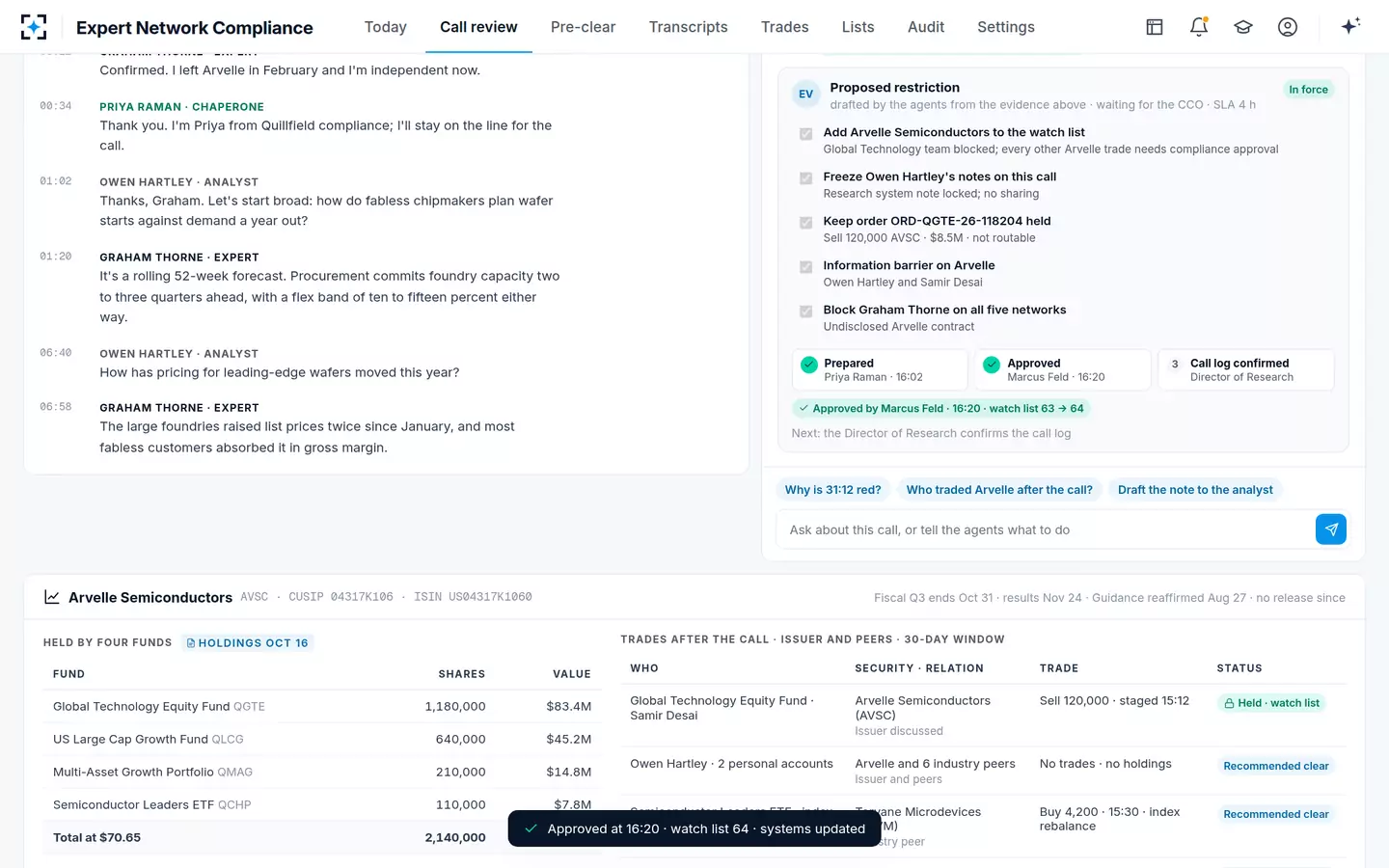
Expert calls create exactly the kind of information both rules worry about, and usually not through the person who places the trade. An analyst who hears something on a call may tell a colleague; a portfolio manager may act on the analyst's changed view. In the solution's fictional sample data, the analyst who took a call that produced a red flag had no holdings or trades in the company; a portfolio manager on the same team staged a fund sell order in it twenty minutes later. A PA dealing review that looks only at the caller's own account would have found nothing.
A restriction after an expert call: the watch list, the team block and the held order
Where Expert Network Compliance fits in UK and US PA dealing
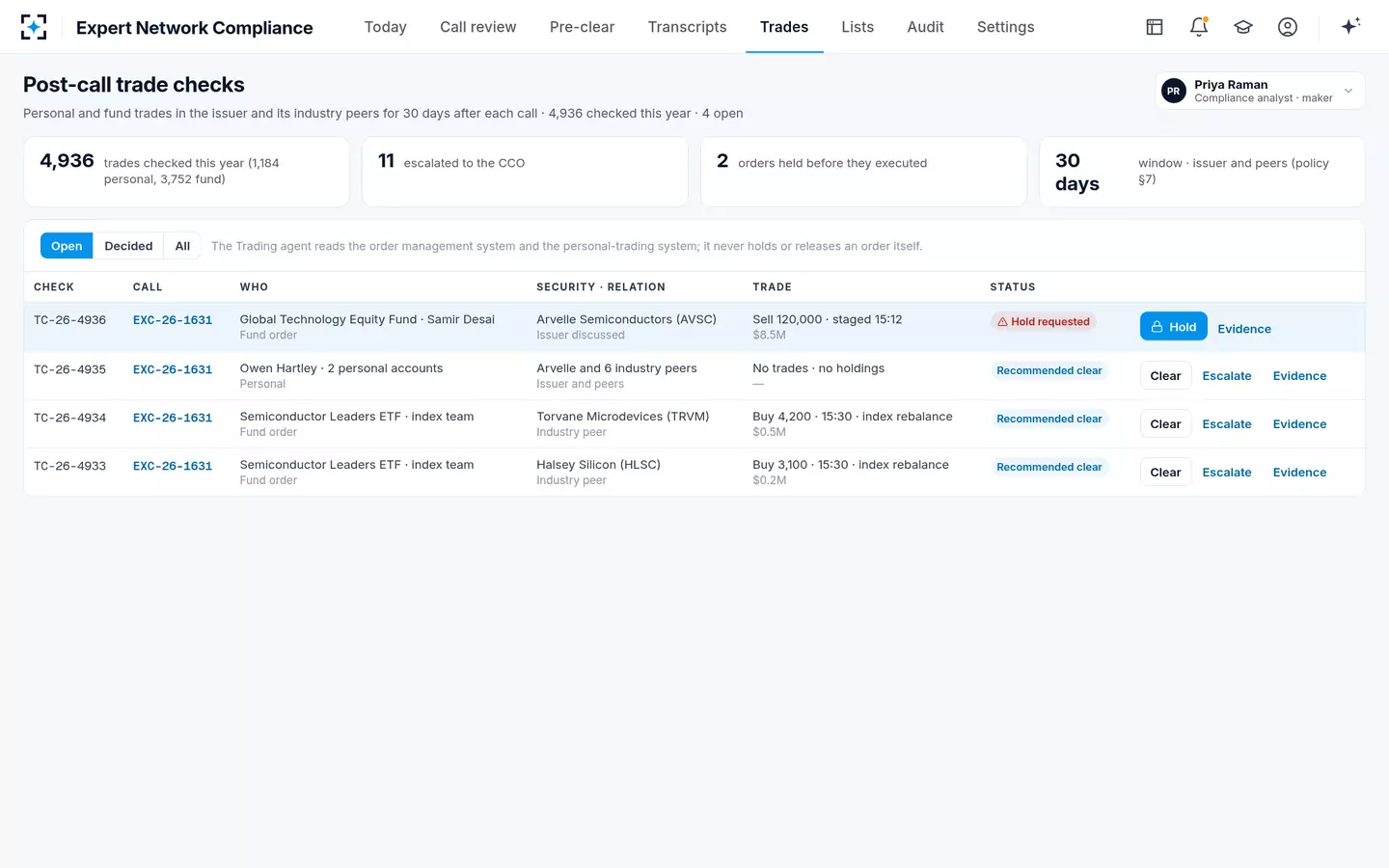
Expert Network Compliance is not a PA dealing system; it reads the firm's personal-trading system and order management system rather than replacing them. What it adds is the link to expert calls. Its Trading agent checks covered people's personal trades, as policy allows, and fund orders in the issuer discussed and its industry peers for 30 days after each call, and asks compliance to hold a staged order linked to a flagged call. Restrictions it drafts, once the chief compliance officer approves them, update the firm's watch list, which its pre-clearance checks use. On the sample firm's data it checked 4,936 trades after calls this year, 1,184 of them personal.
Post-call trade checks in Expert Network Compliance, across personal accounts and funds
Six measures of a code of ethics show how to test the US side; who waits on whom around an expert call shows why the trade check has to start when the call ends.
Questions people ask
Where are the personal account dealing rules in the FCA Handbook?
In the Conduct of Business Sourcebook: COBS 11.7 for firms conducting designated investment business and COBS 11.7A for MiFID, equivalent third country or optional exemption business. Both require arrangements to prevent prohibited personal transactions, prompt knowledge of every personal transaction, and a record of each with any authorisation or prohibition.
Does personal account dealing include spread bets and CFDs?
The rules cover personal transactions in financial instruments, and the FCA's Market Watch 62 specifically mentioned staff trading spread bets on their firm's own shares against policy, and the risk of round-the-clock CFD and spread betting markets. A firm's policy should name these products expressly.
Is a holding period required by the FCA?
COBS 11.7 does not set one; firms do. But the FCA's 2025 Market Watch 83 listed staff not complying with their firm's holding period among its findings, so a firm that has one is expected to enforce it and follow up breaches.
Must PA dealing breaches be reported to the FCA?
Not automatically. Market Watch 62 said firms need to work out how serious a breach was, assess the requirements of Principle 11 and consider whether to inform the FCA. Separately, a trade that gives reasonable suspicion of market abuse may require a suspicious transaction and order report.
Do the rules cover trades in fund units?
COBS 11.7.5R disapplies the section for personal transactions in units of qualifying collective investment undertakings where the relevant person is not involved in managing them. Under the SEC's rule, shares of open-end funds the adviser manages or sub-advises are reportable securities, so a UK and US manager's policy usually covers its own funds.
Who is a relevant person under COBS 11.7?
A director, partner or equivalent, manager or appointed representative of the firm, and any employee or other person to the extent they are involved in the firm's designated investment business or collective portfolio management. The PA dealing arrangements apply to relevant persons with conflicts or access to inside or confidential client information.