Expert network platforms are the companies and portals through which investors find, book and pay industry experts for calls, and increasingly buy transcripts of past calls. For a compliance team, choosing or renewing one is a control decision, not a procurement one: the network decides who the experts are, what they attest to and what evidence of each call reaches the firm. Section 204A still puts the duty on the adviser, and the SEC's 2011 cases began with experts who were moonlighting for a network while their employers did not know. The ten questions below are the ones a chief compliance officer can put to any network and then verify, with what a good answer looks like. Botminds' Expert Network Compliance is not an expert network; it works across the networks a firm already uses and applies the firm's own rules to every call they book.
Ten questions for expert network platforms, with answers you can check
1Will you tell us each expert's employers for the last five years, with dates?
A good answerA dated employment history per expert, in a format your pre-clearance can test.
How to check itCompare a sample with the expert's public profile and what the expert says on the call.
2Do you exclude current employees of public companies, and how do you know?
A good answerA written rule, a question in the expert's attestation, and a re-check before each call.
How to check itAsk how many experts were removed last year for a current role.
3What does the expert attest to before each call, not just at sign-up?
A good answerA per-call attestation naming the client's topic, signed and sent to you.
How to check itRequest the attestations for last quarter's calls.
4Can we apply our own restricted list and cooling-off rules on your side?
A good answerYour lists and rules screened before an expert is offered, with matches logged.
How to check itPlant a test name on your list and see if the network blocks it.
5Do you record calls, and will you give us the audio and a transcript?
A good answerRecording on request or by default, transcripts within hours, both delivered to you.
How to check itTime the last ten transcripts from call end to delivery.
6Will you send a complete log of our calls every week?
A good answerEvery call by analyst, expert, date and topic, including cancelled and rescheduled calls.
How to check itReconcile it against your own calendar and notes.
7What happens when an expert discloses something they should not?
A good answerA process to report it to you, investigate and block the expert across the network.
How to check itAsk for the number of experts blocked last year and why.
8Will you answer our questions about an expert the same day?
A good answerA named contact who confirms or corrects employment facts quickly.
How to check itTest it with one real question during diligence.
9How do you treat former government officials and healthcare practitioners?
A good answerStated cooling-off and conflict rules for each, applied before an expert is offered.
How to check itRead the rule, then check three experts from each group.
10What records do you keep, and for how long?
A good answerCall details, attestations and transcripts kept long enough to cover your own retention period.
How to check itCompare with the five-year retention your own records usually need.
What is an expert network platform, and what does compliance need from it?
An expert network platform keeps a pool of experts, matches them to a client's question, collects their employment history and attestations, books and hosts the call, pays the expert and invoices the client. Some now offer transcripts of each call and libraries of past transcripts. For compliance the platform is the source of four things the firm cannot produce by itself: who the expert really is, what the expert promised, what was said, and a list of every call the firm's analysts booked.
The SEC's examiners asked for those things in their April 2022 risk alert, which found advisers without adequate policies on tracking and logging expert calls and reviewing detailed notes of them (SEC risk alert, April 26, 2022). A firm whose network cannot supply a complete call log and a transcript has to build both itself, by hand. The Investment Research guide to expert network compliance covers the method inside the firm; this page is about what to demand from outside it.
Why the network is the first control, not the only one
The network is the first filter on who the experts are, and the SEC's cases show both its value and its limits. In February 2011 the SEC charged employees of technology companies who consulted for one network while their employers did not know, passing inside information about companies including AMD, Apple, Dell, Flextronics and Marvell to the network's clients; the consultants "received hundreds of thousands of dollars in purported consulting fees" (SEC press release 2011-38). In the 2012 CR Intrinsic complaint, the SEC alleged that a doctor working on a drug trial and a portfolio manager scheduled their network-arranged consultations around the trial's safety committee meetings (SEC press release 2012-237).
In both, the network's own vetting and the expert's own promises did not stop the information. The law did not move the duty either: Section 204A requires every adviser to establish, maintain and enforce its own policies against the misuse of MNPI, fitted to its business (15 U.S.C. 80b-4a). A network can make those policies easier to run. It cannot run them for the firm.
What the 2011 expert network cases put on the record
$130K+
paid by one network to one consultant, Jan. 2008 to Mar. 2010, for talking to the network and its clients
$200K+
paid to another consultant for consultations with select clients, Sept. 2006 to Dec. 2008
5
technology companies named whose inside information the consultants were alleged to have passed
Do expert networks record calls?
Some do by default and others on request; practices differ by network and by client contract, so the only reliable answer is the one in the firm's own contract. At the solution's sample firm every expert call held this year has a transcript, and the transcript of its flagged call arrived 39 minutes after the call ended. Compliance should ask for recording and a transcript on every call, delivered to the firm rather than kept only on the network's platform, because the SEC's examiners measure review of detailed notes and a transcript is the most complete account available. Where a transcript is relied on for advice, the firm's own recordkeeping duties under Rule 204-2 may apply to it.
Two details matter in the contract. The first is timing: a transcript that arrives two days after the call arrives after any trade the call prompted, so ask for delivery times and measure them. The second is completeness: the network should tell the firm when a recording failed or a transcript is missing, so the firm's call log shows the gap instead of reporting coverage it does not have.
How expert networks screen experts, and where screening fails
Networks screen experts by collecting an employment history, asking them to confirm they are free to consult, and requiring an attestation that they will not disclose confidential information. Each step relies on the expert telling the truth. The 2011 consultants were current employees who did not tell their employers; an expert with an undisclosed advisory contract can sign an attestation that is wrong on the day he signs it.
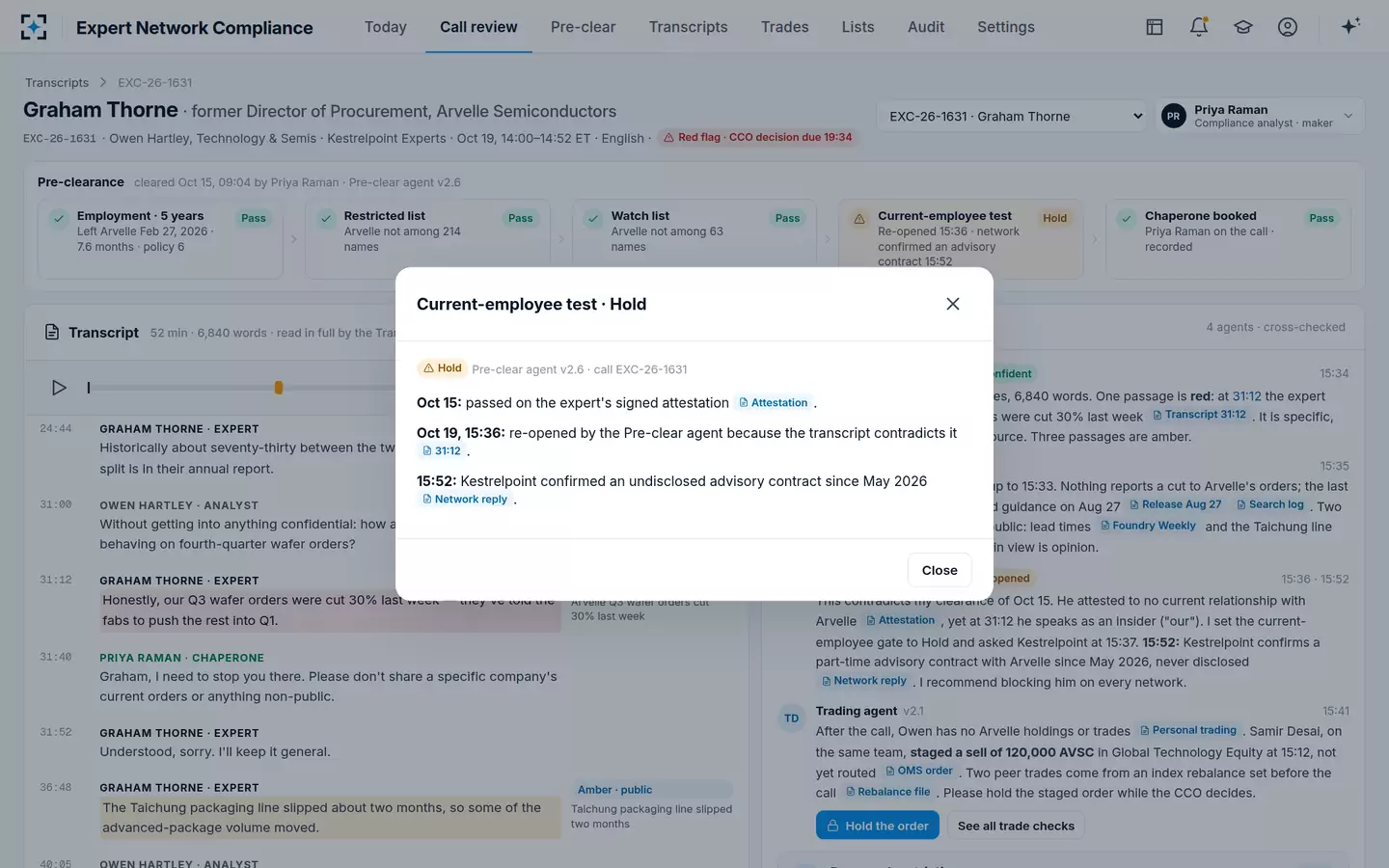
That is why the firm's own pre-clearance should test the expert again, against its own lists and holdings, and why the transcript should be read against the attestation. In the solution's fictional sample data, an expert attested to no current relationship with his former employer; on the call he spoke of its orders as "our" orders; the firm's clearance was re-opened within minutes and the network confirmed an undisclosed advisory contract the same afternoon.
The network's answer in Expert Network Compliance: a clearance re-opened and confirmed
Are expert networks a scam?
No. Expert networks are lawful businesses that sell access to industry knowledge, and investors use them because a former procurement director or a practising clinician knows things about an industry that filings do not say. The SEC's cases charged individuals who passed or traded on confidential information, and later advisers whose controls failed; none treated the network model itself as unlawful. What makes a call risky is who the expert is and what he or she says, which is why the questions above are about evidence rather than reputation.
Expert network companies compared: what to compare
Expert network companies differ less in what they promise than in what they hand over. Compare candidates on the ten answers, then on the evidence: the share of last quarter's calls for which the network delivered a transcript, the median time to delivery, the number of experts it removed for a current role or a disclosure, and whether its weekly log reconciles to the firm's own calendar. No regulator or independent study publishes these figures for the industry; the firm has to ask for them and test them during diligence.
What the expert network controls, and what stays with the firm
The network can: Collect employment history and attestations; exclude current employees under its own rules.
The firm must still: Test the expert against its own restricted list, watch list and holdings, with its own cooling-off rules.
The network can: Host and record it; open with a compliance reminder.
The firm must still: Decide which calls need a chaperone, and who the analyst may ask about what.
The network can: Deliver a transcript and audio.
The firm must still: Read it, decide every passage that looks like MNPI, and restrict or release.
The network can: Nothing: it does not see them.
The firm must still: Check personal and fund trades in the issuer and its peers after the call.
The network can: Send a call log and keep its own records.
The firm must still: Reconcile the log, keep its own records and produce them to an examiner.
Checking the answers: diligence that holds up
A diligence questionnaire filed once at onboarding is the weakest form of control; the SEC's 2022 alert criticised advisers for ad hoc diligence of alternative data providers and for not re-performing it when time passed or practices changed. The same discipline applies to networks. Re-diligence on a set cycle, at least annually; test the answers against the firm's own calls; and keep the results.
The expert network diligence file: what it should hold
- The ten answers, dated and signed
Renewed on a set cycle, and whenever the network changes its model, such as adding transcript libraries.
- The contract terms that matter
Recording and transcript delivery, weekly logs, the firm's right to apply its own lists, reporting of disclosures.
- A reconciliation of last quarter's calls
The network's log against the firm's calendar, notes and pre-clearances, with differences explained.
- Transcript delivery times
Median and slowest, from call end to delivery, for last quarter.
- A planted-name test
Evidence that the network blocked an expert tied to a name added to the firm's restricted list for the test.
- Incidents
Experts the network blocked or removed, and any disclosures it reported to the firm.
Using several networks under one set of rules
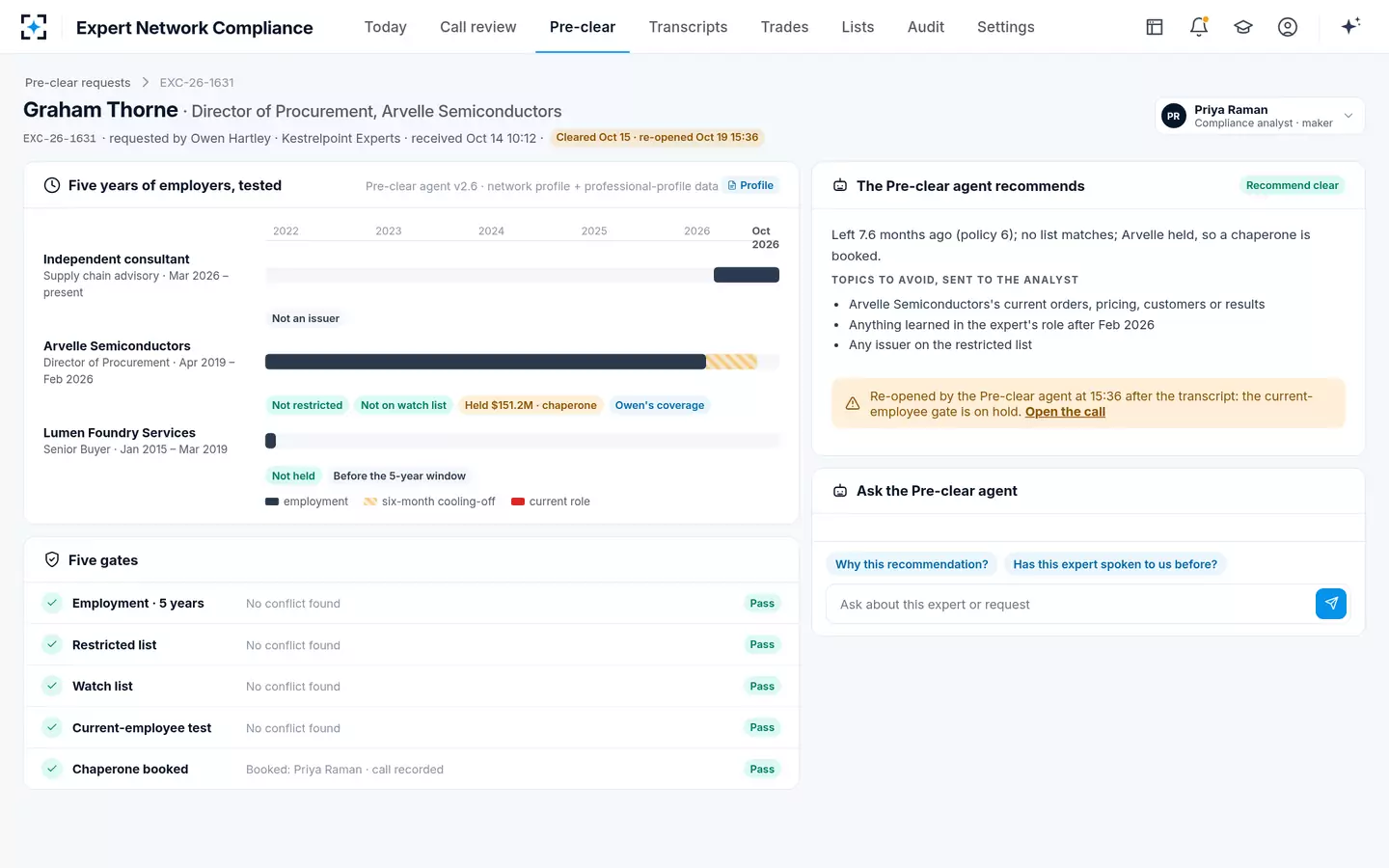
Most firms that use experts use more than one network, and each has its own portal, profile format and attestation. That is where pre-clearance slows down and where rules drift: a cooling-off period applied on one portal is forgotten on another. The firm's rules should sit above the networks, applied the same way to every request whichever portal it came from, and an expert blocked for a disclosure should be blocked on every network the firm uses.
The solution's sample firm uses five networks. Requests from all five arrive in one queue, are tested against the same lists and settings, and carry the same one-business-day deadline; when the sample expert's undisclosed contract came to light, the restriction the chief compliance officer approved blocked him on all five.
One set of rules across expert network platforms: the expert tested, whichever portal he came from
Where Expert Network Compliance fits beside the networks
Expert Network Compliance does the firm's side of the division above. Its Intake agent takes requests from every network portal and email; the Pre-clear agent tests five years of each expert's employers against the firm's lists and holdings; the Transcript agent reads every transcript the networks deliver, in its own language; the Trading agent checks the trades after each call; and the Evidence agent reconciles the networks' logs with the firm's calendars and notes each week. When a transcript contradicts a network's profile or an expert's attestation, the agents ask the network, and the answer joins the evidence.
It does not replace the networks, rank them or book calls. Choosing a network stays with the firm, and the ten questions are where to start. Who is on a call, and who waits on whom, and the policy clauses the agents run, are covered in sibling guides.
Questions people ask
What are the best expert network companies?
We do not rank networks, and no regulator or independent study does either. For compliance, the best network is the one whose answers to the ten questions are complete and verifiable: dated employment histories, per-call attestations, recordings and fast transcripts, weekly logs that reconcile, and the ability to apply the firm's own restricted list and cooling-off rules.
What services do expert networks offer?
The core service is arranging paid one-to-one calls with experts. Some also offer transcripts of the firm's own calls, libraries of past call transcripts, surveys of experts and in-person meetings. Each adds a different compliance question: a library transcript, for example, records a call between an expert and someone else, and still needs the firm's own review.
How big is the expert network industry?
No regulator or independent study publishes a reliable figure for the industry's size or revenue. What the public record does show is how widely investors use networks: the SEC's 2022 risk alert treated expert networks as an ordinary source of MNPI risk for advisers, alongside alternative data and investors with inside access.
Does a network's own compliance program replace ours?
No. Section 204A requires every adviser to establish, maintain and enforce its own policies against the misuse of MNPI, and the SEC's 2022 alert looked for the adviser's own logging, review and trade checks. A strong network program reduces the work and improves the evidence; the decisions and the duty stay with the adviser.
How often should an expert network be re-diligenced?
At least annually, and whenever the network changes how it works or an incident occurs. The SEC's 2022 alert criticised advisers that onboarded data providers once with no system for deciding when diligence needed to be re-performed, and the same reasoning applies to networks.
Should an expert be blocked on every network after a disclosure?
Yes, if the firm's policy treats a disclosure of confidential information as disqualifying, because the expert's conduct does not change with the portal. The block is a decision for compliance, recorded with its reason, and the firm should also tell the network so it can act on its own side.