FCA STOR reporting means sending the Financial Conduct Authority a suspicious transaction and order report (STOR) through its Connect system, without delay, whenever a firm that arranges or executes trades forms a reasonable suspicion that an order or transaction could be insider dealing or market manipulation. The duty comes from Article 16 of UK MAR; the form comes from the template in Delegated Regulation 2016/957, which has six sections. A STOR the FCA can use is one whose reasons section explains, in facts and analysis, why the firm is suspicious and what it checked, with the trade data attached. Writing that section well is hard because the evidence is spread across the order system, the news, the chats and the lists. Botminds' Trade Surveillance assembles that evidence into a cited case for every alert, so when an analyst escalates, the report is drafted from sources already checked and approved by the Head of Surveillance.
The worked example on this page comes from a fictional asset manager, Quillfield Capital, whose sample data runs through the solution. Figures on STOR volumes are the FCA's own.
What the FCA receives, and what it does with it
4,528
STORs received in 2024, 87% of them for suspected insider dealing
3,806
STORs received in 2025, of which 3,124 were for suspected insider dealing
679
STORs for suspected market manipulation in 2025, up from 581 in 2024
70%+
of the FCA's live market abuse investigations in April 2025 began with a STOR
What is a STOR? The FCA's meaning
A STOR is the report a firm sends the FCA when it suspects an order or a transaction could be market abuse. The FCA defines the trigger plainly: "A suspicious transaction or order is one where there are 'reasonable grounds' to suspect it might be market abuse, such as insider dealing or market manipulation" (FCA, How to report suspected market abuse as a firm or trading venue). Attempts count, and so do orders that never executed.
Two groups must file. UK trading venues report under Article 16(1) of UK MAR. Everyone "professionally arranging or executing transactions" reports under Article 16(2): brokers, banks, and buy-side firms such as fund managers, whose duty is set out in the guide to Market Abuse Regulation Article 16. The older acronym, STR, named transactions only; MAR, in force from 3 July 2016, made suspicious orders reportable as well, and the FCA reminds firms that they "must report suspicious 'orders' as well as suspicious transactions".
How many STORs does the FCA receive a year?
Between three and five thousand in recent years: 4,528 in 2024 and 3,806 in 2025. Insider dealing dominates. In 2024 it accounted for 3,945 reports, or 87%; in 2025 for 3,124, or 82%, while suspected market manipulation rose from 581 to 679 (FCA, Number of STORs received: 2025).
Equity insider dealing is most of the 2025 total; fixed income is a sliver
The fixed income sliver is not a sign of clean bond markets. The FCA said in Market Watch 56 that its "view is that submissions continue to be too low in fixed income products", and that some analysts reviewed only the product that triggered the alert without "considering other trading in correlated products" (FCA, Market Watch 56, September 2018). A fund manager with a large credit book that files no bond STORs should be able to explain why.
When must a firm submit a STOR to the FCA?
Without delay, once reasonable suspicion is formed. Delegated Regulation 2016/957 requires arrangements "for the submission of a STOR without delay ... once reasonable suspicion of actual or attempted insider dealing or market manipulation is formed" (Article 6(1)). The clock does not start at the trade or at the alert. It starts when a person at the firm, looking at the evidence, reaches suspicion.
That has three practical consequences. First, a firm need not finish an internal investigation before filing: the FCA has reminded firms that the STOR may be due "before the full internal investigation is concluded", and that information "not available at the time of the submission can be communicated to us at a later date" (FCA, Market Watch 69). Second, old trades can be reported when later events cast them in a new light, but the STOR must then explain "the delay between the suspected breach and the submission" (Article 6(2)). Third, new facts after filing must be sent on: firms "shall submit to the competent authority any relevant additional information which they become aware of after the STOR has been originally submitted" (Article 6(3)).
The FCA STOR template, section by section
The FCA's STOR form follows the template in the Annex to Delegated Regulation 2016/957. Its six sections mirror the minimum contents in Article 7(2): who is reporting and in what capacity, what the order or transaction was, why it is suspicious, who was involved, and anything else that helps the regulator.
The six sections of the STOR template, and what each needs from the firm
| Section | What the template asks for | Where a buy-side firm finds it |
|---|---|---|
| 1 · Identity of the reporting entity | Name and position of the person submitting; the entity, its LEI and address; its "acting capacity" for the orders; any relationship with the suspected person; a contact for follow-up. | Compliance, the legal entity register; capacity is usually portfolio management or reception and transmission of orders. |
| 2 · Transaction or order | The instrument with its identifier and ISO 10962 CFI code; dates and times "specifying the time zone"; venue or "outside a trading venue"; price, volume, order type, who placed and received it, and any cancellation or amendment with its time and author. | The order management system and its audit log; the execution management system; broker fills. |
| 3 · Nature of the suspicion | The type: insider dealing, market manipulation, or an attempt at either. Then the reasons: the activity, "how the matter came to the attention of the reporting person", and "the reasons for suspicion". | The analyst's case file: alert, news, communications, lists, and the reasoning that connects them. |
| 4 · Suspected person | Name, date of birth, address, employment, account numbers, client identifier, and any relationship with the issuer. | HR records for an employee; client onboarding records for a client. |
| 5 · Additional information | Background, such as trading habits, how the order compares with the person's average order "for the past 12 months", and other people involved. | Peer and history analysis of the person's or desk's past trading. |
| 6 · Documentation attached | A list of attachments, for example "e-mails, recordings of conversations, order/transaction records, confirmations, broker reports". | The communications archive, call recordings, order exports; trade data and graphs go here. |
Section 2 is where most avoidable errors happen. A STOR that gives times without a time zone, or lists the fills but not the order's amendments, forces the FCA to come back for basics. The template asks for "the time of the alteration or cancellation, the person who altered or cancelled the order" and the nature of the change, because for manipulation and for some insider dealing the amendment is the evidence. If the firm's surveillance does not keep amended and cancelled orders, it cannot complete this section.
What goes in the reasons for suspicion
Facts, the analysis that links them, and the checks that failed to explain them away. Article 5(3) requires that "information submitted as part of a STOR is based on facts and analysis, taking into account all information available" to the firm (Delegated Regulation 2016/957, Article 5(3)). The FCA's own guidance adds the reason this matters: a firm "will need to be able to explain the basis for the suspicion when notifying the FCA", and trades that look innocent alone "might deliver such indications of possible market abuse, when seen in perspective with other transactions, certain behaviour or other information" (FCA Handbook, SUP 15.10.4G).
A reasons section the FCA can act on: eight checks before you file
- Open with the suspicion in one sentence
Who traded what, when, ahead of or around which event, and which type of abuse it could be. The reader should know the allegation before the detail.
- Give the timeline to the minute, with time zones
Order creation, amendments, executions, the news or announcement, and any communication in between. Sequence is usually the whole case.
- Quantify the advantage
Profit made or loss avoided at the first close after the news, and how unusual the size was against the person's or desk's own history.
- Say how it came to light
The template asks how the matter came to the firm's attention: an alert, a front office escalation, a whistleblower, a later event.
- State the innocent explanations you tested
A model rebalance, a client instruction, a risk limit, a public news item. Say what each check found and why it does not explain the trade.
- Name the information path, if there is one
A wall-crossing, a market sounding, an expert call, a chat. Where no path is known, say so; the FCA has said that the absence of an obvious link does not by itself justify closing an alert.
- Keep facts and judgment apart
Quote the source for each fact; mark inference as inference. The FCA can verify the first and weigh the second.
- Attach what proves it
Trade data, graphs, the relevant messages or call extract, in section 6. The FCA asks for attachments rather than pasting data into the text.
The sixth check deserves emphasis. The FCA has criticised firms that escalate and consider reporting only "where they identify an obvious link between the client and the issuer or source of the inside information"; it said such a link "may be an aggravating factor", but "its absence does not necessarily serve as sufficient mitigation to close alerts" (Market Watch 69). A fund manager rarely sees how information reached a trader. The reasons section should say what the firm could and could not see.
Tipping off: completing a STOR without alerting the subject
The person under suspicion must not learn that a STOR is coming, including from the questions asked to complete it. Article 5(4) requires procedures so that the subject, and anyone "not required to know about the submission of a STOR by virtue of their function or position", is not informed; Article 5(5) adds that the firm must complete the STOR without informing them, "including through requests of information relating to the person" (Article 5(4) and (5)).
For a buy-side firm this bites when the suspect is an employee. Asking a portfolio manager's desk head why an order was placed may be the obvious step, and also the step that warns the subject. The FCA recognises that firms want to investigate their own staff more deeply, and reminds them to do so "while taking care not to inform the subject of the STORs or anyone else who is not required to know" (Market Watch 69). Evidence that can be gathered from systems, such as order audit logs, recorded lines and lists, should be gathered there first.
FCA STOR submission through Connect, and what to attach
STORs go to the FCA through its Connect system, on the STOR form. The FCA's instructions are short and worth following to the letter: "Please make sure the form is completed in full. Include all relevant information in the body of the STOR, including the basis for reporting the STOR. Add attachments for trade data, graphs and any other relevant documents in section 6 of the form" (FCA STOR page).
The FCA runs a STOR helpline for questions about completing or submitting the form, but it will not make the call for the firm: "We cannot advise firms on whether to submit a STOR, as the decision is the responsibility of firms." That sentence is why the decision and its reasons belong in the firm's own file, signed by a named person.
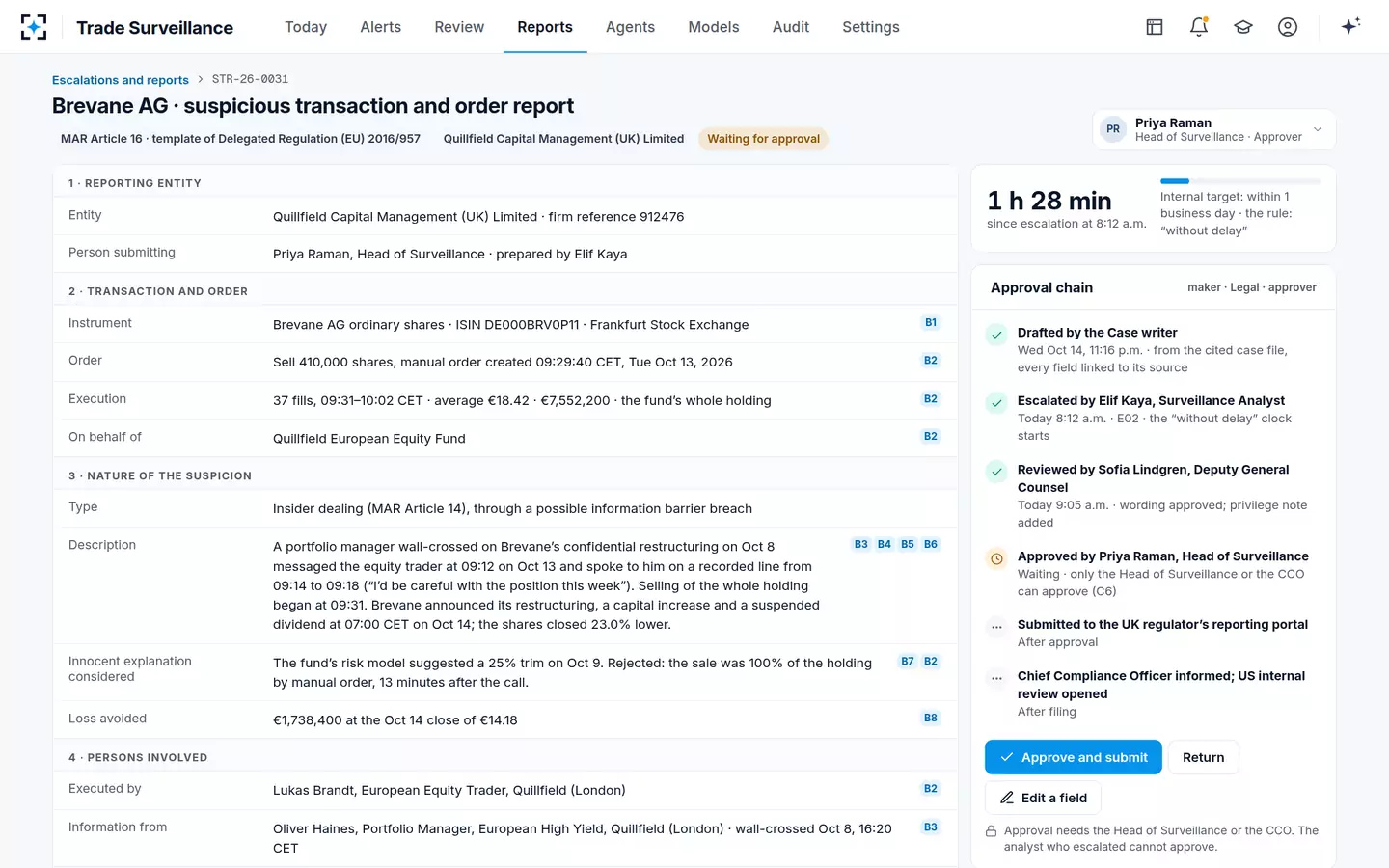
A STOR drafted from the case file, every field linked to its source
STOR, market observation or SAR: the edges of the FCA STOR regime
A STOR is for suspected market abuse under UK MAR and nothing else. The FCA asks firms not to use it "to report other types of suspicion or incidents that are not considered market abuse as defined in UK MAR", and gives two other routes for what does not fit.
Three reports a firm can send, and which one fits
STOR: Orders or transactions the firm arranged or executed that could be insider dealing, market manipulation or an attempt, under Article 16 of UK MAR.
Market observation or SAR: Market observation: activity the firm observed but was not involved in, so it "doesn't have complete information". SAR: suspected money laundering or terrorist financing.
STOR: The FCA, on the STOR form in Connect.
Market observation or SAR: Market observation: the FCA, on a separate Connect form under "Notifications". SAR: the National Crime Agency, not the FCA.
STOR: UK MAR Article 16 and Delegated Regulation 2016/957.
Market observation or SAR: Market observation: voluntary. SAR: the Proceeds of Crime Act 2002 and the Terrorism Act 2000.
STOR: Where suspicious trading also gives rise to a suspicion of money laundering, the firm's nominated officer submits a SAR to the National Crime Agency as well.
Market observation or SAR: The FCA's financial crime guide lists, as poor practice, senior management that thinks its obligations are met "solely by submitting a STOR and/or SAR".
After filing: the follow-up, and the alerts you did not report
Filing is not the end of the duty. Beyond sending later information under Article 6(3), a firm should decide what to do about the person: the FCA's financial crime guide lists as poor practice a firm that "believes that its obligations cease when it reports the suspicious transactions and orders", and expects options such as enhanced monitoring, restricted access or, for an employee, disciplinary action (FCA, FCG 8.2).
The bigger record is the one that never reaches the FCA. For every alert examined, Delegated Regulation 2016/957 requires the firm to keep "the reasons for submitting or not submitting a STOR" for five years (Article 3(8)). A team that files a few STORs a year may close thousands of alerts in the same period, and the regulator can ask for any of those closes. A close note built to hold up covers that side of the work.
Drafting a STOR from a case file: a worked example
In the sample firm, a high-yield portfolio manager was brought inside on a German issuer's restructuring on 8 October. Five days later he messaged an equity trader in German and spoke to him on a recorded line for four minutes; thirteen minutes after the call ended, the trader began selling the European Equity Fund's whole holding, 410,000 shares. The company's ad hoc announcement the next morning sent the shares down 23.0%, a loss avoided of €1.74 million.
By the time the analyst opened the case, the agents had assembled it: the order and its audit log, the chat in the original German with English beside it, the call transcript ("I'd be careful with the position this week"), the wall-crossing that restricted only the high-yield team, and the Skeptic agent's best innocent explanation, a 25% trim the fund's risk model had suggested. The analyst answered it from the record: the sale was 100% of the holding, by manual order. She escalated with reason code E02, and the report was drafted from the same case file, every field linked to its source. Legal approved the wording, and the clock on screen read 1 hour 28 minutes since escalation when it reached the Head of Surveillance, against an internal target of one business day.
The point of the example is the reasons section. It states the allegation, the timeline to the minute, the advantage in euros, how the matter came to light, the innocent explanation and why it fails, and the information path, with the attachments in section 6. For how the case reached that point, see insider dealing examples; for the solution, start at Trade Surveillance.
Questions people ask
What does STOR stand for?
Suspicious transaction and order report. It replaced the older STR, which covered transactions only, when the Market Abuse Regulation took effect on 3 July 2016 and made suspicious orders, including cancelled and amended ones, reportable as well.
Is there a deadline in days for a STOR?
No. The rule is "without delay" once reasonable suspicion is formed, with no fixed number of days. Firms set internal targets, and should be able to show when suspicion arose and why the report took as long as it did; for older trades, the STOR itself must explain the delay.
Can the FCA tell a firm whether to file a STOR?
No. The FCA's STOR helpline answers questions about completing and submitting the form, but the FCA states that it cannot advise firms on whether to submit a STOR, "as the decision is the responsibility of firms".
Do fund managers file STORs on their own employees?
Yes, when they suspect them. A firm subject to Article 16 must report suspicious orders and transactions whoever placed them, and the FCA has said that a STOR on an employee may be due before the firm's internal investigation finishes, provided the employee is not tipped off.
Does a STOR replace a suspicious activity report?
No. A STOR goes to the FCA under UK MAR; a SAR goes to the National Crime Agency under the Proceeds of Crime Act 2002 and the Terrorism Act 2000. The same conduct can require both, and the FCA lists as poor practice treating a STOR or a SAR as the whole of a firm's financial crime obligations.
How many STORs are about bonds?
Few. In 2025 the FCA received 173 fixed income STORs out of 3,806, about 4.5%, and 182 in 2024. The FCA has said it believes fixed income submissions are lower than they should be.