The broker onboarding process, for an asset manager, is the sequence that takes a fund from "we want to trade with this broker" to an account that can take an order: approve the broker, answer its KYC questionnaire, sign its agreement, provide tax forms, exchange standing settlement instructions (SSIs) and set the broker up in the order management system. It passes through six or more people at the fund and at least one desk at the broker, and most of its elapsed days are spent waiting between them: for a signature, a reply, a document or a decision. Mapping who waits on whom usually shows that one slow internal sign-off costs more days than the broker's whole review. Botminds' Counterparty Onboarding is built around those hand-offs: it plans each opening back from the fund's first trade date, hands every finished leg to its next named owner with the evidence attached, and chases whoever is holding the lane.
Examples come from fictional sample data in the solution, where Quillfield Capital's onboarding team has 186 openings in flight across 38 funds and 32 counterparties.
The broker onboarding process as hand-offs: agents carry the work between people who decide
Agent
Read what the broker sentThe Intake agent reads the questionnaire, agreement and tax requests in their own language, matches the fund by name and LEI and opens the lane.
Never: guesses a fund when two match
Agent
Plan back from the first trade dateThe Relay agent sets a date for each leg and names its owner.
Never: sends a chaser without an approved template
Agent
Draft every answerQuestionnaire, Forms and Agreements agents draft from approved documents; the Checker agent re-derives each answer.
Never: answers from a superseded document
A person decides
Specialist reviews; compliance signsRoutine answers by the specialist; ownership, PEP, sanctions and source of funds by compliance.
A person decides
Team lead approves and submitsA lead who did not prepare the submission approves it; only then does anything reach the broker.
A person decides
Settlement and trading sign offSSIs called back and released by two people; trading operations signs the fund trade-ready.
What is the broker onboarding process? Approve, open, set up
The process has three stages that are often blurred. First the manager approves the broker: is it registered, unsanctioned, creditworthy, and on the list of brokers the funds may use. Then the broker onboards the fund: its customer identification program, beneficial ownership rules where they apply, its own risk questions and its agreement. Finally the fund sets the broker up: settlement instructions, the order management system, the FIX session, allocation accounts and accounting.
The stages overlap in time but not in authority. A specialist can draft the KYC answers while the agreement is with Legal, but the account cannot be set up before the broker confirms it, and nothing should be sent before the broker is approved. The five legs of counterparty onboarding lay out the work itself; this guide is about the people between the legs.
Who is involved in broker onboarding at a fund?
At least seven roles touch every opening, and each holds something no one else can give. The bottleneck is rarely the person doing the most work; it is the person whose signature everything else is waiting for.
Seven seats on one broker opening, and what each one holds
Today
Copies answers from offering documents into each broker's form, in each broker's language.
With agents
Reviews answers already drafted beside their source pages, and accepts or corrects them.
Still theirs: Prepares; cannot approve their own work.
Today
Chases every team by email and finds out a launch is at risk late.
With agents
Sees which lanes could miss launch and why, and approves submissions others prepared.
Still theirs: Approves every submission to a counterparty.
Today
Signs ownership answers from screenshots of a register.
With agents
Gets only the answers that need her, with the register, consent and screening beside them.
Still theirs: Signs every ownership, PEP, sanctions and source-of-funds answer.
Today
Checks W-8BEN-E and CRS forms by hand and meets every expiry at once.
With agents
Approves forms checked field by field against the entity master and the IRS list.
Still theirs: Approves forms; a director signs them.
Today
Reads each broker's terms from the first page.
With agents
Sees only the clauses outside the playbook.
Still theirs: Decides every deviation.
Today
Types SSIs from emails and calls whatever number is on the letter.
With agents
Calls back on the directory number; a colleague releases.
Still theirs: Two people, call-back and release.
Today
Hears "done" by email and finds a missing mapping on the first order.
With agents
Gets setup requests with every value cited and sees the test order acknowledged.
Still theirs: Alone signs the fund trade-ready.
Where does broker onboarding wait longest? Four kinds of wait
Every wait in an opening falls into one of four kinds, and naming them is the first step to shortening them. Waiting on the broker, for a reply or an account number. Waiting on an internal signer, such as compliance, a director or Legal. Waiting on a document the fund has to produce, such as a renewed LEI or a corrected tax form. And rework, when the broker returns the submission with a query. Only the first is outside the fund's control.
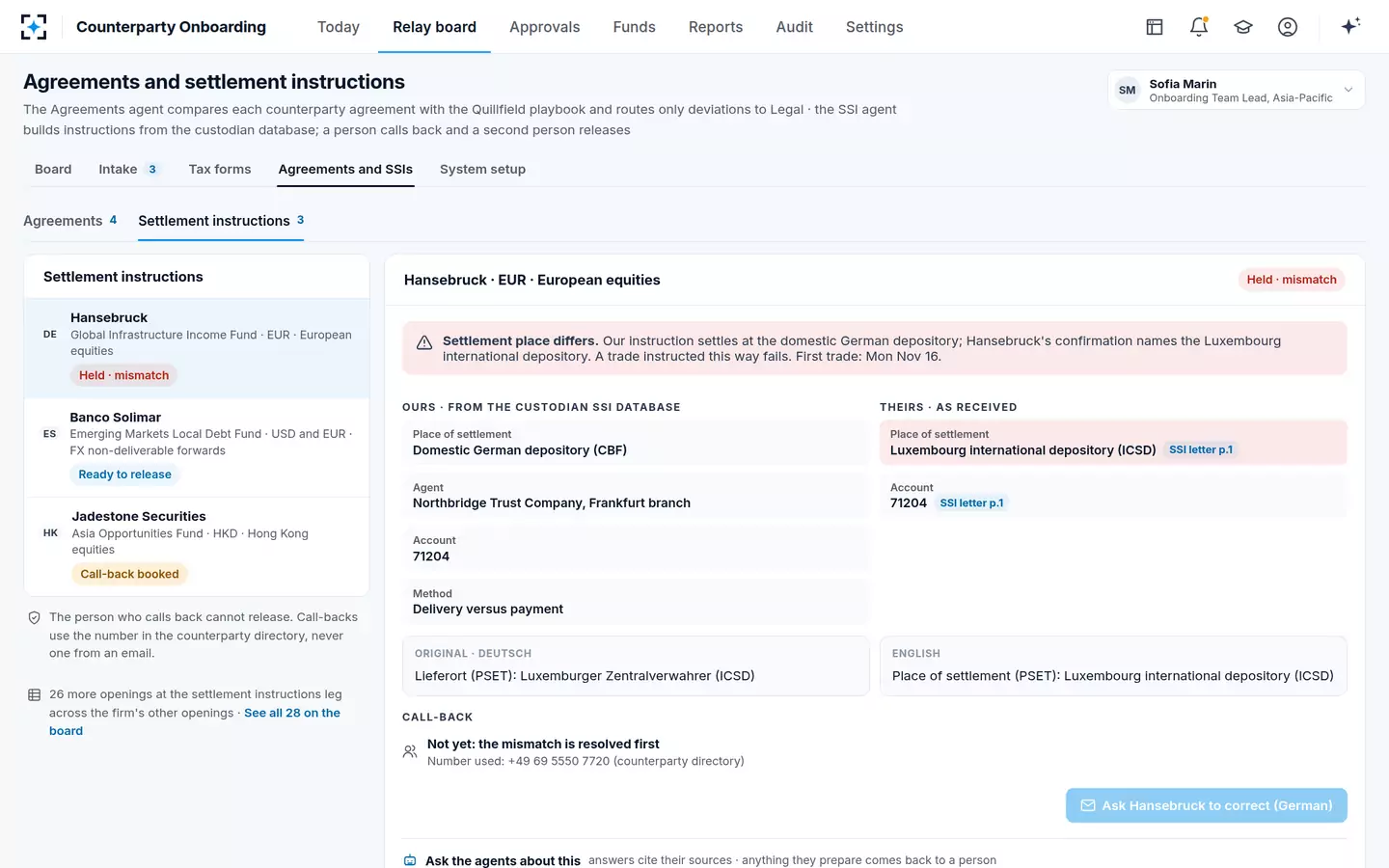
The sample firm's morning list shows all four. Gyeongbok Securities in Seoul has not replied for two days, and the Relay agent has drafted a chaser in Korean for a person to approve. Nordhavn Bank has held the prime brokerage agreement for six days. Ponte Vecchio's opening for the European real estate fund is held because the fund's LEI lapsed on October 12 and the renewal was filed on October 19. And Hansebruck's settlement instructions name a different place of settlement from the fund's own, which would fail a trade if released.
The team lead's morning: four numbers and one next step each
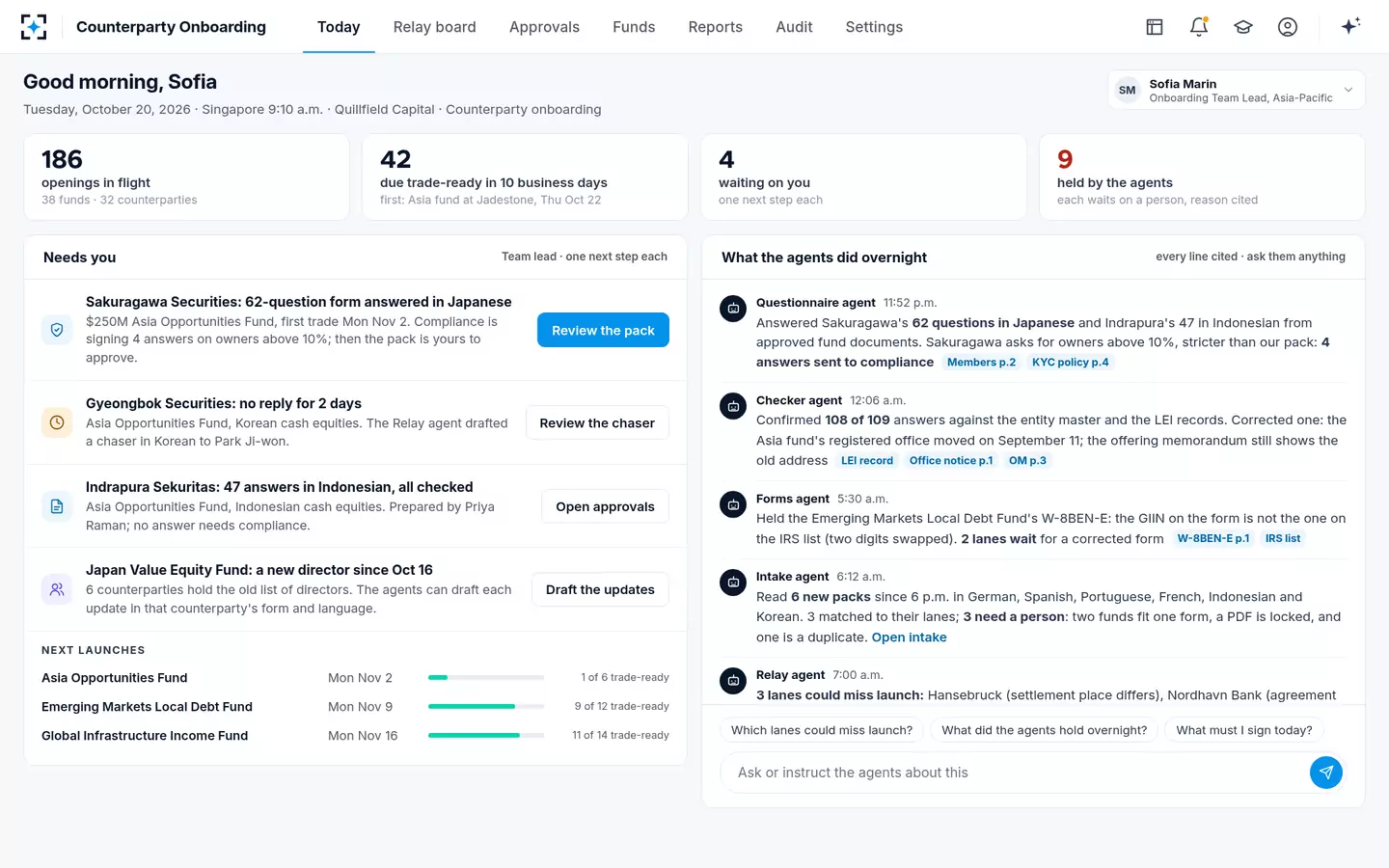
Of the four, internal signers are the cheapest to fix and the most often ignored, because no one measures them. A broker's KYC desk works to its own queue, but a compliance signature or a director's e-signature waits only on the fund. The way to see this is to record, for every lane, which party held it on each day, and to review the slowest decile each month by holder.
Who chases whom in broker onboarding?
Someone must own the chase for every lane, inside and outside the fund, and the chase works best on a written clock. In the sample firm the clock is a setting: a service level for each leg, a chaser to the counterparty after two and four days without a reply, and escalation inside the firm when a lane runs out of slack.
The clock each hand-off runs on, as settings
| Setting | Value in the sample firm | Who acts |
|---|---|---|
| Service level per leg | KYC 2 · tax forms 2 · agreements 5 · SSIs 1 · system setup 1 business days | The Relay agent plans each lane on this clock |
| Chaser to the counterparty | After 2 and 4 days with no reply, in the counterparty's language, from an approved template | Drafted by the agent; a person approves before it is sent |
| Escalation to the team lead | One day of negative slack against the first trade date | Team lead |
| Escalation to the head of operations | Three days of negative slack | Global head of investment operations |
| A counterparty asks for more than the firm's standard | Drafted from the register; compliance signs | Compliance officer |
The chase into the fund matters as much as the chase out of it. An internal signer who receives a request with the evidence attached, the deadline and the trade date it protects, signs faster than one who receives a forwarded email thread. The price of a late first trade gives the number to put in that message.
How do you approve a new broker before onboarding?
Approve the broker first, on facts you can check yourself, then open the account. The registration check is the quickest and is often skipped because the broker is well known. For a US broker-dealer it means FINRA's BrokerCheck, whose firm reports set out the profile, history, operations and disclosure events from the industry's registration database (FINRA, About BrokerCheck). For an FCM it means the NFA's BASIC system, and the FCM's own disclosure document, which CFTC rules require it to publish with its capital, material risks and recent enforcement actions (NFA BASIC; 17 CFR 1.55(k)).
The US broker population a fund chooses from
3,184
brokerage firms overseen by FINRA
146,826
branch offices
639,000+
registered representatives
Sanctions screening has to reach the broker's owners as well as the broker; the method is in the OFAC 50 rule explained. Credit approval and limits come from the fund's counterparty risk function, set out in counterparty due diligence on a bank that reports in its own language. And the decision to add the broker to the funds' approved list, and on what basis, is the trading desk's, discussed in the approved broker list. The onboarding process needs the outcome of each, with its date, before it sends the first submission.
What should the first message to a new broker contain?
Everything the broker will otherwise ask for in its second message. Most round trips in broker onboarding come from facts the fund held all along but did not send: its LEI, its category under FinCEN's beneficial ownership rule, the paragraph of the eligible contract participant definition it meets, whether it is an FCM's institutional customer, its MiFID category for an EU firm, its current authority resolution, its tax forms with expiry dates, and the operational contacts and settlement details the broker will need at setup.
Sending them with the first reply costs nothing and removes the queries that would otherwise arrive one at a time. It also fixes the fund's answers at the start: when the broker's questionnaire arrives, it can be checked against what the fund already told it, so the fund never gives the same broker two versions of the same fact.
How do T+1 settlement rules change broker onboarding?
They move settlement data from after the first trade to before it. In the US, a broker-dealer's written agreements or procedures must get each trade allocated, confirmed and affirmed on trade date (17 CFR 240.15c6-2), so a fund whose SSIs are not in place before the first order makes its broker's deadline harder to meet. In the EU, a delegated regulation requires investment firms to have professional clients supply settlement reference data in a structured electronic form and keep it up to date in good time (Delegated Regulation (EU) 2026/1536).
The UK industry plan published by HM Treasury is explicit. It expects SSIs to be communicated before trade execution where possible, and its action STAT 02 has trading venues that execute trades in in-scope securities not eligible for central clearing mandate "SSI & KYC onboarding of accounts of member firms as a condition for new membership", to be completed by 31 December 2026 (Accelerated Settlement Technical Group report, February 2025). For a fund, the lesson is the same in all three markets: SSIs belong in the onboarding, confirmed before the account is used, not collected after the first fill.
Settlement instructions held before the call-back when the place of settlement differs
Where Counterparty Onboarding fits in the broker onboarding process
Botminds' Counterparty Onboarding gives every fund-and-broker opening one lane and one plan, and moves it between people without anyone forwarding a thread. The Relay agent plans each lane back from the first trade date, hands each finished leg to its next owner with the evidence, drafts chasers in the counterparty's language and says early which lanes could miss launch and why. People keep every decision: the specialist prepares, compliance signs, a different lead approves, Legal decides, two people handle SSIs and trading operations signs trade-ready.
The management of standing settlement instructions after onboarding, including changes and fraud controls, is a separate discipline; the onboarding lane only needs the instructions confirmed and released before setup.
A broker onboarding checklist, in the order the hand-offs happen
- Broker approved
Registration checked in BrokerCheck or NFA BASIC, sanctions screened through owners, credit limit approved and dated.
- First trade date set
Every leg is planned back from it, with an owner and a due date.
- Questionnaire drafted from approved documents
Every answer cited to its page; stricter questions flagged.
- Compliance signatures in
Ownership, PEP, sanctions and source of funds.
- Submission approved by someone who did not prepare it
Then, and only then, sent to the broker.
- Tax forms approved and signed
Expiry date recorded.
- Agreement signed
Every deviation from the playbook decided by Legal.
- Account number confirmed by the broker
In writing, on the broker's channel.
- SSIs called back and released
Directory number; a second person releases.
- System setup tested
OMS counterparty, FIX session, allocation accounts, accounting; a test order acknowledged.
- Trade-ready signed
By trading operations, with the date the desk may use the broker.
Questions people ask
How long does broker onboarding take for a fund?
No regulator or independent study publishes a figure, so measure your own from the broker's first request to trade-ready. In the solution's fictional sample, one Japanese broker took three business days against the sample firm's usual 19, and the design target is about five per opening.
What is the difference between broker onboarding and broker approval?
Approval is the manager's decision that a broker may be used, based on registration, sanctions, credit and best execution. Onboarding is the work of opening the account once approved: the broker's KYC, the agreement, tax forms, SSIs and setup.
Who should own broker onboarding at an asset manager?
Usually investment operations, with a team lead accountable for each fund's launch date. Compliance, tax, Legal and trading operations each own a decision inside it, and the process works when those decisions are scheduled rather than requested ad hoc.
Do I need to check a broker on BrokerCheck if it is a large firm?
It takes minutes and records that the check was done. BrokerCheck firm reports show disclosure events and the firm's history, including mergers and name changes, which matters when the entity you contract with is not the one you expected.
What changes in broker onboarding for funds trading in the UK from 2027?
The government has committed to legislate for T+1 from 11 October 2027, and the industry plan expects SSIs to be exchanged before trading and allocations and confirmations sent electronically on trade date. Onboarding should confirm settlement data before the first trade.