Broker KYC, for a fund, is a job of answering: every broker, futures commission merchant (FCM) and bank it trades with runs its own know-your-customer review of the fund and sends its own KYC questionnaire, tax forms and agreement, and the fund must answer each accurately in its own name. Most AI tools sold for client onboarding serve the other side of that exchange: they read identity documents, screen names, extract data from registries and score risk for the broker. The AI that helps there drafts answers from the fund's approved documents in the counterparty's language, cites every answer to its page, checks each one independently and sends every ownership, sanctions and source-of-funds answer to compliance by name instead of guessing. An agent that asks the right person is safer than one that answers alone, and it is the kind of control examiners say they will look for. Botminds' Counterparty Onboarding is that kind of tool, built for the fund's side of the form.
Examples use fictional sample data from the solution, where Quillfield Capital's onboarding team answers questionnaires in Japanese, Korean, Indonesian, Portuguese and German for 38 funds.
One questionnaire answer, from question to signature
Agent
Read the questionIn the counterparty's language, with an English translation kept beside it; matched to the fund's approved facts.
Never: opens a protected file by other means
Agent
Draft from approved documentsEvery answer cited to a page of a current, approved document; questions stricter than the firm's standard are flagged.
Never: answers from a superseded document
Agent
Check independentlyA second agent on a different model re-derives the answer from the entity master, the LEI registry and the IRS list.
Never: edits silently; both sources are shown
Agent
Route by answer type and confidenceRoutine answers to the specialist; ownership, PEP, sanctions and source of funds to compliance; low confidence to the top of the review.
Never: signs anything
A person decides
Review and signThe specialist reviews routine answers; compliance signs its answers with a reason code.
A person decides
Approve and submitA team lead who did not prepare the answers approves; only then is the form sent.
How can AI help with client onboarding? Three kinds of tool, two sides of the form
AI helps client onboarding in three ways: reading and extracting documents, answering questions as an assistant, and running the work as agents with written limits. Which one helps depends on which side of the form you are on. A bank onboarding a fund needs to extract and verify; a fund answering a bank needs to draft and route.
Three kinds of AI sold for client onboarding, seen from the fund's desk
Built for the firm onboarding a client: Extracts names, addresses and owners from the client's documents to verify them.
What a fund answering its counterparties needs: Reads the counterparty's questionnaire in its language, and the fund's own documents to answer it.
Built for the firm onboarding a client: Matches the client against sanctions and PEP lists; verifies identity documents.
What a fund answering its counterparties needs: Consumes screening results the fund already has, dated, for the people it names.
Built for the firm onboarding a client: Answer an analyst's questions about a file.
What a fund answering its counterparties needs: Answer the team lead's questions about which lane could miss launch, citing sources.
Built for the firm onboarding a client: Move a client file through review and approval.
What a fund answering its counterparties needs: Plan each opening back from the first trade date, draft, check and chase, and stop where a person must decide.
Built for the firm onboarding a client: Did we verify the client correctly?
What a fund answering its counterparties needs: Did every answer given in the fund's name agree with its own records, and did the right person sign it?
The difference shows in what goes wrong. On the bank side, a weak tool lets a fraudster through: FINRA reports that fraudsters "are increasingly using GenAI tools to gain access to financial accounts and create new accounts in the names of unsuspecting investors" (FINRA, 2026 Annual Regulatory Oversight Report). On the fund side, a weak tool sends a confident answer that is wrong, in the fund's name, to a regulated firm that will rely on it. The controls differ accordingly.
Can an AI agent fill in a broker's KYC questionnaire?
Yes, as a draft that people review and sign, and the gain is large because most of a questionnaire repeats facts the fund already holds. In the sample data, Sakuragawa Securities' 62-question Japanese application was answered overnight from nine approved documents: 49 of its questions had been answered before for other brokers, five compliance-approved standard answers were reused unchanged, and every answer was cited to its page in Japanese and English.
How the agents answered a broker's form overnight
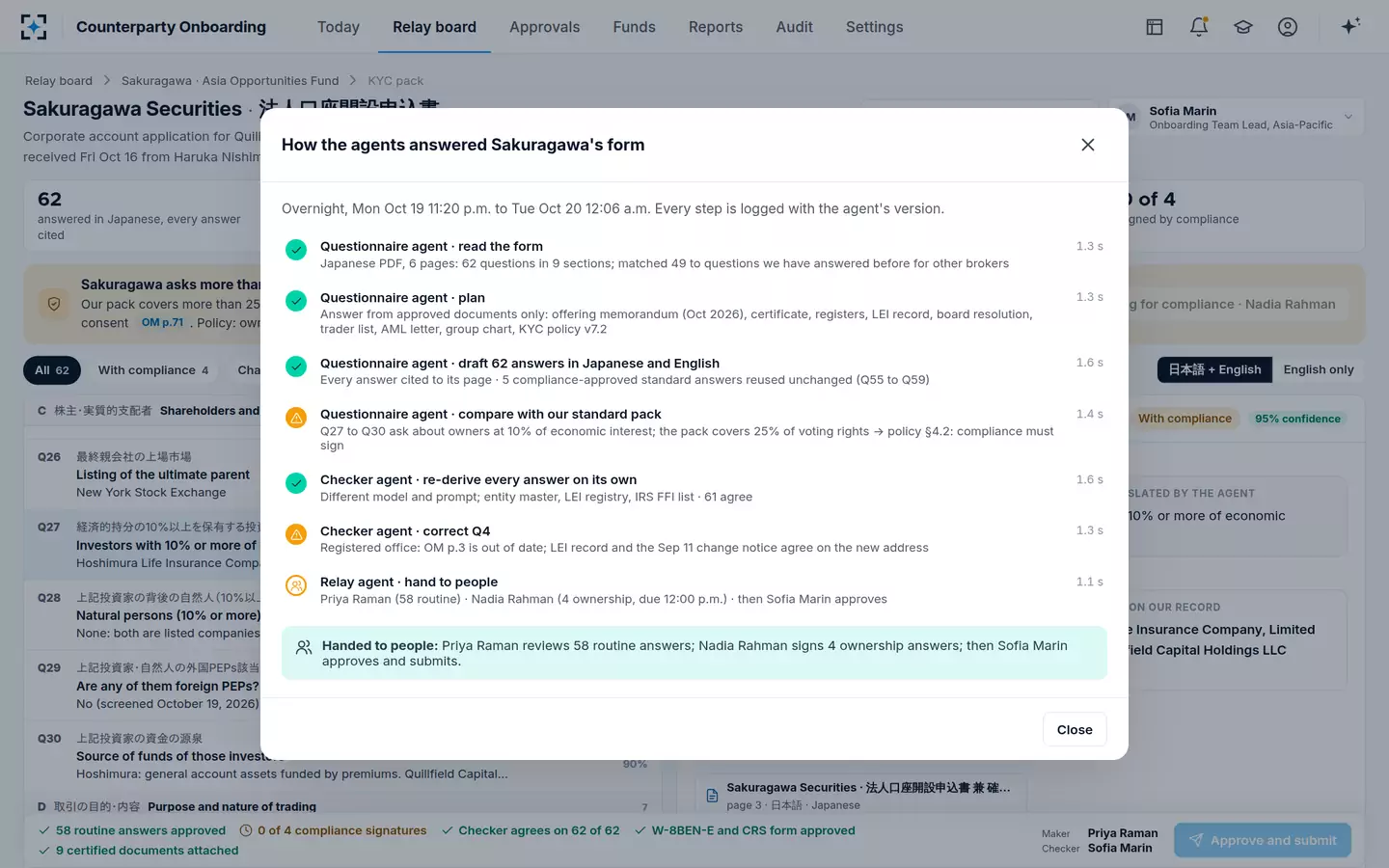
The draft is not the product; the routing is. Four of the 62 answers asked about owners at 10% of economic interest, where the sample firm's standard covers more than 25% of voting rights. An agent that reused the standard answer would have answered a different question. The agents drafted those four from the register of members, cited the investors' consent to disclosure, and sent them to the compliance officer, who signed with a reason code the next morning.
Which onboarding answers must a person approve?
All of them, before anything reaches a counterparty; the question is which person. The sample firm's rules give each class of answer an owner who cannot be bypassed.
Who approves what, when agents draft the answers
Today
Researched every answer from offering documents.
With agents
Reviews routine answers beside their sources, lowest confidence first.
Still theirs: Prepares; cannot approve their own submission.
Today
Signed ownership answers she could not trace.
With agents
Signs ownership, PEP, sanctions and source-of-funds answers with the register, consent and screening beside them.
Still theirs: The only one who can sign those answers.
Today
Typed tax forms from the entity master.
With agents
Approves forms completed and checked field by field.
Still theirs: Approves; a director signs.
Today
Read each agreement in full.
With agents
Decides the clauses outside the playbook.
Still theirs: Every deviation is a Legal decision.
Today
Approved forms prepared under time pressure.
With agents
Approves a submission only when every condition is met, and sees who prepared it.
Still theirs: Approves; cannot approve what they prepared.
How does an AI agent know whom to ask?
From written rules, set by the firm, not from the model's judgement. Three kinds of rule do the routing: answer type (ownership, PEP, sanctions and source of funds always go to compliance), comparison with the firm's standard (a stricter counterparty question goes to compliance even if the answer looks routine), and confidence (answers below a threshold go to the top of the specialist's review).
The routing rules, with the effect of a threshold shown before it changes
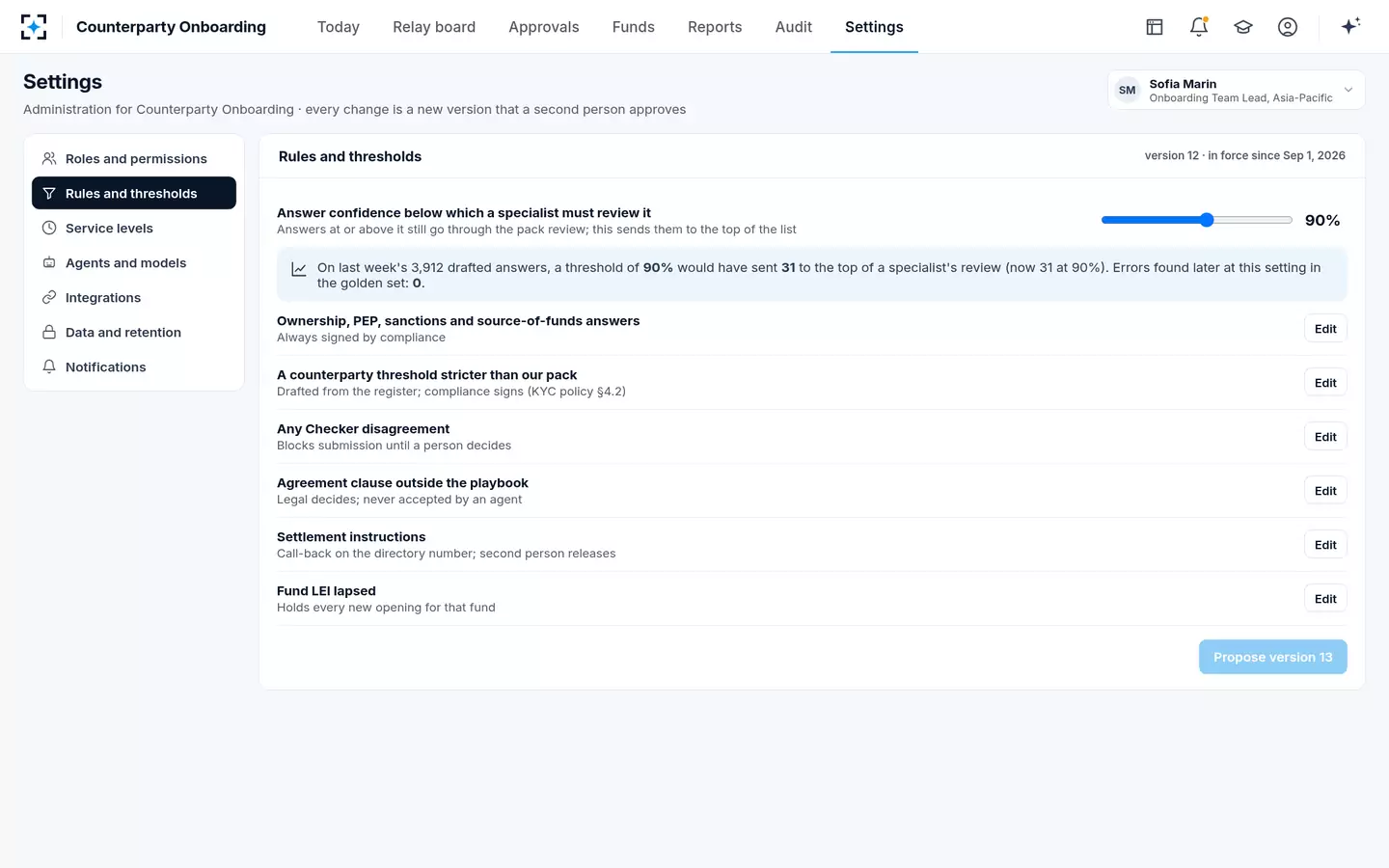
The confidence threshold deserves care, because it is the one rule tuned by trade-off. Set too high, it sends every answer to the top of the queue and the review becomes a formality; set too low, it lets uncertain answers through with the routine ones. The sample firm's setting shows the effect on last week's answers before a change is proposed: at 90%, 31 of 3,912 drafted answers went to the top of a specialist's review. Whatever the threshold, it never moves an ownership answer away from compliance.
What happens when an AI answer is uncertain, or two agents disagree?
The submission stops until a person decides. In the sample, the Checker agent re-derived all 62 answers on a different model from the entity master, the LEI registry and the IRS list of foreign financial institutions, and 61 agreed. On the 62nd, the registered office, the offering memorandum's directory showed an old address while the LEI record and a change notice dated September 11 showed the new one. The agent corrected the answer, showed both sources and flagged the memorandum for its next supplement; the specialist accepted the correction.
That design rests on a simple observation: a second reading is evidence only if it reads the sources again rather than the first answer. Two agents agreeing because one copied the other prove nothing; two agents reaching the same answer from different records do. How to test KYC questionnaire answers for accuracy turns that into a test a firm can run before trusting any tool.
What do regulators say about AI in AML compliance and back-office work?
Regulators expect firms to supervise AI with the controls they already owe, and they are starting to examine it. The SEC's Division of Examinations describes registrants building what it calls "super intelligence" into their businesses, and its fiscal 2027 priorities include examining policies and procedures for monitoring that technology, including its use in fraud prevention, back-office operations and compliance with anti-money laundering obligations (SEC, FY2027 examination priorities). An onboarding tool whose answers feed a counterparty's AML file sits squarely in that scope.
How far UK financial firms let AI decide on its own
55%
of reported AI use cases involve some degree of automated decision-making
2%
of use cases have fully autonomous decision-making
118
firms responded to the survey
The survey's message for onboarding is about where the line sits. Automating parts of a decision is common; letting a model decide alone is rare. A fund's answers to its counterparties are statements in its own name, and the beneficial ownership certification under FinCEN's rule is literally certified by an individual as accurate to the best of their knowledge (31 CFR 1010.230(b)(1)). No tool can give that certification for them.
What should an AI agent answering broker KYC never do?
They should never act where the fund's accountability sits. In the solution's governance, the agents may never send anything to a counterparty without a person's approval, sign for anyone, release settlement instructions, activate a counterparty in the order management system, mark a fund trade-ready, answer from a superseded document or accept an agreement deviation. Any tool you evaluate should be able to show its own list, in writing, and show it enforced in the software rather than in a policy.
Questions to put to any AI tool for client onboarding before a pilot
- Show me the source of every answer
Each answer should open the page it came from, in the original language.
- What does it do with a question stricter than our standard?
The right answer is: flag it and route it, never reuse the standard.
- Who checks the draft, and how?
An independent re-derivation from records, not the same model re-reading its answer.
- Which answers can it never route away from compliance?
Ownership, PEP, sanctions and source of funds.
- Can the preparer approve their own submission?
The software, not a policy, should prevent it.
- What happens to a lapsed LEI or a wrong GIIN?
It should hold the opening before any counterparty receives the form.
- Can it send anything without a person?
It should not, including chasers.
- What is logged?
Who, what, when, why, the evidence and the agent version, exportable per opening.
Counterparty Onboarding is for the fund's side of the form
Botminds' Counterparty Onboarding is for the fund's side of counterparty onboarding: opening the fund's accounts at brokers, FCMs and FX banks, from each counterparty's questionnaire and tax forms to agreements, settlement instructions and system setup. It works with the screening, entity master and document stores the firm already has; it is not an identity verification service, a sanctions screening engine or a credit system.
For the other direction, a manager onboarding its own investors and clients, the tools are different and so are the rules: investor KYC and AML onboarding covers investors in the funds, and institutional client onboarding covers mandates. The approach shared by all three is the one on this page: agents read and draft, a second agent checks against records, and named people decide. The four approaches to client onboarding solutions compares this with building, buying a platform or outsourcing.
Questions people ask
What are the best AI tools for broker KYC at an asset manager?
It depends on direction. For onboarding your own investors, identity verification, screening and document extraction tools; for being onboarded by your brokers, agents that draft answers from approved documents, check them independently and route risky answers to compliance. Ask any vendor to show the source of every answer.
Can AI sign a KYC questionnaire or a W-8BEN-E?
No. The IRS requires a W-8BEN-E to be signed by an authorised representative or officer, and a beneficial ownership certification is certified by the individual opening the account. An agent can complete and check the form; a person signs.
Is using AI for onboarding allowed by regulators?
Regulators have not prohibited it; they expect existing obligations to be met whatever the technology. The SEC's fiscal 2027 examination priorities include firms' policies for monitoring super intelligence, its term, in back-office operations and AML compliance.
How accurate are AI agents at answering KYC questionnaires?
No regulator or independent study publishes accuracy for this task, so measure it on your own past questionnaires. In the solution's sample, an independent check agreed with 61 of 62 drafted answers and corrected the one that came from an out-of-date document.
Does an AI onboarding tool replace the onboarding team?
No. It removes copying, translating and chasing; people still review, sign, approve and decide every deviation. In the sample, each of the opening's five legs was finished by a different named person.