The fund onboarding process, in investment operations, is the work of getting a new fund accepted by every counterparty it needs, its brokers, futures commission merchants (FCMs), FX banks and prime broker, and set up to trade with each, before its first trade date. A launch is ready only when the last counterparty is, so the process is as fast as its slowest opening. No regulator or independent study publishes how long it takes or what a late first trade costs; both have to be measured from the firm's own launches. The cost of a day is the return the fund's money does not earn while it waits, the fees the manager does not earn, and the commitments to investors that slip with the date. Most of the days are waits between parties, which makes them the cheapest to remove. Botminds' Counterparty Onboarding plans every opening back from the first trade date and says early which ones could miss it, and why.
Examples come from fictional sample data in the solution: Quillfield Capital is launching three funds in November 2026 and adding markets to a fourth.
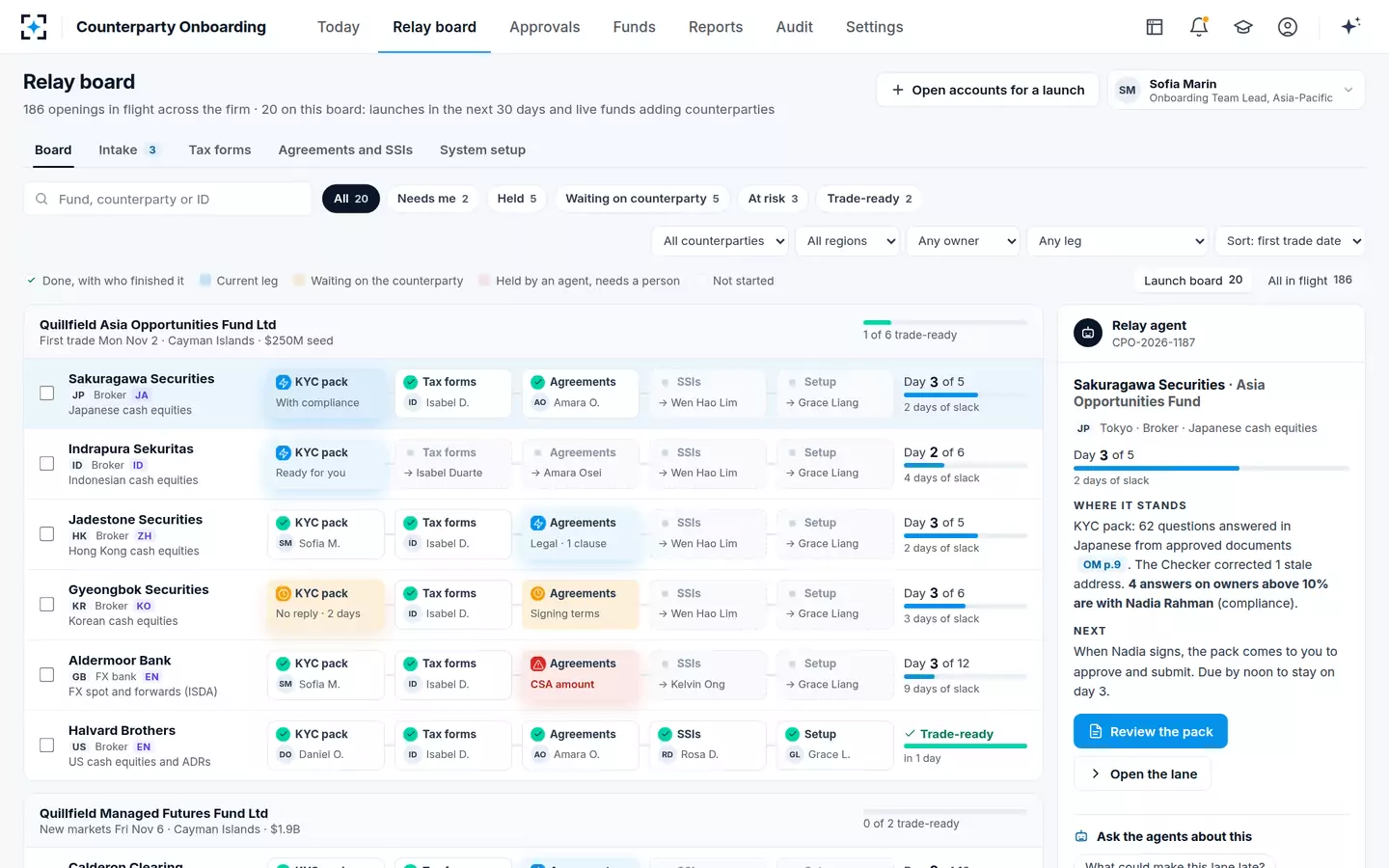
One launch, six counterparties: the slowest opening sets the date
- Doneday 1
- Elapsed2
- Slack4 left
- Elapsed3
- Slack2 left
- Elapsed3
- Slack2 left
- Elapsed3
- Slack3 left
- Elapsed3
- Slack9 left
How long does the fund onboarding process take?
As long as the slowest opening, measured from the day each counterparty's forms arrive to the day trading operations signs the fund ready to trade with it. Industry surveys are often quoted, but no regulator or independent study publishes a figure, and the spread between counterparties is wide: in the sample launch above, a US broker was ready in a day while an FX bank's target is twelve business days because its ISDA Master Agreement and Credit Support Annex must be negotiated.
One sample opening, and the target
3days
Sakuragawa Securities, from the broker's 62-question form to trade-ready
Sample data
19days
the sample firm's usual time for the same opening by hand
Sample data
5days
design target per fund-and-counterparty opening
Target
How do you measure fund onboarding time? Four numbers per launch
Measure each opening, then the launch. Four numbers are enough: the business days from the counterparty's first request to trade-ready, per opening; the same, per leg (KYC questionnaire, tax forms, agreement, settlement instructions, system setup); the days each opening was held by each party, the counterparty, an internal signer, a document the fund had to produce, or rework after a query; and, per launch, the days between the last opening's trade-ready and the planned first trade, which is negative when the launch slips.
The third number is the one most firms lack and the one that shows what is avoidable. A day waiting on a counterparty's KYC desk can be chased but not removed; a day waiting on a director's signature, a renewed LEI or a corrected tax form is the fund's own. The hand-offs in the broker onboarding process sets out who holds each wait.
Three November launches, by share of openings trade-ready on October 20
Asia Opportunities Fund · first trade Nov 2
- Trade-ready, 1 · 17%
- In flight, 5 · 83%
Emerging Markets Local Debt Fund · Nov 9
- Trade-ready, 9 · 75%
- In flight, 3 · 25%
Global Infrastructure Income Fund · Nov 16
- Trade-ready, 11 · 79%
- In flight, 3 · 21%
What does a delayed first trade cost a new fund?
Three things, in different hands. The fund's money sits in cash instead of the portfolio its investors subscribed for; the manager earns no fee on assets it cannot invest, or invests them through a stop-gap; and the dates the fund promised, to its seed investor, its distributors or its board, slip with the trade date. Only the first is a cost to investors. The method below prices each one for a single day; the inputs are the firm's own.
The cost of one business day's delay to a fund's first trade, written as a sum
Return the money does not earn
seed × (expected portfolio return − cash yield) ÷ 252
An expected cost, not a certain one: markets can fall while the fund waits. Use the fund's own long-run assumption, never a forecast.
Portfolio manager and risk
Fees not earned
assets × management fee rate ÷ 365
The manager's cost, where fees start with the first trade or the launch date in the fund documents.
Finance
Commitments that slip
priced case by case
Seed agreement milestones, distributor launch dates, a board-approved launch. Some carry terms; most carry reputation.
Product and legal
Days the agents remove
(usual days − days with agents) × the sum above
Count only waits that disappear, not work that moves to another person.
Operations
The arithmetic behind the illustration is short: $250 million × 4% ÷ 252 is about $39,700, and $250 million × 0.75% ÷ 365 is about $5,100. Change the expected return and the first term moves in proportion; it can even turn into a gain in a falling market, which is why it should be presented to a board as an expected cost with its assumption stated, not as a loss.
Who bears the cost of a missed launch date?
Investors bear the cash drag, the manager bears the fees and the reputational cost, and the operations team bears the work of the stop-gaps. For a fund with a liquidity risk program, cash is not idle in the rule's eyes either: the SEC's liquidity rule asks funds to consider short-term and long-term cash flow projections in assessing liquidity risk (17 CFR 270.22e-4(b)(1)(i)). A launch that leaves the seed in cash for weeks changes those projections, and the fund's own disclosures should tell investors what to expect.
Research on funds' cash shows why the difference matters to performance. Chernenko and Sunderam, in an NBER working paper, find that mutual funds hold large cash buffers to absorb investor flows rather than trade the portfolio, especially funds with illiquid assets (NBER Working Paper 22391). Cash held by choice is a liquidity tool; cash held because a broker account is not open is drag with no benefit.
Which fund onboarding delays are avoidable?
Every wait the fund holds itself, and most of the rework. The table sorts the delays in the sample firm's openings by who controls them; the first three rows are the fund's own.
Fund onboarding delays, by who can remove them
| Delay | Who holds it | Avoidable? | Sample case |
|---|---|---|---|
| A signature waits in an inbox | Internal signer: compliance, a director, Legal | Yes: schedule signatures from the first trade date | Four compliance signatures due by noon to keep a lane on its day |
| A fund document is out of date | The fund | Yes: check against independent records before sending | An address that moved after the offering memorandum was printed |
| A fund identifier lapsed or wrong | The fund | Yes: check LEIs and GIINs daily, not at submission | A lapsed LEI holding the European real estate fund's opening |
| The counterparty asks a stricter question | The counterparty's policy | Partly: route it on day one, not after a query | Owners at 10% of economic interest |
| The counterparty does not reply | The counterparty | No, but it can be chased early, in its language | Gyeongbok Securities, no reply for two days |
| A negotiated term | Both sides' Legal | Partly: start the agreement first | A CSA amount held at an FX bank |
T+1 settlement adds a seventh row: settlement data. It applies in the US now, in the EU from 11 October 2027, and in the UK from the same day under the government's plan. The UK industry plan notes that under T+1 the time available for customer due diligence before settlement is compressed, and asks for onboarding standards that collect the data needed to settle (Accelerated Settlement Technical Group report, February 2025). A fund whose settlement instructions are not confirmed with each counterparty before the first trade risks a failed settlement on its first day.
Three lanes that could miss launch, named with their reason
How early can you see a launch slipping? Watch slack, not elapsed days
Early enough to act, if each opening carries a target and its slack is visible every morning. Elapsed days say how long a lane has been open; slack says how many days it can still lose before the first trade moves. A lane on day 3 of a 12-day target is in less danger than one on day 3 of 5, and a lane with negative slack has already moved the launch unless something changes today.
The sample firm turns slack into escalation rules: the onboarding team lead is told when any lane reaches one day of negative slack, and the global head of investment operations at three. That makes a slipping launch a named person's problem while there is still time to choose: chase the counterparty's senior contact, split the order flow to a broker that is ready, or move the date with the seed investor's agreement. Each of those decisions belongs to people; the plan only has to surface it in time.
What a launch readiness report should show the COO
One line per launch, and one line per opening that could move it. A report that lists every open task hides the two that matter; a report that shows only percentages hides why. Five facts per launch are enough for a decision.
A launch readiness report, one row per fund
| Field | What it shows | Why it matters |
|---|---|---|
| First trade date | The date every opening is planned back from | Everything else is measured against it |
| Openings ready of needed | Trade-ready counterparties against the launch plan | The launch is ready only at 100% |
| Lanes at risk, with reason | Each opening with negative or thin slack, and what holds it | Turns a percentage into a decision |
| Who holds each at-risk lane | Counterparty, internal signer, fund document or rework | Shows which delays the firm can remove itself |
| Decision needed and by when | Chase, re-route, or move the date | Puts the choice in front of the person who can make it |
Where Counterparty Onboarding takes the days out
Botminds' Counterparty Onboarding removes the days that come from copying, translating, re-checking and chasing, and makes the remaining waits visible early enough to act on. Each opening is planned back from the first trade date with a target per leg; the Relay agent hands each finished leg to its next owner with the evidence and says each morning which lanes could miss launch and why; the Checker agent finds out-of-date documents and lapsed identifiers before a counterparty does.
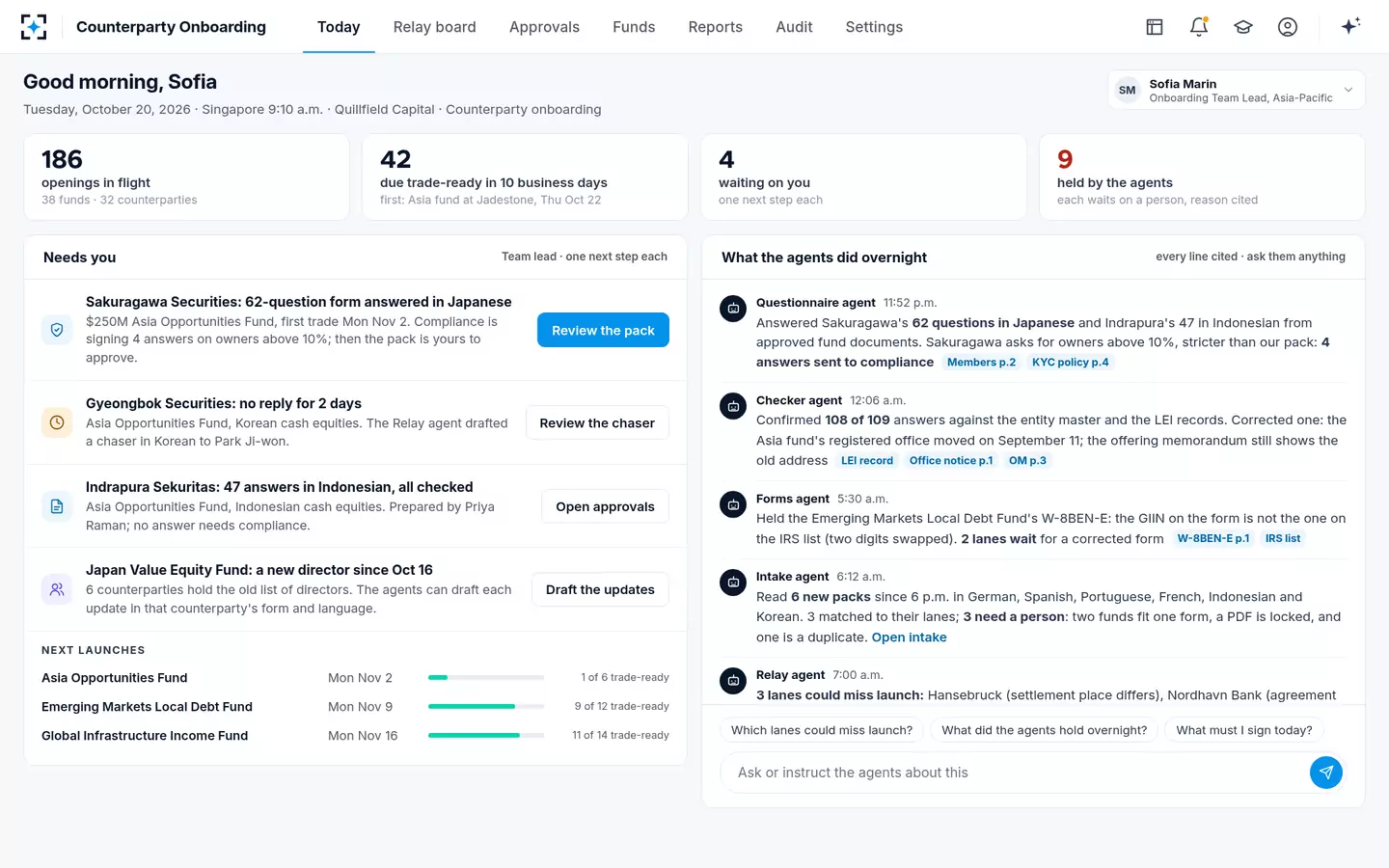
Asked which lanes could miss launch, the sample firm's agents name three: Hansebruck for the Global Infrastructure Income Fund, on its last planned day with a place-of-settlement mismatch; Nordhavn Bank for the Currency Alpha Fund, where the prime brokerage agreement has been with the bank for six days; and Ponte Vecchio for the European real estate fund, held by a lapsed LEI whose renewal was filed on October 19. Each has an owner and a next step. The decisions stay with people; the agents make sure no one hears about a missed launch on the launch date.
The morning view: what is due, what waits on whom
Questions people ask
What is the fund onboarding process?
In investment operations, it is opening a new fund's accounts with each broker, FCM, FX bank and prime broker it needs, answering their KYC questionnaires, providing tax forms, signing agreements, exchanging settlement instructions and setting up systems, before the fund's first trade.
How long does it take to launch a fund's trading accounts?
No regulator publishes a figure, and it varies by counterparty: a broker that needs only a questionnaire can be ready in days, while a bank that needs an ISDA Master Agreement and Credit Support Annex takes longer. Measure your own, per counterparty, from first request to trade-ready.
What is cash drag on a new fund?
The difference between what the fund's money earns in cash and what it would have earned invested as intended. Before the first trade it is the whole seed; price it as an expected cost with your assumption stated, because markets can also fall while the fund waits.
Can a fund trade before all its counterparty accounts are open?
It can trade with the counterparties that are ready, if its strategy allows. Whether to launch with fewer brokers is a portfolio and best-execution decision, not an operations one, and should be made before the launch date, not on it.
Who should own the fund launch date in operations?
An onboarding or launch lead who sees every opening for the fund, with authority to escalate. In the sample firm, the team lead is escalated at one day of negative slack and the global head of investment operations at three.