A give-up agreement in futures is the agreement, made before any trade, between a fund, the broker that executes its orders and the futures commission merchant (FCM) that clears them, under which the executing broker "gives up" each trade to the clearing FCM. The CFTC requires it: when a firm executes an order for a customer but gives it up to another firm for clearing, the clearing FCM must set risk-based limits for that customer and agree in advance with the executing firm that it will screen the customer's orders against them. So the agreement is the clearing FCM's risk control reaching into another broker's order flow, not paperwork. For a fund that uses several executing brokers, every one of them needs it before the first order. Botminds' Counterparty Onboarding treats each give-up as part of the agreement leg of a futures opening, with the clearing FCM's documents compared clause by clause and the three signatures chased to a date.
Examples on this page come from fictional sample data in the solution, where Quillfield Capital's Managed Futures Fund is adding new markets and clearing brokers. The rules are quoted from the CFTC's regulations in the Code of Federal Regulations.
A futures give-up, from order to cleared position
| Step | Who | What happens | The rule |
|---|---|---|---|
| 1. Order | The fund's trader | Sends the order to an executing broker the fund has a give-up agreement with, naming the clearing FCM and account. | The agreement must exist first: 1.73(a)(2)(iv)(A) |
| 2. Screen | Executing broker | Checks the order against the risk-based limits the clearing FCM set for this fund, before it reaches the market. | 1.73(a)(2)(iv)(A) |
| 3. Give-up | Executing broker | Submits the fill for clearing into the fund's account at the clearing FCM. | 1.72 bars terms that restrict the fund's choice of executing brokers |
| 4. Accept or reject | Clearing FCM | Accepts or rejects against its own criteria, as quickly as fully automated systems would allow. | 1.74(b) |
| 5. Reconcile | The fund's operations | Matches the cleared position and fees on the FCM statement with the executing broker's confirmation. | The fund's own control |
What is a give-up agreement? Three parties, one customer account
A give-up agreement is a three-party contract that separates who executes a futures trade from who carries it. The fund keeps one account, with margin, at its clearing FCM. It can then send orders to any executing broker with which it has an agreement, and each executed trade is moved into that account. The arrangement lets a manager choose execution by market or by desk while its margin, collateral and statements stay in one place.
The executing broker accepts a duty in the agreement: to screen the fund's orders against limits it did not set. The clearing FCM accepts the trades the executing broker gives up, within those limits. The fund agrees to both and to the fees each charges. This guide describes what the agreement must achieve under the CFTC's rules, not the wording of any particular form.
Why does a futures give-up need an agreement in advance? Because the FCM carries the risk
The clearing FCM guarantees the fund's positions to the clearing house, so it must control how much risk the fund can put on, including through orders it never sees before execution. The CFTC's clearing FCM risk management rule makes the advance agreement the mechanism.
"The clearing futures commission merchant shall establish risk-based limits for the customer, and enter into an agreement in advance with the executing firm that requires the executing firm to screen orders for compliance with those limits"
17 CFR 1.73(a)(2)(iv)(A), Commodity Futures Trading Commission
The rest of Rule 1.73 shows what those limits are for. The clearing FCM must set limits in each customer account "based on position size, order size, margin requirements, or similar factors", monitor them intra-day and overnight, stress test customer accounts that could pose material risk at least once a week, and evaluate weekly its ability to meet initial and variation margin (17 CFR 1.73(a)). A give-up agreement is how that framework extends to an order placed with someone else.
Rule 1.74 closes the loop on the other side. The clearing FCM must accept or reject each trade submitted for it or its customers "as quickly as would be technologically practicable if fully automated systems were used", and may do so by pre-screening orders against criteria it specifies or by authorising the clearing house to accept or reject on its behalf (17 CFR 1.74(b)). The executing broker's screen is, in effect, the FCM's criteria applied before execution.
What the CFTC forbids in clearing arrangements, and why it protects the fund
The rules also limit what an FCM can demand through the paperwork. Rule 1.72 bars any customer clearing arrangement with five effects, and together they mean a give-up agreement may set an overall risk limit but may not narrow the fund's choice of executing brokers or its access to good prices.
Five things no FCM clearing arrangement may do
| Rule 1.72 | The arrangement may not | What it means for the fund |
|---|---|---|
| (a) | Disclose to the FCM, a swap dealer or major swap participant the identity of a customer's original executing counterparty | The clearing side cannot use the paperwork to learn whom the fund traded with. |
| (b) | Limit the number of counterparties with whom a customer may enter into a trade | The fund may add executing brokers; each needs its own agreement, not the FCM's permission. |
| (c) | Restrict position size with any individual counterparty, apart from an overall limit at the FCM | The FCM sets one overall limit, not a cap per executing broker. |
| (d) | Impair a customer's access to execution on terms with a reasonable relationship to the best terms available | Clearing terms cannot steer the fund away from better prices. |
| (e) | Prevent compliance with the acceptance timeframes in 1.74(b), 23.610(b) or 39.12(b)(7) | Trades are accepted or rejected promptly, so the fund knows where it stands. |
For a fund's operations team, rule (b) is the practical one. Adding an executing broker is the fund's decision, made through the broker approval process; what the fund needs from the clearing FCM is not consent but its signature on one more agreement. A request that stalls on the FCM's side is a request to chase, not a negotiation over whether the broker may be used.
Block orders: when the asset manager does the screening
When a manager bunches orders for several funds into one block and allocates the fills after execution, the rule moves part of the screening duty onto the manager. The FCM that first clears the block must set limits for the block account and screen the order; the FCMs that clear the allocated trades must set limits for each customer "and enter into an agreement in advance with the account manager that requires the account manager to screen orders for compliance with those limits" (17 CFR 1.73(a)(2)(v)(B)).
That has two consequences for a manager that trades futures for several funds. Its own order management system must hold each fund's limits at each clearing FCM and check orders against them, and the onboarding of a new fund at an FCM is not finished until those limits are loaded and tested. The system setup leg of the opening, not just the agreement leg, carries the CFTC requirement.
How much paperwork is it? The CFTC's own estimate
The CFTC estimates the burden of the customer clearing documentation its rules require each time it renews the information collection, and its August 2026 notice gives the latest figures.
The CFTC's estimate of the customer clearing documentation burden
204
respondents: the firms that must keep customer clearing documentation
40hours
average annual burden per respondent
8,160hours
estimated total burden a year
The figure is the brokers' burden, not the fund's, and it is modest per firm. The fund's cost is different in kind: it is the days a new executing broker cannot be used while three parties sign. No regulator or independent study publishes how long that takes, so measure it per agreement, from the request to the last signature, and record which party held it longest.
Who signs a give-up agreement for a fund?
Someone with documented authority to bind the fund signs for it, and that is usually where the time goes. The executing broker and the clearing FCM each sign for themselves; the fund's signature comes from a director, the general partner or the manager acting under its investment management agreement, depending on the fund's structure. The FCM keeps a record of anyone who exercises trading control over the account (17 CFR 1.37(a)), so the signatory and the traders named must match the authority the fund has given. The account opening resolution is the document that settles who that is.
Six people on one give-up, and what each holds
Today
Emails three parties and tracks signatures in a spreadsheet.
With agents
Sees the agreement as one leg of the futures opening, with the party holding it and the days elapsed.
Still theirs: Approves what is sent in the fund's name.
Today
Reads each FCM's form from scratch.
With agents
Gets the clauses that differ from the playbook, with the standard wording beside them.
Still theirs: Decides every deviation.
Today
Signs when asked, often without knowing the trade date it blocks.
With agents
Signs with the resolution that gives the authority attached.
Still theirs: The only one who binds the fund.
Today
Learns a broker is unusable when an order is rejected.
With agents
Sees which executing brokers are live for which fund and clearing account.
Still theirs: Chooses where to execute.
Today
Waits for the FCM's limits to set up the screen.
With agents
Receives the signed agreement and the limits together.
Still theirs: Screens every order before execution.
Today
Sets limits and accepts trades under Rules 1.73 and 1.74.
With agents
Unchanged; its acceptance criteria are its own.
Still theirs: Accepts or rejects every trade.
What happens to a futures trade without a give-up agreement?
There is no route for it. The rule requires the clearing FCM to have agreed in advance with the executing firm, so a fund that has not completed the agreement cannot route orders to that broker for that clearing account. The practical risks come from the edges: an agreement signed for one fund but not the next fund the manager launches, an agreement that names an old clearing account, or limits loaded at the executing broker for the wrong entity.
Each of those is a data problem as much as a legal one. The fund name, its LEI, the clearing account number and the names of the people with trading authority must match across the agreement, the FCM's account records and the executing broker's screen. Checking that match is cheaper before the first order than after a rejected one. Before a new FCM is chosen at all, its registration and disciplinary history can be read in the NFA's BASIC system, which the CFTC requires every FCM to link to from its website (NFA BASIC; 17 CFR 1.55(o)(3)).
The agreement leg of an opening, with every clause decision on the record
Where Counterparty Onboarding fits in a futures opening
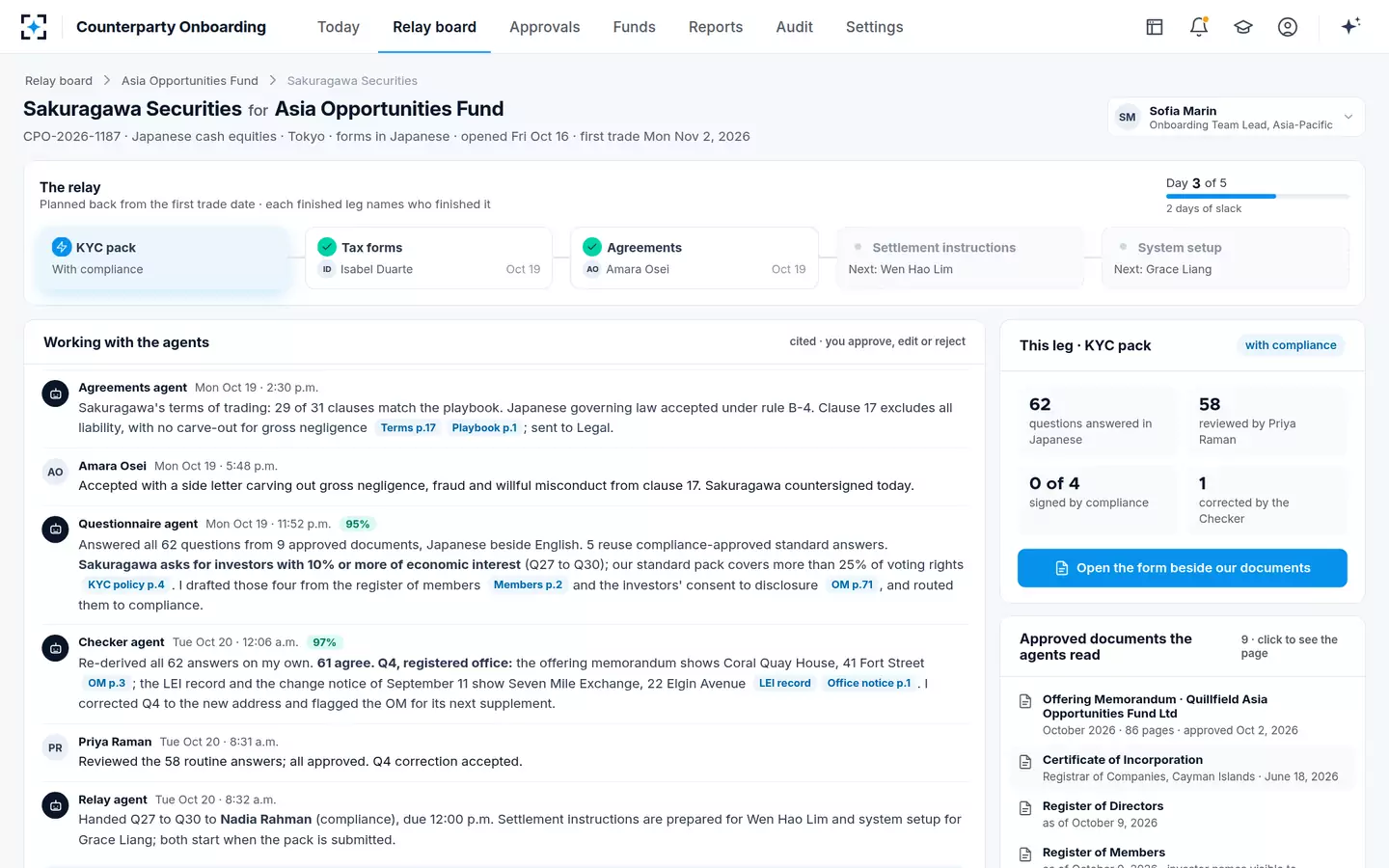
Botminds' Counterparty Onboarding runs a futures opening as a lane with the clearing FCM's documents and each give-up inside the agreement leg. The Agreements agent compares each document with the firm's playbook and drafts the redline for Legal; the Relay agent plans the lane back from the date the fund wants to trade the new market and chases whichever party is holding the signature, in that party's language; the Setup agent prepares the allocation accounts and the order management requests, with every value cited to the signed agreement.
The limits are not the agents' to set. The clearing FCM sets them, the executing broker screens against them, and the fund's trading operations confirms they are loaded before signing the fund ready to trade. The agents never sign an agreement, never accept a deviation and never activate a broker in the order management system.
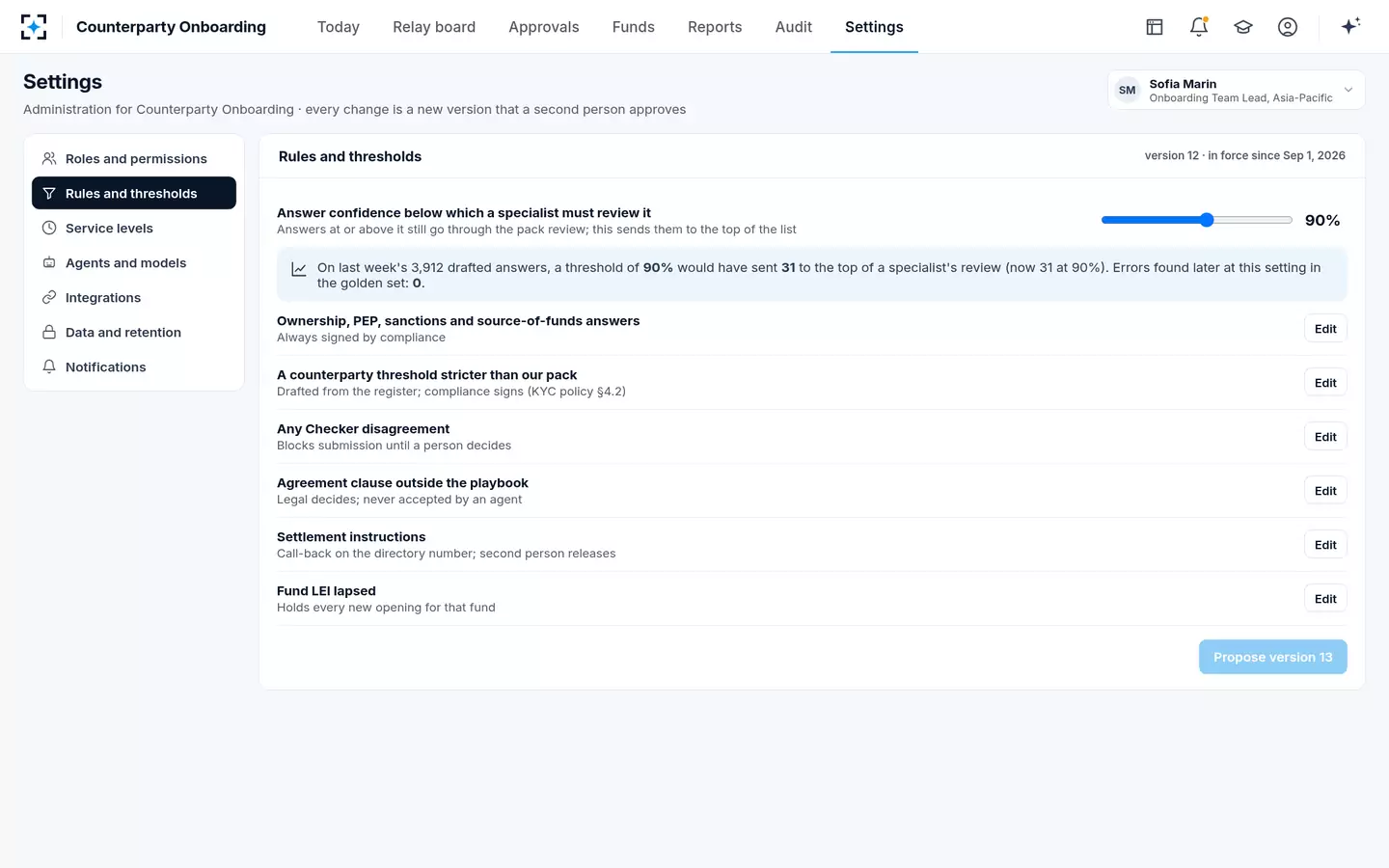
The rules a futures opening runs on, as versioned settings
Before the first order through a new executing broker
- Agreement signed by all three parties
Fund, executing broker and clearing FCM, for this fund and this clearing account.
- Limits set by the FCM and received by the broker
The screen Rule 1.73 requires is live before execution.
- Signatory authority on file
The resolution that lets the signer bind this fund.
- Traders named match the FCM's records
Rule 1.37 has the FCM record anyone exercising trading control.
- Block allocation limits loaded
If the manager bunches orders, its own system screens each fund's limits.
- Fees agreed
Execution and give-up fees on both brokers' schedules.
- Desk told the broker is live
For which fund and which clearing account, from which date.
Questions people ask
What is the difference between the executing broker and the clearing broker?
The executing broker takes the fund's order and gets it filled; the clearing FCM carries the resulting position, holds the margin and guarantees it to the clearing house. A give-up agreement lets one fund use many executing brokers while keeping a single clearing account.
Does the CFTC require a give-up agreement?
Yes, in substance. CFTC Rule 1.73 requires a clearing FCM to set risk-based limits for a customer whose trades are given up to it and to agree in advance with the executing firm that it will screen orders against those limits.
Can a clearing FCM limit which executing brokers a fund uses?
No. CFTC Rule 1.72 bars clearing arrangements that limit the number of counterparties a customer may trade with or restrict position size with any one of them, apart from an overall limit at the FCM.
Who screens orders when a manager trades a block for several funds?
The account manager. Rule 1.73(a)(2)(v) requires the FCMs clearing the allocated trades to agree in advance with the manager that it will screen orders against each customer's limits, while the FCM that first clears the block screens the block itself.
Is a give-up agreement the same as an ISDA?
No. A futures give-up agreement governs execution and clearing of exchange-traded futures through an FCM; an ISDA Master Agreement governs bilateral OTC derivatives with a dealer. A fund that trades both needs both, in different legs of different openings.