A KYC questionnaire is the form each broker, FCM and bank sends a fund before it opens the fund's account, asking who the fund is, who owns and controls it, where it is resident for tax and how it will trade (its sections are laid out in the due diligence questionnaire template). Automation can read each counterparty's questionnaire, fill every field from the fund's documents, track expiries and chase replies, and it makes files complete quickly. Completeness is the wrong test of it. The errors that cost an opening days, or put a misstatement in a regulated firm's file, are fields that are filled in and wrong: a legal entity identifier (LEI) that has lapsed, a GIIN with two digits swapped, a registered office that moved after the offering memorandum was printed, a 25% ownership answer to a 10% question. Every one of them passes a check that asks whether the field is empty. The test that finds them re-derives a sample of "complete" files from independent records and counts the disagreements. Botminds' Counterparty Onboarding builds that test into the work: a second agent re-derives every answer from the entity master, the LEI registry and the IRS list of foreign financial institutions, and any disagreement stops the submission until a person decides.
Examples come from fictional sample data in the solution; the public figures come from the Global LEI Foundation's data and from regulators, linked where they appear.
One fund LEI in four in the global index has lapsed
What in a KYC questionnaire can be automated, and what should not be?
The mechanical work can be automated: reading each counterparty's questionnaire in its language, drafting answers from approved documents, completing tax forms from the entity master, computing their expiry, building settlement instructions from the custodian's database, preparing system setup requests and chasing replies. The decisions should not: signing for the fund, approving ownership and sanctions answers, accepting an agreement deviation, releasing settlement instructions and declaring a fund ready to trade.
Between the two sits checking, and that is where most automation projects stop too early. A tool that fills a form from a document reproduces the document's errors; a tool that checks the form against the same document confirms them. Checking only adds information when it uses a different source from the one the answer came from.
Which onboarding errors pass a completeness check?
Any error in a field that has a value. The table lists the ones that matter in counterparty onboarding, why a completeness check passes them, and the independent record that catches each. Every example is from the solution's fictional sample data.
Eight errors that pass a completeness check, and the record that catches each
| Error | Why it passes | What catches it | Sample case |
|---|---|---|---|
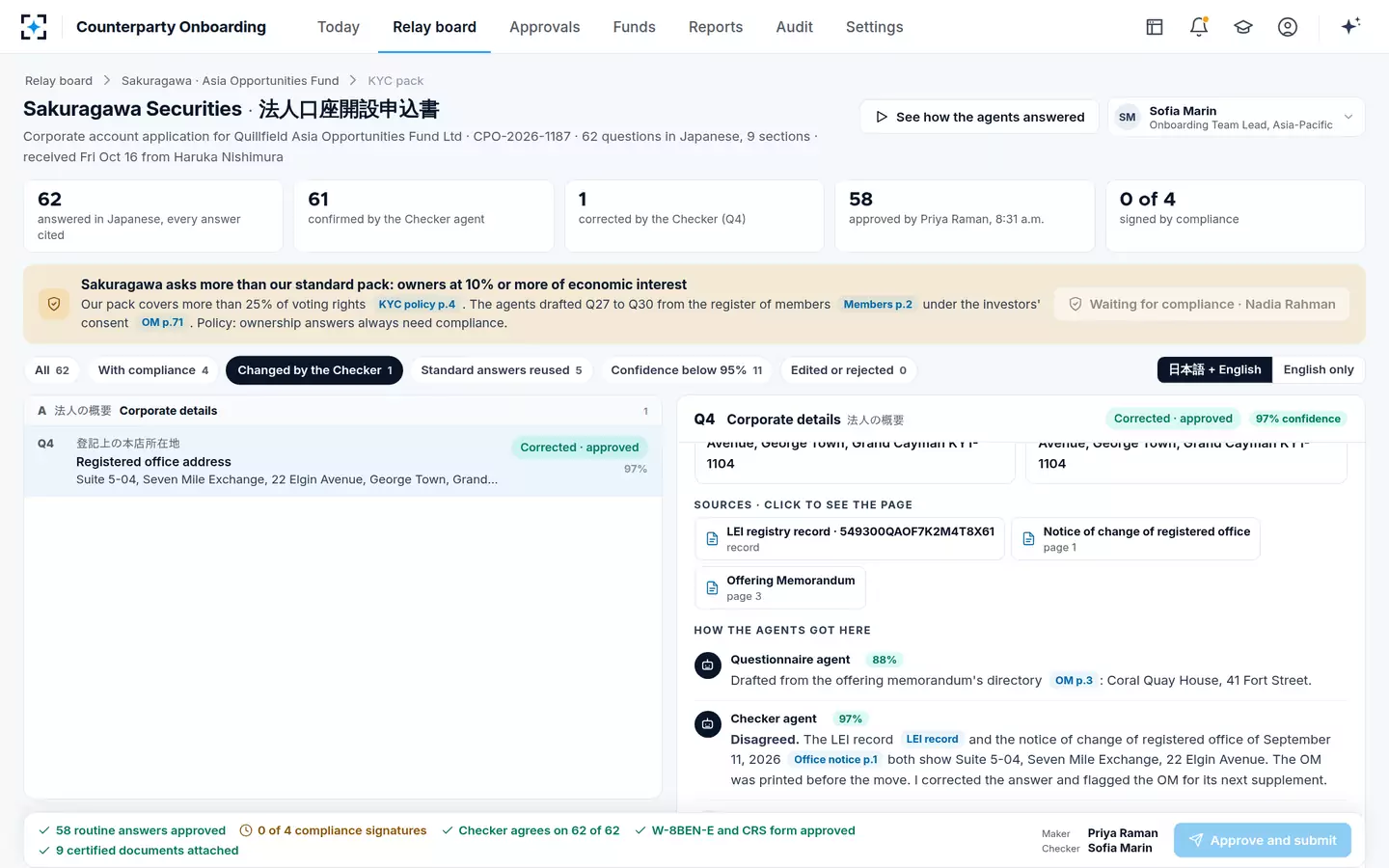
| Registered office out of date | The offering memorandum prints an address | The LEI data and the registered office change notice | The Asia fund moved on September 11; its memorandum still showed the old address |
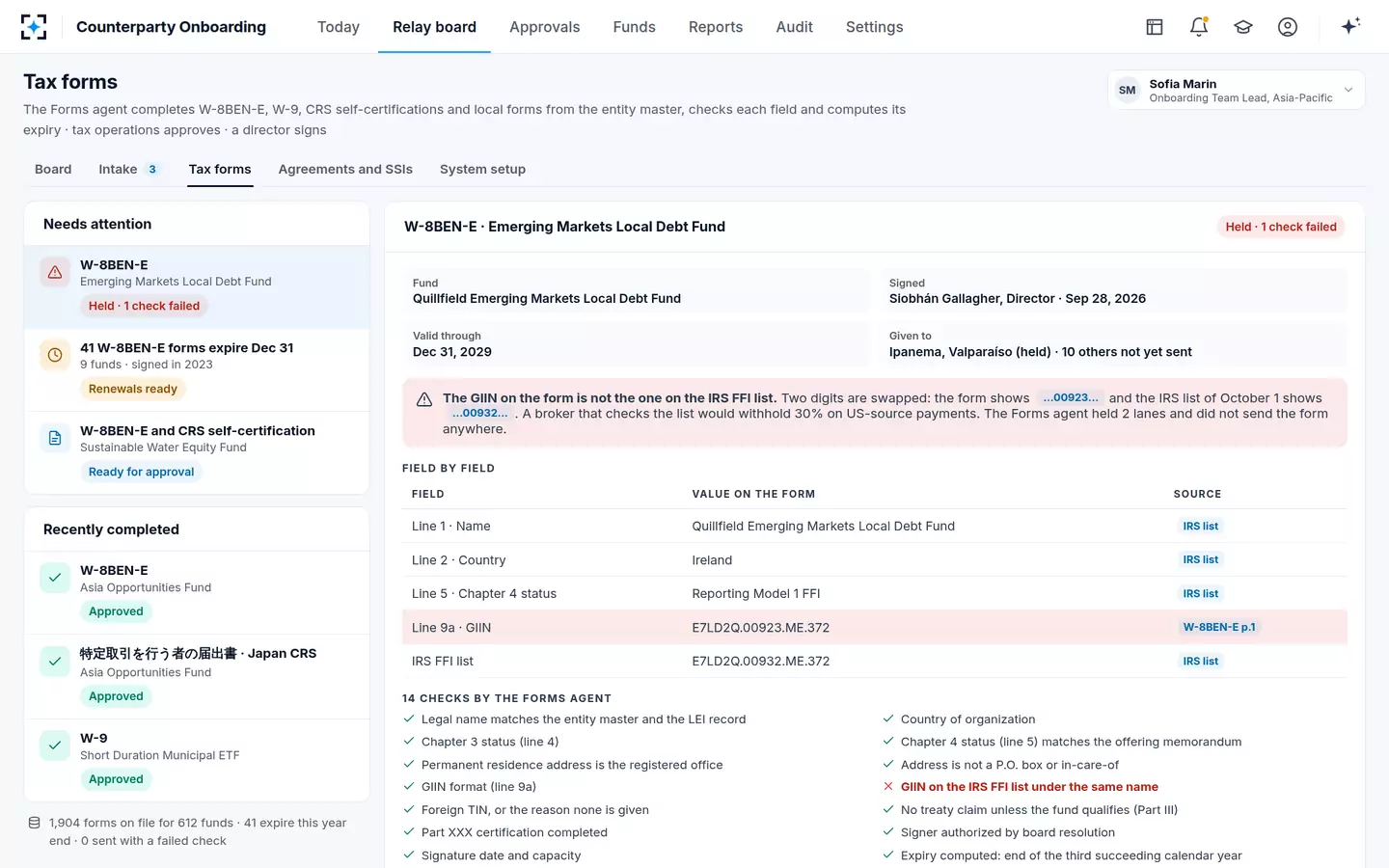
| GIIN with two digits swapped | The field is in the right format | The IRS list of foreign financial institutions, by name | The Emerging Markets Local Debt Fund's W-8BEN-E, held before any broker received it |
| LEI lapsed | The code is valid and was issued | The registration status and next renewal date in the LEI data | The European real estate fund's LEI lapsed on October 12; renewal filed October 19 |
| Ownership answered at the wrong threshold | The firm's standard answer is complete | Comparing the question's threshold with the standard's | A 10% economic-interest question against a 25% voting-rights standard |
| Place of settlement differs | Both sides have an SSI | Field-by-field comparison with the counterparty's confirmation | Domestic German depository on one side, Luxembourg international depository on the other |
| Director change not propagated | Each counterparty's file is complete | The register of directors against each counterparty's list | Six counterparties held the Japan Value Equity Fund's old directors |
| Tax form past its validity | The form is on file | The expiry computed from the signature date | Forty-one W-8BEN-E forms for nine funds expiring on one December 31 |
| Signer without authority | A signature is present | The authority resolution | Every tax form checks its signer against the board resolution |
Two patterns run through the table. Most of the catching records are public or held by the fund already: the LEI data, the IRS list, the register, the resolution. And most of the errors are not mistakes in drafting but changes the fund's own documents had not caught up with. An automated file is only as current as the newest of its sources, which is why reusing questionnaire answers has to mean reusing facts with their dates, not sentences.
A W-8BEN-E held because its GIIN is not the one on the IRS list
What is a lapsed LEI, and why does it matter at onboarding?
A lapsed LEI is a registration whose reference data has not been renewed by its next renewal date; it is still a valid code for an entity that still exists. The Global LEI Foundation's data standard defines LAPSED as a registration "that has not been renewed by the NextRenewalDate and is not known by public sources to have ceased operation" (GLEIF, LEI-CDF format), and its search guidance adds that users can decide whether a lapsed record is acceptable for their purpose or whether they accept only issued records (GLEIF).
Counterparties often decide for the fund. CFTC rules require swap counterparties eligible for an LEI to obtain and "maintain" one and be identified by it in swap records and reporting (17 CFR 45.6). EU firms may not trade a reportable transaction for an eligible client before obtaining its LEI (Delegated Regulation (EU) 2017/590, Art. 13(2)). The UK's T+1 industry plan asks regulators to consider making LEIs a condition of authorisation and onboarding firms to record counterparties' LEIs at onboarding (Accelerated Settlement Technical Group, ENV 06.00 and 08.00). And the nine US agencies' joint data standards under the Financial Data Transparency Act adopted the LEI as the legal entity identifier, effective October 1, 2026, without yet changing any reporting requirement (91 FR 38246). The renewal itself belongs to reference data management; the onboarding question is simply whether the code is current on the day each form goes out.
How do you check that an automated onboarding file is correct?
Re-derive each answer from a record other than the one it came from, and treat any disagreement as a question for a person. In the solution, the Checker agent runs on a different model from the one that drafted the answers and works from the entity master, the LEI registry and the IRS list rather than from the draft. On the sample Japanese questionnaire it agreed with 61 of 62 answers and disagreed on the registered office, with both sources shown.
A check that reads the same document as the answer can only confirm the answer. A check that reads a different record can disagree with it, and only that disagreement is information.
Every morning the same agent compares all 612 sample fund records with the LEI registry and the IRS list, so a lapse or a list change is found before the next form, not by the counterparty. Under the sample firm's rules a lapsed fund LEI holds every new opening for that fund until the renewal is through.
A corrected answer, with both sources shown side by side
How do you test KYC questionnaire automation before you trust it?
Run it on files you have already closed and compare its answers with what was actually right, then sample its live output against independent records. No regulator or independent study publishes accuracy for this work, so the test has to be your own. A sound protocol has four parts.
A four-part accuracy test for KYC questionnaire automation
- 1. Replay closed openings
Feed the tool the questionnaires and tax requests from last quarter's openings; compare every answer with the submission that was finally accepted.
- 2. Replay the queries
Take every counterparty query and rejection from the same period; count how many the tool would have prevented.
- 3. Sample "complete" live files
Each week, pick a random set of files the tool marked complete and re-derive every answer from independent records: LEI data, the IRS list, the register, the resolution.
- 4. Score by error type, not overall
Report misses per type (address, identifier, ownership, tax status, authority, settlement data); a 99% overall score can hide every ownership error.
What did FINRA find about automated account opening?
FINRA has seen automation fail on the broker's side of the same process. Among the AML deficiencies in its 2026 oversight report it lists "Auto-approving the opening of customer accounts without reasonably verifying the identity of the customer within a reasonable timeframe despite red flags", and among effective practices it suggests "limiting automated approval of multiple accounts for a single customer" (FINRA, 2026 Annual Regulatory Oversight Report). The findings concern brokers verifying their customers, but the principle carries over: automation that approves on completeness, without testing the content against independent evidence, is the weakness examiners name.
What a check against independent records found on one sample form
62
answers drafted from approved documents
Sample data
61
confirmed by the independent check
Sample data
1
corrected: an address the offering memorandum had not caught up with
Sample data
0
submissions reaching a counterparty with an answer that disagrees with the entity master or LEI record
Target
What should an onboarding accuracy report show each week?
Disagreements by type, and what happened to each. A useful weekly report gives, for each error type in the table above, how many answers the independent check disagreed with, how many of those the reviewer upheld, and how many errors were found later by a counterparty query that the check had missed. The last number is the one that shows whether the check works; a check that never misses has probably never been tested.
Trend matters more than level. A rise in address disagreements points to a fund document that has gone stale; a rise in GIIN disagreements just after the IRS publishes its monthly list points to the list. Read that way, the report tells operations which source to fix, not just which answer.
Who reviews automated onboarding files?
People who did not prepare them, and the right person for each kind of answer. The specialist reviews routine answers, compliance signs ownership, PEP, sanctions and source-of-funds answers, tax operations approves forms, and a team lead approves the submission; the preparer cannot approve, and the software enforces it. Review is faster when it starts from disagreements and low-confidence answers rather than from question one, which is how the solution orders it.
Accuracy also needs a record. A fund must notify the withholding agent within 30 days of a change in circumstances that makes its W-8BEN-E incorrect (IRS, Instructions for Form W-8BEN-E), and a counterparty may rely on the fund's representations only while they are kept current. A log of what the fund told whom, from which source, on which date, is what lets it find every counterparty that needs telling when a fact changes.
What Counterparty Onboarding automates, and what it checks
Botminds' Counterparty Onboarding automates the reading, drafting, form completion, settlement instruction building, setup requests and chasing for each fund-and-counterparty opening, and builds the independent check into every answer. The Checker agent re-derives each answer from different records on a different model and blocks any disagreement; the Forms agent runs 14 checks on each tax form, including the GIIN against the IRS list; a lapsed LEI holds new openings for the fund. The design target is that no submission reaches a counterparty with an answer that disagrees with the entity master or the LEI record. People approve everything that is sent.
Questions people ask
What is a KYC questionnaire?
The form a broker, FCM or bank uses to collect what its customer identification, beneficial ownership, sanctions and tax rules require about a new client: legal name and identifiers, ownership and control, authorised signatories, tax status and expected activity. For a fund, automation can draft the answers from its own approved documents; a person signs them.
Is a lapsed LEI still valid?
The code remains assigned to the entity, but its reference data has not been renewed by the next renewal date. GLEIF leaves it to users to decide whether a lapsed record is acceptable, so a counterparty may insist on an issued one, and the CFTC's swap rule requires the LEI to be maintained.
How do you measure onboarding accuracy?
Re-derive a sample of finished files from independent records and count disagreements by error type. Overall accuracy hides the rare, costly errors, so report ownership, identifier, tax status and authority errors separately.
Does automation reduce counterparty queries?
Only if it checks content against what the counterparty will check: LEI data, the IRS list, the register. Automation that fills fields from an out-of-date document produces faster forms with the same queries.
How often should fund LEIs and GIINs be checked?
Before every form that carries them, and ideally daily across all funds; in the solution's sample, the Checker agent compares all 612 fund records with the LEI registry and the IRS list every morning.