The FinCEN beneficial ownership certification is the statement a legal entity customer gives a US bank, broker-dealer, mutual fund or FCM when it opens an account: the name and identifying details of each individual who owns 25% or more of its equity, and of one individual with significant responsibility to control, manage or direct it, certified as accurate by the person opening the account. For a fund the first question is not who its owners are but whether the rule applies: FinCEN's customer due diligence (CDD) rule excludes registered investment companies, and pooled vehicles operated or advised by an SEC-registered adviser, from the definition of legal entity customer, and puts other pooled vehicles under the control prong only. Getting that category right is the difference between a one-line answer and a register of investors sent to every broker. Botminds' Counterparty Onboarding answers each broker's ownership questions from the fund's documented category and register, and never sends one without a compliance signature.
The rule text quoted here is the current 31 CFR 1010.230. Examples come from fictional sample data in the solution, where Quillfield Capital's Asia Opportunities Fund Ltd, a Cayman Islands fund, opens accounts with six counterparties.
Does the fund owe a beneficial ownership certification? It depends on who runs it
| The fund | Where it sits in the rule | What a covered US institution must identify |
|---|---|---|
| A registered investment company (mutual fund, ETF, closed-end fund) | Excluded: 1010.230(e)(2)(iv) | No beneficial owners under this rule. |
| A private fund advised by an SEC-registered investment adviser | Excluded: (e)(2)(xi), read with (e)(2)(v) | No beneficial owners under this rule. |
| A pool operated by a CFTC-registered commodity pool operator | Excluded: (e)(2)(xi), read with (e)(2)(viii) | No beneficial owners under this rule. |
| A pooled vehicle whose operator or adviser is not an excluded institution (for example, an adviser not registered with the SEC) | Control prong only: (e)(3)(i) | One individual with significant responsibility to control, manage or direct the fund. |
| Any other legal entity (a holding company, an SPV that is not a pooled vehicle) | Legal entity customer: (e)(1) | Each individual with 25% or more of the equity, and one controlling individual. |
What is the FinCEN beneficial ownership certification?
It is the way a covered institution meets the identification half of the CDD rule. The rule lets the institution either obtain a certification in the form set out in the rule's appendix from the individual opening the account, or obtain the same information by other means, provided that individual certifies it is accurate to the best of their knowledge (31 CFR 1010.230(b)(1)). The institution must then verify the identity of each person named, using risk-based procedures that contain at least the elements of its customer identification program for individuals.
The rule has two prongs. The ownership prong names each individual who, directly or indirectly, owns 25% or more of the equity interests; the control prong names a single individual with significant responsibility to control, manage or direct the entity, such as a chief executive officer, chief financial officer, managing member, general partner, president or treasurer. FinCEN's own note to the definition says the ownership prong can produce up to four people and the control prong exactly one, and that the same person may appear under both.
Two details matter for funds. If a trust owns 25% or more, the trustee is the person named. And if an excluded entity, such as a regulated financial institution or a registered fund, owns 25% or more, no individual need be named for that stake (1010.230(d)(3)). A feeder fund owned through a regulated platform may therefore have fewer reportable owners than its register suggests.
Does a fund need a beneficial ownership certification? Start with the exclusions
Often it does not. The definition of legal entity customer lists sixteen exclusions, and three of them cover most funds: an investment company registered with the SEC, an investment adviser registered with the SEC, and "A pooled investment vehicle that is operated or advised by a financial institution excluded under paragraph (e)(2) of this section" (1010.230(e)(2)(iv), (v) and (xi)). Because SEC-registered advisers and CFTC-registered commodity pool operators are themselves excluded institutions, a private fund they advise or operate is excluded too.
"The following legal entity customers are subject only to the control prong of the beneficial ownership requirement: (i) A pooled investment vehicle that is operated or advised by a financial institution not excluded under paragraph (e)(2) of this section"
31 CFR 1010.230(e)(3), FinCEN
The second group is narrower and easy to miss. A fund whose adviser is not on the excluded list, for example because the adviser is not registered with the SEC, is still a legal entity customer, but only the control prong applies. The broker needs one controlling individual, not a list of investors. Investors in a pooled vehicle change with every subscription and redemption, and the rule does not make the fund report them at account opening.
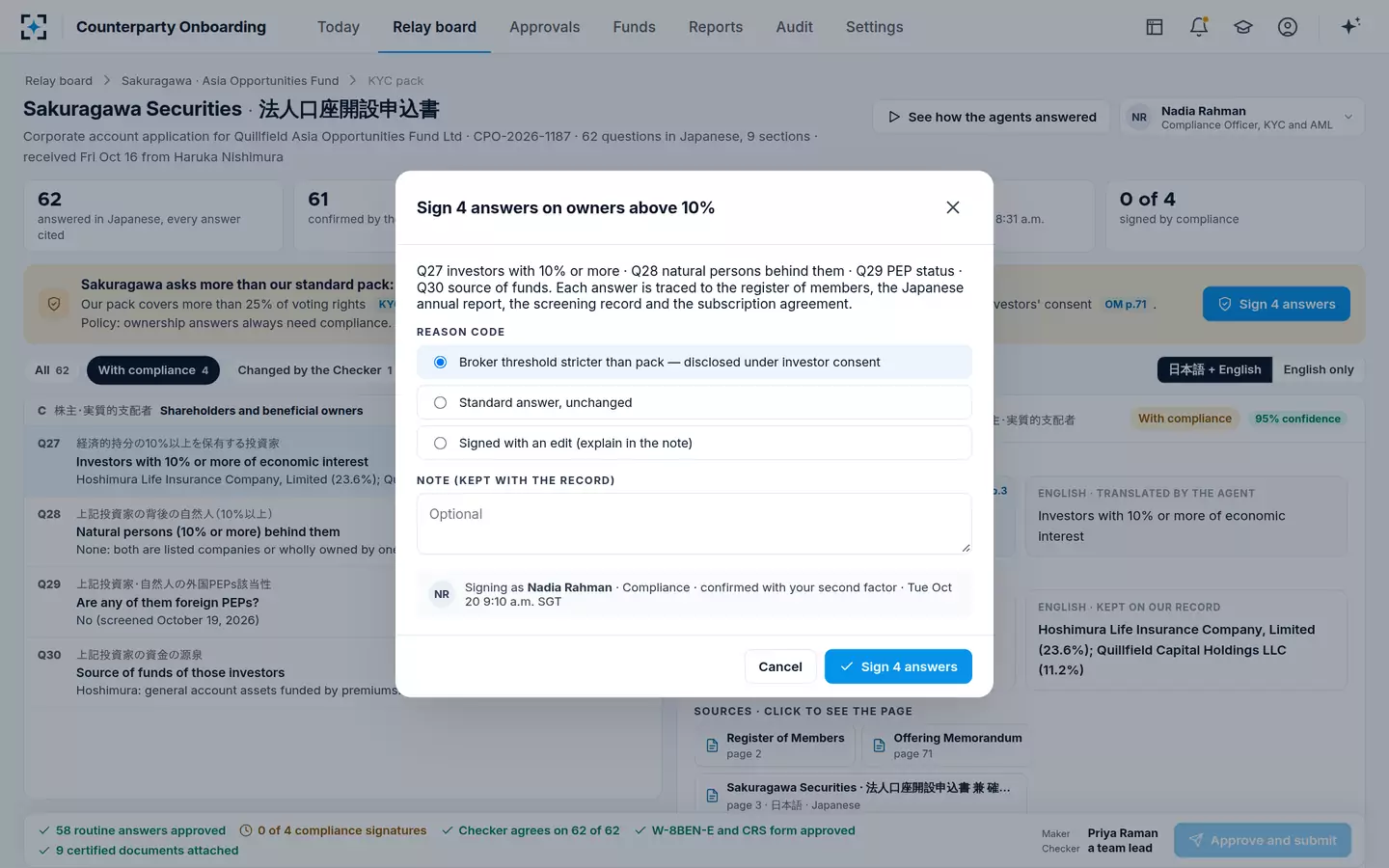
None of this stops a broker from asking for more. Firms can identify additional individuals "if it deems appropriate on the basis of risk", in the rule's own words, and a counterparty outside the United States applies its own law. What changes is the footing: an ownership answer given because the counterparty's policy asks is a disclosure the fund chooses to make, under whatever consent its investors gave, and compliance should sign it as such.
What is the control prong for a fund? One named individual
The control prong is one individual with significant responsibility to control, manage or direct the fund, and for most funds the honest answer sits at the manager or the general partner. The rule's examples, an executive officer such as a chief executive, chief financial or chief operating officer, a managing member, general partner, president, vice president or treasurer, or anyone who regularly performs similar functions, are titles of people, so where the general partner is itself a company the answer is an individual who directs it.
The practical point is consistency. The same individual should appear on every counterparty's form, on the fund's register of directors or the general partner's records, and on the resolution that gives authority to open accounts. A control person who differs between two brokers' files is a discrepancy one of them will query, and the account opening resolution is where the fund settles who acts for it.
Does a fund have to certify at every new account? Not since February 2026
Since February 13, 2026, a covered institution may identify and verify a legal entity customer's beneficial owners when the customer first opens an account, rather than at each new account. FinCEN's exceptive relief limits the obligation to three occasions: the first account; any later time the institution learns facts that reasonably call the information it holds into question; and as its own risk-based ongoing due diligence requires (FinCEN order FIN-2026-R001). The rule text itself still says "at the time a new account is opened"; the order grants relief from it.
A fund's second account at the same broker, before and after the 2026 relief
Before February 13, 2026: A new certification, or the same information certified again.
After FinCEN order FIN-2026-R001: The broker may rely on what it collected at the first account, if its procedures say so.
Before February 13, 2026: Caught at the next account opening, if then.
After FinCEN order FIN-2026-R001: A fact that calls the information into question: the broker re-identifies.
Before February 13, 2026: Separate from account opening.
After FinCEN order FIN-2026-R001: The broker re-identifies as its risk-based ongoing due diligence requires.
Before February 13, 2026: Re-send the same answers at every account.
After FinCEN order FIN-2026-R001: Tell each counterparty when its controlling individual or ownership changes, and keep one current answer.
For a fund manager the relief reduces repeat work at existing counterparties, not new ones. A new fund at a broker is a new customer, and the first account is still the moment of identification. A bank-side view of how institutions apply the order is in FinCEN's CDD rule relief, at the second account.
What documents does a broker's CIP ask a fund for?
The certification is separate from the broker's customer identification program (CIP), which covers the fund itself unless it falls outside the rule's definition of customer; that definition leaves out, among others, a financial institution regulated by a federal functional regulator (31 CFR 1023.100(d)). For a fund that is a customer, a broker-dealer must obtain, before opening the account, at least the fund's name, an address and an identification number, and verify its identity within a reasonable time before or after opening; FCMs and introducing brokers follow a near-identical rule (31 CFR 1023.220; 31 CFR 1026.220).
The CIP minimum for a fund, and where the answer comes from
| CIP item | What the rule says for a non-individual | Usual source in the fund's documents |
|---|---|---|
| Name | The customer's name. | Certificate of incorporation or registration; must match the LEI data. |
| Address | A principal place of business, local office or other physical location. | Registered office notice; the offering memorandum's directory may be out of date. |
| Identification number | A taxpayer identification number for a US person; for a non-US person, a TIN or the number of another government-issued document. A foreign business without one must be asked for other government-issued documentation certifying its existence. | EIN or foreign tax number; for a Cayman fund, its registration documents. |
| Verification | Documents showing the entity exists, such as certified articles, a government licence, a partnership agreement or a trust instrument; or non-documentary methods. | Certified constitutional documents; regulator registration where one exists. |
| Lists check | Whether the customer appears on any federal list of known or suspected terrorists or terrorist organisations, within a reasonable time after opening. | Done by the broker; the fund only needs consistent names. |
FINRA's examiners see the cost of getting this wrong from the broker's side. Its 2026 oversight report lists, among firms' CIP and CDD failures, "Not recognizing that certain relationships established with the firm to effect securities transactions are customer relationships (and, consequently, not conducting CIP or CDD as required)" (FINRA, 2026 Annual Regulatory Oversight Report). A broker that has been criticised for that will ask a fund for more, not less.
When a broker asks more than FinCEN: the 10% question
Counterparties outside the US, and many inside it, ask for owners below 25%. In the sample data, Sakuragawa Securities in Tokyo asks for investors with 10% or more of the fund's economic interest, while the sample firm's standard answers cover holders above 25% of voting rights. The agents drafted the four ownership answers from the register of members, cited the investors' consent to disclosure in the offering memorandum, and sent them to compliance rather than reusing the standard answer.
Beneficial ownership answers routed to compliance when a broker asks for more
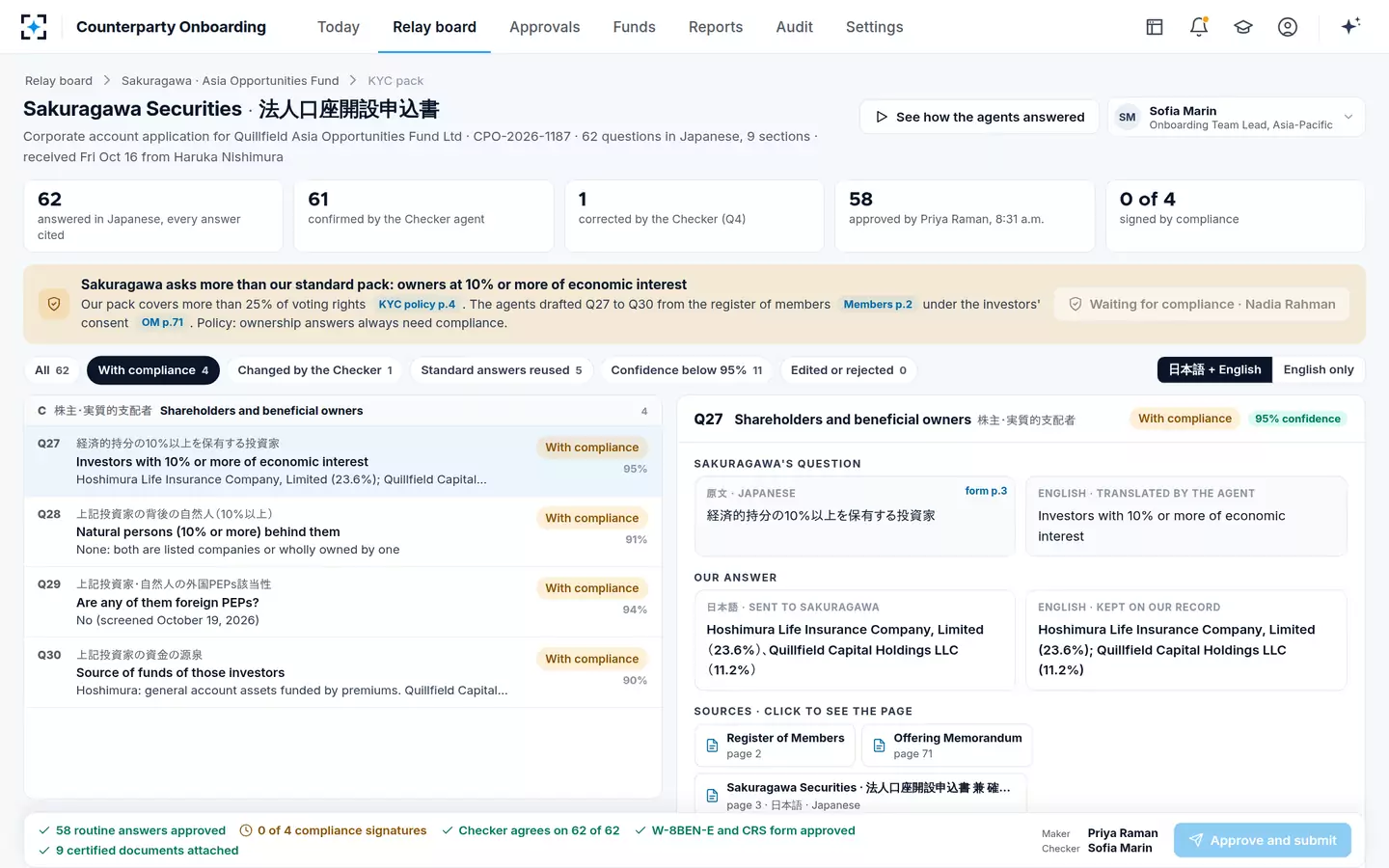
Two lessons travel beyond the example. Compare every ownership question with the fund's own standard before reusing an answer, because a 25% answer to a 10% question is not a smaller answer, it is a wrong one. And keep the basis for disclosure with the answer: the register page, the consent and the screening date, so the officer who signs can see what she is signing.
Compliance signs the ownership answers, with a reason code
How long must a certification be kept, and what changes in 2028?
The institution keeps the identifying information, including the certification, for five years after the account closes, and the verification records for five years after they are made (1010.230(i)). The fund has no matching federal duty under this rule, but it should keep what it certified, to whom and when, because the relief order turns any later change in that information into a fact the counterparty is entitled to act on.
The fund's own side changes when FinCEN's investment adviser rule takes effect. FinCEN has delayed it: "This rule is effective January 1, 2028" (91 FR 36, January 2, 2026). Advisers then run their own anti-money laundering programs, which makes the manager's answers about its own controls, such as the AML letter many brokers ask for, a description of a regulated program. What moved to 2028, and what advisers should do before then, is covered in the investment adviser AML rule and its 2028 date.
How Counterparty Onboarding answers ownership questions
Botminds' Counterparty Onboarding keeps each fund's category, controlling individual and register in the entity master, and answers every counterparty's ownership questions from them. The Questionnaire agent compares each question with the firm's standard and flags any that asks for more; the Checker agent re-derives the answer independently; compliance signs every ownership, PEP, sanctions and source-of-funds answer with a reason code; and a team lead who did not prepare the submission approves it. The agents never sign and never send.
Seven checks before a fund answers a beneficial ownership question
- Which category is the fund in?
Excluded, control prong only, or a full legal entity customer, from 1010.230(e).
- Who is the one controlling individual?
The same person on every form, the register and the authority resolution.
- Does the question ask for more than the rule?
A lower threshold, economic rather than voting interest, or a look-through.
- Is there consent to disclose investors?
Cite the offering document clause with the answer.
- Are excluded owners treated as excluded?
No individual is named for a stake held by an excluded entity.
- Is every named person screened?
With the date of the screening on file.
- Has compliance signed?
Every ownership answer, whatever the threshold.
Questions people ask
Are pooled investment vehicles excluded from the CDD rule?
A pooled vehicle operated or advised by an excluded financial institution, such as an SEC-registered adviser or a CFTC-registered commodity pool operator, is excluded from the definition of legal entity customer. Other pooled vehicles are legal entity customers subject only to the control prong.
Does a mutual fund need a beneficial ownership certification?
Not under FinCEN's rule when it opens an account: an investment company registered with the SEC is excluded from the definition of legal entity customer. Its broker may still ask for ownership or control information under its own policy.
What is the beneficial ownership certification form?
It is the form set out in the appendix to 31 CFR 1010.230. An institution may use it or collect the same information another way, as long as the individual opening the account certifies it is accurate to the best of their knowledge.
How many beneficial owners can a legal entity have under FinCEN's rule?
Up to four under the 25% ownership prong and exactly one under the control prong, as FinCEN's note to the definition explains. The same person can be named under both.
What did FinCEN change on February 13, 2026?
Its exceptive relief order lets covered institutions identify and verify a legal entity customer's beneficial owners at the first account, rather than at every new account, and again only when facts call the information into question or their risk-based procedures require it.
Is the beneficial ownership certification the same as Corporate Transparency Act reporting?
No. The certification is given to a financial institution when an account opens; Corporate Transparency Act reporting is a filing with FinCEN itself, and FinCEN's final rule of August 14, 2026 exempts reporting companies from reporting any US-person beneficial owners.