Counterparty onboarding, for an asset manager, is the work of getting a fund accepted as a customer by each broker, futures commission merchant (FCM) and FX bank it will trade with, and of approving each of those counterparties in return, before the fund's first trade date. Every opening has five legs: the counterparty's KYC questionnaire and documents, tax forms, the trading agreement, standing settlement instructions (SSIs) and system setup. They run in parallel, so the slowest leg, not the sum of all five, decides when the fund can trade. It is hard because each counterparty asks in its own form, often its own language, against rules written for its own licence, while a seeded fund waits. Botminds' Counterparty Onboarding exists for that clock: it plans each fund-and-counterparty opening back from the first trade date, drafts every answer from the fund's approved documents, and leaves every signature with a named person.
The examples below use fictional sample data from the solution: Quillfield Capital, a manager whose Quillfield Asia Opportunities Fund Ltd, a Cayman Islands fund with a $250 million seed, needs six counterparties before its first trade on Monday, November 2, 2026. The rules come from the regulators that wrote them, linked where they appear.
Where an opening's days go: the KYC leg and the agreement take two-thirds
Before the agents · 19.6 leg-days
- KYC questionnaire and documents, 7.5 · 38%
- Agreements, 5.5 · 28%
- Tax forms, 3.0 · 15%
- SSIs, 2.2 · 11%
- Setup, 1.4 · 7%
With the agents · 6.8 leg-days
- KYC, 2.1 · 31%
- Agreements, 2.4 · 35%
- Tax, 0.8 · 12%
- SSIs, 0.9 · 13%
- Setup, 0.6 · 9%
Read the second bar for what it says about agreements. Drafting and checking shrink the KYC leg most, because most of a questionnaire repeats facts the fund already holds. A negotiated agreement shrinks least, because Legal still decides every clause outside the firm's playbook. That makes the agreement the leg to start first.
What is counterparty onboarding? Two sets of checks against one date
Counterparty onboarding is two due diligence exercises running toward the same trade date. In one, the counterparty onboards the fund: a US broker-dealer must run a customer identification program (CIP), an FCM runs the futures equivalent, a swap dealer must know its counterparty and confirm it may trade swaps at all, and an EU investment firm must classify the fund and hold its legal entity identifier (LEI). In the other, the manager approves the counterparty: is it registered, is it sanctioned or owned by someone who is, is its credit good enough for the limit the desk wants, and is the paperwork signed.
Most of the labour sits in the first exercise, because every counterparty writes its own questionnaire. Most of the risk sits in both. An answer given in the fund's name that disagrees with the fund's public LEI data, its tax form or its offering memorandum is a misstatement to a regulated firm. A counterparty approved without a registration check is a counterparty the board never really approved. The broker onboarding process, hand-off by hand-off, shows how the two exercises interleave inside a fund's operations team.
What does a broker need before a fund can trade? It depends on the licence
A broker needs whatever its own rulebook makes it collect before it opens the account, and that differs by licence. The table sets out the minimum each kind of counterparty is required to obtain; a counterparty's questionnaire is that minimum plus its own policy.
What each counterparty must collect before a fund's account opens
| Counterparty | The rule | What it must have from the fund |
|---|---|---|
| US broker-dealer | 31 CFR 1023.220 (CIP); 31 CFR 1010.230 (beneficial owners) | Name, address of the principal place of business and an identification number before opening; identity verified within a reasonable time, by documents or other methods; owners and one controlling person unless the fund is excluded. |
| US FCM | 31 CFR 1026.220; 17 CFR 1.37; 17 CFR 1.55 | The same CIP minimum; a record of anyone guaranteeing the account or exercising trading control over it; a risk disclosure acknowledged before opening, unless the fund is an institutional customer. |
| Swap dealer | 17 CFR 23.402, 23.430, 23.504 | The essential facts about the fund, including the authority of anyone acting for it; verification that it is an eligible contract participant; trading documentation with credit support terms in place before or with the first swap. |
| EU investment firm | MiFID II, Art. 30 and Annex II; Delegated Regulation 2017/590, Art. 13(2) | A client category (eligible counterparty, professional or retail); the fund's LEI before any trade it must report. |
Three details from those rules change how a fund prepares. First, the FCM disclosure: Rule 1.55 bars an FCM from opening a futures account until it has furnished the risk disclosure statement and received the customer's signed acknowledgment, but paragraph (f) lets it skip that for an "institutional customer" as the CFTC defines it (17 CFR 1.55). Whether the fund qualifies is a question it should answer before the FCM asks.
Second, the swap dealer must verify eligibility, and it may rely on the fund's written representation only if the fund names the specific provision of the eligible contract participant definition that it meets (17 CFR 23.430(d)). A fund that answers "yes, we are an ECP" without the paragraph gives the dealer nothing it can rely on. Third, under the EU's transaction reporting rules, "An investment firm shall not provide a service triggering the obligation to submit a transaction report for a transaction entered into on behalf of a client who is eligible for the legal entity identifier code, prior to obtaining the legal entity identifier code from that client" (Delegated Regulation (EU) 2017/590, Art. 13(2)). No LEI, no trade.
Many funds are lighter work than the questionnaires suggest. FinCEN's beneficial ownership rule excludes a registered investment company and a pooled vehicle operated or advised by an SEC-registered adviser from its definition of a legal entity customer, and limits other pooled vehicles to the control prong (31 CFR 1010.230(e)). A broker may still ask for owners under its own policy; what changes is which answers the law requires. Which funds owe FinCEN's beneficial ownership certification works through each fund type.
The five legs of counterparty onboarding, and why they run side by side
The five legs are independent enough to run at once and dependent enough to block each other at the end. The KYC questionnaire, the tax forms and the agreement can all start the day the counterparty's forms arrive. Settlement instructions need the account number the counterparty confirms after accepting the KYC submission. System setup needs the agreement terms, the account and the SSIs. A good plan starts the three independent legs on day one and protects the two dependent ones from waiting on a late signature.
One opening, leg by leg: the account number unlocks the last two legs
- Read and answered overnightFri–Mon
- Compliance signs 4; lead approvesTue a.m.
- W-8BEN-E and Japan CRS form, 14 checks eachby Oct 19
- 29 of 31 clauses matched; Legal settles clause 17by Oct 19
- Waits for the account numberwaiting
- Call-back and second-person releaseTue p.m.
- Waits for account and SSIswaiting
- OMS, FIX, test orderTue
The timeline has one lesson that applies to any fund. The tax forms and the agreement were finished a day before the KYC leg, and the settlement and setup legs could not start until the counterparty confirmed the account. So the critical path ran through the KYC submission, and the only way to shorten it was to make that submission right the first time. A form a counterparty sends back for a missing document or a wrong address puts every later leg back by its round trip.
Who owns each leg? Five owners, and one person who signs trade-ready
Each leg has a different owner and a different meaning of "done", and an opening slips when nobody owns the space between them. In the sample firm the owners are an onboarding specialist who prepares the questionnaire, a team lead who approves every submission, compliance for ownership and anti-money laundering answers, tax operations for the forms, Legal for agreement clauses, settlement operations for SSIs, and trading operations, who alone signs the fund trade-ready.
Each leg, its owner, and what 'done' must mean
| Leg | Who signs | Done means |
|---|---|---|
| KYC questionnaire and documents | Specialist prepares; a different team lead approves; compliance signs ownership, PEP, sanctions and source-of-funds answers | The counterparty has confirmed the account, not just received an email. |
| Tax forms | Tax operations approves; a director signs | W-8BEN-E or W-9 and CRS self-certification accepted, with the expiry known. A W-8BEN-E generally stays valid until the end of the third calendar year after signing, unless a change makes it incorrect (IRS instructions). |
| Agreement | Legal | Terms, FCM documents or the ISDA Master Agreement and Credit Support Annex signed by both sides; every deviation from the playbook decided by Legal. |
| Settlement instructions | One person calls back; a second releases | Instructions confirmed field by field on a number from the counterparty directory, never from the email that carried them. |
| System setup | Trading operations | Order management, FIX session, allocation accounts and accounting mapped, and a test order acknowledged. |
The other direction: approving the broker, FCM or bank
Before a fund opens an account, the manager should know the counterparty is registered, unsanctioned, creditworthy and documented. These checks rarely sit in operations, but the opening cannot finish without their results, so they belong on the same plan.
Registration. For a US broker-dealer, FINRA's BrokerCheck "is a free tool from FINRA that can help you research the professional backgrounds of investment professionals"; its firm report carries the profile, history, operations and disclosures drawn from the industry's registration database (FINRA). For an FCM, the National Futures Association's BASIC system serves the same purpose, and its own page addresses "an NFA Member contemplating a new business relationship" as much as an investor (NFA BASIC). The CFTC requires every FCM to link to BASIC from its website, and to publish a firm-specific disclosure document covering its capital, its material risks and any enforcement actions against it in the last three years, before it takes a customer's money or signs its account agreement (17 CFR 1.55(i), (k), (o)). That document is the first thing to read about a new FCM.
Sanctions. A counterparty is screened against the sanctions lists, and so are the owners that could make it blocked. Under OFAC's ownership rule an entity owned 50% or more by blocked persons, alone or together, is itself blocked, which is why the screening has to reach through the ownership chain; the OFAC 50 rule, worked through five examples, sets out the method. The SEC's examiners will be looking at the same thing from the broker's side: their fiscal 2027 priorities say they will review whether broker-dealers are monitoring OFAC sanctions and ensuring compliance with them (SEC Division of Examinations, FY2027 priorities).
Credit and limits. The desk wants a limit; risk sets one from the counterparty's credit. That review is the job of a fund's counterparty risk function, covered in what Archegos taught a fund's own counterparty desk. The onboarding plan only needs the approved limit, with its date, before setup.
Documentation. For OTC derivatives the trading documentation must be signed before or at the same time as the first swap, and the CFTC lists what it must contain, from payment netting and events of default to the credit support arrangements, margin, eligible collateral and custody (17 CFR 23.504). Reading those terms into the collateral system is its own discipline, and what each term means is set out in credit support annex meaning; repo and securities lending relationships bring the GMRA and GMSLA into the same leg.
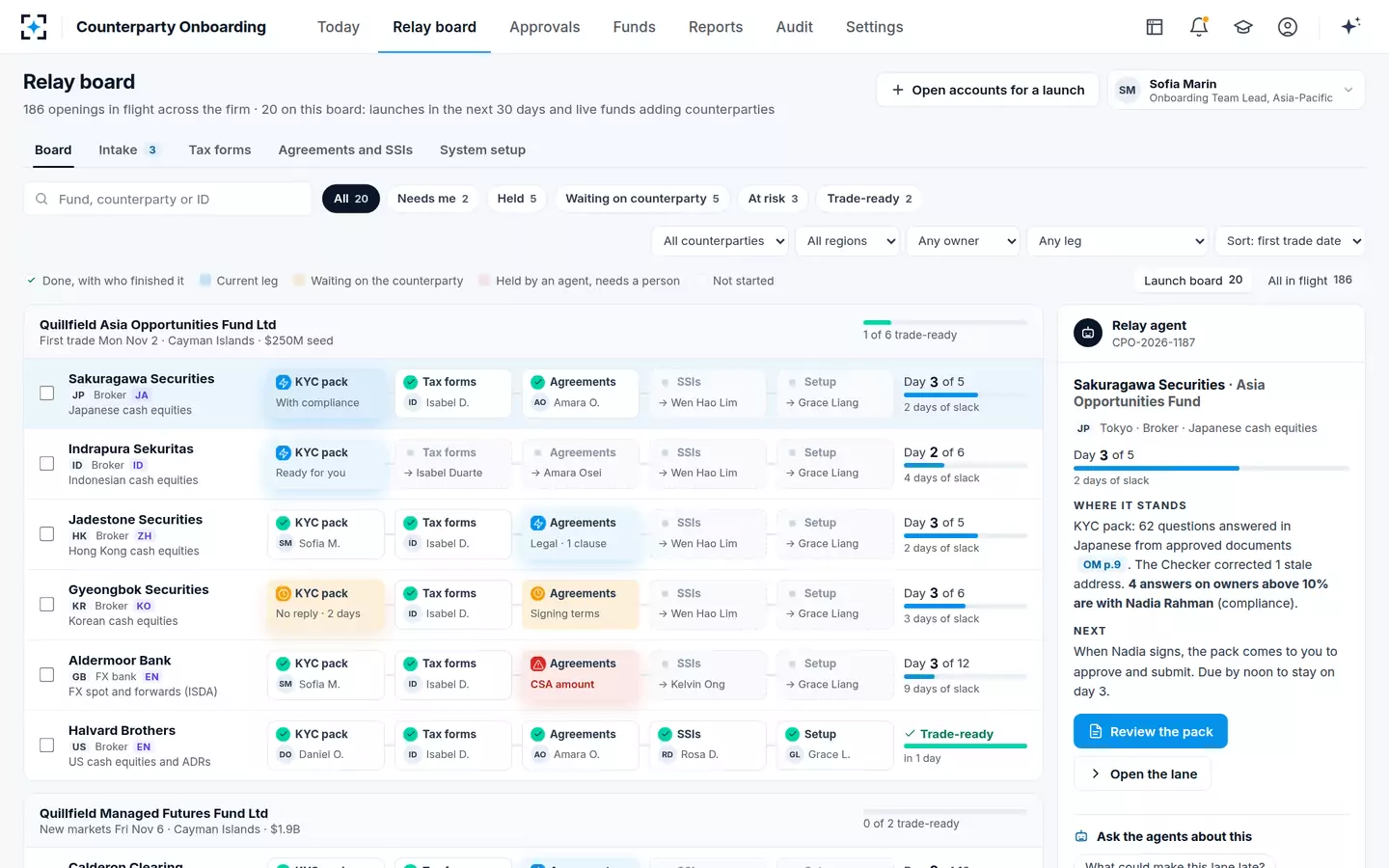
Counterparty onboarding as a board of lanes, one per fund and counterparty
How long does counterparty onboarding take? Measure the slowest leg
No regulator or independent study publishes how long it takes a fund to open accounts with its counterparties, so the honest answer is your own number, measured per opening from the day the counterparty's forms arrive to the day trading operations signs trade-ready. Track the median and the slowest decile separately: a launch with six counterparties is late if any one of them is.
One sample opening, and the target per opening
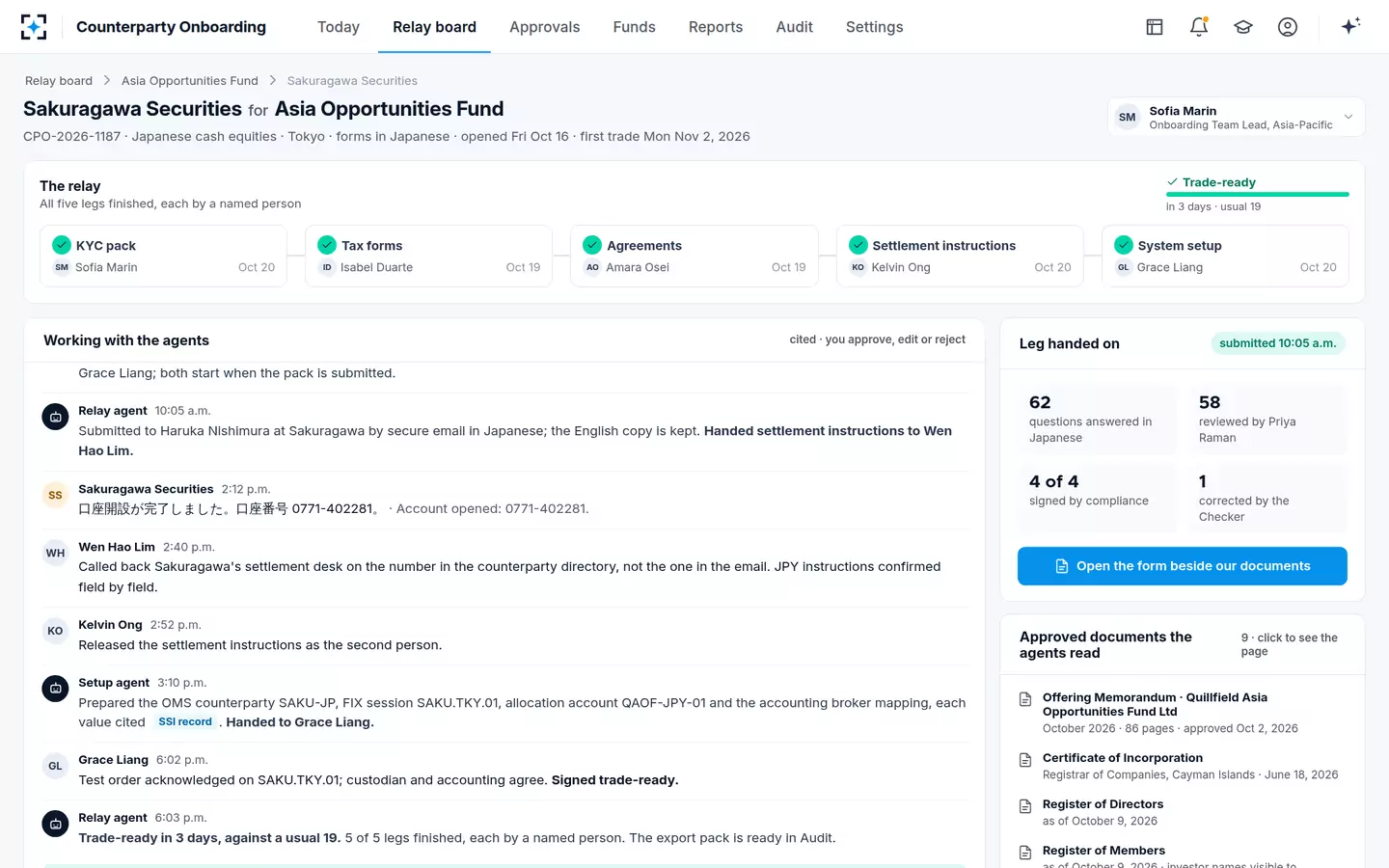
3days
from the broker's form to trade-ready on the sample Sakuragawa opening
Sample data
19days
the sample firm's usual time for the same work by hand
Sample data
5days
design target per fund-and-counterparty opening
Target
6
counterparties the sample fund needs before its first trade
The measurement only helps if it records why a lane waited, not just how long. The useful categories are few: waiting on the counterparty, waiting on an internal signer, waiting on a document the fund had to produce, and rework after a counterparty query. The price of a late first trade shows how to turn those days into money for a launch.
What T+1 changes: settlement data at onboarding, not after the first trade
Shorter settlement cycles move settlement data from after the first trade to before it. In the United States, where T+1 has applied since May 2024, a broker-dealer's agreements or procedures must see each trade allocated, confirmed and affirmed on the day it is done, which leaves no time to collect an SSI after execution. Europe follows: a Commission delegated regulation requires investment firms to make professional clients provide the reference data needed to settle in a structured, electronic form and to keep it current well before settlement, with that provision applying from 7 December 2026 under its Article 2 (Delegated Regulation (EU) 2026/1536).
The UK's industry plan, published by HM Treasury, is more direct about onboarding. Its environmental recommendation ENV 08.00 asks firms to adopt a market standard for client onboarding documentation and says "Where possible, onboarding firms should record their counterparties' LEIs at the point of onboarding", because under T+1 the time to complete due diligence before settlement is compressed (Accelerated Settlement Technical Group report, February 2025). The government has committed to legislate for UK T+1 from 11 October 2027, and its implementing regulations were published in draft. Either way, a fund whose SSIs and LEI travel with its KYC answers is ready for every regime at once.
Where Counterparty Onboarding fits, and what stays with people
Botminds' Counterparty Onboarding runs the five legs as one lane per fund and counterparty, planned back from the first trade date. Eight agents do the reading, drafting, checking and chasing: one reads each counterparty's forms in its own language, one answers the questionnaire from the fund's approved documents with every answer cited to its page, a second checks every answer independently against the entity master, the LEI registry and the IRS list of foreign financial institutions, and others complete tax forms, compare agreements with the playbook, build SSIs and prepare system setup.
People keep every decision that reaches a counterparty. A specialist prepares, a different team lead approves each submission, compliance signs every ownership and anti-money laundering answer, Legal decides every clause outside the playbook, a second person releases SSIs and trading operations alone signs trade-ready. The agents never send, sign, release or activate anything.
Trade-ready: five legs finished, each by a named person
A counterparty onboarding checklist for the next launch
A checklist cannot shorten a negotiation, but it can stop the avoidable round trips. These are the checks that, in our reading of the rules above, a fund should clear before it sends anything to a new counterparty.
Twelve checks before the first submission to a new counterparty
- Start the agreement on day one
It is the leg least shortened by drafting; Legal's queue sets its length.
- Know the fund's FinCEN category
Excluded, control prong only, or full beneficial ownership: answer from 31 CFR 1010.230(e).
- LEI issued, not lapsed
An EU firm may not trade a reportable transaction for an eligible client without it.
- Registered office matches the LEI data
Counterparties compare; an old address in the offering memorandum is a query waiting to happen.
- ECP status, by paragraph
A swap dealer can rely on a representation that names the provision of the definition the fund meets.
- Institutional customer status for FCMs
It decides whether the risk disclosure acknowledgment is needed.
- MiFID category agreed
Eligible counterparty or professional client, and any request to be treated otherwise.
- Tax forms current
W-8BEN-E or W-9 and CRS self-certification, with expiry dates and the GIIN checked against the IRS list.
- Authority to act
A current resolution naming who may open accounts and sign for the fund.
- Counterparty registration checked
BrokerCheck for broker-dealers, NFA BASIC for FCMs, the FCM's disclosure document read.
- Sanctions screening through the owners
The counterparty and the owners that could make it blocked.
- Credit limit approved and dated
Setup should not wait for risk on the last day.
Questions people ask
What is counterparty onboarding in an asset manager?
It is opening a fund's accounts at the brokers, FCMs and FX banks it will trade with, and approving those counterparties in return. Each opening has five legs (KYC questionnaire and documents, tax forms, agreement, settlement instructions and system setup) and must finish before the fund's first trade date.
Is counterparty onboarding the same as client onboarding?
It is the mirror image. Client onboarding is a firm taking on a customer; in counterparty onboarding the fund is the customer, answering each broker's questions, while the manager runs its own checks on the broker. Software built for the first is rarely built for the second.
What documents does a broker ask a fund for?
A US broker-dealer's identity program must obtain the fund's name, principal place of business and an identification number before opening the account, and verify its existence, typically from formation documents. The sample broker's 62 questions were answered from nine approved documents, among them the offering memorandum, the registers of directors and members, a board resolution, the trader list and the manager's AML letter.
How does a fund check that a broker or FCM is registered?
Use FINRA's BrokerCheck for broker-dealers and the NFA's BASIC system for FCMs and other futures firms. CFTC Rule 1.55 also requires every FCM to publish a disclosure document covering its capital, material risks and recent enforcement actions before it opens an account.
Does every fund need an LEI to trade?
Any fund trading swaps reportable to the CFTC must obtain and maintain one under 17 CFR 45.6, and an EU investment firm may not execute a reportable trade for an eligible client without it. In practice most counterparties ask for it on the questionnaire.
What is the biggest cause of a late first trade?
In the sample data, the KYC questionnaire and the agreement, which together take about two-thirds of leg-days. No regulator publishes a cause breakdown across the industry, so measure your own openings by why each lane waited.