The Archegos collapse was the default, on 26 March 2021, of Archegos Capital Management, a family office that had built huge concentrated stock positions through total return swaps with several banks; when it could not meet margin calls, the banks sold the hedges into falling markets and lost more than $10 billion between them, about $5.5 billion at Credit Suisse alone. Supervisors in the US, the UK and Switzerland then published what went wrong inside the bank that lost most, and the Basel Committee rewrote its counterparty guidelines. Those findings were written about banks facing a fund. Read from the other side, by an asset manager whose funds trade with the same banks, they describe exactly how a counterparty review fails. Botminds' Counterparty Risk Management reviews, rates and sets limits for the banks and brokers a fund manager trades with from their own filings, and watches them between reviews, which is where the Archegos lessons apply.
The Archegos collapse in four official numbers
>$10bn
lost across several large banks, principally outside the US (Federal Reserve, SR 21-19)
$5.5bn
lost by Credit Suisse in 2021 (Federal Reserve, July 2023)
$24bn
Credit Suisse's position from the relationship in March 2021 (FINMA)
$268.5m
Federal Reserve fine; the UK PRA added £87m, its largest ever
What was the Archegos collapse? A family office, swaps and a margin call it could not meet
Archegos was a family office whose leverage came from banks, not from investors. The SEC's charges, announced on 27 April 2022, alleged that its owner "purchased on margin billions of dollars of total return swaps", taking the portfolio from "approximately $1.5 billion with $10 billion in exposure in March 2020" to "a value of more than $36 billion with $160 billion in exposure at its peak in March 2021", and that Archegos "repeatedly and deliberately misled many of Archegos's counterparties about Archegos's exposure" (SEC press release 2022-70). Those are the SEC's allegations.
The mechanism is in the Swiss supervisor's account. Under a total return swap the bank "undertook, for example, to pay Archegos any increase in the value of the synthetically held positions", and hedged by buying the shares itself. When some of the stocks fell, Archegos "no longer had the necessary funds to compensate for these losses in value", and the bank "itself had to sell the shares that it had previously acquired in its own name as a hedge", suffering "massive losses due to share prices having fallen sharply in the meantime" (FINMA, 24 July 2023). The Basel Committee summarised the trigger in a footnote: "the default event was triggered by a massive VM margin call that was not met" (CRI40.57, footnote 5).
How much did banks lose from Archegos?
Banks lost more than $10 billion. The Federal Reserve's supervisory letter says Archegos "defaulted on March 26, 2021, causing over $10 billion in losses across several large banks, principally outside the United States" (SR 21-19). The largest single loss was at Credit Suisse: "In 2021, Credit Suisse suffered approximately $5.5 billion in losses because of the default of Archegos, an investment fund" (Federal Reserve, 24 July 2023).
Three supervisors, one bank: what each published on 24 July 2023
| Supervisor | Loss it cites | Penalty | What it found |
|---|---|---|---|
| Federal Reserve Board (US) | About $5.5bn at Credit Suisse in 2021 | $268.5m fine, consent order with UBS Group AG | Credit Suisse "failed to adequately manage the risk posed by Archegos despite repeated warnings" |
| Prudential Regulation Authority (UK) | About $5.1bn booked to the two UK firms | £87m, the PRA's highest fine; £124.4m before the 30% settlement discount | Breaches of four Fundamental Rules, including "failures to adequately respond when limit breaches were exceeded" |
| FINMA (Switzerland) | "over USD 5 billion" | Corrective measures ordered at UBS as legal successor | Credit Suisse "seriously and systematically violated financial market law" |
The PRA's press release ends the Credit Suisse part of the story without drawing a line from one event to the next: the losses "resulted in significant financial and reputational damage", and "Credit Suisse was ultimately acquired by UBS Group AG", in 2023 (PRA, 24 July 2023). For a fund that faced Credit Suisse in forwards or held its bonds, March 2021 was the first visible sign, two years early.
Why did Credit Suisse lose so much on Archegos? Limits raised instead of enforced
Credit Suisse lost the most because its exposure was the largest and its limits did not hold. FINMA found the position "had a value of USD 24 billion in March 2021. This corresponded to four times the position of the next largest hedge fund client and more than half the equity of Credit Suisse Group AG." Risk monitoring "regularly indicated that applicable limits had been exceeded", yet "the responsible employees acted in favour of the client" (FINMA).
"On the other hand, exceeded limits were simply increased repeatedly. Thus, the overruns were reduced, but the actual risks of loss increased."
FINMA, on Credit Suisse and Archegos, 24 July 2023
Three more findings matter to any counterparty desk. The executive board "were not informed of the facts", because nothing required responsible executives to raise large, risky relationships "on their own initiative". The collateral "could not fulfil its purpose in an emergency because it was not diversified". And two weeks before the collapse the bank paid out USD 2.4 billion of margin at Archegos' request, with "no indications that the bank actually examined the possibility internally of not having to make these payments". The PRA's notice describes the same pattern in the UK firms: a risk culture "that failed to balance considerations of risk against commercial reward appropriately" (PRA).
What did regulators change after Archegos? Five years from default to rulebook
Regulators answered in three layers: a US supervisory letter within nine months, enforcement in 2023, and international standards in 2024 and 2025. The Federal Reserve's SR 21-19 came first, in December 2021. The SEC filed its complaint in April 2022. The three supervisors acted together in July 2023. The Basel Committee published its Guidelines for counterparty credit risk management on 11 December 2024, replacing its 1999 sound practices for dealings with highly leveraged institutions (BCBS d588), and the FSB followed with recommendations on non-bank leverage in July 2025.
From the default to the rulebook: where the five years went
- Default, 26 Mar 2021 → SR 21-199
- → SEC charges4
- → Fed, PRA and FINMA act15
- → Basel guidelines17
- → FSB recommendations7
- → SR 21-19 revised6
The FSB's recommendations are aimed at authorities, and two point straight at counterparty desks. Recommendation 6: "Authorities should ensure the timely and thorough implementation of the BCBS's guidelines on counterparty credit risk". Recommendation 7: authorities "should review the adequacy of existing counterparty disclosure practices made privately between leveraged nonbanks and leverage providers, including the level of granularity, frequency, and timeliness of such disclosures" (FSB, 9 July 2025). In the US, the SEC's examiners say their FY2027 broker-dealer work "will assess prime brokerage activities considering concentration, liquidity, and counterparty credit risks" (SEC, FY2027 Examination Priorities).
Why could no bank see the whole position? Swaps, several prime brokers and one client
No single bank saw the whole position because Archegos spread its swaps across several prime brokers, and each saw only its own book. The Basel guidelines now name the pattern: "horizontal hoarding" refers to "the replication by a single counterparty of the same or similar position across multiple broker-dealers", and banks are told to assess the counterparty "conservatively, giving due consideration to scenarios such as horizontal hoarding or crowding" (CRI40.58).
SR 21-19 lists the information a bank should have demanded: "size, leverage, largest or most concentrated positions, and number of prime brokers with sufficient detail or frequency to determine the fund's ability to service its debt" (SR 21-19). A fund manager cannot see its bank's client book. It can see what the bank discloses, and whether the bank is concentrated in a way its own filings reveal.
The models said it was safe: potential exposure under a tenth of the loss
The banks' exposure models did not see the loss coming. The Basel Committee is unusually direct: "in the case of Archegos Capital Management (whose closeout period was not unusually long), the forecasted PFE was less than a tenth of the realised closeout losses" (CRI40.68). And on collateral: "the realised VM collateral shortfall at default for one of the exposed broker-dealers was more than $1 billion, as compared with no projected shortfall under the PFE metric" (CRI40.76).
The lesson for a fund's counterparty desk is about comfort, not modelling. A bank's capital ratio, its rating and its own risk numbers are the inputs a fund relies on when it reviews that bank, and Archegos showed how far a large bank's internal view could sit from its real position. A review that reads the bank's figures without asking what they leave out, concentration, a single outsized client relationship, a fall in capital that the ratio's denominator hides, takes the same comfort the banks' models gave them.
The lesson reversed: test your own bank reviews against SR 21-19
SR 21-19's central sentence was written about banks reviewing funds, and it reads just as well the other way round. The Federal Reserve was "concerned with practices where, both at the inception of a fund relationship and, on an ongoing basis during periodic credit reviews, firms accept incomplete and unverified information from the fund", and said such practices "represent insufficient due diligence" (SR 21-19). Replace "fund" with "bank" and it describes a fund manager that rates a counterparty from a vendor's summary of a report nobody on the team has read.
Archegos lessons, turned into checks on a fund's own counterparty reviews
- Is every rating driver traceable to the counterparty's own filing?
SR 21-19's "incomplete and unverified information" is the failure. A figure from a translated summary, with no page behind it, is unverified.
- Do limit excesses end in a cure or a decision, not a bigger limit?
FINMA found limits "simply increased repeatedly". An increase to absorb an excess should need the same signatures as any new limit.
- Are passive breaches reviewed like active ones?
Basel CRI40.111: a breach caused by a market move deserves the same review and challenge as one caused by a new trade (see the UCITS limits page).
- Does someone senior see the largest exposures without asking?
Credit Suisse's executive board "were not informed of the facts". A monthly report should name the top exposures and every excess.
- Is the bank watched between annual reviews?
News, regulator notices, spread moves and filings arrive every day; a yearly cycle sees them late, and a counterparty can fail between two reviews.
- Is collateral tested for correlation with the counterparty?
FINMA: the collateral "could not fulfil its purpose in an emergency because it was not diversified".
- Can the file be re-performed?
Who decided, when, on which page and with what reason: the evidence an internal auditor or examiner will ask for.
What should a fund's counterparty desk watch at its prime brokers and banks?
A fund's counterparty desk should watch its banks' capital, liquidity and concentration, and the signals that move between annual reviews: regulator actions, rating changes, bond spreads and the bank's own news. The SEC's FY2027 priorities put prime brokerage concentration and counterparty credit risk on the examiners' list, and the Federal Reserve's May 2026 Financial Stability Report titles one chart "Hedge fund gross leverage reached record highs" (Federal Reserve, Financial Stability Report, May 2026). By that gross measure, leverage in the business Archegos was in stands at a record.
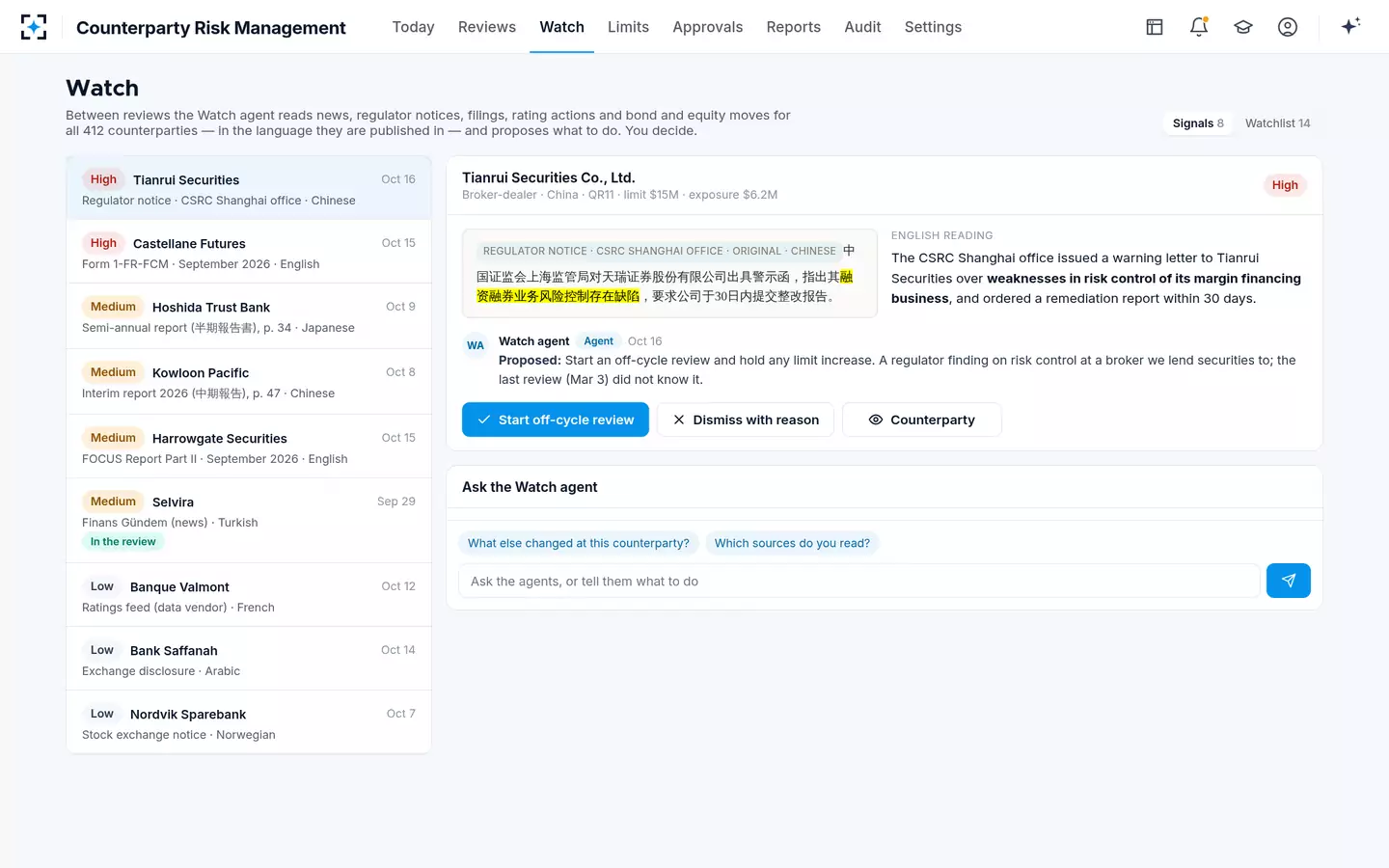
Take a fictional sample asset manager, Quillfield Capital, as it runs through Counterparty Risk Management. Between reviews the Watch agent reads news, regulator notices, filings, rating actions and bond and equity moves for each of its 412 counterparties, in the language they are published in, and proposes an action. One morning it raised a warning letter from a Chinese regulator's Shanghai office to a broker the firm lends securities to, over margin-financing controls the broker's last review in March had not known about, and proposed an off-cycle review with a hold on any limit increase.
A regulator's warning letter, read in Chinese, becomes a proposed off-cycle review
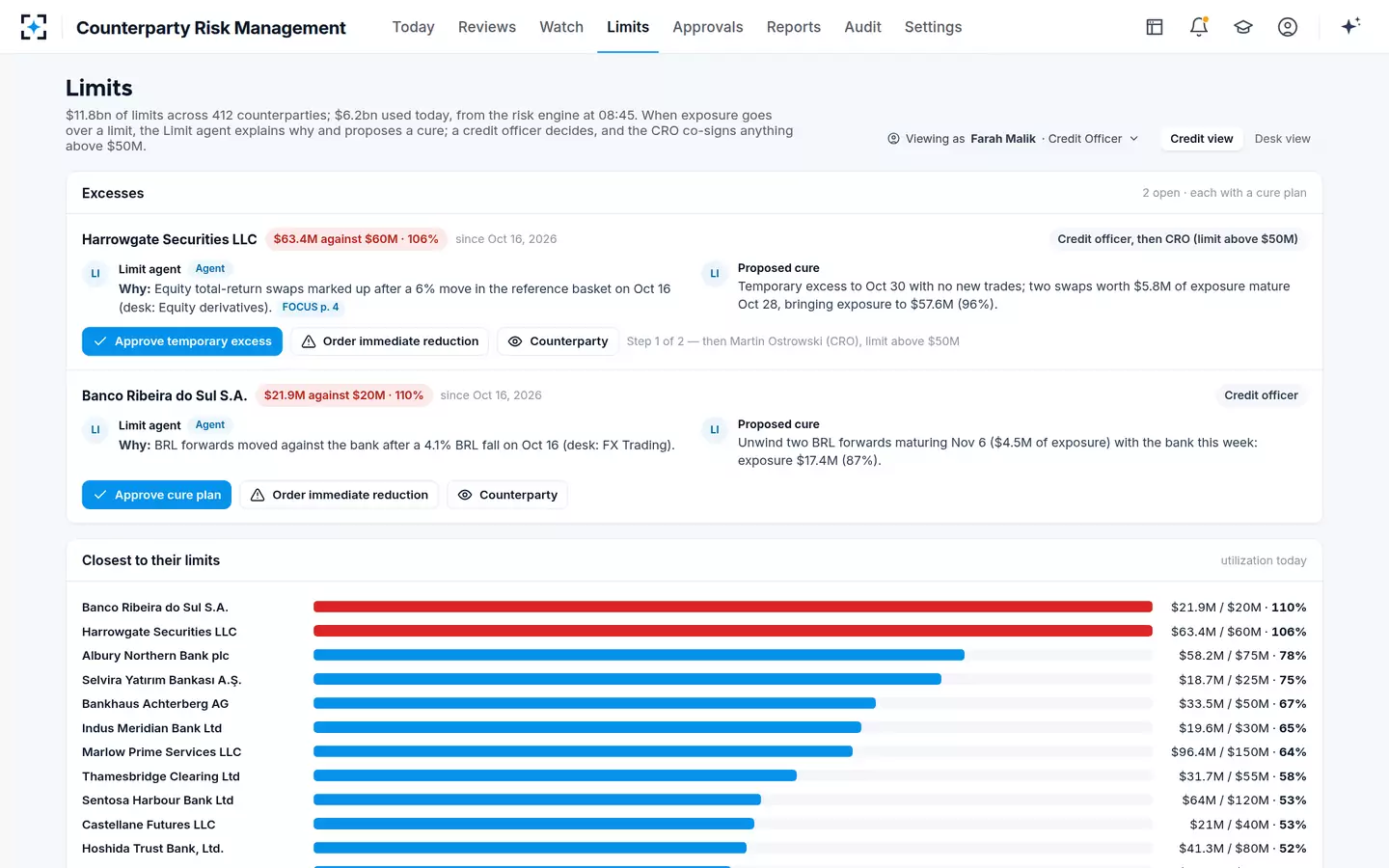
The limit side carries the other Archegos lesson. On the same sample book, a US broker-dealer's exposure rose to $63.4M against a $60M limit after equity total return swaps marked up on a 6% move in the reference basket. The Limit agent explained the cause and proposed a temporary excess until two swaps matured, but it could not raise the limit: a credit officer had to sign first, and because the limit was above $50M, the CRO after her.
An excess on total return swaps: a cause, a cure and two signatures, not a bigger limit
A fund is a counterparty too: what banks will now ask of you
Archegos changed what banks ask of their fund clients as well as what funds should ask of banks. The Basel guidelines say "In some cases, the collection of financial statements alone is insufficient to assess the riskiness of a counterparty", and that "risky and complex counterparties such as hedge funds should provide additional disclosures and risk metrics – such as value-at-risk or stress test results" (CRI40.14). Recommendation 7 of the FSB asks authorities to review exactly those private disclosures.
For an asset manager the two directions meet in one team. The people who answer a prime broker's questionnaire about the fund's leverage and concentration are often the people who review that prime broker's own capital. Doing both from evidence, cited and kept, is what the supervisors asked of Credit Suisse, and what counterparty due diligence on a bank's own filings looks like in practice. The difference between the risk a fund takes as a bondholder and as a trading partner of the same bank is set out in counterparty risk vs credit risk.
Questions people ask
What was Archegos Capital Management?
A family office that managed its owner's money and borrowed from banks through total return swaps rather than raising outside capital. The SEC alleged that its exposure reached $160 billion at its peak in March 2021, against a portfolio value of more than $36 billion.
Who fined Credit Suisse over Archegos?
On 24 July 2023 the Federal Reserve fined UBS Group AG $268.5 million for Credit Suisse's conduct, the UK Prudential Regulation Authority fined two Credit Suisse UK firms £87 million, and FINMA ordered corrective measures at UBS as legal successor. The PRA put the combined US and UK penalties above $387.5 million.
What are total return swaps?
Contracts in which a bank pays a client any rise in the value of a reference asset, such as a stock, and the client pays any fall plus a financing charge. The client gets the economics of owning the stock without holding it; the bank usually hedges by buying the stock itself, as Credit Suisse did.
Did any bank avoid losses on Archegos?
The supervisors' texts say only that losses of over $10 billion fell across several large banks, principally outside the US; they do not rank banks by how fast they sold. What the Basel Committee drew from the episode is that banks should stress the close-out itself, because the forecast exposure was less than a tenth of the realised loss.
Is Archegos relevant to a long-only asset manager?
Yes, through its banks. Any manager whose funds hedge currency or rates with dealer banks, lend securities or keep cash at a bank carries exposure to the institutions that lost money in March 2021. The question Archegos raises is whether its own reviews of those banks would notice a comparable problem.