Counterparty credit risk metrics measure two things: the exposure a firm has to each counterparty, today and under stress, and the health of the program that rates and limits those counterparties. The first layer is familiar from bank supervision: current exposure, potential future exposure, stressed exposure, concentration and wrong-way risk. The second is where asset managers' reporting is usually thin: how many counterparties are on a current review, how long a warning sign waits for a decision, how many limits are in excess and why, and what each review costs. Botminds' Counterparty Risk Management reads exposure from the firm's risk engine, runs the reviews, limits and monitoring with agents and credit officers, and logs every step, so both layers come from the same place.
What supervisors ask of counterparty measurement and reporting
4
key practices in the Basel guidelines; one is to measure, control and limit with complementary metrics
Daily
counterparty exposure to be quantified, using potential future exposure or alternatives
1month
at most between senior management reviews of counterparty reports, on data no more than three weeks old
Yearly
policy review that Basel encourages banks to aim for
What counterparty credit risk metrics do supervisors expect?
Supervisors expect a range of complementary exposure metrics rather than one number, because each one misses something. The Basel Committee's December 2024 guidelines list four key practices for banks, among them to "measure, control and limit CCR using a wide variety of complementary metrics" (BCBS d588). The interagency guidance names the core set for large dealers: "Current exposure (both gross and net of collateral)", "Forward-looking exposure (that is, potential exposure)", "Stressed exposure (broken out by market risk factors, and/or by scenario)", credit valuation adjustment measures, the largest exposures by business line and product, and "Correlation risks, such as wrong-way risk, as well as the credit quality of collateral" (Interagency Supervisory Guidance).
Smaller firms are not exempt from measuring, only from the full suite: "At a minimum, all banking organizations should calculate current exposure and stress test their CCR exposures." That minimum is a sensible floor for an asset manager too. Above it, the choice of metrics should follow where the firm's counterparty risk actually sits: in bilateral FX forwards and swaps, in repo and securities lending, in margin held at brokers and in cash at banks.
Exposure metrics: what a fund manager can measure, and where each comes from
A fund manager's exposure metrics should cover what it could lose now, what it could lose under stress, and where losses would concentrate. Basel adds a set many firms skip: "simple and intuitive risk metrics that are model-free", including "gross notional amount or gross market value", "gross trades' delta exposure", "received and posted collateral composition" and "country or regional gross exposure" (BCBS, CRI40.59, 40.60). They are cheap to produce and hard to game.
Counterparty exposure metrics for an asset manager, and what each one misses
| Metric | What it measures | What it misses | Usually from |
|---|---|---|---|
| Current exposure, gross and net of collateral | What the fund loses if the counterparty fails today, before and after collateral | Tomorrow's move; the close-out period | Risk engine, collateral system |
| Potential future exposure | "how sizeable the CCR exposure of a given counterparty's portfolio may become" at a confidence level | Gap moves and margin-driven defaults, by Basel's own account | Risk engine |
| Stressed exposure | Exposure under named scenarios, by market factor | Scenarios nobody wrote | Risk engine stress module |
| Gross notional and gross market value | Size of the book with a counterparty, before netting | Direction and collateral | Order management, risk engine |
| Concentration | Share of total exposure in the top names, by fund and firm-wide | The counterparty's own concentration | Dashboard over risk engine |
| Country or regional gross exposure | Exposure to banks in one jurisdiction or region | Group links across borders | Counterparty master with country of risk |
| Collateral composition | What collateral was received and posted, by issuer and type | Correlation with the counterparty unless tested | Collateral system |
| UCITS headroom | Each UCITS fund's exposure against its Article 52 caps | Everything outside the legal test | Limit check, fund by fund |
What is potential future exposure, and why it is not enough on its own?
Potential future exposure is a high-percentile estimate of how large the exposure to a counterparty could become over a future horizon. Basel defines it as "a risk metric calibrated on current/recent market conditions that quantifies, over a defined future horizon and at a specified confidence level, how sizeable the CCR exposure of a given counterparty's portfolio may become given the applicable contractual terms and credit risk mitigants" (CRI40.4), and asks banks to "quantify CCR exposure daily, using PFE or alternative metrics" (CRI40.65).
The same guidelines warn against relying on it alone. "When relying on PFE to manage CCR, stakeholders should maintain a sound understanding of both the risks captured by the metric and its inherent limitations", which should be "compensated in the CCR management process by assessing exposures using complementary risk metrics such as factor sensitivities, aggregation on a gross basis and stress testing" (CRI40.67). The case that made the point, and the size of the miss, is told in the Archegos collapse, from a fund's counterparty desk.
Program metrics: is the counterparty program itself working?
Program metrics tell a risk committee whether the reviews, limits and monitoring that sit behind the exposure numbers are being done, on time and on evidence. Where policy says every counterparty is reviewed, rated and given a fresh limit at least once a year, a program that cannot say how many reviews are current, how many are late and how long a warning waits for a decision is managing exposure to names it may no longer understand.
Counterparty credit risk program KPIs: definitions, and where the sample firm stands
Review currency
DefinitionCounterparties with a review completed within policy ÷ all approved counterparties
Sample or targetTarget 100%
On-time reviews
DefinitionReviews completed by their due date ÷ reviews due, year to date
Sample or targetSample: 97.3%, 3 overdue
Signal to decision
DefinitionDays from a watch signal to a credit officer's accept or dismiss, median and worst
Sample or targetMeasure
Open limit excesses
DefinitionCount, size and days open, split passive (market move) and active (new trades)
Sample or targetSample: 2 open, both passive, both with a cure
Exceptions and overrides
DefinitionPolicy exceptions approved, and agent proposals overridden, each with its reason
Sample or targetMeasure
Agent disagreements
DefinitionProposals escalated because two agents disagreed beyond tolerance ÷ proposals
Sample or targetSample night: 1 of 11
Hours per review
DefinitionAnalyst hours from filing to signature, per annual review
Sample or targetEstimate 20 by hand; target under 4
Re-performance
DefinitionAudit samples re-derived from the stored file with the same result ÷ samples
Sample or targetMeasure; sample audit plan: 25 a year
Two of these deserve a definition fixed in writing, because they are easy to flatter. Review currency should count a counterparty as current only if its review was completed and signed within policy, not merely started. Open excesses should count passive breaches, caused by market moves, alongside active ones: Basel wants passive breaches reviewed and challenged exactly as active ones are (quoted in UCITS counterparty limits), and says technical breaches caused by "bad data, incorrect mapping or similar issues" still need exception approval while the root cause is fixed (CRI40.110, 40.111).
How often should counterparties be reviewed?
Counterparties should be reviewed at least yearly, more often when they are riskier, and immediately when something material changes; the frequency belongs in written policy. Basel says due diligence standards "should discuss the frequency and intensity of credit reviews", that the frequency of rating reviews "should account for their inherent risk as well as the dynamic nature of their positions", and that a material change in a counterparty's risk profile should prompt a fresh assessment (CRI40.11, 40.25).
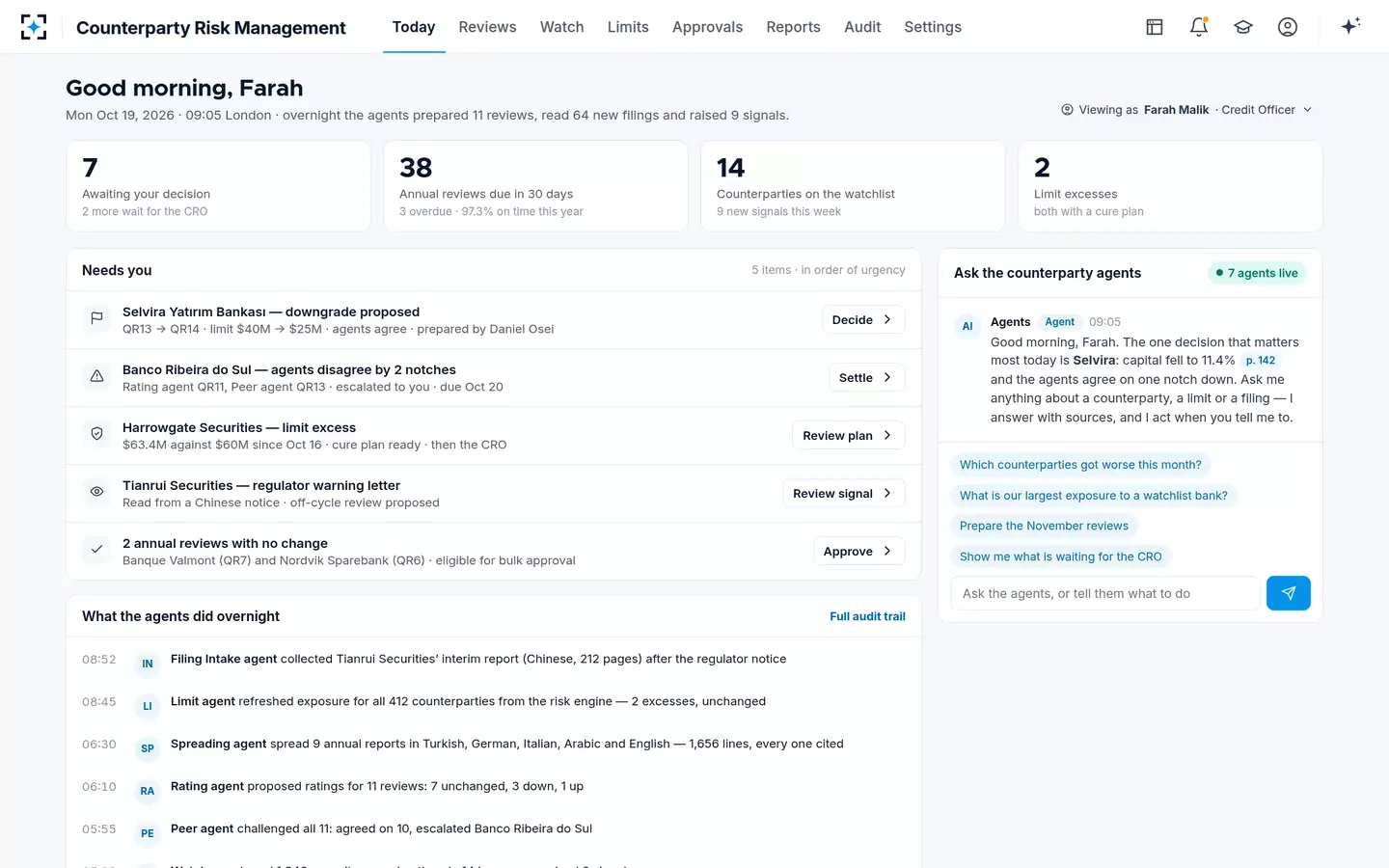
A program metric follows directly: off-cycle reviews triggered, and the share started within the policy's window after the trigger. In the sample firm's policy every counterparty is reviewed yearly, watchlist names every six months, and the Watch agent proposes off-cycle reviews from news, regulator notices, rating actions and market moves. Its credit officer's home screen on the morning shown listed 38 annual reviews due in 30 days, 3 overdue and 97.3% on time this year.
The program's KPIs where the credit officer starts her day
What is a counterparty watch list, and what should it report?
A counterparty watch list is the set of names under closer monitoring, usually limited to restricted or risk-reducing activity, with a shorter review cycle. Basel asks that "independent credit officers should be engaged in regular oversight of counterparties and they should maintain a watch list of any names that require restricted or risk-reducing activity only" (CRI40.133).
The watch list's metrics are its size and movement: names added and removed each month, the reason for each, exposure to watchlist names as a share of total, and how long names stay on it. A list that only grows is not being managed; one with large exposure to watchlist names is a limit decision waiting to be taken. In the sample, 14 counterparties were on the watchlist, with 9 new signals in the week shown.
What should the monthly counterparty report to the risk committee contain?
The monthly report should combine the two layers: exposure by counterparty, concentration and trend, limits and breaches, the watch list, and the program's own KPIs, with a short narrative of what changed. The interagency guidance lists what institutions generally report, including "Exposures to weak or problem counterparties", "Growth in exposures over time" and "A qualitative discussion of key risk drivers of exposures or conditions or factors that would fundamentally change the risk profile of CCR" (Interagency guidance). Basel adds that reporting should cover "relevant limits, breaches and other flagged risks" and "the degree of likelihood of a potential loss" (CRI40.101).
In the sample, the Review Writer agent drafts the monthly counterparty risk report for the risk committee, every sentence cited, and marks every judgement as the analyst's; the CRO receives it drafted. The reporting gap the FSB flagged for leverage providers, the "granularity, frequency, and timeliness" of counterparty disclosures (FSB, July 2025, Recommendation 7), applies inside a firm too: a monthly report with data older than three weeks is describing last month's counterparties.
What does a counterparty review cost, and how do you measure it?
No regulator or independent study publishes the cost of an annual counterparty review, so a program has to measure its own: hours per review by task, multiplied by the loaded cost of the people doing them, plus data subscriptions and the cost of reviews that run late. Botminds' estimate for one annual bank review is about 20 analyst hours by hand and about 3 with agents collecting, spreading and drafting; the solution's design target is under four hours.
The cost of a counterparty program, in terms a risk committee can check
| Component | How to count it | What goes in | Owner |
|---|---|---|---|
| Review hours | Reviews a year × hours per review | Sample: 412 annual + 14 extra watchlist reviews; Botminds' estimate 20 hours by hand, 3 with agents | Head of counterparty risk |
| People cost | Review hours × loaded hourly cost | Your own salary and overhead figures | Finance |
| Data and tools | Subscriptions + licences | Credit data feeds, news, translation, the review system itself | Risk technology |
| Exposure on stale reviews | Overdue reviews × days overdue × exposure | A risk measure, not a cash cost: exposure carried on information nobody has reviewed | CRO |
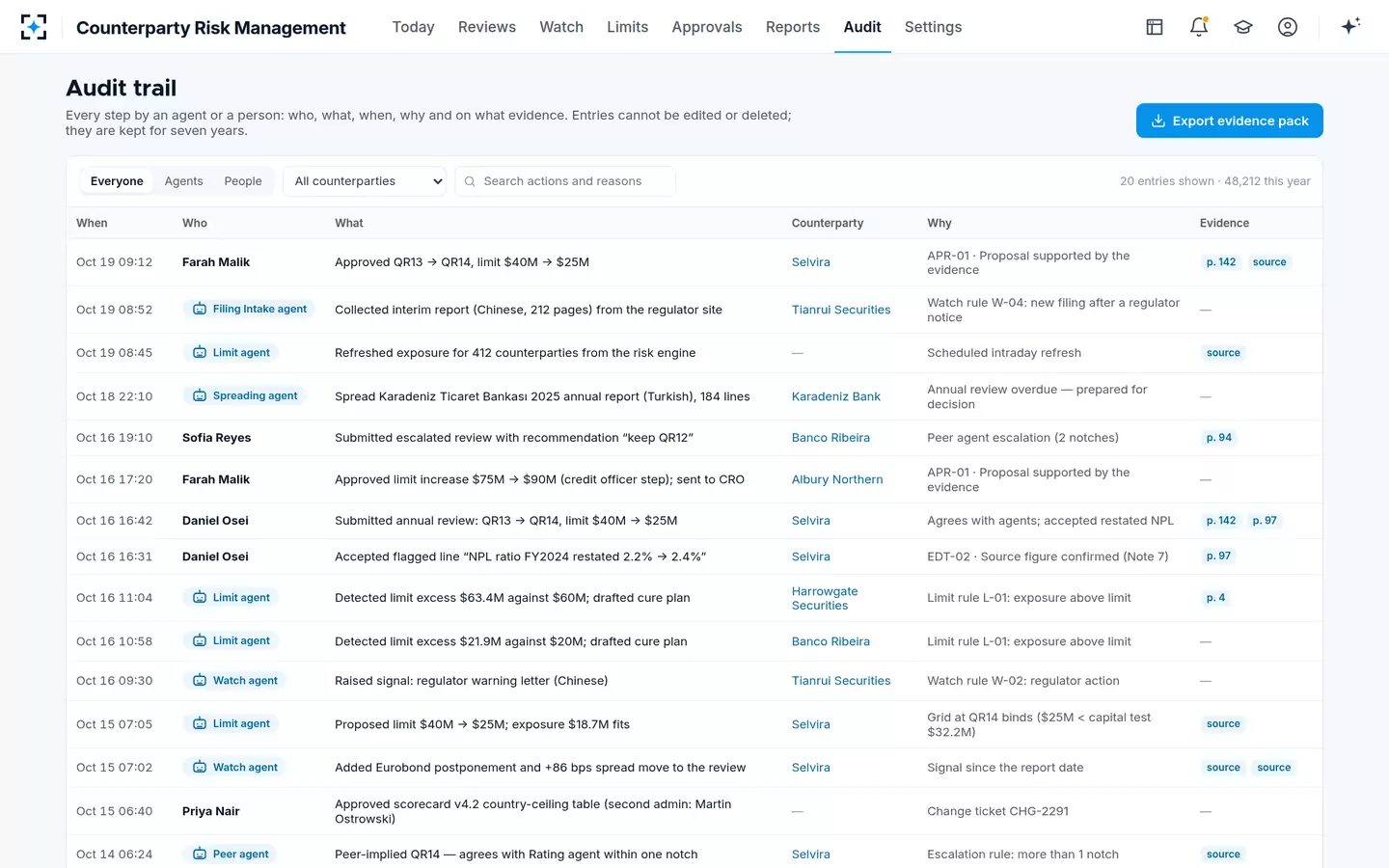
The stale-review line is the one most worth adding to the committee's page. Exposure carried on a review that is months overdue is credit risk taken on information the firm has not looked at; multiplying it by the days overdue turns a compliance statistic into a risk number. The audit trail is what makes every one of these metrics re-performable rather than self-reported.
The audit trail every metric is computed from
Which inputs a firm needs to produce these metrics from day one is listed in what you bring to a counterparty risk system; how exposure and public data are joined on one screen is in the counterparty risk dashboard.
Questions people ask
What is counterparty credit exposure?
The amount a firm would lose if a counterparty defaulted, measured as current exposure (replacement cost now, gross or net of collateral) and potential exposure (how large it could become at a confidence level over a horizon). For a fund it arises from derivatives, repo and securities lending, margin at brokers and cash at banks.
What is a counterparty credit risk framework?
The set of policy, limits, measurement, reporting and governance a firm uses to control counterparty risk. Basel's 2024 guidelines organise it around due diligence, credit risk mitigation, exposure measurement with complementary metrics, and governance, including limits and management reporting.
Should a fund manager calculate potential future exposure?
If it runs material bilateral derivatives, yes, through its risk engine, alongside stressed and gross measures. The interagency guidance's minimum for smaller banks is current exposure plus stress testing, which is a reasonable floor for a manager whose derivatives are mainly currency hedges.
How many KPIs should a counterparty program report?
Few enough to be read every month. Basel warns against reporting that overwhelms users with data. Eight program measures and a short exposure section, each with a fixed definition and a trend, usually say more than a long deck of charts.
What is a good on-time review rate?
The policy's answer should be every review on time, and anything less needs a reason and an exposure figure. In the sample, 97.3% of this year's reviews were on time with 3 overdue; the design target is every counterparty on a current annual review.