UCITS counterparty limits are the caps in Article 52 of the UCITS Directive on how much of a fund's assets can be at risk to one derivatives counterparty: 10% of assets when the counterparty is a credit institution, 5% in other cases, measured on the positive mark-to-market value of the contracts, with netting allowed only against the same counterparty. A second cap stops a fund combining that exposure with the same bank's bonds and deposits above 20% of assets. The hard part is not the arithmetic but the inputs: exposure moves every day with the market, collateral and netting change the number, and the limit is only as safe as the review of the bank behind it. Botminds' Counterparty Risk Management reviews, rates and sets limits for the banks and brokers a fund manager trades with, and checks every proposed limit against each UCITS fund's Article 52 headroom before a credit officer signs.
The four numbers in Article 52 that govern a UCITS fund's banks
10%
of assets: exposure to one credit institution in uncleared derivatives
5%
of assets: the same cap for any other counterparty, such as a broker-dealer
20%
of assets: bonds, deposits and derivatives exposure to one body, combined
35%
of assets: the ceiling no combination of Article 52 limits may exceed
What are the UCITS counterparty limits? 10% for banks, 5% for everyone else
The UCITS counterparty limit is a cap per counterparty, set as a share of the fund's assets, and it depends on who the counterparty is. The consolidated directive reads: "The risk exposure to a counterparty of the UCITS in a derivative transaction that is not centrally cleared through a CCP authorised in accordance with Article 14 of Regulation (EU) No 648/2012 or recognised in accordance with Article 25 of that Regulation, shall not exceed either: (a) 10 % of its assets when the counterparty is a credit institution referred to in Article 50(1)(f); or (b) 5 % of its assets, in other cases" (Directive 2009/65/EC, Art. 52(1)).
The credit institutions that earn the higher cap are those Article 50(1)(f) describes: a bank with its registered office in an EU Member State, or a third-country bank "subject to prudential rules considered by the competent authorities of the UCITS home Member State as equivalent". An investment firm, a US broker-dealer affiliate or a non-bank dealer falls into "other cases" at 5%, which is why a fund's counterparty file has to name the legal entity that signed the master agreement, not the group's brand.
Article 50 sets a threshold condition before any limit applies: the counterparties to OTC derivatives must be "institutions subject to prudential supervision, and belonging to the categories approved by the competent authorities of the UCITS home Member State". A UCITS cannot trade with an unsupervised dealer at any size. Everything after that is about how much.
UCITS counterparty limits beside a US fund's rules, line by line
The limit
UCITS fund10% of assets to a credit institution, 5% to anyone else, per counterparty (Art. 52(1))
US registered fundNo numeric limit on derivatives counterparty exposure in the Investment Company Act rules
What is measured
UCITS fundPositive mark-to-market of the OTC contracts with that counterparty (Directive 2010/43, Art. 43)
US registered fundWhatever the fund’s own program measures; Rule 18f-4 names counterparty risk among derivatives risks
Netting
UCITS fundOnly OTC derivatives with the same counterparty, only under a legally enforceable netting agreement
US registered fundA matter for the program and the master agreement
Collateral
UCITS fundMay reduce exposure if it meets ESMA’s ten criteria; collateral the fund posts counts against it
US registered fundNo rule-based reduction test
Cleared trades
UCITS fundOutside the counterparty limit once national law transposes Directive (EU) 2024/2994 (due 25 June 2026)
US registered fundNo limit to leave
The same bank’s bonds
UCITS fundBonds, deposits and OTC exposure to one body combined: 20% cap; 35% hard cap
US registered fundRule 12d3-1: at most 5% of total assets in one securities-related issuer’s securities
How is UCITS counterparty exposure measured? Positive mark-to-market, netted only with the same bank
UCITS counterparty exposure is the positive mark-to-market value of the fund's OTC derivatives with that counterparty, less eligible collateral. Commission Directive 2010/43/EU says management companies "shall use the positive mark-to-market value of the OTC derivative contract with that counterparty" (Art. 43(2)). Notional does not enter the counterparty test; only what the fund would lose if the bank failed today does.
Netting is allowed, narrowly. A management company "may net the derivative positions of a UCITS with the same counterparty, provided that they are able to legally enforce netting agreements with the counterparty on behalf of the UCITS", and "Netting shall only be permissible with respect to OTC derivative instruments with the same counterparty and not in relation to any other exposures the UCITS may have with that same counterparty." A negative swap with Bank A cannot offset a deposit at Bank A, and a forward with Bank A's broker-dealer subsidiary nets against Bank A only if one enforceable agreement covers both.
The enforceability test is where the master agreement and the legal opinion behind it meet the risk number. A fund that cannot point to an enforceable netting agreement in the counterparty's jurisdiction must count every in-the-money contract gross. Extracting those terms from the documents is a separate job, done in ISDA and CSA Data Extraction; the limit check needs only the answer, per counterparty and per fund.
One illustrative bank, one UCITS fund: how netting and collateral move the counterparty test
| Step | Calculation | Exposure | Share of €500m assets |
|---|---|---|---|
| 1. Gross positive mark-to-market | Forwards and swaps in the money to the fund: €30.0m; contracts out of the money (€8.0m) ignored | €30.0m | 6.0% |
| 2. With an enforceable netting agreement | €30.0m − €8.0m | €22.0m | 4.4% |
| 3. Less eligible collateral received | €22.0m − €15.0m of government bonds after haircut | €7.0m | 1.4% |
| 4. Without the netting agreement | €30.0m − €15.0m (collateral still counts, netting does not) | €15.0m | 3.0% |
| 5. Against the cap for a credit institution | 10% of €500m | €50.0m cap | headroom 8.6 points (step 3) |
Can collateral reduce UCITS counterparty exposure? Yes, if it passes ESMA's ten tests
Collateral can reduce UCITS counterparty exposure, and in the limit it can remove it. CESR's 2010 guidelines put it plainly: "UCITS may disregard the counterparty risk on condition that the value of the collateral, valued at market price and taking into account appropriate discounts, exceeds the value of the amount exposed to risk at any given time" (CESR/10-788, Box 26). ESMA's 2014 guidelines replaced the criteria the collateral must meet, and they are strict.
ESMA's collateral criteria: what must hold before collateral reduces UCITS counterparty exposure
- Liquidity
Non-cash collateral "should be highly liquid and traded on a regulated market or multilateral trading facility with transparent pricing".
- Valuation
Valued "on at least a daily basis"; volatile assets only with "suitably conservative haircuts".
- Issuer credit quality
"Collateral received should be of high quality."
- Correlation
Issued by "an entity that is independent from the counterparty" and not expected "to display a high correlation with the performance of the counterparty". A bank's own bonds fail.
- Diversification
No more than 20% of the fund's net asset value to one issuer across collateral baskets, with a derogation for government securities from at least six issues.
- Operational and legal risk
Identified, managed and mitigated by the risk management process.
- Custody
Held by the depositary under title transfer, otherwise by a supervised third-party custodian unrelated to the provider.
- Enforceability
Capable of being fully enforced "at any time without reference to or approval from the counterparty".
- No re-use of non-cash collateral
Non-cash collateral "should not be sold, re-invested or pledged".
- Cash collateral kept safe
Only deposited with eligible credit institutions, invested in high-quality government bonds, used for recallable reverse repo with supervised banks, or placed in short-term money market funds.
Two traps follow from the list. Collateral the fund posts is exposure too: Directive 2010/43/EU requires management companies to take into account collateral passed to an OTC counterparty, and allows it on a net basis "only if the management company is able to legally enforce netting arrangements with this counterparty". And the correlation test rules out the most convenient collateral of all, the counterparty's own paper, which is worth least on the day it is needed.
The 20% single-body limit joins the bank's bonds, deposits and derivatives
The second cap catches a fund that is both lender to and trading partner of the same bank. Notwithstanding the individual limits, "a UCITS shall not combine, where this would lead to investment of more than 20 % of its assets in a single body", investments in its securities, deposits with it and exposure from uncleared derivatives with it (Art. 52(2)). Group companies consolidated for accounts "shall be regarded as a single body".
A further ceiling sits above every Article 52 combination: investments in, deposits with and derivatives with one body "shall not exceed in total 35 % of the assets of the UCITS". The single-body test is where most surprises happen, because the bond holdings sit with the portfolio manager, the deposit with treasury and the forwards with the trading desk. Why the two exposures behave differently, and why they must still be added, is the subject of counterparty risk vs credit risk.
Repo, securities lending and margin at a broker count too
Derivatives are not the only route to a counterparty. ESMA's guidelines say "The risk exposures to a counterparty arising from OTC financial derivative transactions and efficient portfolio management techniques should be combined when calculating the counterparty risk limits of Article 52" (ESMA/2014/937, para. 41). A fund that does reverse repo with a bank and FX forwards with the same bank has one counterparty number, not two.
CESR's 2010 guidelines add the exposure funds most often forget: "Initial margin posted to and variation margin receivable from a broker relating to exchange-traded or OTC derivatives which is not protected by client money rules or other similar arrangements to protect the UCITS against the insolvency of the broker" belongs inside the OTC counterparty limit (Box 27). The same box tells a fund to "establish whether its exposure is to an OTC counterparty, a broker or a clearing house".
Do centrally cleared derivatives count towards UCITS counterparty limits? Not since June 2026
Centrally cleared derivatives no longer count towards the 10% and 5% caps once a Member State has transposed Directive (EU) 2024/2994, which was due by 25 June 2026. The directive explains what it changed: the UCITS Directive "imposes regulatory limits on counterparty risk only in respect of over-the-counter (OTC) derivative transactions, irrespective of whether the derivatives have been centrally cleared", and the new text removes counterparty limits "only when the counterparties use CCPs that are authorised or recognised" under EMIR (Directive (EU) 2024/2994, recital 1 and Art. 4).
Three points need care in a fund's own procedures. The exemption depends on the CCP being authorised under Article 14 or recognised under Article 25 of EMIR, so a trade cleared elsewhere stays inside the limit. The 20% single-body test changed the same way. And whether initial margin left with a clearing broker still belongs in the limit, as CESR's 2010 guidance counted it when unprotected, is a question to settle with the home regulator and document in the risk management process rather than assume.
What happens when a UCITS breaches a counterparty limit?
A UCITS that breaches a counterparty limit for reasons outside its control must fix it, but need not dump positions. Article 57(2) says that when the limits are exceeded for reasons beyond the fund's control, or because subscription rights were exercised, putting the breach right becomes the priority of the fund's sales, with due regard to its unit-holders' interests (Art. 57(2)). The directive sets no fixed number of days; a passive breach caused by a market move is remedied as a priority, an active one should not happen.
Bank supervisors draw the same line and close the obvious loophole. The Basel Committee's 2024 guidelines say "Passive breaches of counterparty credit limits – ie breaches caused by changes in MTM, not position changes – should require the same review and challenge as active breaches" (BCBS, CRI40.111). A fund whose FX forwards with one bank rally into a breach has a counterparty decision to make, not only a compliance note to file.
Settlement limits vs counterparty limits: the risk in the next hour and the risk until maturity
A settlement limit caps what a fund can lose while a trade settles, when one side has paid and the other has not; a counterparty limit caps what it can lose if the counterparty fails before the contract ends. UCITS rules speak only to the second. Bank supervisors expect both on one report: the interagency counterparty guidance says "Exposure reports should also include the size of settlement and clearing lines" (Interagency Supervisory Guidance on Counterparty Credit Risk Management).
For an asset manager the two come from different places. A settlement line follows the trading desk's daily FX volume with a bank and is set in hours of exposure. A counterparty limit follows the bank's credit, the fund's mark-to-market and the Article 52 cap. Kept in separate systems, they can disagree about the same bank on the same morning, which is the case for a counterparty risk dashboard that joins them.
Do US mutual funds have counterparty limits? A program, not a percentage
US registered funds have no rule that caps exposure to one derivatives counterparty at a percentage of assets. Rule 18f-4 instead requires a derivatives risk management program whose risks include counterparty risk, with weekly stress tests that take account of payments to derivatives counterparties, and leaves the limits to the fund's own risk guidelines (17 CFR 270.18f-4; Rule 18f-4 in plain words). The board sees the program, not a counterparty cap.
The US caps the bond side instead. Rule 12d3-1 lets a fund buy securities of a broker, dealer, underwriter or adviser that earns more than 15% of its revenue from securities activities only if, immediately afterwards, no more than 5% of the value of its total assets sits in that issuer's securities (17 CFR 270.12d3-1(b)(3)). A US fund can therefore hold no more than 5% of its assets in a dealer's bonds while carrying forward exposure to the same dealer with no numeric cap at all, the opposite of the UCITS design.
Private funds face reporting rather than limits. From 1 July 2027, when the 2024 Form PF amendments apply after the September 2026 extension (91 FR 56593), advisers to hedge funds report up to five counterparties to which a fund has net mark-to-market exposure "equal to or greater than either (1) five percent of the reporting fund's net asset value as of the data reporting date or (2) $1 billion, after taking into account collateral" (Form PF adopting release, 2024). The SEC and CFTC proposed in April 2026 to cut some Form PF burdens, so check the questions in force before building to them.
How to set counterparty credit limits inside the legal cap
The legal cap is a ceiling, not a limit policy. A fund manager's own limit comes from its view of the bank's credit, and Article 52 is checked last, fund by fund. The Basel guidelines describe the logic a credit policy should copy: limits "should be set at levels consistent with the bank's assessment of the counterparty's credit quality, the degree of transparency the bank has on the counterparty's overall financial condition and leverage", and "should not be set so high" that risk builds up nor "too low such that they do not serve as a credible reflection of the bank's risk tolerance" (CRI40.82, CRI40.113).
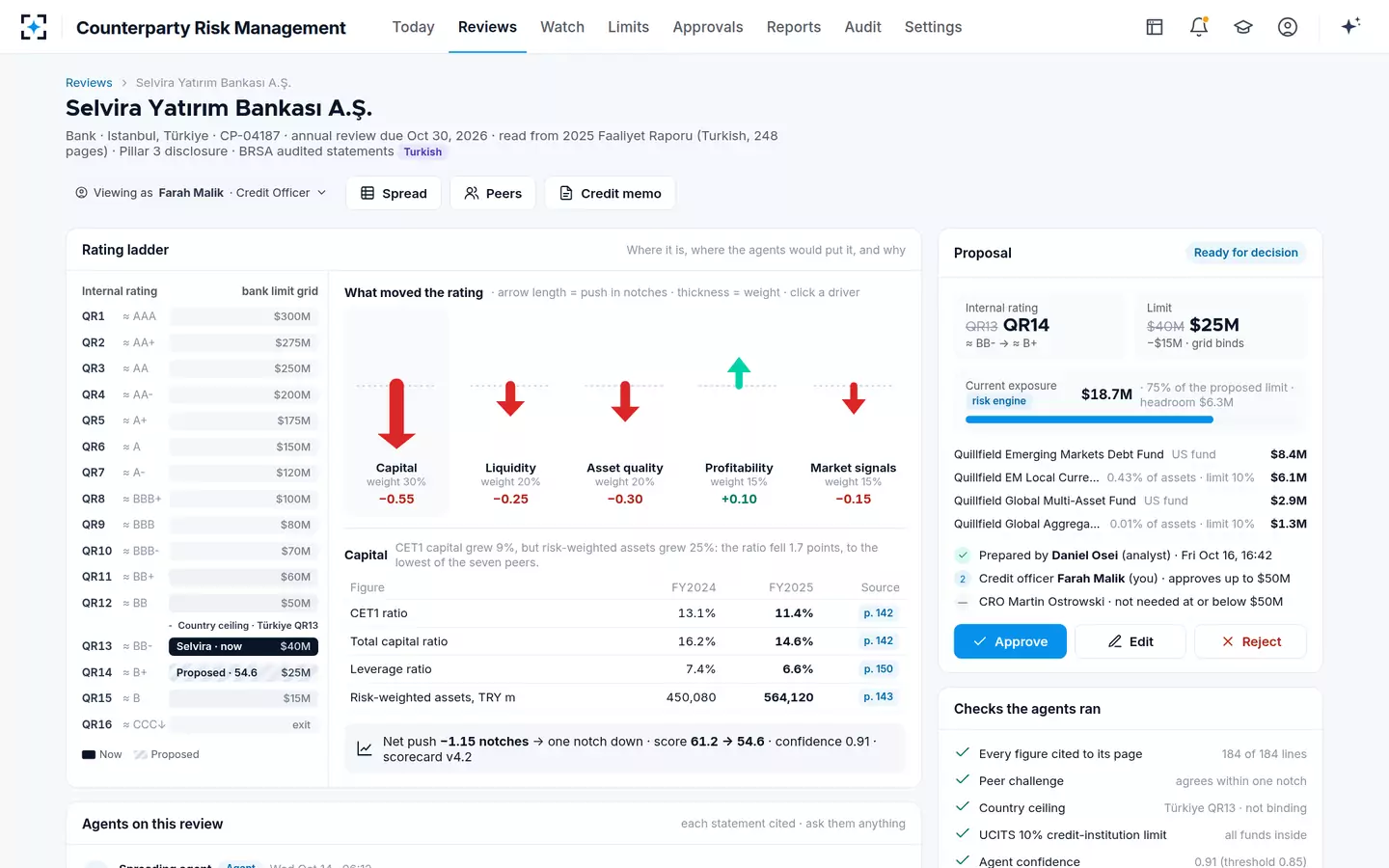
Take a fictional sample asset manager, Quillfield Capital, as it runs through Counterparty Risk Management. Its credit policy, held as settings, maps each internal rating notch to a maximum limit and adds a capital test: no more than 2% of a bank's Tier 1 capital. When its Istanbul counterparty Selvira Yatırım Bankası moved from QR13 to QR14, the grid limit fell from $40M to $25M, below the $32.2M capital test, so the grid set the limit. Exposure of $18.7M across four funds left $6.3M of firm-wide headroom.
One bank, four funds: where the firm-wide limit and the UCITS caps bite
The bars show why the legal test is necessary and rarely sufficient. The two UCITS funds are at 0.43% and 0.01% of assets against a 10% cap; the US funds have no cap at all. What protects all four is the firm-wide limit tied to the bank's credit, which is why the Limit agent checks UCITS headroom fund by fund but proposes the limit from the grid, and why a credit officer, not the agent, signs it.
The UCITS check sits beside the rating, not after it
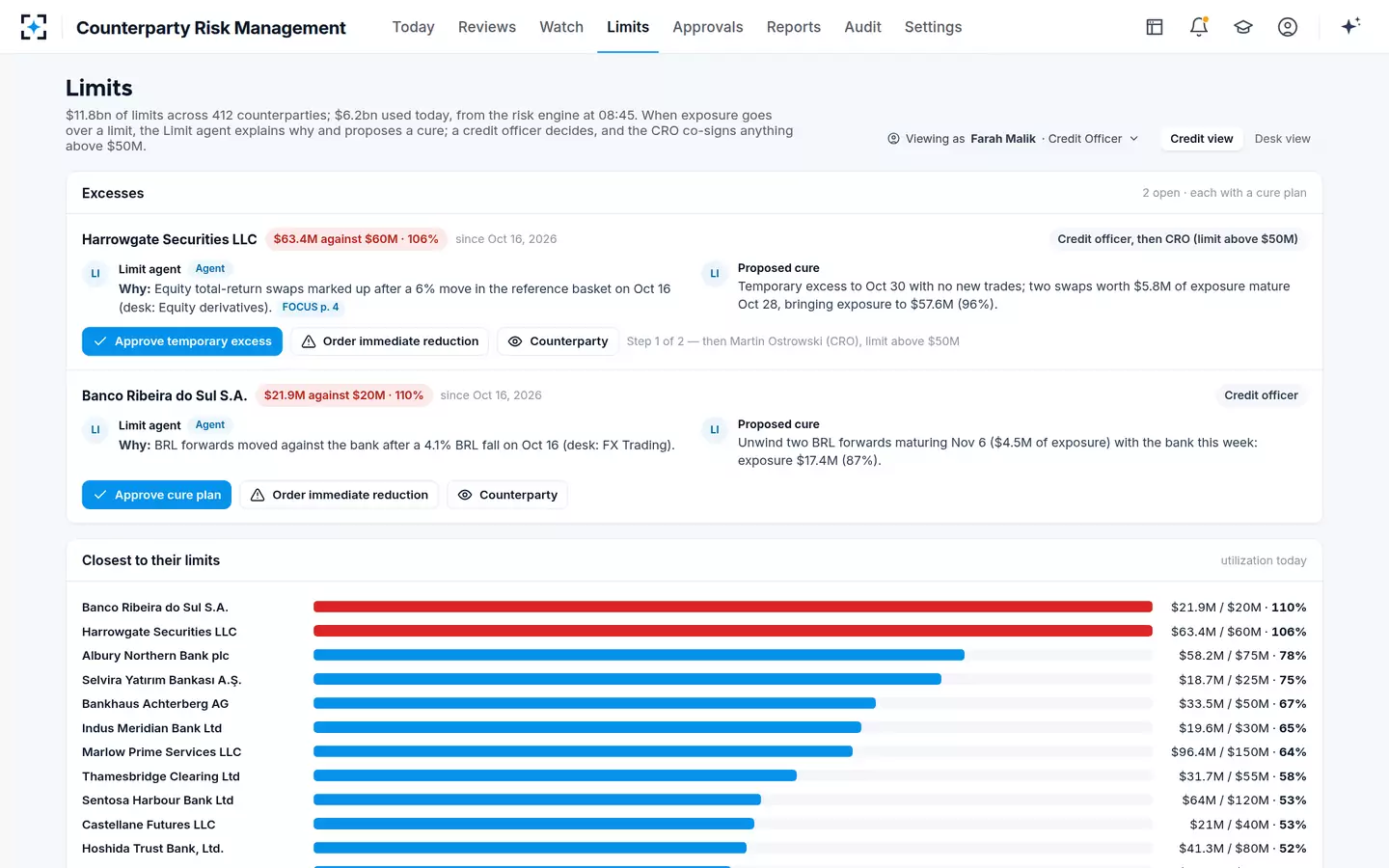
When exposure does exceed a limit, the solution treats it as the Basel text does: a cause, a cure and a decision. On the sample book, a Brazilian bank sat at $21.9M against a $20M limit after a 4.1% fall in the real moved FX forwards against it, a passive breach, and the Limit agent's proposed cure was to unwind two forwards maturing in November. A credit officer approved or rejected it with a reason; nothing changed in the limit system before the signature.
Limit excesses with a cause and a cure, and every counterparty's utilisation
Questions people ask
What is the UCITS 5/10/40 rule, and is it the same as the counterparty limit?
No. The 5/10/40 rule is the issuer limit in Article 52(1)-(2): no more than 5% in securities of one issuer, raisable to 10% if holdings above 5% total no more than 40%. The counterparty limit is the separate 10% or 5% cap on derivatives exposure to one counterparty. Both meet in the 20% single-body test.
Is a UCITS counterparty limit measured on notional?
No. Directive 2010/43/EU measures it on the positive mark-to-market value of the OTC contracts with the counterparty. A €200m notional forward that is €3m in the money uses €3m of the limit, and an out-of-the-money contract uses none.
Does a third-country bank get the 10% limit?
Only if it is a credit institution that Article 50(1)(f) covers: registered in a Member State, or in a third country and subject to prudential rules the fund's home regulator considers equivalent. Otherwise the 5% cap applies. The legal entity on the master agreement decides it, not the group.
Can a UCITS hold a bank's bonds and trade derivatives with it?
Yes, within limits. The bonds count against the 5% issuer limit, the uncleared derivatives against the 10% counterparty limit, and the two together with deposits at that bank against the 20% single-body limit and the 35% overall ceiling in Article 52.
Do UCITS limits apply to AIFs?
No. Article 52 is part of the UCITS Directive. An AIF manager sets counterparty limits in its own risk management policy under AIFMD, and the fund's documents and investors' terms may impose their own.
How often must UCITS counterparty exposure be checked?
Article 52 states the caps without a testing frequency. Because Directive 2010/43/EU requires global exposure to be calculated at least daily, managers normally refresh counterparty exposure with each daily valuation. The bank's credit behind the limit is reviewed on the manager's own cycle, at least yearly and sooner on a signal.