Counterparty credit risk and AI meet at a clear line: AI agents can do the reading, spreading, scoring and watching that fill an analyst's week, and propose a rating and a limit with every driver cited, but setting the rating and the limit is a credit decision that bank supervisors expect to be made independently of the business, approved within a delegated authority and documented. For an asset manager reviewing hundreds of banks and brokers, that line decides whether an AI tool shortens the review or quietly takes over the decision. Botminds' Counterparty Risk Management is built on that line: seven agents read, rate, challenge and watch every counterparty; the analyst prepares, a credit officer approves, the CRO co-signs larger limits, and nothing reaches the limit system before a signature.
Where the sample firm draws the line, as settings
0.85
agent confidence below which no rating is proposed at all
>1notch
disagreement between two agents that goes to a credit officer
2
signatures on any limit above $50M: the credit officer's, then the CRO's
0roles
that can set or change a limit directly, agents or people
Counterparty credit risk and AI: where does the line sit?
The line sits between proposing and deciding. Everything up to a proposal, collecting filings, reading them, spreading figures, scoring them against the scorecard, comparing peers, sizing a limit from the grid and drafting the memo, can be done by agents whose work is cited and checkable. The rating, the limit and any exception to policy are decisions, and the Basel Committee's 2024 guidelines describe who owns them: "Limits should be set and verified independently of the business function", and "Limit actions such as exceptions should require approval from an independent risk function", with "an adequate audit trail of such approvals" (BCBS, CRI40.108, 40.109).
Nothing in those texts mentions AI, which is the point. They describe who may decide, not which tool prepared the file. A firm that lets a model write a limit to the limit system has moved a decision out of the approval chain the guidelines describe, whatever the model's accuracy.
One counterparty review: what each agent may do, and where people decide
Agent
Filing Intake agentCollects annual reports, Pillar 3 disclosures, audited statements and broker filings; detects language, period and accounting basis.
Never: Uses a file it cannot read fully, or guesses a period.
Agent
Spreading agentReads each filing in its own language into the firm's template, every figure cited to its page.
Never: Estimates a missing figure.
Agent
Rating agentApplies the firm's scorecard and proposes a notch with weighted drivers and a confidence.
Never: Sets the final rating, or proposes one below 0.85 confidence.
Agent
Peer agentRe-rates the counterparty from similar banks as a challenge to every proposal.
Never: Overrides the Rating agent, or settles a gap of more than one notch itself.
Agent
Limit agentTurns the notch into a limit from the grid and the capital test, checks live exposure and UCITS headroom.
Never: Writes to the limit system before a signed approval.
A person decides
AnalystDecides flagged lines, may override an agent with a reason, and submits.
Never: Approves.
A person decides
Credit officer, and the CRO above $50MReads the cited case, asks the agents back, and approves, edits or rejects with a reason code.
Never: Approves their own work.
What can AI do in counterparty credit risk today?
AI can do most of the work that precedes a counterparty credit decision: finding and reading filings, including in languages the team does not read, extracting figures with their pages, applying a scorecard, comparing peers, monitoring news and notices, and drafting the memo. The SEC's examiners already see it across the industry: their FY2027 priorities describe registrants bringing what the SEC calls "super intelligence (SI)" into core operations, from investment analysis to client management and coding (SEC, FY2027 Examination Priorities).
The same document describes how the SEC uses that technology on its own side, and the phrasing is a useful model. The Division of Examinations says it is bringing SI into its own examinations and risk assessment to add capacity and strengthen oversight, "without displacing examiner judgment". Replace "examiner" with "credit officer" and it is a fair specification for AI in a counterparty program.
What AI does well here follows from the work's shape. A bank review needs a few hundred figures read accurately from a long document, a fixed scorecard applied consistently and a comparison across similar banks, every year, for hundreds of names. Those are repeatable, checkable tasks. What it should not be trusted to do alone is the part that needs accountability: deciding what the evidence means for this firm's risk appetite.
Can AI set a counterparty credit limit?
AI should not set a counterparty credit limit; it can propose one, sized from the firm's own grid and checked against exposure, for a person with delegated authority to approve. Supervisors expect limits to be approved by an independent risk function and escalated by size: the interagency guidance describes "a process to escalate limit approvals to higher levels of authority, depending on the size of counterparty exposures, credit quality, and tenor" (Interagency Supervisory Guidance). A tool that writes limits directly removes the escalation.
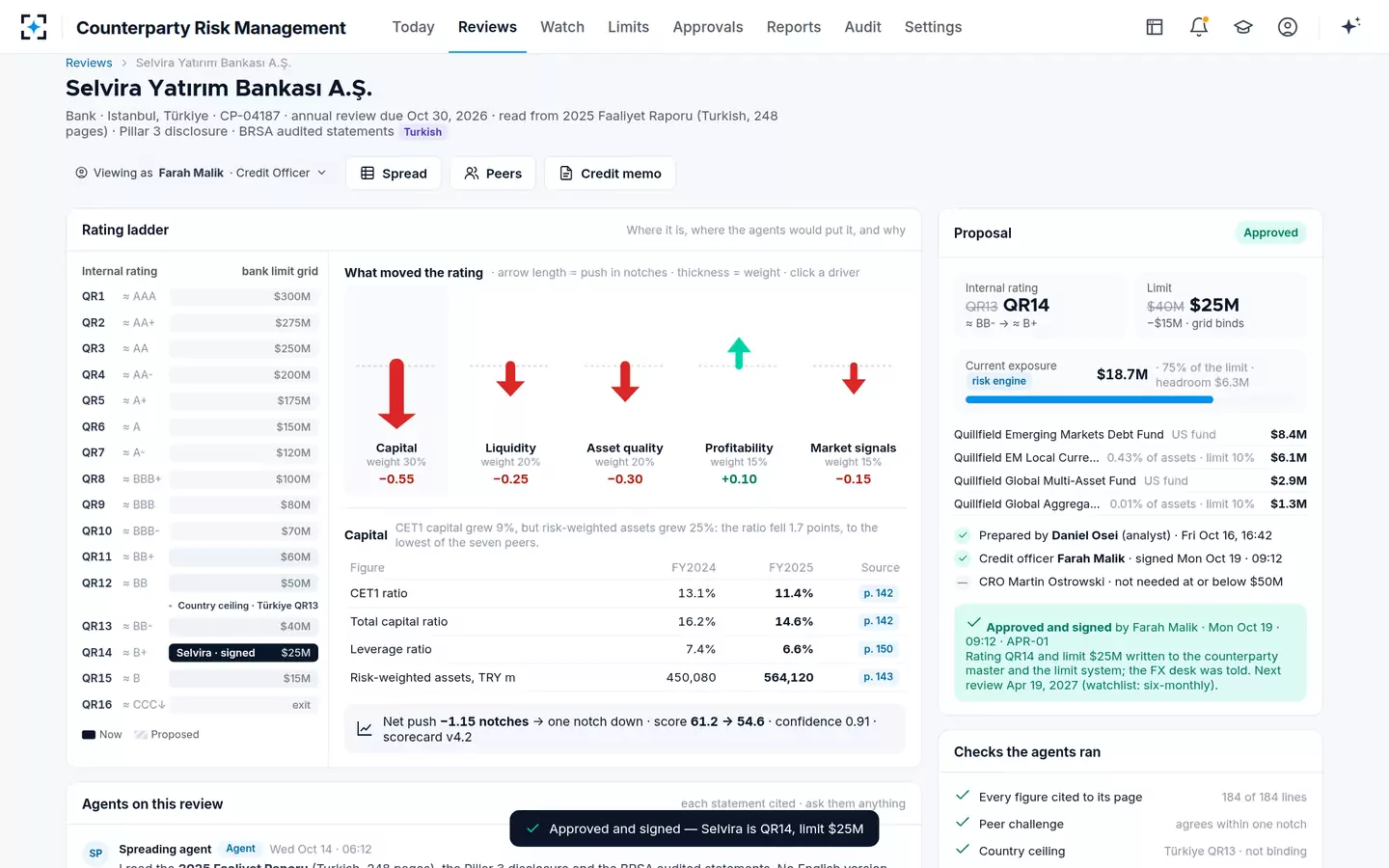
Take a fictional sample asset manager, Quillfield Capital, as it runs through Counterparty Risk Management. When its Istanbul counterparty moved down a notch, the Limit agent read the grid, $25M for a bank at QR14, below a capital test of 2% of Tier 1 that gave $32.2M, and proposed cutting the limit from $40M to $25M against $18.7M of exposure. Because the new limit was below $50M, the credit officer could approve alone. She signed with reason code APR-01, "Proposal supported by the evidence", and only then were the rating and limit written to the counterparty master and the limit system, and the FX desk told.
Signed first, written second: the approval states exactly what was decided
Who approves a counterparty rating?
A counterparty rating is approved by a credit officer with delegated authority, independent of the person who prepared it and of the trading desk, with larger or riskier decisions escalated to the CRO or a credit committee. Basel asks firms to show that oversight "is conducted by risk managers with clearly defined roles and responsibilities and appropriate levels of authority, including exception approval and a clearly defined and actionable escalation framework" (CRI40.89), and policies to set "clear guidelines for credit approval authority" (CRI40.93).
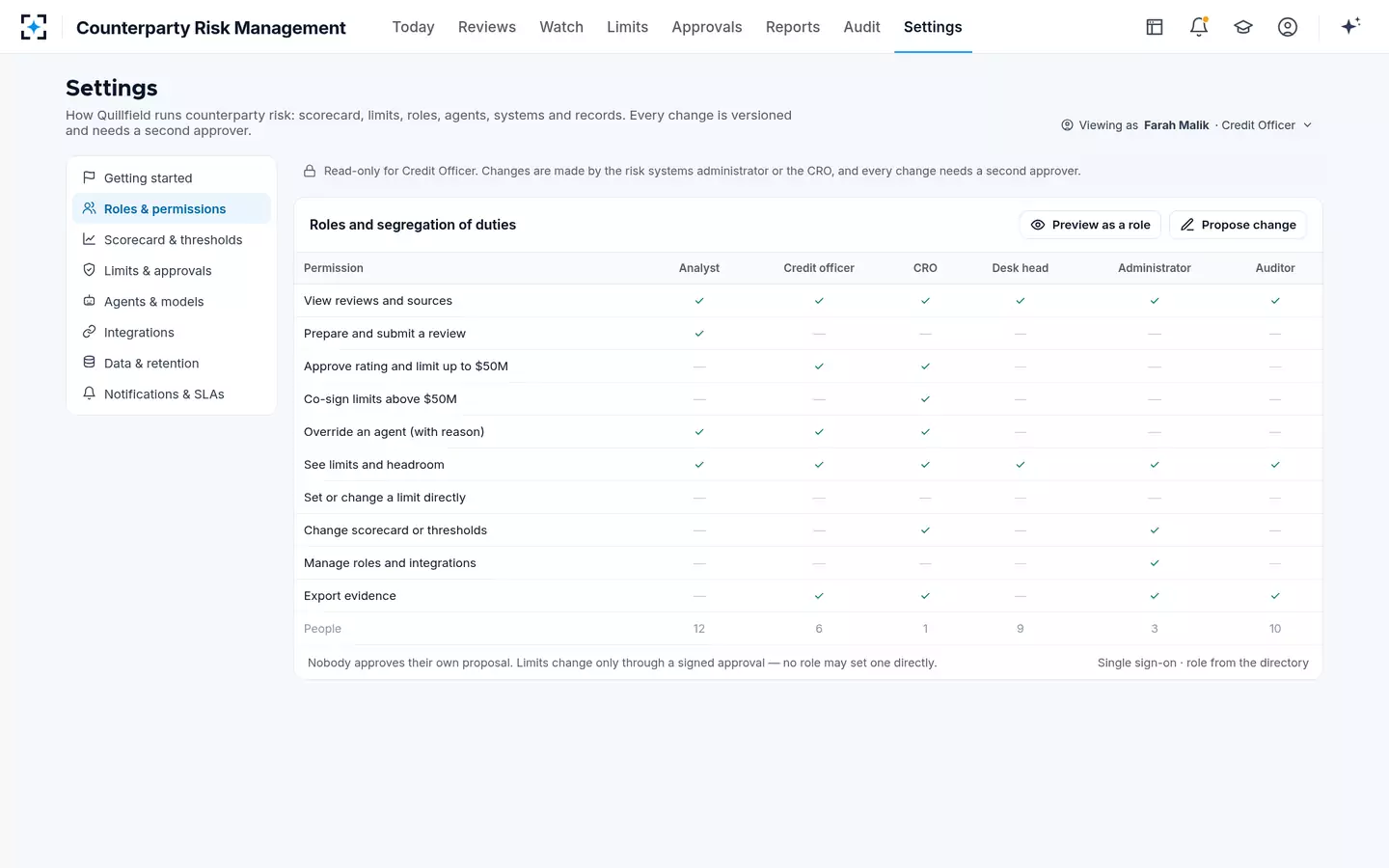
Segregation is easier to prove when it is a permission, not a habit. In the sample firm's settings, only analysts can prepare and submit a review, only credit officers and the CRO can approve, only the CRO can co-sign above $50M, desk heads can see limits but never change them, and no role, administrators included, can set a limit directly. The Federal Reserve's counterparty letter describes the principle behind it: risk management functions "fully independent from CCR-related trading operations" and with "sufficient authority to enforce policies" (SR 11-10).
Roles against permissions: who may prepare, approve, co-sign or change a limit
What happens when two AI agents disagree on a rating?
When two agents disagree on a rating by more than the firm's tolerance, neither wins: the review goes to a credit officer with both arguments side by side, and she decides with a reason. Disagreement is the most useful thing a second agent produces, because it marks the reviews where a scorecard is least reliable.
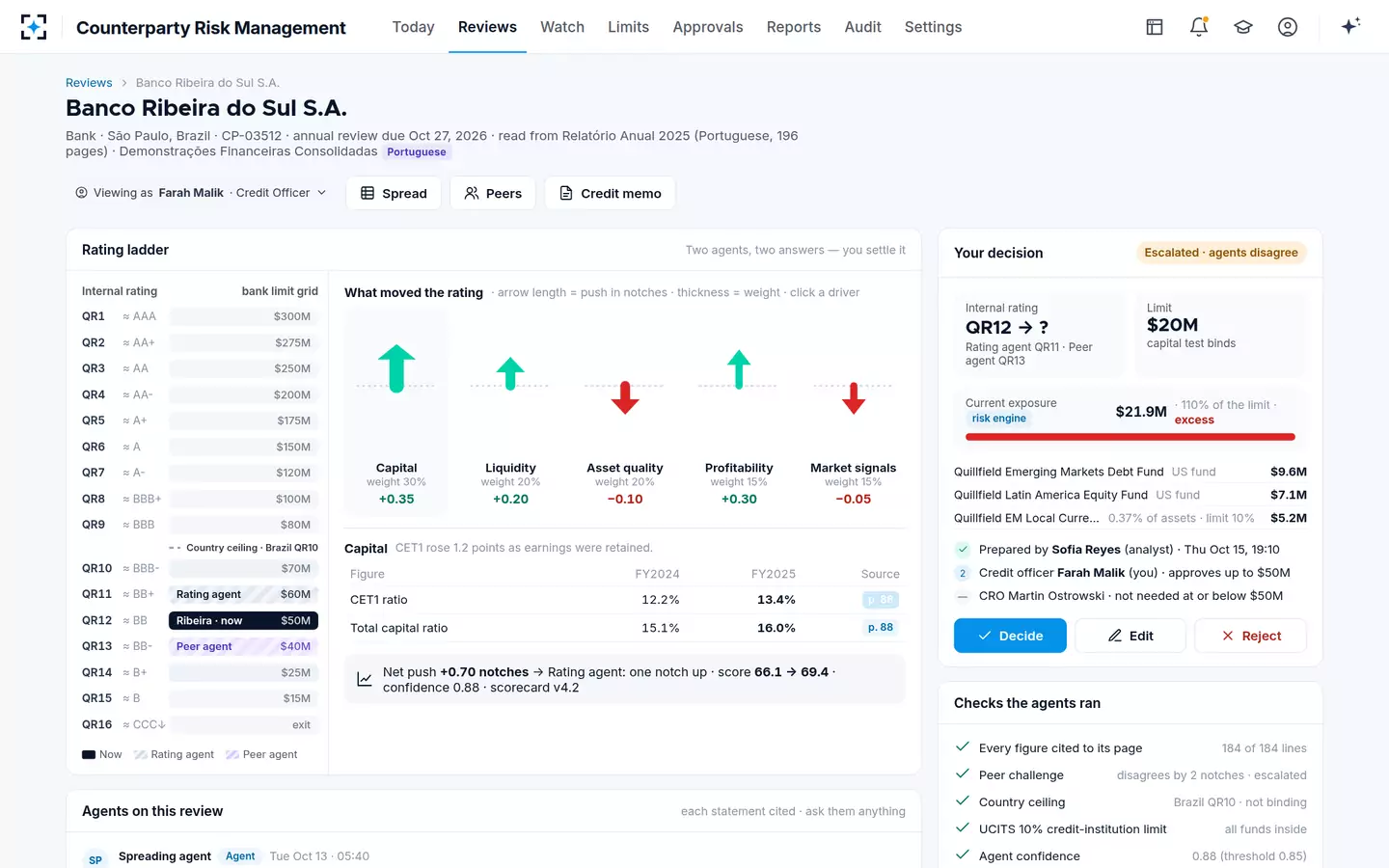
In the sample, the Rating agent proposed upgrading a São Paulo bank from QR12 to QR11 on stronger capital and profitability in its Portuguese annual report. The Peer agent, re-rating it against six Brazilian mid-size banks, implied QR13, because its top 20 depositors held 38% of deposits against a peer median of 21%. Two notches apart, the review escalated. The analyst recommended keeping QR12; the credit officer chose the rating and gave her reason. Asked why the agents disagreed, the system answered that the scorecard in force had no funding-concentration driver, a gap now listed for its next version.
Two agents, two notches apart: escalated to the credit officer with both arguments
What must AI never do in credit approval?
AI must never sign, never approve its own proposal, never change a limit or rating outside the approval chain, and never fill a gap in the evidence with an estimate presented as a figure. Those are the failures that make a counterparty file indefensible, and each can be written as a hard limit on the agent rather than a guideline for its user.
Never lines for AI in counterparty credit approval, and why each exists
- Never set the final rating or limit
Basel: limits "set and verified independently of the business function"; the decision needs an accountable person.
- Never write to the limit system before a signed approval
Otherwise the escalation by size the interagency guidance describes never happens.
- Never estimate a missing figure
A guessed capital ratio in a cited spread is worse than a gap: it looks verified.
- Never propose below a confidence threshold
Below the firm's threshold, the analyst rates without a proposal to anchor on.
- Never resolve its own disagreement with another agent
A gap above tolerance goes to a person with both arguments.
- Never hide its sources
Every figure and driver links to the page of the counterparty's own filing.
- Never change its own rules
Scorecard weights, thresholds and escalation rules are settings with a second approver, versioned.
How do you test that the boundary holds?
The boundary is tested like any other control: by trying to break it, and by checking the audit trail afterwards. Bank supervisors set the standard for the numbers an agent produces. Metrics used in counterparty risk management "should undergo the appropriate level of internal governance and independent review applicable to the models used, irrespective of any perceived analytical simplicity", and end users, "including senior risk officers", can take part by "reviewing parallel runs, impact studies and concrete examples" (CRI40.55).
Four tests of the line between agent and officer, and what passing looks like
| Test | How to run it | Pass |
|---|---|---|
| Parallel run | Run last year's reviews through the agents and compare ratings with the ones the committee approved. | Differences explained by evidence the agents cite, not by missing figures. |
| Permission test | Try to change a limit as an analyst, a desk head, an administrator and an agent. | Every attempt refused; each refusal logged. |
| Escalation test | Feed a review where the two agents disagree by two notches, and one with confidence below the threshold. | The first reaches a credit officer with both arguments; the second arrives with no proposal. |
| Re-performance | Ask internal audit to re-derive five ratings from the stored file alone. | Same figures, same pages, same policy version, same signature and reason. |
Documentation is the other half. ESMA's 2024 statement on AI in investment services, written for MiFID firms, expects records of how AI is deployed: the decision process, the data used, the algorithms and every change made to them over time. It also warns that firms may lean on AI for decisions and lose sight of human judgment (ESMA, 30 May 2024). A counterparty program that keeps the agents' steps, the person's decision and the version of the rules in force on the day can answer both. How accurate the agents' figures are, measured line by line, is the subject of bank credit analysis by agents.
Where AI goes wrong in counterparty credit work, and the control for each
AI fails in counterparty credit work in a few predictable ways, and each has a control that does not depend on trusting the model. The most dangerous is not a wrong figure but a right-looking one: a proposal so well argued that the person approving it stops checking. ESMA's warning about over-reliance is aimed at exactly that, and the controls below are how a program shows it took the warning seriously.
Six ways AI goes wrong in a counterparty review, and the control that catches each
| Failure | What it looks like | Control |
|---|---|---|
| Anchoring | The credit officer signs a proposal she would not have reached alone. | No proposal below the confidence threshold; a reason code on every approval; track how often proposals are approved without a question or edit. |
| Silent extraction error | A capital ratio read from the wrong column, or a decimal comma misread. | Every figure cited to its page; flagged and fast-moving lines checked first; peer comparison as a cross-check. |
| Stale rules | The scorecard lacks a driver the bank's risk now turns on. | Agent disagreements reviewed for patterns; scorecard changes versioned with a second approver. |
| Mistranslation | A home-language term read as a different English measure. | The original passage beside the English reading on every cited figure. |
| Scope creep | A tool that started by drafting begins to write limits. | Write access to the limit system only after a signed approval, enforced as a permission. |
| Provider dependency | The review cannot be repeated if the tool or model changes. | Keep the evidence, the agents' steps and the decision with the review, so it can be re-performed without the tool. |
The anchoring measure deserves to be on the risk committee's page. A credit officer who approves every proposal unchanged may be approving good proposals, or may have stopped reviewing; the rate alone cannot tell, but a rate that drifts upward over a year, with fewer questions asked of the agents, is a reason to sample her approvals. In the sample, every approval carries a reason code and a confirmation that the cited evidence was reviewed, and the questions asked of the agents are kept with the review.
Buying AI for counterparty credit risk: what to ask, and where this solution fits
Ask any vendor of AI for counterparty credit risk four questions: what the agents may write, and where; who can change the thresholds; what happens below the confidence line; and whether every figure opens its source page. A tool that answers "it writes the rating and the limit" is selling a decision, not a review. One that cannot open the page behind a figure is selling a number you cannot verify.
Counterparty Risk Management fits firms that want the agents to do the reading, spreading, scoring, peer challenge, monitoring and drafting, and want people to keep the rating, the limit and every exception. It does not price trades or calculate exposure, which stays in the risk engine, and it does not replace the credit committee. It replaces the retyping in front of both. What a firm brings to switch it on is in what you bring to a counterparty risk system.
Questions people ask
Can AI read bank annual reports in other languages?
Yes, and that is one of its strongest uses in counterparty work. What matters is that each figure keeps its page and its original passage, so a reader who does not speak the language can check it. In the sample, agents read reports in Turkish, Portuguese, German, Italian, Arabic and English into one template.
What is a credit officer's role in counterparty approval?
The credit officer decides: reviews the analyst's case and the agents' evidence, approves, edits or rejects the rating and limit within a delegated authority, and gives the reason. Above the firm's threshold, the CRO or a committee co-signs. The officer is independent of both the analyst who prepared the review and the desk that trades.
Does using AI change the regulator's expectations?
Not the obligations, which are technology-neutral. Supervisors' texts on counterparty risk describe independent limit-setting, escalation by size and an audit trail; those apply whether a person or an agent prepared the file. What changes is what examiners ask about: how the tool is governed, tested and recorded.
Should an agent's confidence score be shown to the credit officer?
Yes, with its threshold. In the sample the Selvira proposal carried a confidence of 0.91 against a 0.85 threshold, and the Brazilian bank's 0.88. Below the threshold the agent proposes nothing, so the analyst is not anchored on a weak proposal.
Can an analyst override an agent?
Yes, with a reason that is kept. Overriding a proposal, a different notch, a corrected figure or a policy exception, is kept with the person and the reason, and still goes through the same approval as any other decision.