A counterparty credit analyst reviews the banks, broker-dealers, futures brokers and prime brokers a firm trades with: collects their annual reports and regulatory disclosures, spreads the figures into the firm's template, scores them against the firm's scorecard, compares them with peers, proposes an internal rating and a limit, and writes the credit memo a credit officer signs. At an asset manager the role sits in the risk function, between the trading desks that want limits and the credit officers who approve them. The work is hard less because of the judgement than because of the volume before it: hundreds of counterparties, each to be redone at least yearly, many reporting in their own language. Botminds' Counterparty Risk Management gives that analyst agents that collect and spread the filings, cite every figure to its page, propose a rating and watch each name between reviews, while the analyst prepares and a credit officer decides.
One annual bank review, by the solution's estimate
20hrs
of analyst time per annual review by hand: two to three working days
8hrs
of them retyping and translating the annual report into the spread
3hrs
per review once agents collect, spread and draft
<4hrs
the design target per annual review
What does a counterparty credit analyst do?
A counterparty credit analyst decides, with evidence, how much a firm should trust each institution it trades with, and writes that down so someone else can approve it. US occupational data files the work under two neighbouring descriptions. Credit analysts read credit data and financial statements to judge the risk of extending credit (O*NET OnLine, 13-2041.00); financial risk specialists measure the credit and market risk that threatens an organization's assets and earnings (O*NET OnLine, 13-2054.00). The counterparty analyst does the first about institutions whose exposure is the second.
The tasks O*NET lists read like the analyst's week. The credit analyst's list includes comparing a firm's liquidity, profitability and credit history with similar firms in its industry and region, which is a peer review by another name. The risk specialist's includes gathering risk data from inside and outside the firm, and writing up findings, risk positions and recommended changes. What sets the counterparty analyst apart is the object, a bank or broker rather than a borrower or a security, and the output: a rating that sets a limit the trading desk will live with.
Where the week goes: retyping before judging
Most of a counterparty credit analyst's hours go into getting the figures into the template, not into deciding what they mean. On Botminds' estimate for one annual bank review done by hand, retyping and translating the annual report takes 8 of 20 hours, writing the memo 4, scoring and peer comparison 3, collecting the filings 2, checking exposure and limits 2, and approval rounds 1. Scoring and peers, the part that is analysis, is 15% of the time.
One annual bank review: where the analyst's hours go, by hand and with agents
By hand · 20 hours
- Collecting filings · 10%
- Retyping and translating · 40%
- Scoring and peers · 15%
- Exposure and limits · 10%
- Writing the memo · 20%
- Approvals · 5%
With agents · 3 hours
- Collecting filings · 7%
- Checking the spread · 17%
- Scoring and peers · 17%
- Exposure and limits · 10%
- Editing the memo · 33%
- Approvals · 16%
The second bar changes shape as well as length. With agents collecting and spreading, the analyst's three hours go mostly to the memo's argument, the flagged lines and the approval itself: the parts where a person's judgement is the point. The persona the solution was designed around, a counterparty credit analyst called Daniel Osei on fictional sample data, puts the old week in one line: "Half my week is retyping Turkish and Portuguese annual reports into the template."
Monday to Friday: one illustrative week of bank and broker reviews
A week of counterparty reviews mixes scheduled annual reviews, watchlist names, limit requests from the desks and whatever the news brought in. The table below is an illustrative week for one analyst at a fictional sample asset manager, Quillfield Capital, built from the solution's own estimates and sample counterparties; it shows how the same week runs by hand and with agents.
One illustrative week for a counterparty credit analyst, by hand and with agents
| Day | By hand | With agents |
|---|---|---|
| Monday | Download a Turkish bank's 248-page annual report and its Pillar 3 disclosure; start retyping the balance sheet into the 184-line template. | Open the Turkish bank's spread, already pinned to its pages; decide the three flagged lines, including a restated prior-year NPL ratio. |
| Tuesday | Finish the spread; translate the capital table; reconcile totals that do not foot. | Read the Rating agent's proposal, one notch down, and the Peer agent's challenge against six banks; agree and submit. |
| Wednesday | Score the bank against the scorecard; build a peer table by hand from three other banks' reports. | A Brazilian bank where the agents disagree by two notches: read both arguments, check the funding concentration on its page, recommend keeping the rating. |
| Thursday | Write the memo; the desk asks for a limit increase on a broker-dealer, queued for next week. | Prepare the broker's limit request; check its excess net capital in the CFTC's monthly data. |
| Friday | Walk the memo to the credit officer; the watchlist, the news and a regulator notice on a Chinese broker wait until Monday. | Review the Watch agent's proposals: an off-cycle review of the Chinese broker after a regulator's warning letter. |
What skills does a counterparty credit analyst need?
A counterparty credit analyst needs bank accounting, regulatory capital and liquidity, a working knowledge of derivatives and collateral, the ability to read filings in other markets' formats, and the judgement to write a rating case a credit officer can challenge. Bank supervisors describe the bar for the function from their side. The Basel guidelines say managers of counterparty credit risk "need to have sufficient experience, expertise and stature to understand CCR and interact with counterparts in trading businesses" (BCBS, CRI40.90), and that the function needs market risk and credit risk staff working closely together (CRI40.88; the passage is quoted in counterparty risk vs credit risk).
The Federal Reserve put the same point in its Archegos letter: "Risk management and control functions should have the experience and stature to effectively control risks associated with investment funds" (SR 21-19). Stature matters because the analyst's output often disappoints the desk. A proposal to cut a bank's limit from $40M to $25M needs an argument the desk cannot wave away, and that argument is only as strong as the figures under it.
Two skills are rising in weight. Reading across languages and accounting conventions, because the counterparties that most need a close look often publish in their own language. And geopolitical sense: Basel asks firms to "assess the impact of potential wars and sanctions on their ongoing businesses" (CRI40.91), which for a counterparty analyst means country ceilings and the speed at which a sanctioned jurisdiction's banks become unpayable.
How many counterparties does one analyst cover?
No regulator or independent study publishes a standard number of counterparties per analyst; it follows from the firm's policy and the hours each review takes, and a team can work it out for itself. The arithmetic has three terms: scheduled reviews (every counterparty at least yearly), extra reviews (watchlist names at a shorter cycle, off-cycle reviews after signals, new names), and the hours each review takes.
Working out a counterparty team's review load from its own policy
| Term | How to count it | Sample firm | Who sets it |
|---|---|---|---|
| Scheduled reviews | Counterparties × reviews a year | 412 counterparties, each at least yearly | Credit policy |
| Extra reviews | Watchlist names × extra cycles, plus off-cycle and new names | 14 watchlist names reviewed six-monthly, plus off-cycle reviews from signals | Credit officers |
| Hours per review | Collect + spread + score + limits + memo + approval | Botminds' estimate: about 20 by hand, about 3 with agents | Measure on your own files |
| Analysts needed | (Scheduled + extra reviews) × hours per review ÷ productive hours per analyst | Not set in the sample: depends on your hours; leave room for limit requests, desk queries and monitoring | Head of counterparty risk |
Run on the sample firm with the by-hand estimate, 412 annual reviews plus 14 extra watchlist reviews come to roughly 8,500 hours of review work a year before a single off-cycle review or limit request. At that load, a team staffed for the schedule has little left for watching names between reviews, which is exactly where a twelve-month cycle misses what the news and the regulators publish in the meantime.
Who else is in a counterparty review: the seats around the analyst
The analyst prepares; four other seats depend on the result, and each needs something different from the same review. Supervisors expect the roles to stay separate: risk functions "fully independent from CCR related trading operations (in both activity and reporting)", with "sufficient authority to enforce policies" (Interagency guidance).
The counterparty review, seen from five seats
Today
Retypes annual reports, often in Turkish or Portuguese, into the template; half the week before any judgement.
With agents
Checks a spread already pinned to its pages, decides the flagged lines and submits.
Still theirs: Prepares; never approves.
Today
Reads a memo whose figures sit in a spreadsheet that never links to the page.
With agents
Opens each review on the rating ladder with every driver cited, asks the agents back, signs with a reason code.
Still theirs: Approves ratings and limits up to $50M.
Today
Learns who is getting worse from the market.
With agents
Sees what waits for a co-signature and receives the monthly report drafted for the risk committee.
Still theirs: Co-signs above $50M.
Today
Finds out a limit was cut when a trade is blocked.
With agents
Sees limits and headroom by counterparty, read-only, and is told the moment a limit changes.
Still theirs: Never sets a limit.
Today
Asks who decided, when, why and on what evidence, and gets the answer in pieces.
With agents
Filters the audit trail by counterparty or person and exports every decision, source and version.
Still theirs: Samples reviews independently.
What changes when agents do the spreading
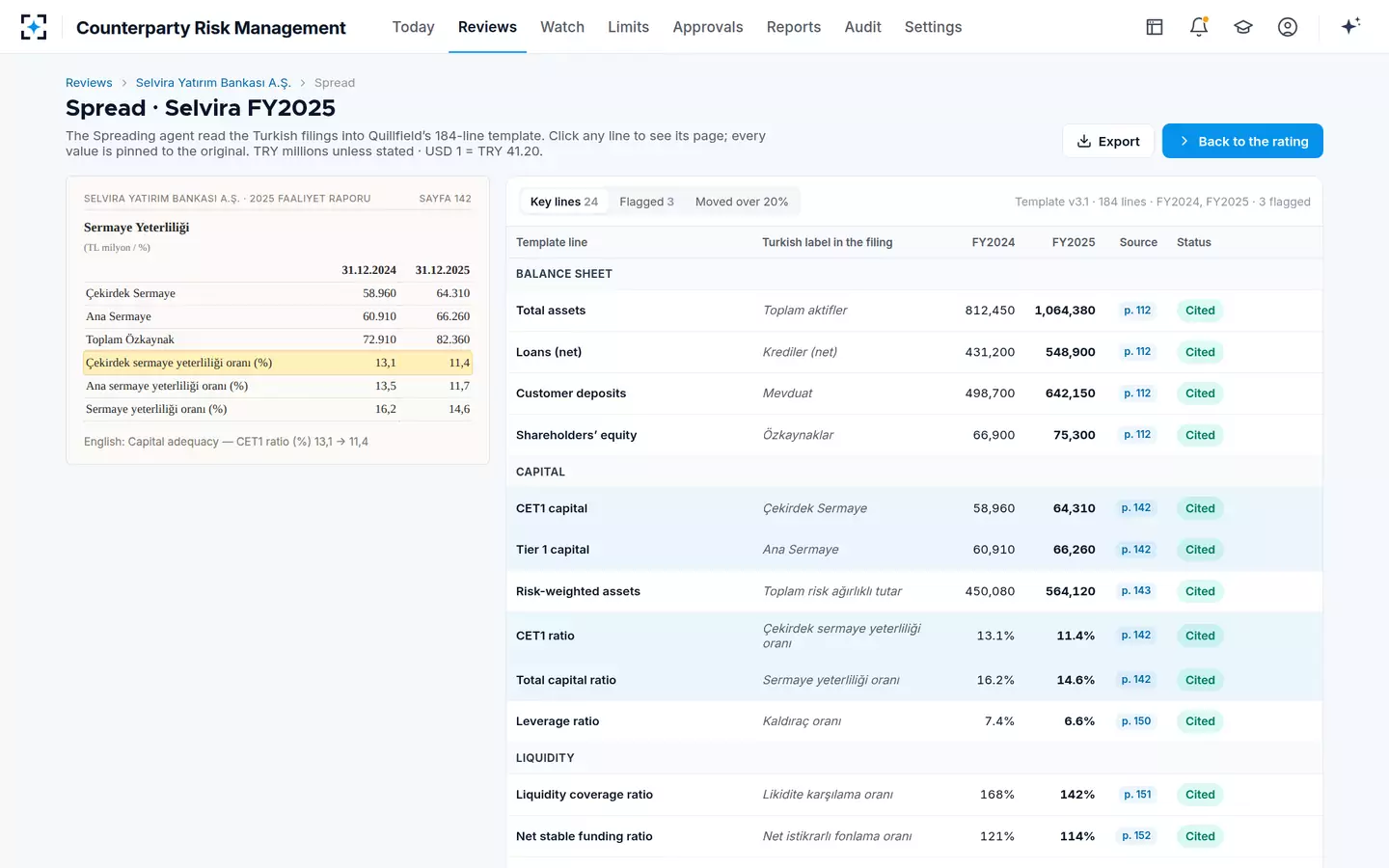
When agents collect and spread the filings, the analyst's review starts from a finished spread with exceptions marked, not from a blank template. In the sample, the Spreading agent read nine annual reports overnight in Turkish, German, Italian, Arabic and English into 1,656 lines, every one cited. The analyst's Monday begins on the three lines it flagged rather than the 184 it filled.
The analyst's starting point: a spread pinned to its pages, with flagged lines first
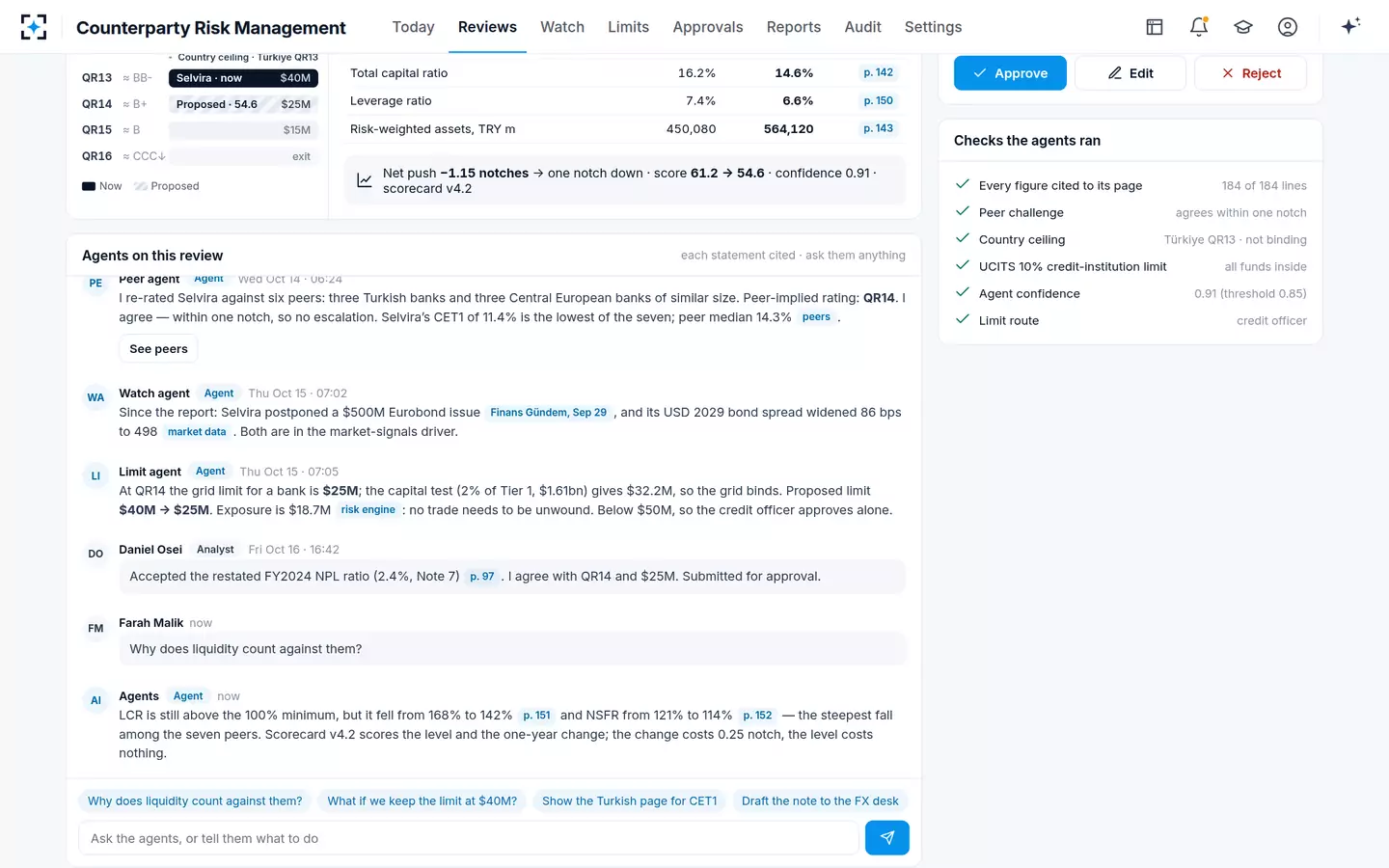
The credit officer's questions change too, because she can ask them directly. In the sample, she asked why liquidity counted against a bank whose liquidity coverage ratio was far above 100%. The answer came back with its pages: the ratio fell from 168% to 142% and the net stable funding ratio from 121% to 114%, the steepest fall among seven peers, and the scorecard scores the one-year change. Under the old process that question would have gone back to the analyst as an email.
Questions answered with their pages, inside the review
The part that stays human: judgement, restatements and the argument
What stays with the analyst is everything that needs a reason: whether a restated figure is accepted, whether a peer set is fair, whether a bank's story explains its numbers, and how strongly to recommend. In the sample, the Spreading agent never estimates a missing figure and sends restatements and reclassifications to the analyst; the Rating agent hands a review to the analyst without a proposal when its confidence is below 0.85; and the analyst can override an agent, with a reason that is kept.
The analyst's influence also grows where the agents disagree. When the Rating agent proposed upgrading a Brazilian bank and the Peer agent implied a downgrade, two notches apart, the review went to the credit officer with both arguments, and the analyst's recommendation to keep the rating was the deciding argument. How that boundary between proposing and deciding is drawn is the subject of counterparty credit risk and AI, and how the spread's accuracy is measured, line by line, is in bank credit analysis by agents.
Questions people ask
What is the difference between a counterparty risk analyst and a counterparty credit analyst?
Titles vary by firm. A counterparty credit analyst usually reviews the institution itself, its filings, rating and limit. A counterparty risk analyst may also measure exposure, collateral and limit utilisation from the trading side. At an asset manager one team often does both.
Is a bank credit analyst the same job?
Close, with a different reader. A bank credit analyst may review banks as issuers for a bond portfolio or as borrowers; a counterparty credit analyst reviews them as trading partners and proposes a limit. The skills, bank accounting and regulatory capital, are the same.
Does a counterparty credit analyst need to read other languages?
It helps, and it is rarely enough: one team may cover banks reporting in a dozen languages. What the review needs is that every figure can be traced to its page in the original, so an analyst who does not read the language can still check the lines that drive the rating.
Do counterparty credit analysts approve limits?
Usually not. Sound practice separates preparing from approving: the analyst prepares the review and proposes, a credit officer approves within a delegated authority, and larger limits go to the CRO or a credit committee. In the sample, the analyst role cannot approve anything.
How long does a counterparty review take?
It depends on the counterparty and the template. Botminds' estimate for one annual bank review is about 20 analyst hours by hand, two to three days, and about 3 hours with agents doing the collecting, spreading and first draft; the solution's design target is under four hours.