Counterparty due diligence is the review a firm does of a bank, broker-dealer or futures broker before it trades with it and again at every periodic review: collecting the counterparty's filings, reading its capital, liquidity and asset quality, judging what the figures leave out, and turning the result into a rating and a limit. For an asset manager the hardest cases are the banks that matter most in emerging-market and local-currency funds, because many publish their full annual report only in their own language, and the review then rests on someone else's translation or a data vendor's standardised fields. Botminds' Counterparty Risk Management reads each counterparty's own filings in the language they are published in, cites every figure to its page with the original passage beside the English reading, and proposes a rating for a credit officer to decide.
What counterparty due diligence has to read, and how fast it arrives
1hub
for prudential data from all EEA banks, public through the EBA since January 2026
17days
business days for a US futures broker to file its monthly financial report with the CFTC
105days
for a US broker-dealer to send customers its audited statement of financial condition
248pages
of a sample Turkish-only bank annual report, read in the original
What is counterparty due diligence? The meaning, in supervisors' words
Counterparty due diligence means collecting information on a counterparty, judging the risk it poses and using that judgement to make credit decisions. The Basel Committee's 2024 guidelines define it for banks in exactly those three verbs: due diligence "encompasses a wide range of processes conducted by a bank as it collects information on its counterparty, assesses the level of risk that the counterparty and its activities pose to the bank, and analyses information to make credit decisions" (BCBS, CRI40.9).
The guidelines were written for banks reviewing funds, but the obligations translate directly. Reviews start with "a comprehensive collection and review of financial and non-financial information"; standards "should discuss the frequency and intensity of credit reviews"; and a counterparty's "failure to provide information commensurate with their risk profile should lead to a more conservative approach to risk rating, limit setting, margining and other forms of credit risk mitigation, or even the rejection or offboarding of the client" (CRI40.10, 40.11, 40.13). A fund manager reviewing a bank has less leverage to demand private information than a bank reviewing a hedge fund, which makes what the bank publishes the core of the file.
Why the weakest reviews are of banks that report in their own language
The weakest counterparty reviews are of banks whose full disclosures exist only in a language the review team does not read, because every figure then passes through a translation or a standardised dataset before an analyst sees it. A bank may publish a summary or selected statements in English while the full annual report, its notes, the restatements and the management commentary stay in the home language. The fields a data vendor standardises are the ones it chose, mapped to its own definitions.
The supervisors' warning applies to the chain, not the language. The Federal Reserve was concerned with firms that "accept incomplete and unverified information" in periodic credit reviews (SR 21-19), and the Basel guidelines ask that "adequate proof, assurance or verification – where relevant and practicable – is applied as part of their due diligence processes", so that "credit risk decisions are not made based solely on unverified or verbal information" (CRI40.15). A CET1 ratio copied from a vendor screen, with no page behind it, is a figure nobody on the team has verified.
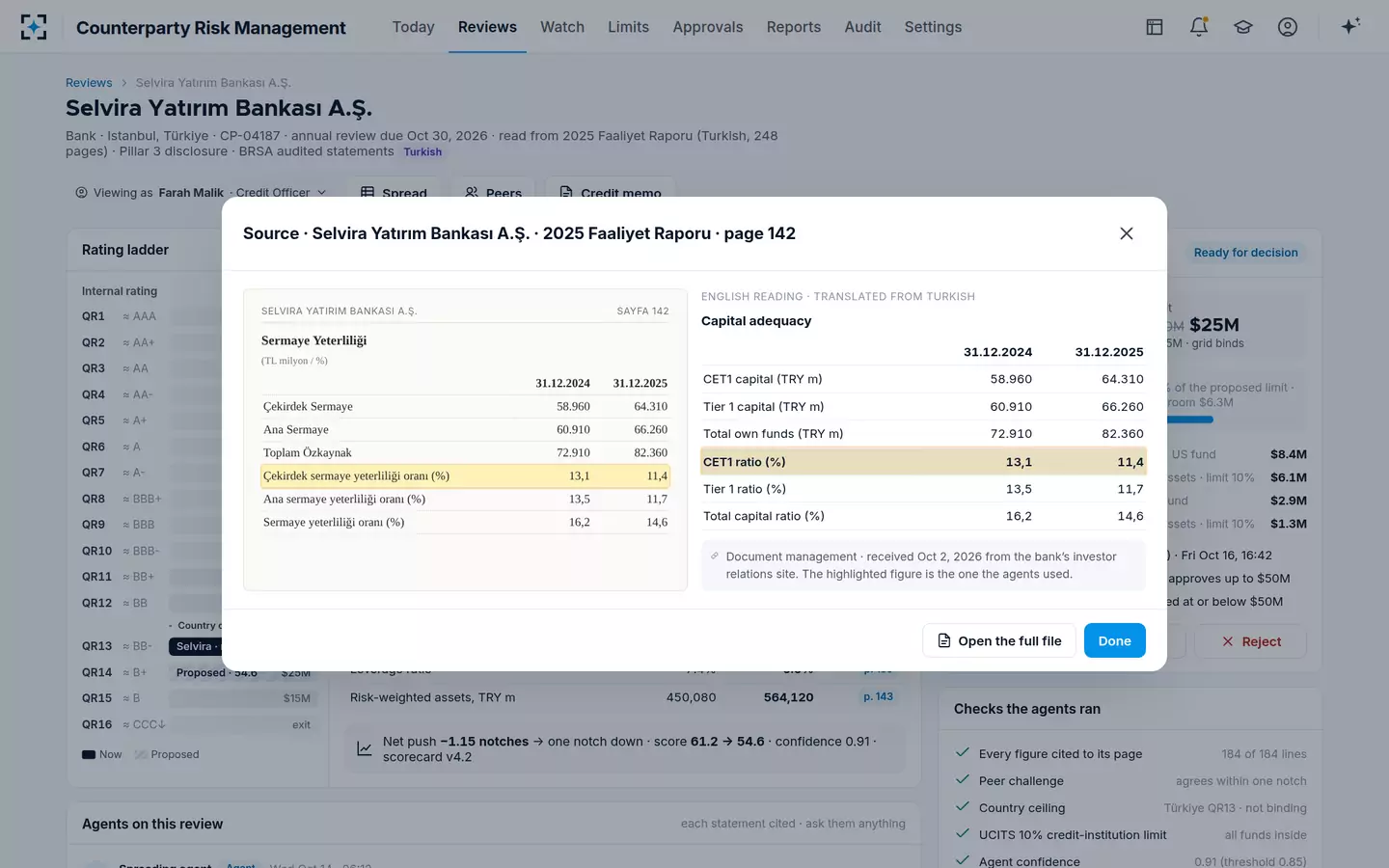
One annual report table, original beside English, each figure cited to its page
Çekirdek Sermaye
English readingCET1 capital (TRY m)
31.12.202458.960
31.12.202564.310
Pagep. 142
Ana Sermaye
English readingTier 1 capital (TRY m)
31.12.202460.910
31.12.202566.260
Pagep. 142
Toplam risk ağırlıklı tutar
English readingRisk-weighted assets (TRY m)
31.12.2024450.080
31.12.2025564.120
Pagep. 143
Çekirdek sermaye yeterliliği oranı
English readingCET1 ratio (%)
31.12.202413,1
31.12.202511,4
Pagep. 142
Likidite karşılama oranı
English readingLiquidity coverage ratio (%)
31.12.2024168
31.12.2025142
Pagep. 151
Net istikrarlı fonlama oranı
English readingNet stable funding ratio (%)
31.12.2024121
31.12.2025114
Pagep. 152
The table carries two lessons a translated summary hides. The number format is one: read with English conventions, "58.960" becomes fifty-eight, a factor of a thousand out, and an automated copy that misses it fails silently. The other is the story inside the figures. CET1 capital rose about 9%, but risk-weighted assets rose about 25%, so the ratio fell from 13.1% to 11.4%: a bank growing faster than its capital, which the headline ratio shows and the absolute capital figure does not.
What filings should counterparty due diligence read?
Counterparty due diligence should read the counterparty's audited financial statements, its regulatory disclosures and its regulator's public data, in that order of reliability, and know which of its reports are not public at all. What exists depends on the type of counterparty and where it is regulated.
Where the public evidence on a counterparty sits, by type
| Counterparty | What it publishes or a regulator posts | How often | What is not public |
|---|---|---|---|
| EU or EEA bank | Annual report and audited statements; Pillar 3 disclosures, now collected in the EBA Pillar 3 data hub | Pillar 3 quarterly, half-yearly or yearly, as CRR Articles 433a to 433c set for each type of bank | Supervisory findings; detailed supervisory reporting |
| US bank | Annual report; Call Report data and the Uniform Bank Performance Report in the FFIEC Central Data Repository | Call Report as of each quarter-end, usually public about 6 hours after submission | Exam ratings and findings |
| US broker-dealer | Annual audited statement of financial condition with a net capital footnote, sent to customers and filed with the SEC | Audited yearly within 105 days; unaudited six months later within 65 days | FOCUS reports filed under Rule 17a-5(a), which are "deemed confidential" |
| US futures commission merchant | CFTC posts selected monthly figures: adjusted net capital, the requirement, excess net capital and customer segregation | Monthly; filed within 17 business days of month-end | The full 1-FR-FCM filing |
| Bank outside the EU and US | Annual report and audited statements, often in the home language; local Pillar 3 or equivalent where the regulator requires it | Varies by jurisdiction | Varies; check the home regulator |
What is a Pillar 3 disclosure, and where can you find EU banks' Pillar 3 data?
A Pillar 3 disclosure is the public report on capital, risk and liquidity that EU banking law requires banks to publish, in standard templates. The implementing standards in force from 1 January 2025 open with "Disclosure of key metrics and overview of risk-weighted exposure amounts", and set the frequency by institution: banks disclosing quarterly give five quarterly periods, those disclosing half-yearly give three, and annual disclosers two (Commission Implementing Regulation (EU) 2024/3172, Arts 1 and 26).
Since January 2026 those disclosures sit in one place. The European Banking Authority announced the go-live of its Pillar 3 data hub, "marking the first time prudential information from all EEA institutions is made publicly accessible through a single, harmonised digital platform", with a visualisation tool and bulk downloads; the full data for the June, September and December 2025 reference dates was expected by June 2026 (EBA, Pillar 3 data hub goes live). For a fund reviewing European banks, the comparable capital and liquidity figures are now a download, not a hunt across bank websites.
The hub does not reach the banks that cause the most work. A Turkish, Brazilian or Japanese bank publishes under its own regulator's rules, in its own format and often its own language, and its annual report remains the primary source. Those reviews are where reading the original matters most.
Broker due diligence: what a broker-dealer and a futures broker make public
Broker due diligence starts from less public data than a bank review, and from different documents. A US broker-dealer's monthly and quarterly FOCUS reports go to the SEC and "will be deemed confidential"; what is public is the annual statement of financial condition, filed as a document "which is not confidential" (17 CFR 240.17a-5(a)(2), (e)(3)). Customers receive the audited statements "within 105 days after the end of the fiscal year", with a footnote stating net capital and required net capital, and unaudited statements six months later "within 65 days".
Futures commission merchants are more transparent month to month. They file financial reports with the CFTC every month, within 17 business days of month end, and the CFTC posts selected figures, generally within 12 further business days (CFTC, Financial Data for FCMs). Among them is excess net capital, the cushion of adjusted net capital above the firm's requirement (CFTC field descriptions; how the figure feeds a dashboard is in the counterparty risk dashboard), the kind of figure a capital test on a broker's limit is built on. A fall in it from one month to the next is a signal a yearly review would miss.
Reading in the original: labels, numbers and restatements
Reading a filing in the original means more than translating words. Three things go wrong in a translated or standardised copy, and each can move a rating. Labels: a home-language term may not map to the English field it resembles, such as a regulatory capital measure that differs from the accounting equity next to it. Numbers: decimal commas, thousands separators and units stated once at the top of a table. Restatements: a prior-year figure that changed in this year's report, usually explained only in a note.
Counterparty due diligence on a foreign-language filing: who does what
Agent
CollectTakes the annual report, Pillar 3 disclosure and audited statements from the bank's investor relations site and regulator sites; detects language, period and accounting basis.
Never: Uses a file it cannot read fully, or guesses a period.
Agent
Read and spreadReads each filing in its original language into the firm's template, two years side by side, the original label and page on every line.
Never: Estimates a missing figure.
Agent
FlagMarks restatements, reclassifications and figures that moved sharply for the analyst.
A person decides
Analyst checksOpens each flagged figure on its page, accepts or corrects it with a reason, and submits.
A person decides
Credit officer decidesReads the rating proposal with every driver cited, and signs or sends it back.
Take a fictional sample asset manager, Quillfield Capital, as it runs through Counterparty Risk Management. Its Istanbul counterparty published a 248-page annual report in Turkish only. The Spreading agent read it with the Pillar 3 disclosure and the audited statements into a 184-line template and flagged three lines, among them a non-performing loan ratio for the prior year restated from 2.2% to 2.4% in note 7. The analyst confirmed the restatement on page 97 and accepted it; the audit trail shows who, when and why.
Any figure opens its page, original beside the English reading
Verifying what you read: every figure on its page
Verification in counterparty due diligence means that any figure in the file can be traced to the page it came from and re-read by someone else. The Basel guidelines ask banks to "monitor the timeliness and quality of financial statements and risk information provided by the client on an ongoing basis and track exceptions to established standards" (CRI40.15). For a foreign-language filing, a page reference with the original passage is what makes that tracking possible for a reader who does not speak the language.
The spread: Turkish label, two years and a page on every line
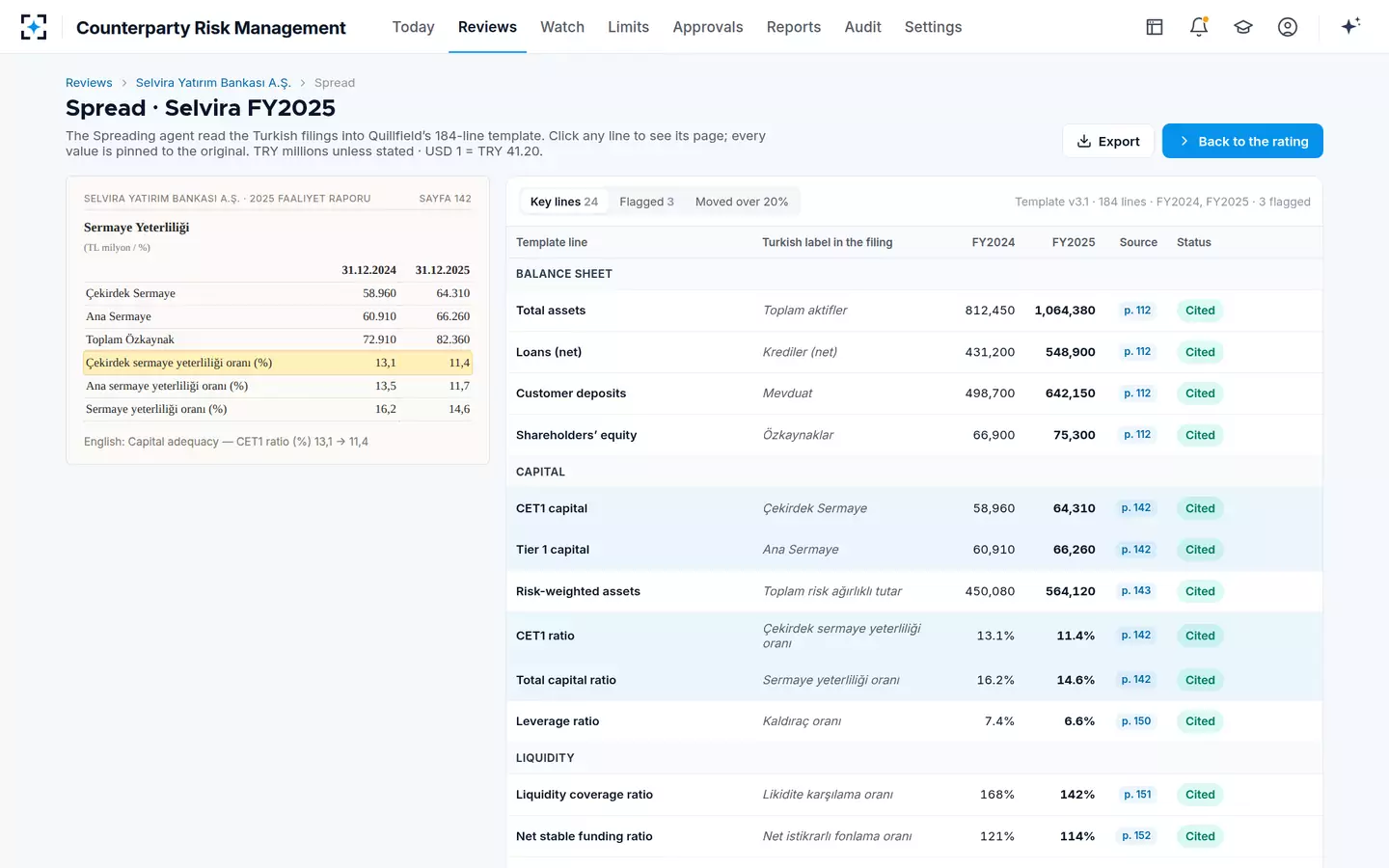
How accurate such a spread is, and how to measure it field by field rather than trusting a headline rate, is the subject of bank credit analysis by agents, measured line by line.
How often should counterparty due diligence be refreshed?
Counterparty due diligence should be refreshed at least yearly for every counterparty, more often for riskier names, and immediately when something material changes. The Basel guidelines leave the cycle to the firm but bind it to risk: banks should set "a frequency for ongoing monitoring and predefined triggers for metrics such as performance, volatility, liquidity, management quality and concentration", and "the risk rating process should ensure that any material change in the counterparty's risk profile triggers a revised assessment" (CRI40.24, 40.25).
In the sample, the cycle is a setting: every counterparty yearly, names on the watchlist every six months, and an off-cycle review whenever the Watch agent's proposal is accepted. After its downgrade, the Istanbul bank's next review was set six months out rather than twelve. Between reviews, a monthly regulatory data series such as the CFTC's FCM figures or a bank's quarterly Pillar 3 update is the cheapest early warning a desk can have.
Where onboarding ends and credit review begins
Onboarding establishes who the counterparty is and what documents govern the relationship; credit review decides how much risk to take with it. The Basel guidelines let firms reuse the first for the second: banks "may leverage upstream processes, such as those that may already exist in compliance and operational risk management frameworks (eg know-your-customer), to inform and drive assessments performed in the credit risk decision-making process, rather than replicate capabilities across functions" (CRI40.20).
In an asset manager the two usually sit with different teams. The legal entity, its identifiers, the KYC file and the trading documents come through onboarding, handled by Counterparty Onboarding; the credit review reads the entity's financial condition and proposes the rating and limit. Counterparty Risk Management writes ratings and limits to the counterparty master only after a signed approval, so the onboarding file and the credit decision stay distinct and both stay on file.
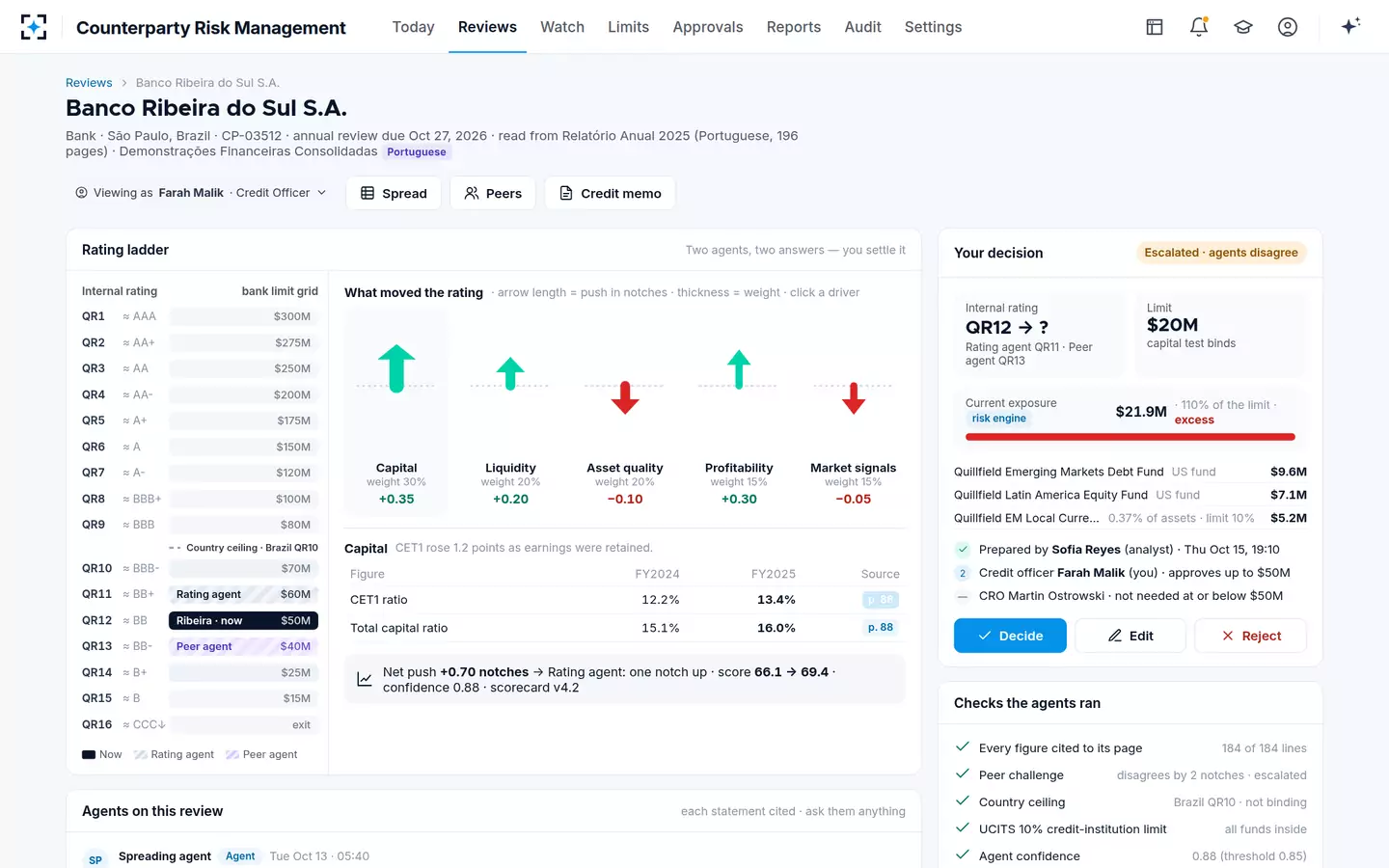
A Portuguese annual report, two agents and a funding concentration only the original showed
Questions people ask
What does counterparty due diligence mean?
It means collecting and reading what a counterparty discloses, judging the risk it poses and using that to decide whether to trade, under what limit and with what collateral. Basel's 2024 guidelines describe it as collecting information, assessing the risk and analysing it "to make credit decisions", at onboarding and at every later review.
Are broker-dealer financial statements public?
The annual audited statement of financial condition is: Rule 17a-5 has it filed as a document "which is not confidential", and customers receive it within 105 days of year-end with a net capital footnote. The monthly and quarterly FOCUS reports filed with the SEC are deemed confidential.
Is machine translation enough for a bank review?
Not on its own. A translation can render the words and still miss a decimal convention, a regulatory term that differs from its English look-alike, or a restatement explained in a note. What makes it usable is a page reference and the original passage beside each figure, so an analyst can check the ones that drive the rating.
What is the difference between KYC and counterparty due diligence?
KYC establishes who the counterparty is, who owns and controls it and whether it raises financial-crime concerns. Counterparty credit due diligence asks whether it can pay. The Basel guidelines encourage reusing KYC work in the credit process rather than duplicating it.
Does every counterparty need the same depth of review?
No. Basel's guidelines say rating scorecards "may, with appropriate guidance, serve as a means of stratifying due diligence expectations by counterparty risk". A highly rated bank with small exposure can have a lighter annual review than a lower-rated bank on the watchlist, provided the policy says so in advance.