Counterparty risk vs credit risk comes down to who can lose and how much. Credit risk on a loan or a bond runs one way and is sized by the amount lent: a fund holding $10M of a bank's bonds can lose at most $10M, and knows it on the day it buys. Counterparty risk on a derivative runs both ways and is sized by the contract's market value at the moment of default, which can be zero today and millions next month. Counterparty risk is a kind of credit risk, the bank still has to fail, but its size is a market question. An asset manager often has both exposures to the same bank at once, held in different funds and watched by different teams. Botminds' Counterparty Risk Management reviews each bank and broker a fund manager trades with from its own filings, proposes one rating and one limit, and checks live exposure against it, so the two views of the same name meet in one decision.
Where a US fund's counterparty risk comes from: derivatives held by mutual funds, March 2026
$1,117bn
notional of foreign exchange forwards: bilateral contracts with banks
$951bn
notional of interest rate swaps
$215bn
notional of credit swaps
$1,202bn
notional of interest rate futures, exchange-traded and cleared
Counterparty risk vs credit risk: what is the difference?
The difference is direction and size. The Federal Reserve's definition puts both in one sentence: "Unlike the credit risk of a loan, where only the lending banking organization faces the risk of loss, CCR creates a bilateral risk of loss because the market value of a transaction can be positive or negative to either counterparty" (SR 11-10). On a bond, the fund is always the creditor. On an FX forward, the fund is the creditor when the contract is in its favour and the debtor when it is not, and the roles can swap within a week.
Size follows from that. Credit exposure on a bond is the bond: its price may move, but the fund cannot lose more than it holds. Counterparty exposure on a derivative is what the fund would have to pay a new bank to replace the contract on the day the old one fails. That depends on exchange rates, rates and spreads, none of which the fund controls, which is why the same SR 11-10 letter calls counterparty credit risk "a multidimensional form of risk, affected by the exposure to and credit quality of the counterparty, both of which are sensitive to market-induced changes".
The same bank as issuer and as counterparty: one credit, two exposures
As issuer: a bond: Only the fund, as lender.
As counterparty: FX forwards: Either side: whoever is in the money when the other fails.
As issuer: a bond: Known at purchase: the holding, less recovery.
As counterparty: FX forwards: Unknown: positive mark-to-market on the default day, less collateral, less recovery.
As issuer: a bond: With the bank's spread and the bond's price.
As counterparty: FX forwards: With exchange rates, rates and spreads, daily, often by more than the bond.
As issuer: a bond: Market value or par held.
As counterparty: FX forwards: Current exposure and potential exposure, gross and net of collateral.
As issuer: a bond: 5% issuer limit (raisable to 10% under the 40% rule).
As counterparty: FX forwards: 10% of assets to a credit institution, 5% otherwise, uncleared only.
As issuer: a bond: Rule 12d3-1: 5% of total assets in a securities-related issuer.
As counterparty: FX forwards: No percentage cap; managed in the Rule 18f-4 program.
As issuer: a bond: Portfolio manager and credit research.
As counterparty: FX forwards: Trading, operations and the counterparty credit team.
What is counterparty risk in finance? A loss that depends on the market on the day of default
Counterparty risk is the chance that the other side of a trade fails before the trade is finished and leaves the fund with a loss. The Basel Committee's 2024 guidelines define counterparty credit risk as "the risk that the counterparty to a transaction could default before the final settlement of a transaction's cash flows" (BCBS, CRI40.4). For an asset manager that means the banks on its FX forwards, swaps, repo and securities lending, the brokers holding its margin, and the futures commission merchants clearing its futures.
What makes it different from lending is that the loss is a replacement cost. If a bank fails while a fund's forward is $4M in the fund's favour, the fund keeps its currency hedge only by buying the same forward from another bank, which now costs $4M more than the old one. If the forward was against the fund, the bank's estate is the creditor and the fund owes the money anyway. The risk exists only on the days the fund is winning.
What is counterparty exposure? Current exposure now, potential exposure later
Counterparty exposure is the amount a fund would lose if the counterparty failed, measured now and projected forward. The interagency guidance defines the first: "Current exposure is the larger of zero, or the market value of a transaction or a portfolio of transactions within a netting set with a counterparty that would be lost upon the default of the counterparty, assuming no recovery on the value of those transactions in bankruptcy" (Interagency Supervisory Guidance, Appendix A). It is also called replacement cost, and may be reported gross or net of collateral.
The second is the one that limits are set on. Peak, or potential future, exposure is "a high percentile (typically 95 percent or 99 percent) of the distribution of exposures at any particular future date", and the same guidance says banks "should consider peak potential exposure when setting counterparty credit limits". An asset manager that sets limits on today's mark-to-market alone is setting them on the quietest number it has.
One illustrative forward with one bank: credit exposure stays put, counterparty exposure swings
| Day | Market move | Value of the fund's forward | Fund's exposure to the bank |
|---|---|---|---|
| Day 0 | Fund sells €100m for dollars, 3 months forward | about zero | zero |
| Day 20 | Euro falls 3% | about +€3m to the fund | about €3m |
| Day 40 | Euro falls 6% from the start | about +€6m to the fund | about €6m |
| Day 60 | Euro recovers to 2% above the start | about −€2m: the fund owes | zero; the bank is exposed to the fund |
| Day 90 | Settlement | paid | only settlement risk, for hours |
Is counterparty risk a type of credit risk? Yes, and that is why it falls between two desks
Counterparty risk is a type of credit risk with a market risk engine inside it. The Basel Committee says so directly: "CCR contains elements of both market risk and credit risk, requiring CCR management to involve strong collaboration between the market risk and credit risk functions at the bank" (CRI40.88). The same paragraph warns banks to "prevent siloed thinking in their risk departments".
Asset managers have the same split in a different shape. Credit research rates the bank as an issuer, for the bond funds. The counterparty team rates it as a trading partner, for the funds that hedge. Operations holds the collateral. Each sees part of the bank. When the review of the bank as an issuer and the review as a counterparty use different figures from the same annual report, a credit committee can hold two opinions of one bank without knowing it.
"CCR creates a bilateral risk of loss because the market value of a transaction can be positive or negative to either counterparty."
Federal Reserve, SR 11-10
Where a fund's counterparty exposure comes from: forwards and swaps, not futures
A US fund's counterparty exposure to banks comes from bilateral contracts such as FX forwards and uncleared swaps; exchange-traded futures put a clearing house, not a bank, on the other side. The SEC's own statistics show the scale. In March 2026, mutual funds reported $1,116.9bn of FX forwards, $950.8bn of interest rate swaps and $215.0bn of credit swaps in notional terms, beside $1,201.9bn of interest rate futures (SEC, Registered Fund Statistics, Table 7.1).
Mutual funds' derivatives by type, March 2026: forwards and swaps rival futures
Notional is the wrong unit for the exposure and the right one for the dependency. Take an illustrative fund with $500M of forwards across eight banks: on a calm day its exposure may be a few million dollars, yet it also has $500M of hedges that must be replaced at once if one bank fails in a stressed market. The 2026 change to the UCITS rules that takes cleared derivatives out of the counterparty limit is explained in UCITS counterparty limits.
What is wrong-way risk? When exposure grows as the bank weakens
Wrong-way risk is the case where a fund's exposure to a bank rises at the same time as the bank's chance of failing. The Basel guidelines define the specific form: it "arises when the exposure to a particular counterparty is positively correlated with the probability of default of the counterparty due to the nature of the transactions with the counterparty"; the general form "arises when the probability of default of counterparties is positively correlated with general market risk factors" (CRI40.4).
For an emerging-markets fund the textbook case is close to home. A fund long dollars against lira with an Istanbul bank gains on its forward when the lira falls, and a sharp fall in the lira is also the day local banks' capital and funding come under strain. The exposure is largest when the counterparty is weakest. A review that rates the bank on last year's report and sizes the exposure on today's rate prices neither the correlation nor the day it matters.
Adding them up: a rule in Europe, a habit to build in the US
Issuer and counterparty exposure to one bank must be added under UCITS and should be under any sound policy. Article 52(2) forbids a UCITS to combine, above 20% of assets in a single body, its holdings of that body's securities, its deposits with it and its uncleared derivatives exposure to it (Directive 2009/65/EC). CESR's guidance adds that net exposure from stock lending and repo with the bank belongs in the same 20% test (CESR/10-788, Box 27).
US rules have no such sum. Rule 12d3-1 limits a fund to 5% of total assets in securities of a broker or dealer (17 CFR 270.12d3-1), and the derivatives program handles the trading side. Bank supervisors show what good practice looks like: systems should allow "aggregation of other forms of credit risk to the same counterparty (for example, loans, bonds, and other credit risks)", and management should see every kind of exposure to one counterparty in one report or system (Interagency guidance; the dashboard that joins them). The guidance also warns that current exposure can be added while potential exposure is "less meaningful" added up, so the sum is a monitoring view, not a new metric.
Reviewing the bank once, for both exposures
The credit question behind both exposures is the same: will this bank pay. It should be answered once, from the bank's own filings, and used twice. Take a fictional sample asset manager, Quillfield Capital, as it runs through Counterparty Risk Management. Its Istanbul counterparty Selvira Yatırım Bankası, which four of its funds face in FX forwards and reverse repo, saw its CET1 ratio fall from 13.1% to 11.4% in its Turkish-only annual report. One review moved the internal rating from QR13 to QR14, and the same rating set the limit for every fund that trades with it.
One rating, cited to the bank's own page, sets one limit for every fund
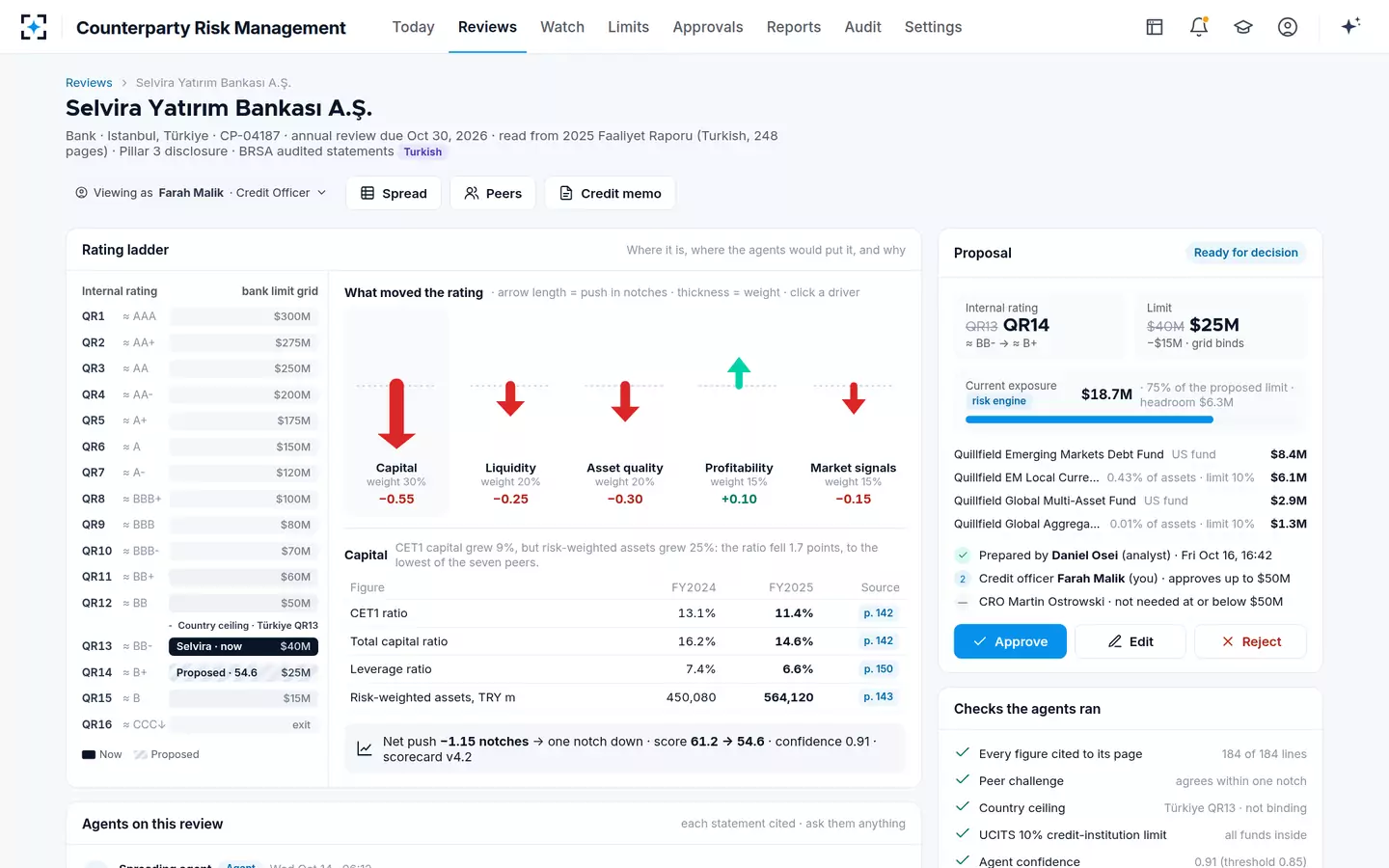
What the solution does not do is replace the risk engine. Current and potential exposure by fund come from the system that already calculates them; the agents read them, compare them with the proposed limit and draft a cure when a limit is exceeded. The credit side, the filings, the spread, the rating drivers and the peer challenge, is where the agents do the work, and a credit officer signs. The exposures supervisors expect a bank to report from that combination are set out in counterparty credit risk metrics a program should report.
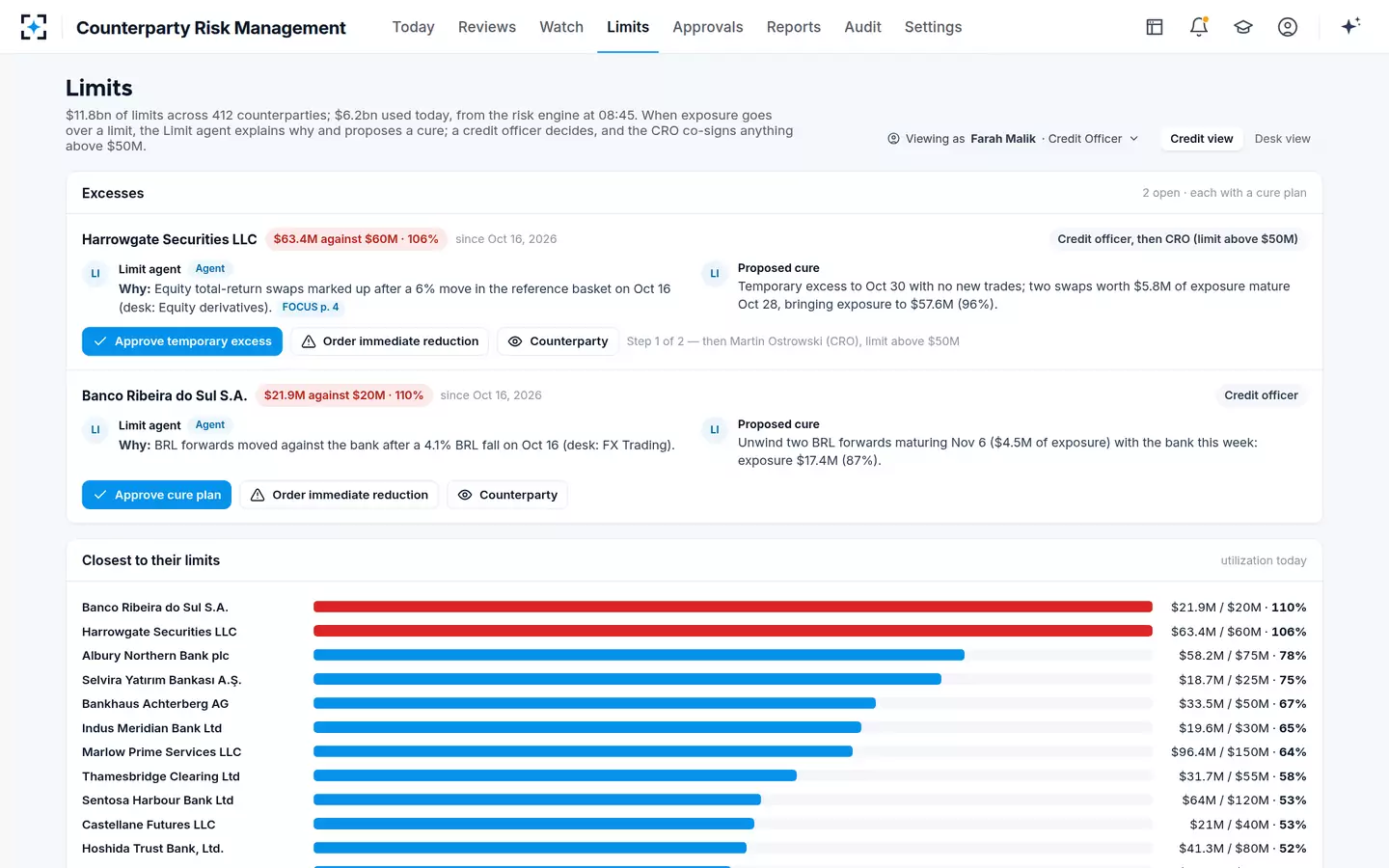
Utilisation by counterparty: the counterparty view of the same banks
Questions people ask
Is counterparty risk the same as default risk?
Not quite. Default risk is the chance the counterparty fails; counterparty risk is the loss that failure causes, which also depends on how much the contracts are worth to the fund at that moment. A bank with a high chance of default and no in-the-money trades with the fund causes no counterparty loss today.
Is settlement risk part of counterparty risk?
It is the short-lived end of it. Settlement risk is the exposure in the hours when the fund has paid and not yet received, such as on an FX trade settling across time zones. Bank supervisors expect settlement and clearing lines to appear on the same exposure report as counterparty exposure.
Does collateral turn counterparty risk into zero?
It can cover current exposure, not the move between the last margin call and the close-out. The Basel guidelines call that window the margin period of risk and expect banks to stress it, because collateral and exposure can both move against the holder on the same day; a fund's own version of that test is the market stress run described in how to stress test a portfolio.
Who bears counterparty risk in a cleared trade?
The clearing house stands between the two sides, so the fund's exposure is to the central counterparty and to the clearing member holding its margin. Under Directive (EU) 2024/2994, due in national law by 25 June 2026, trades cleared through an authorised or recognised CCP fall outside the UCITS counterparty limit.
How do you measure credit risk on a bank's bond?
By the holding: market value or par, the bank's rating and spread, and the bond's seniority. For a UCITS it counts against the 5% issuer limit and, with deposits and derivatives with the same bank, against the 20% single-body limit.
Why did the Archegos losses count as counterparty risk?
The banks were not lending in the usual sense; they were the other side of total return swaps. When the fund could not meet margin calls, the swaps were worth billions to the banks and the fund could not pay. The Archegos collapse, seen from a fund's own counterparty desk, follows what supervisors found.