A credit support annex (CSA) is the part of an ISDA agreement that governs collateral: when one party must post collateral to the other, how much, in which assets, valued how, and when it comes back. The CFTC puts it in one line: a CSA "sets forth the terms of the collateral arrangement for the derivatives transaction" (CFTC, 86 FR 6850, 2021). The meaning of any particular credit support annex lies in a dozen defined terms, from the threshold and minimum transfer amount to eligible collateral, haircuts and the valuation agent, and every margin call is arithmetic on them. The difficulty is that those terms live in signed PDFs amended over years, while collateral and risk systems run on whatever was keyed at signing. Botminds' ISDA and CSA Data Extraction reads every executed annex and amendment and turns the terms into fields, each cited to its clause, so the systems can be checked against the paper.
The worked examples come from a fictional sample firm, Quillfield Capital, with 2,400 executed ISDA, CSA, GMRA and GMSLA agreements across 46 counterparties, as it runs through the solution. The rules are quoted from regulators and courts and linked where they appear.
Regulators already treat a CSA's terms as data
4
things a US swap dealer’s credit support arrangements must contain, from margin requirements to custody
9
terms EU law requires in every exchange of collateral agreement, two of them governing law
24hours
for the largest US financial firms to hand regulators their agreement and collateral records, electronically
What is a credit support annex? The collateral contract inside the ISDA
A credit support annex is a standard form, published by ISDA and completed by the two parties, that sits alongside the ISDA Master Agreement and makes the derivatives relationship collateralised. When the mark-to-market of the trades under the Master Agreement moves in one party's favour, the annex says whether, and by how much, the other must deliver collateral, and when the collateral is returned as the exposure falls.
The clearest public description comes from a court. In 2019 the Court of Appeal read a 1995 English-law annex between the State of the Netherlands and Deutsche Bank and summarised its design: "The standard form CSA provides for “credit support” (collateral) to be provided in appropriate circumstances by both sides to the transaction" (State of the Netherlands v Deutsche Bank AG [2019] EWCA Civ 771). The same judgment shows how much the parties can change. A bespoke election made "Transferor" and "Transferee" refer only to the bank and the State, so the annex became one-way: only the bank posted.
That case also shows what a CSA term is worth. The annex set the interest on the bank's cash collateral at EONIA minus 0.04%. When that rate went negative in June 2014, the State argued the bank owed it negative interest. One election, read two ways, went through the High Court in 2018 and the Court of Appeal in 2019, and the bank won both times ([2018] EWHC 1935 (Comm)).
How does a CSA relate to the ISDA Master Agreement and Schedule?
The Master Agreement is the printed framework for all the trades between two parties: payments, netting, events of default and close-out. The Schedule is where the parties choose among its options and amend it, including the termination events that matter most to a fund. The credit support annex adds collateral on top, and it is woven into close-out: on an early termination, the 1995 English annex provides that "an amount equal to the Value of the Credit Support Balance, determined as though the Early Termination Date were a Valuation Date, will be deemed to be an Unpaid Amount due to the Transferor", in the words of Paragraph 6 that the Court of Appeal set out ([2019] EWCA Civ 771).
So a CSA cannot be read on its own. Its exposure is defined by the trades under the Master Agreement, its close-out treatment depends on the Master Agreement's Section 6, and the Schedule often carries terms that change collateral without touching the annex, such as termination events tied to a fund's net asset value. Each amendment or protocol letter signed since may change any of the three. That chain is why working out today's ISDA terms from an amendment chain is a separate discipline.
Repos and securities loans run on different masters, the GMRA and the GMSLA, with collateral mechanics built into the agreement rather than an annex. A fund can hold all three with the same bank, as the sample firm does, which is why the comparison of GMRA, ISDA and prime brokerage agreements belongs next to this one.
Twelve defined terms carry the whole annex, and each becomes a field
Eligible collateral
What it doesThe assets each party may deliver: cash in named currencies, government bonds, sometimes more
Where it sits“Eligible Credit Support”, Paragraph 11(b)(ii)
The field it becomesOne row per asset type, issuer class, maturity and currency
Valuation percentage or haircut
What it doesHow much of each asset’s market value counts towards the call
Where it sitsBeside each eligible asset in the elections
The field it becomesA percentage per row of the schedule
Threshold
What it doesExposure a party may run before any collateral is owed; often rating-linked
Where it sitsParagraph 11(b)(iii)(B)
The field it becomesAmount and currency per party, with any rating table
Minimum transfer amount
What it doesThe smallest transfer either side must make; below it, nothing moves
Where it sitsParagraph 11(b)(iii)(C)
The field it becomesAmount per party; zero if none is specified
Independent amount
What it doesAn extra amount added to exposure, fixed or triggered by an event
Where it sitsParagraph 11(b)(iii)(A)
The field it becomesAmount, formula or trigger per party
Rounding
What it doesRounds the delivery and return amounts to an agreed multiple
Where it sitsParagraph 11(b)(iii)(D)
The field it becomesMultiple, and whether it rounds up, down or to nearest
Valuation agent
What it doesWho calculates exposure and the amount due
Where it sitsParagraph 11(c)(i)
The field it becomesA party, or “the party making the demand”
Valuation date and notification time
What it doesWhich days are valued and the cut-off for a call that day
Where it sitsParagraph 11(c)
The field it becomesCalendar rule plus a time and its city
Base currency
What it doesThe currency every amount is converted into before netting
Where it sitsThe elections paragraph
The field it becomesAn ISO currency code
Interest rate on cash
What it doesWhat the holder of cash collateral pays back, and when
Where it sitsParagraph 11(f)(i)
The field it becomesIndex, spread, day count, floor, payment dates
Transfer or security
What it doesWhether ownership passes to the receiver or stays with the poster
Where it sitsParagraph 5(a) in the 1995 English annex
The field it becomesA mechanism flag, plus reuse and custody terms
Who posts
What it doesTwo-way, or one party only
Where it sitsElections that define Transferor and Transferee
The field it becomesDirection flag per party
Three of the twelve are not numbers. Who posts, whether title passes, and which party values are choices, and they decide how the numbers are used. A system that holds the threshold correctly but treats a one-way annex as two-way will call collateral the counterparty never agreed to give. The definitions also carry defaults: the 1995 annex the court read says the threshold and the minimum transfer amount are zero "if no amount is specified". A blank in the elections is therefore a value, and an extraction that records it as missing has made an error.
What must a US credit support arrangement contain by rule?
US rules list what the collateral documents of a swap dealer must say. The CFTC's trading relationship documentation rule requires credit support arrangements containing "Initial and variation margin requirements, if any", the assets that may be used as margin with their haircuts, investment and rehypothecation terms, and "Custodial arrangements for margin assets, including whether margin assets are to be segregated with an independent third party" (17 CFR 23.504(b)(3)). The same section asks for a written agreement on how each swap is valued for margin, with a fallback method or a dispute process if an input fails (23.504(b)(4)).
Dealers supervised by the banking agencies have the parallel rule. Their documentation must give both sides "the contractual right to collect and post initial margin and variation margin in such amounts, in such form, and under such circumstances as are required", and specify the valuation methods and the procedures for valuation disputes (12 CFR 237.10). A fund rarely reads these rules, because they bind its dealer. It feels them in the documents the dealer sends it to sign.
Nine terms Europe requires in every collateral agreement
EU law is more specific. Since 2017 the uncleared margin rules have required every exchange of collateral agreement to include at least nine terms, from "the levels and type of collateral required" and the segregation arrangements to the netting set it covers, the procedures for notifying, confirming and settling calls, and who calculates what (Delegated Regulation (EU) 2016/2251, Article 3). The last two are easy to miss: "the law applicable to the non-centrally cleared OTC derivative contract" and "the law applicable to the exchange of collateral agreement" are listed separately, because they can differ.
What US and EU margin rules say a collateral agreement must contain
| Subject | United States (CFTC, banking agencies) | European Union (2016/2251, Article 3) | Where it lives in a CSA |
|---|---|---|---|
| How much collateral | Initial and variation margin requirements (23.504(b)(3)(i)); the contractual right to collect and post them (237.10(a)) | The levels of collateral required (a) | Threshold, minimum transfer amount, independent amount, rounding |
| What collateral | Types of assets that may be used and their haircuts (23.504(b)(3)(ii)) | The type of collateral required (a); settlement procedures for each type (e) | Eligible collateral and valuation percentages |
| Where it is held | Custodial arrangements, including segregation with an independent third party (23.504(b)(3)(iv)) | The segregation arrangements (b) | Custody and reuse elections; separate custody documents for initial margin |
| Reuse | Investment and rehypothecation terms (23.504(b)(3)(iii)) | Covered by the segregation terms; initial margin may not be reused (Article 20) | Use of posted collateral, or title transfer |
| Valuation and disputes | Agreed valuation process and a dispute route (23.504(b)(4); 237.10(b)) | Calculation and valuation methods, timeframes and responsibilities (f) | Valuation agent, valuation date, dispute paragraph |
| Which trades | Netting portfolios under an eligible master netting agreement (23.151) | The netting set the agreement refers to (c) | Which transactions the annex covers |
| Law | Governing law among the documentation terms (23.504(b)(1)) | Law of the derivative (h) and law of the collateral agreement (i) | The Master Agreement and the annex, which can differ |
One margin call, worked through the definitions
A CSA turns exposure into a call in four steps, and each uses an extracted term. The 1995 English annex the court read defines the Credit Support Amount as the receiver's exposure plus any independent amount, less the poster's threshold, and deems it zero "whenever the calculation of Credit Support Amount yields a number less than zero". The Delivery Amount is the Credit Support Amount less the value of collateral already held, and it is due only if it "equals or exceeds the Transferor’s Minimum Transfer Amount", rounded as the elections say ([2019] EWCA Civ 771).
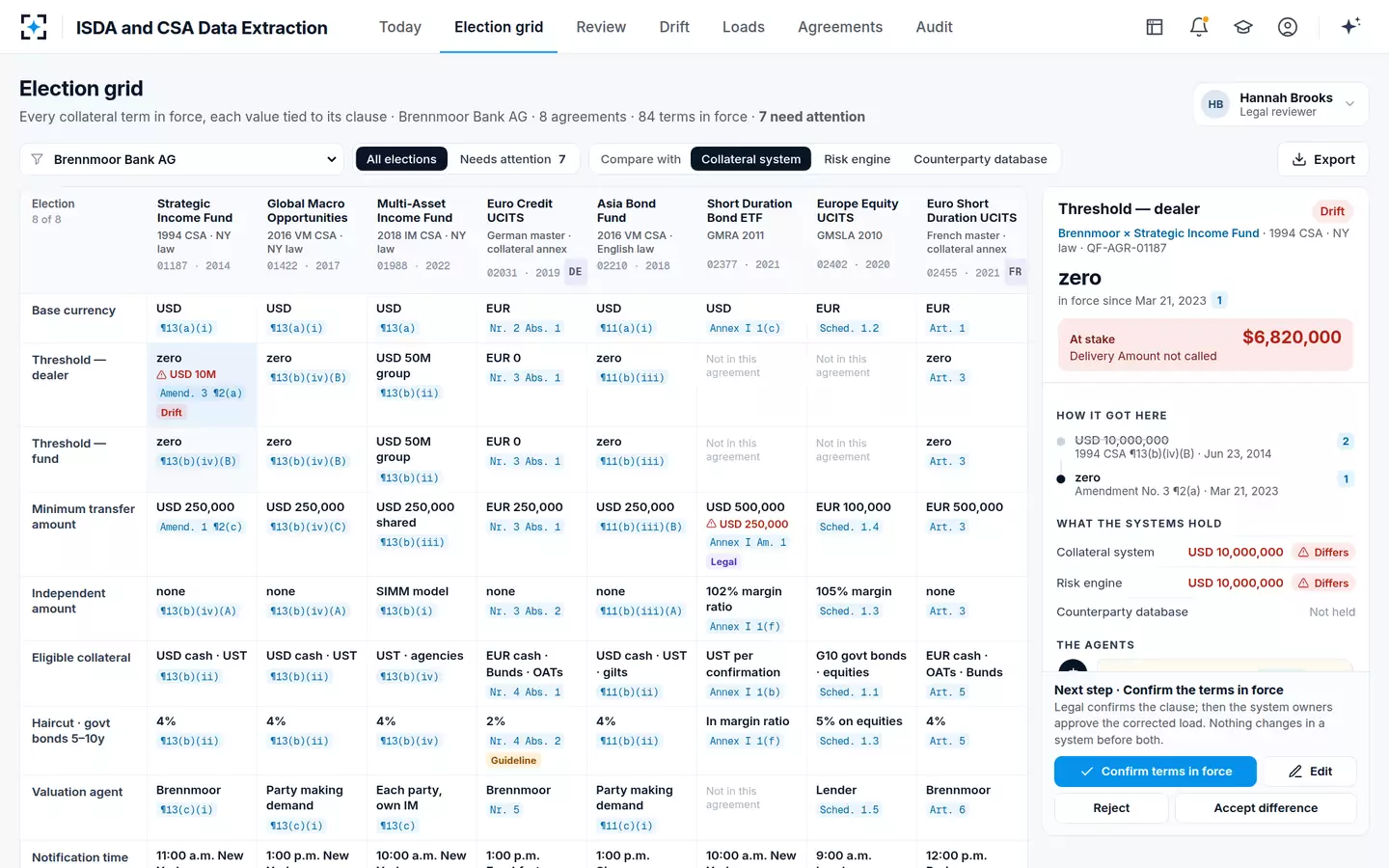
One sample call: the same exposure, the old threshold and the amended one
| Step | What the annex says | Threshold USD 10,000,000 (as keyed in 2014) | Threshold zero (Amendment No. 3, 2023) |
|---|---|---|---|
| 1. Exposure | Mark-to-market of the trades in the netting set, at the valuation time | $6,812,400 | $6,812,400 |
| 2. Plus independent amount | None elected for either party | $0 | $0 |
| 3. Less threshold | The poster’s threshold in force | −$10,000,000 → floored at $0 | $0 to deduct |
| 4. Credit Support Amount | Never below zero | $0 | $6,812,400 |
| 5. Less collateral held | Value of the credit support balance | $0 | $0 |
| 6. Against the minimum transfer amount | USD 250,000 since Amendment No. 1 | Nothing to call | Exceeded |
| 7. Rounded | Up to the nearest USD 10,000 | — | $6,820,000 delivery amount |
Every number in the right-hand column came from a different document. The rounding rule is in the 2014 annex, the minimum transfer amount in a 2016 amendment, and the zero threshold in a 2023 amendment that never reached collateral operations. The arithmetic is trivial; knowing which value is in force is not. The threshold, minimum transfer amount and rounding each deserve a closer look, because the rules treat them differently.
The election grid: every term in force across one dealer's agreements
Why does every CSA term have to become data?
Because the people who act on a CSA in a hurry do not have time to read it. US rules already assume the terms exist as records. The largest US financial firms must be able to give regulators, within 24 hours, tables that include for every agreement an "Agreement governing law" field and, for every item of collateral, "Is collateral re-hypothecation allowed?", kept on values "no less current than previous end-of-day values and information" (31 CFR part 148, Appendix A). Bank supervisors expect the credit valuation adjustment to "reflect margin thresholds or minimum transfer amounts stated in legal documents" (Interagency counterparty credit risk guidance, SR 11-10).
The Basel Committee and IOSCO list the paperwork a new derivatives relationship needs: "the establishment of master agreements, credit support annexes and/or credit support deeds, custodian control agreements, eligible collateral schedules, and standing settlement instructions" (BCBS–IOSCO, January 2025). Each produces terms that a system must hold. When the terms are not held, people guess. Two weeks before Archegos collapsed in March 2021, it demanded USD 2.4 billion from Credit Suisse, and the Swiss supervisor found the bank "paid this amount based on the contract with Archegos" without examining whether it had to (FINMA, 24 July 2023; the wider findings are in the Archegos lessons for a fund's counterparty desk).
“It is true that certain employees assumed that the bank had been contractually obliged to make these payments.”
FINMA, on Credit Suisse's USD 2.4 billion payment to Archegos, July 2023
An assumption about a contract is the failure mode that extraction exists to remove. For an asset manager the stakes run the other way as often as not: a fund owed collateral by its dealer is owed it only if its systems know the term that says so.
Where the terms go wrong between the PDF and the system
The errors cluster in a few places, and none is exotic. An amendment signed as an emailed PDF and filed beside the Schedule. A protocol adherence letter that changes many agreements at once and is never linked to any of them. A rating-linked threshold keyed as a single number. A local-law collateral annex in German or French keyed from its English cover page. A blank election recorded as "not found" instead of zero. Each leaves a system computing calls on terms the parties no longer have.
None of these is found by re-reading the base annex, which is why a CSA review that samples files rarely finds them. They are found by collecting every document in an agreement's chain, ordering it by effective date, and comparing the result with what each system holds, which is the work the form of the annex and the eligible collateral schedule complicate further.
How ISDA and CSA Data Extraction reads a credit support annex
ISDA and CSA Data Extraction gives each term a citation before it gives it a value. An Extraction agent reads the annex, Schedule and amendments in the language they were signed in and records each election with its document, paragraph and page; a Checker agent reads the same clauses blind, with a different method, and the two must agree. An Amendment agent applies the chain by effective date and stops for legal on any conflict. Nothing is auto-confirmed: an analyst verifies, a derivatives lawyer confirms the terms in force, and the collateral system and risk engine are corrected only when their owners approve.
Asking why a system holds a term the paper no longer has
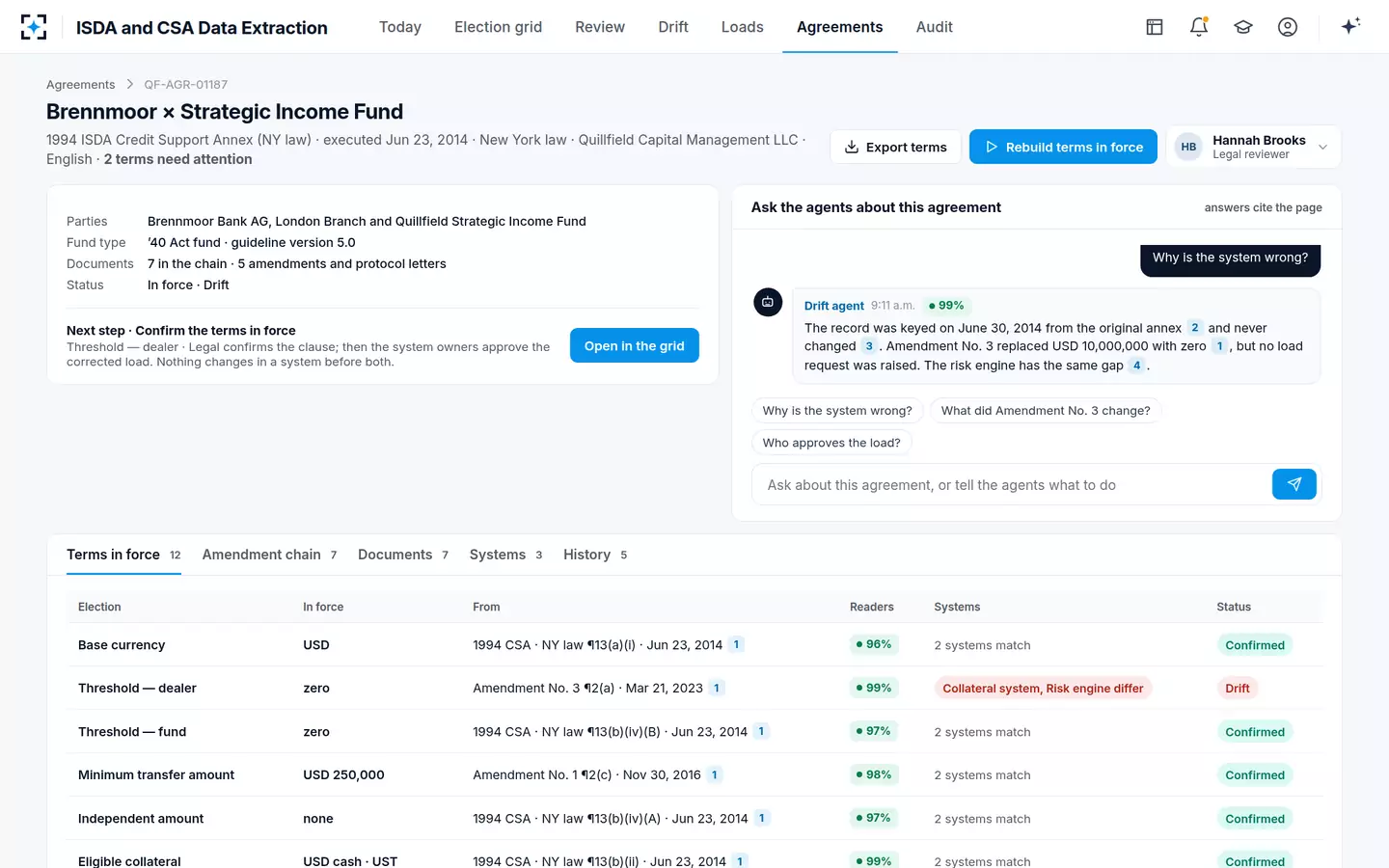
In the sample estate the nightly comparison covers 62,410 terms in force against the collateral system, the risk engine and the counterparty database. It is the meaning of the credit support annex, kept current: the terms the parties signed, as amended, held where the calls are computed.
Questions people ask
What is a CSA in derivatives?
It is the collateral agreement attached to an ISDA Master Agreement. It turns the daily mark-to-market of the trades into an obligation to post or return collateral, using terms the parties elect: threshold, minimum transfer amount, independent amount, eligible collateral, haircuts, valuation agent and timing. The CFTC describes it as setting "the terms of the collateral arrangement for the derivatives transaction".
Is a credit support annex the same as a credit support deed?
No. Under English law the 1995 annex transfers title to the collateral, while the credit support deed creates a security interest, a contrast the Court of Appeal noted in 2019 (the court's words are in credit support annex 1995 vs 1994 vs 2016). The difference changes what the receiver may do with collateral and how it is treated on default.
Who is the valuation agent under a CSA?
Whoever the elections name. In the Netherlands annex the valuation agent for calls and disputes was "the party making the demand", while the bank alone valued interest and distributions. A system that assumes the dealer always values will mis-assign calls the fund is entitled to make.
Is every CSA two-way?
The standard form is, but the elections can make it one-way. The Netherlands annex defined the bank as the only Transferor, so only the bank ever posted. Whether an annex runs one way or both is a direction flag a system must hold, because it decides who can ever be called.
Does a CSA have to be signed before trading?
For a regulated dealer's uncleared swaps, yes. US rules require trading relationship documentation, including credit support arrangements, to be executed before or at the same time as the first swap (17 CFR 23.504(a)(2)), and EU rules require the collateral agreement to be in place no later than when the contract is concluded (Regulation 2016/2251, Article 2).
What is the difference between a CSA and a GMRA?
A CSA collateralises derivatives under an ISDA Master Agreement; a GMRA is the master agreement for repos, where the margin mechanics are part of the agreement itself. Many funds hold both with the same bank, and the eligible collateral and transfer terms in each must be kept separately.