An eligible collateral schedule is the part of a credit support annex that lists the assets each party may deliver as collateral, and the haircut or valuation percentage that says how much of each asset's market value counts. A typical schedule names cash in certain currencies and government bonds by issuer and residual maturity, each with its own percentage. It decides what a fund may post when it is called and what it must accept, and margin rules in the US and the EU limit what may go in it. Because it is a table inside a legal document, often changed by amendment, it is easy to key once and never check again. Botminds' ISDA and CSA Data Extraction reads every schedule and every amendment to it into rows, each with the clause it came from, and compares them each night with what the collateral system accepts.
One schedule, read as rows: asset, maturity, currency, haircut, source
German federal bonds
Residual maturityOver 5, up to 10 years
CurrencyEUR
Haircut2%
Source clauseGerman collateral annex, Nr. 4 Abs. 2, page 6
FlagBelow the fund’s 4% negotiation guideline
US Treasury securities
Residual maturity5 to 10 years
CurrencyUSD
Haircut4%
Source clause1994 New York annex, Paragraph 13(b)(ii)
FlagMatches the guideline
US Treasury securities
Residual maturityUp to 10 years only
CurrencyUSD
HaircutPer schedule
Source clauseAmendment No. 2, Kestrel Harbour annex
FlagOver 10 years removed; the collateral system still accepts any maturity
The examples come from that fictional sample firm, Quillfield Capital, with 2,400 executed ISDA, CSA, GMRA and GMSLA agreements across 46 counterparties, as it runs through the solution. The rules are quoted from US and EU regulators and linked where they appear.
What is an eligible collateral schedule? A table inside a legal document
An eligible collateral schedule is a list of permitted assets with a percentage against each. In the 1995 English-law annex the High Court read in State of the Netherlands v Deutsche Bank, "Eligible Credit Support" meant the items "specified as such for that party in Paragraph 11(b)(ii)", and in that agreement they were, in the court's summary, cash, certain government-issued negotiable debt obligations and "such other Eligible Collateral as may be agreed between the parties" ([2018] EWHC 1935 (Comm)). The schedule can differ by party, so a dealer may accept from a fund what it will not deliver itself.
Each row usually combines several attributes: an asset type, an issuer or issuer class, a residual maturity band, a currency, sometimes a minimum rating, and a percentage. In a German- or French-law collateral annex the same content appears in numbered clauses in the original language. Read as a paragraph, it is one long sentence; held as data, it is a table whose every cell can change by amendment.
Where is the schedule in a CSA?
It sits in the elections, not in the printed body. In the 1995 English annex the definition points to Paragraph 11(b)(ii), as the court quoted ([2019] EWCA Civ 771); the sample firm's 1994 New York annexes carry it in Paragraph 13(b)(ii). Local-law masters put it in their own collateral annex: the sample firm's German annex sets its haircut on German federal bonds in Nr. 4 Abs. 2 on page 6. Amendments often replace the schedule wholesale, so the version in force may be in a three-page amendment, not in the annex at all.
Some agreements also refer to a separate schedule document or a custodian's list for initial margin. The Basel Committee and IOSCO count "eligible collateral schedules" among the documents a new relationship has to establish, beside master agreements, credit support annexes and custodian control agreements (BCBS–IOSCO, January 2025). The schedule in force is whichever of those the chain makes current.
What are valuation percentages and haircuts?
They are two ways of writing the same discount. A haircut is the share of market value that does not count; a valuation percentage is the share that does, so a 4% haircut is a 96% valuation percentage. The banking agencies' counterparty guidance defines it in lending terms: "A haircut is the difference between the market value of an asset being used as collateral for a loan and the amount of money that a lender will advance against the asset" (Interagency counterparty credit risk guidance, SR 11-10). The same guidance asks banks to "strive to ensure that haircuts on collateral do not decline during periods of low volatility".
Haircuts stack. The EU rule values collateral as its market value times one, less the asset haircut, less a currency haircut, and the US rule applies "the sum of the following discounts" (17 CFR 23.156). An extraction that records one percentage per asset, without the currency rule, will overvalue every bond posted in the wrong currency.
Of $100 of a seven-year bond, between $98 and $88 counts, depending on two cells of the schedule
What does the US rule require about eligible assets and haircuts?
Two things: the documents must say what is eligible, and regulated margin must meet a federal list. The CFTC requires a dealer's credit support arrangements to set out the types of assets usable as margin and their valuation haircuts (17 CFR 23.504(b)(3)(ii)). Its margin rule then limits regulatory initial margin to a list running from cash in US dollars, a major currency or the settlement currency, through Treasuries, agency and certain sovereign debt, to equities in the S&P Composite 1500, certain fund shares and gold, with a standardised haircut for each (17 CFR 23.156).
Variation margin depends on who the counterparty is. Between two swap entities it must be "immediately available cash funds" in US dollars, another major currency or the settlement currency. With a financial end user, which is what a fund is, a dealer may post and collect any asset eligible as initial margin, with the same haircuts. Above the required amounts, the rule allows margin "in any form of collateral", and the schedule decides.
Minimum haircuts for the same assets, US and EU, before any currency add-on
| Asset and residual maturity | US rule (23.156) | EU rule, credit quality step 1 (Annex II) |
|---|---|---|
| Cash in the same currency | 0% | 0% for cash variation margin |
| Government and central bank debt, under 1 year | 0.5% | 0.5% |
| Government debt, 1 to 5 years | 2% | 2% |
| Government debt, over 5 years | 4% | 4% |
| Corporate debt, under 1 / 1 to 5 / over 5 years | 1% / 4% / 8% | 1% / 4% / 8% |
| Main-index equities | 15% (S&P 500); 25% (rest of the S&P 1500) | 15% |
| Gold | 15% | 15% |
| Collateral in a currency the agreement did not choose | +8% | +8% |
The EU list, and the currency haircut that depends on the CSA
The EU rule lists eligible asset classes in Article 4, from cash and gold to government, corporate and covered bonds, senior securitisation tranches, main-index equities and certain UCITS units, and then adds conditions a schedule must reflect. Lower-rated assets must be assessed at credit quality steps 1 to 3, and procedures must replace assets that fall below within no more than two months (Article 7). Initial margin from a single issuer is limited to the greater of 15% of the collateral collected or EUR 10 million for several asset classes (Article 8). Collateral "collected as initial margin" may not be rehypothecated, repledged or otherwise reused (Article 20).
One haircut is defined by the CSA itself. For variation margin, "a haircut of 8 % shall apply to all non-cash collaterals posted in a currency other than those agreed in an individual derivative contract, the relevant governing master netting agreement or the relevant credit support annex" (2016/2251, Annex II, point 4). For initial margin the 8% applies to anything not in the agreed termination currency. Whether a bond attracts 8% therefore depends on which currencies the annex agreed, which is an extracted term, not a market fact.
When the rule changes and the schedule does not
A change in the rules does not rewrite a signed schedule. On 17 August 2026 a CFTC amendment took effect "eliminating a provision disqualifying securities issued by certain pooled investment funds ('money market and similar funds')" whose managers lend or repo their assets, "thereby expanding the scope of assets that qualify as eligible collateral", and reset the haircuts for such funds, so that qualifying money market fund shares carry 0.5% (CFTC, 91 FR 45134, July 2026). Those shares are now permitted by the rule. Whether a particular fund may post them depends on its schedule, and a schedule changes only when the two parties amend it.
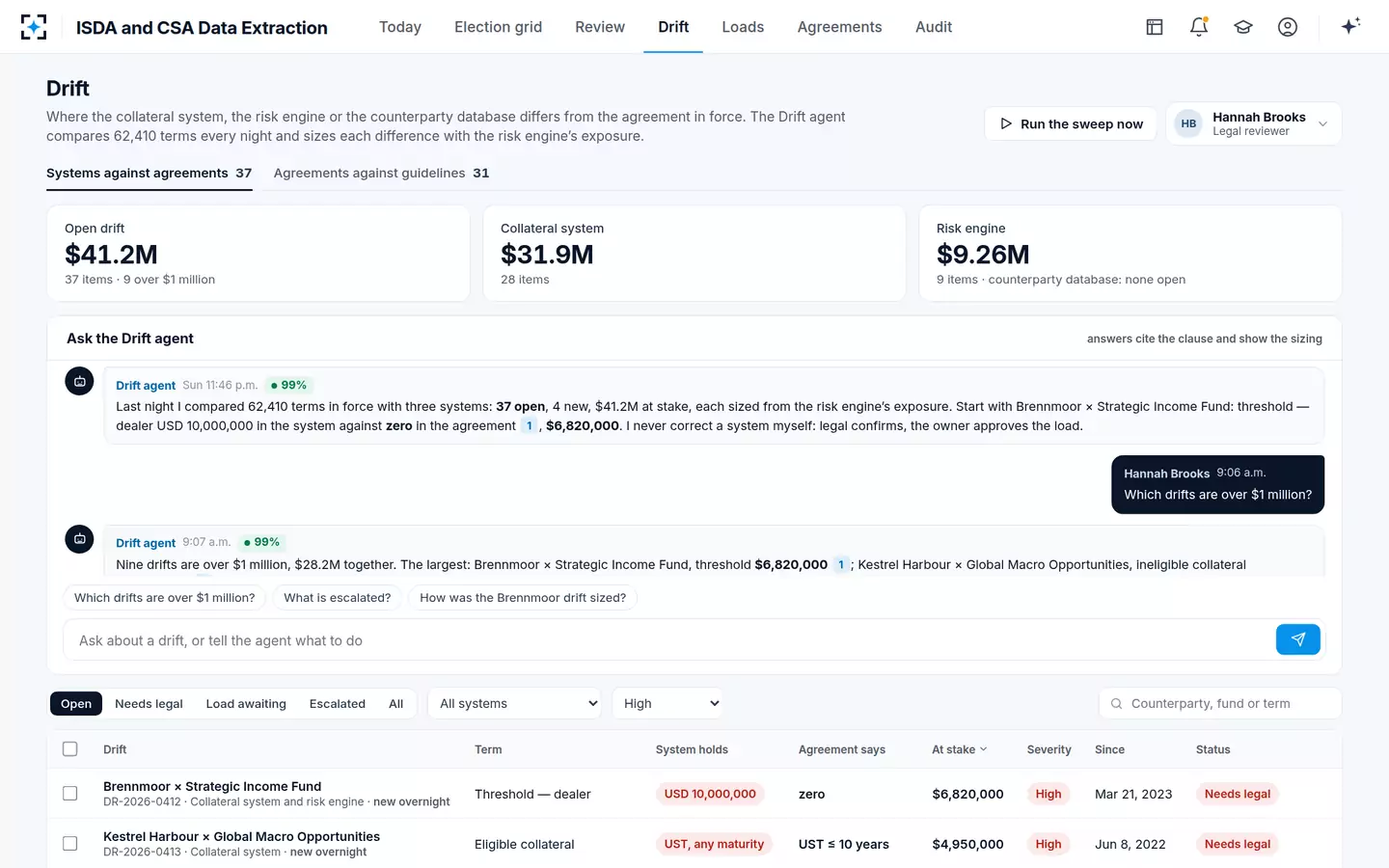
The reverse happens too: the parties narrow a schedule and a system keeps the old one. In the sample estate, Amendment No. 2 to Kestrel Harbour's annex with the Global Macro Opportunities fund limited Treasuries to ten years' maturity. The collateral system still accepts Treasuries of any maturity, and the fund has accepted $4,950,000 of longer Treasuries the agreement no longer allows, a difference open since June 2022. The US rule anticipates the problem from the rule's side: where collateral "is no longer eligible", the dealer must "promptly collect or post sufficient eligible replacement collateral" (23.156(c)). Nothing equivalent watches the contract's side unless someone compares the two.
Ineligible collateral, found by comparing the schedule in force with the system
Why do stress tests ask about eligibility under existing CSAs?
Because in a stress the question is not what assets a fund owns but which of them its counterparties must accept. The Financial Stability Board's 2024 recommendations ask firms to consider, in their liquidity risk management, "the eligibility of assets under any existing Credit Support Annexes (CSAs)", and say stress estimates for bilateral derivatives "should incorporate the mechanics of CSAs, and any associated margin lock agreements" and credit triggers (FSB, Liquidity Preparedness for Margin and Collateral Calls, December 2024). Assets held to meet margin calls should carry limited liquidity, credit and market risk "unless they are eligible under an existing CSA".
The FSB goes further and suggests firms rework their annexes so that they can deliver non-cash collateral when calls come (what that is worth, asset by asset, is in collateral optimization). Neither recommendation can be acted on without the schedules as data: a treasurer cannot answer "which of our bonds can go to which dealer tomorrow" from a folder of PDFs in the time a stress allows.
The schedules also explain why disputes are rarer than they could be. Supervisors found that disputes "primarily concern VM valuation issues, rather than the sets of allowable collateral to be used in settling VM calls, due to collateral schedules being clearly established in legal documents" (BCBS–IOSCO, January 2025). Clear in the document, that is. The same report notes that automation is meant to address "increasingly complex collateral schedules and collateral types". A schedule that is clear on paper but stale in the system produces the dispute the paper was meant to prevent.
How should an eligible collateral schedule be stored as data?
As one row per combination the schedule distinguishes, with the clause and the effective date on every row. A paragraph pasted into a free-text field cannot be compared with a system, priced in a stress test or checked against a rule change. The checklist below is what the rows need to hold.
What each row of a stored schedule needs
- Which party it applies to
Schedules can differ by party; a dealer may accept assets from a fund that it will not deliver.
- Asset type and issuer class
Cash, government, agency, supranational, corporate, covered bond, equity, fund shares, gold, named as narrowly as the clause names them.
- Residual maturity band and any rating floor
The bands drive the haircut in both rules; a rating floor needs a rule for split or withdrawn ratings.
- Currency and the agreed currencies
The agreement’s own currency list decides whether the EU 8% add-on applies.
- Haircut or valuation percentage
Stored as written, with the convention noted, so 96% and 4% are never confused.
- Concentration limits and exclusions
Issuer caps, own-issuer exclusions and maturity cut-offs added by amendment.
- Source clause and effective date
Document, paragraph and page for every row, so a later amendment replaces the right rows and nothing else.
- Regulatory floor beside the contract
The applicable US or EU minimum next to the contractual haircut, so a contract below the rule is visible to legal.
The last row matters in the sample estate. The fictional Euro Credit UCITS fund's German annex sets a 2% haircut on German federal bonds of five to ten years, against at least 4% in the firm's negotiation guideline for UCITS funds. Where the EU margin rules apply to the pair, Annex II also sets 4% as the minimum for top-rated government debt in that band, so the question for legal is wider than whether to grant a guideline exception.
The haircut clause, in German, beside the English and the guideline
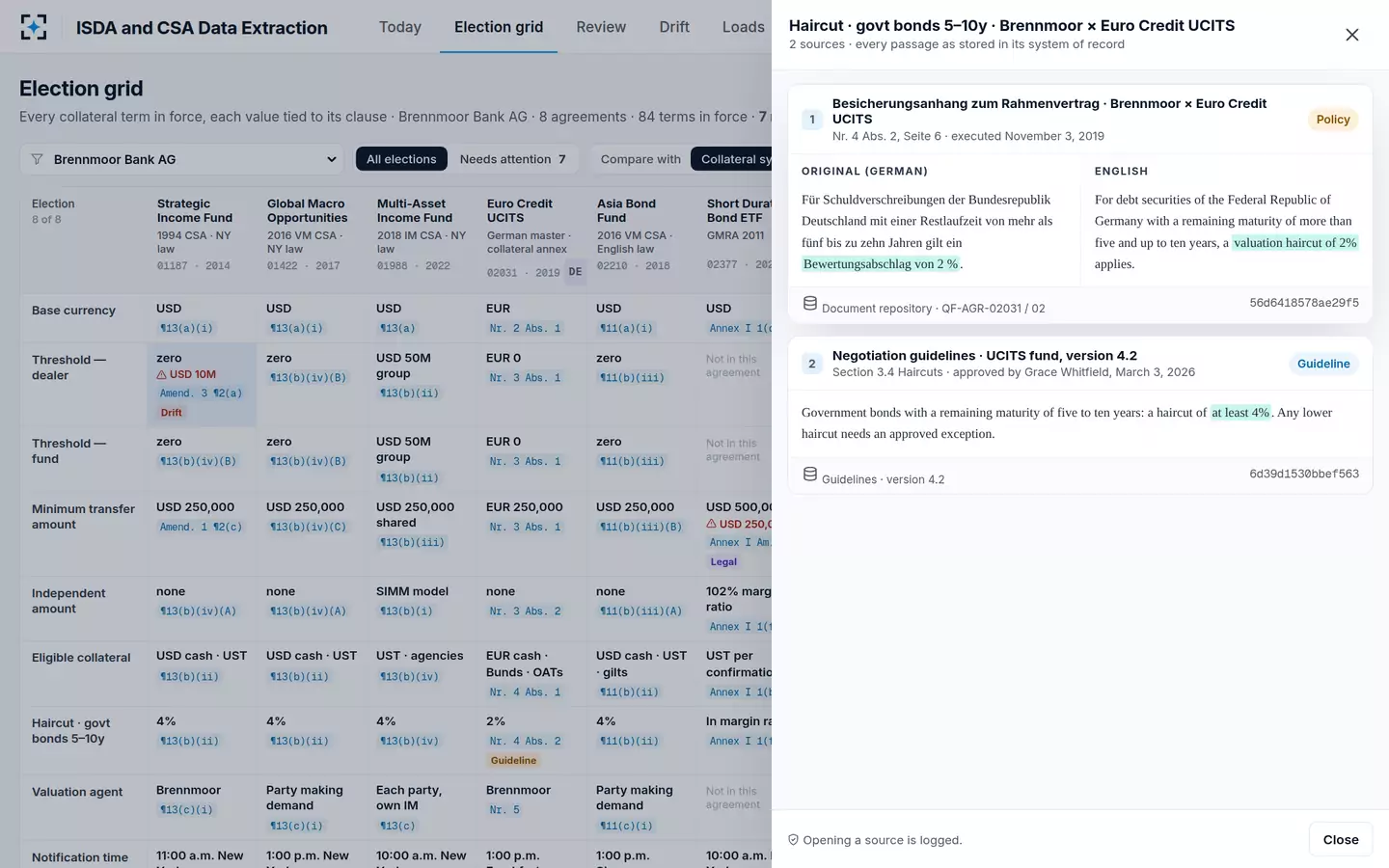
ISDA and CSA Data Extraction reads schedules the way the checklist describes: the Extraction agent records each row with document, paragraph and page in the original language, the Checker agent reads it blind, the Amendment agent replaces only the rows an amendment changes, and the Policy agent compares each row with the firm's guideline for the fund type. The amounts behind each call, the threshold, minimum transfer amount and rounding, are read the same way, and the question of who owns delivered collateral is taken up in the 2016 VM CSA under English law.
Questions people ask
What is eligible collateral in a CSA?
The assets the annex allows each party to deliver, usually cash in named currencies and government bonds within maturity bands, sometimes corporate bonds, equities or fund shares. Anything else may be refused. For regulated initial margin, and for variation margin a dealer exchanges with a fund, US and EU rules also limit the list.
What is the difference between a haircut and a valuation percentage?
A haircut is the share of value that does not count; a valuation percentage is the share that does. A 2% haircut and a 98% valuation percentage say the same thing. Schedules use either convention, so a stored value must record which.
Do haircuts apply to cash collateral?
Not to cash in an agreed currency: the EU rule sets 0% for cash variation margin and the US table sets 0% for cash in the same currency as the swap obligation. Cash in a currency the agreement did not choose can attract an 8% discount under both rules for initial margin.
Can a fund post money market fund shares as collateral?
Under the US rule, shares of funds that meet its conditions are eligible for initial margin, and since 17 August 2026 at a 0.5% haircut for qualifying money market funds. The fund still needs its credit support annex, or a custody document for initial margin, to list them; the rule permits what the contract may still exclude.
What happens if posted collateral stops being eligible?
Under the US rule the dealer must promptly obtain eligible replacement collateral; under the EU rule assets that fall below the required credit quality must be replaced within no more than two months. The contract may set its own timetable, which is another row to extract.