An ISDA CSA agreement, the ISDA Master Agreement with its Schedule and credit support annex, is negotiated and signed by a few people and then read for years by many more. Collateral operations computes calls from it every business day, counterparty risk sets exposure and limits from it, treasury needs to know which assets can leave in a stress, legal keeps the chain of amendments whole, and fund accounting books the interest and distributions. Each seat needs different terms, and each usually reads them from a system keyed long ago rather than from the paper. The hard part is not reading the agreement once; it is keeping five systems faithful to it through every amendment. Botminds' ISDA and CSA Data Extraction reads each executed agreement and amendment into terms cited to their clause, has a person verify and a lawyer confirm them, and lets each system owner approve what reaches their system.
Who reads which part of an ISDA CSA agreement after signing
Threshold, MTA, independent amount, rounding
Collateral opsruns on it
Counterparty riskruns on it
Treasuryreads
Legalreads
Fund accounting—
Eligible collateral and haircuts
Collateral opsruns on it
Counterparty riskreads
Treasuryruns on it
Legalreads
Fund accounting—
Valuation agent, valuation date, notification time
Collateral opsruns on it
Counterparty riskreads
Treasury—
Legalreads
Fund accounting—
Interest on cash and distributions
Collateral opsruns on it
Counterparty risk—
Treasuryreads
Legalreads
Fund accountingruns on it
Transfer or security; custody and reuse
Collateral opsreads
Counterparty riskreads
Treasuryreads
Legalruns on it
Fund accountingruns on it
Dispute and valuation procedure
Collateral opsruns on it
Counterparty riskreads
Treasury—
Legalruns on it
Fund accounting—
Amendments and protocol letters
Collateral opsreads
Counterparty riskreads
Treasury—
Legalruns on it
Fund accounting—
Schedule: NAV triggers and termination events
Collateral ops—
Counterparty riskruns on it
Treasuryreads
Legalruns on it
Fund accounting—
The examples on this page come from a fictional sample firm, Quillfield Capital, with 2,400 executed ISDA, CSA, GMRA and GMSLA agreements, 9,000 amendments and protocol letters, 46 counterparties and 318 funds and mandates, as it runs through the solution. The people named are fictional too.
Who negotiates, signs and maintains an ISDA CSA agreement?
Lawyers negotiate it, authorised signatories sign it, and a legal documentation team maintains it. On the buy side the negotiation can be led by derivatives counsel or a specialist negotiator, with credit risk owning the thresholds and treasury the collateral terms; how those seats share the work is described in who decides ISDA credit terms. Once signed, the agreement moves to a documentation team whose job is to abstract its terms, file every later amendment and protocol letter, and answer questions about what the agreement says.
The regulated dealer on the other side has rules about this. A US swap dealer must execute the trading relationship documentation, credit support arrangements included, before or with the first swap, keep it under written policies approved by senior management, and have an independent auditor periodically test those policies (17 CFR 23.504). EU counterparties must have the terms of the collateral agreement settled no later than the moment the contract is concluded (Delegated Regulation (EU) 2016/2251, Article 2). A fund meets these rules through its dealers, which is why the documents arrive from the dealer's side.
“The CSA has to be read in the context of the Master Agreement and in its entirety.”
Court of Appeal, State of the Netherlands v Deutsche Bank AG, 2019
The court's warning is the operational problem in one sentence. Every seat after signing reads a fragment: collateral operations the elections, risk the thresholds and the Schedule's termination events, accounting the interest clause. None of them reads the agreement in its entirety, and none reads the amendments unless someone tells them one exists.
Collateral operations: the call, every business day
Collateral operations runs the margin cycle, and it is the seat whose system computes with the most terms. Under US rules, variation margin between a dealer and a fund is calculated and exchanged every business day for the life of the swap (17 CFR 23.153(b)), and the EU rule requires the collateral agreement to set out the procedures for notifying, confirming and adjusting calls and for settling them in each type of eligible collateral (2016/2251, Article 3(d) and (e)). Thresholds, minimum transfer amounts, rounding, eligible assets, haircuts, the valuation agent and the notification time all feed the daily call.
The seat learns of errors late. A dealer that disputes a call, or a fund that receives a call it did not expect, is usually the first sign that a term has drifted. In the sample firm, the Collateral Operations Lead had been running calls on a threshold that an amendment removed three years earlier; the amendment, the details of which are in the threshold and minimum transfer amount guide, never reached her system.
Counterparty risk: exposure, limits and the engine's copy of the terms
Counterparty risk needs the same numbers for a different calculation: how much exposure remains after collateral, today and under stress. The banking agencies expect a bank's credit valuation adjustment to reflect the thresholds and minimum transfer amounts in the legal documents, and its stress tests to "challenge the strength of assumptions made about the legal enforceability of netting and the ability to collect and liquidate collateral" (Interagency counterparty credit risk guidance, SR 11-10). That guidance is written for banks, but a fund's risk team measuring its dealers needs the same inputs, and the Schedule's termination events and NAV triggers as well.
The risk engine usually holds its own copy of the terms, keyed separately from the collateral system. In the sample estate, 9 of the 37 open differences between the agreements and the firm's systems, worth $9.26 million, were in the risk engine.
Treasury and liquidity: which assets can leave in a stress
Treasury reads the eligible collateral schedule and the triggers, because in a stress the question is which assets each dealer must accept and when calls can jump. The Financial Stability Board's 2024 recommendations ask market participants to factor the eligibility of assets under their existing credit support annexes into liquidity planning, and to build CSA mechanics, margin lock agreements and credit triggers into stress estimates (FSB, December 2024). The schedule side of that question is covered in the eligible collateral schedule, and the day-to-day call those terms drive in the margin call process.
Legal documentation: keeping the chain whole
Legal is the only seat that owns the whole agreement, and its hardest job is the chain: base agreement, amendments, side letters and protocol adherence letters, each with an effective date that may differ from its filing date. In the sample estate the Brennmoor agreement for the Strategic Income Fund has seven documents in its chain, including a 2018 stay protocol adherence letter, effective in 2019, that was filed three years later under the Schedule folder. A derivatives lawyer asked to sign off on terms she has to rebuild from that folder is doing reconstruction, not review.
The documentation team also answers to examiners and auditors on the dealer's side and to the fund's board and auditors on its own. The largest US financial companies must be able to produce agreement and collateral records electronically within 24 hours of a regulator's request, kept current to the previous end of day (31 CFR 148.3). The rule reaches the largest financial companies, which include the dealers a fund trades with, and the questions those dealers send reflect it.
Five seats around one agreement in ISDA and CSA Data Extraction, before and after
Today
Signs off on CSA terms she has to rebuild from a folder of amendments, side letters and protocol letters, in whatever order they were filed.
With agents
Reads the clause and the amendment that changed it in one cell, asks the agents why a system differs, and confirms the terms in force with a reason.
Still theirs: confirming the terms in force
Today
Abstracts 30 to 150 fields per agreement by hand and keys amendments months later, if she hears about them.
With agents
Verifies the terms both readers agree on in one step, and spends her time on disagreements with both passages in front of her.
Still theirs: verifying every extracted term
Today
Runs the margin cycle on whatever was keyed years ago, and learns a term changed when a dealer disputes a call.
With agents
Sees what today’s cycle will call, approves each load to the collateral system on evidence, and sees it read back.
Still theirs: approving loads to her system
Today
Owns thresholds and eligible collateral in the risk engine without knowing which ones the paper has moved.
With agents
Sees every difference ranked by dollars at stake, sized from his own engine’s exposure, and approves risk engine loads separately.
Still theirs: approving loads to the risk engine
Today
Answers to the COO and auditors for collateral terms nobody can trace from system field to clause.
With agents
Gets differences over $1 million escalated after four hours, approves guideline and agent changes, and gives auditors an export with two names on every load.
Still theirs: approving changes to rules and agents
Who checks an extraction, and who confirms a change after an amendment?
Three different people, in a fixed order. A documentation analyst verifies that each extracted value matches its clause. A derivatives lawyer confirms the terms in force, which is a legal judgment about which document governs. Each system's owner then approves the change to their own system. No one does two of these steps for the same term, and none of them is done by an agent.
The separation exists because each step answers a different question. "Does the value match the page?" is a reading question. "Is this amendment executed and effective, and does it override the side letter?" is a legal one. "Should my system change before the 11:00 a.m. cycle?" is an operational one, with a call attached. Combining them is how errors reach a system with only one person's judgment behind them. The design is set out in more detail in a maker-checker design for AI on legal agreements.
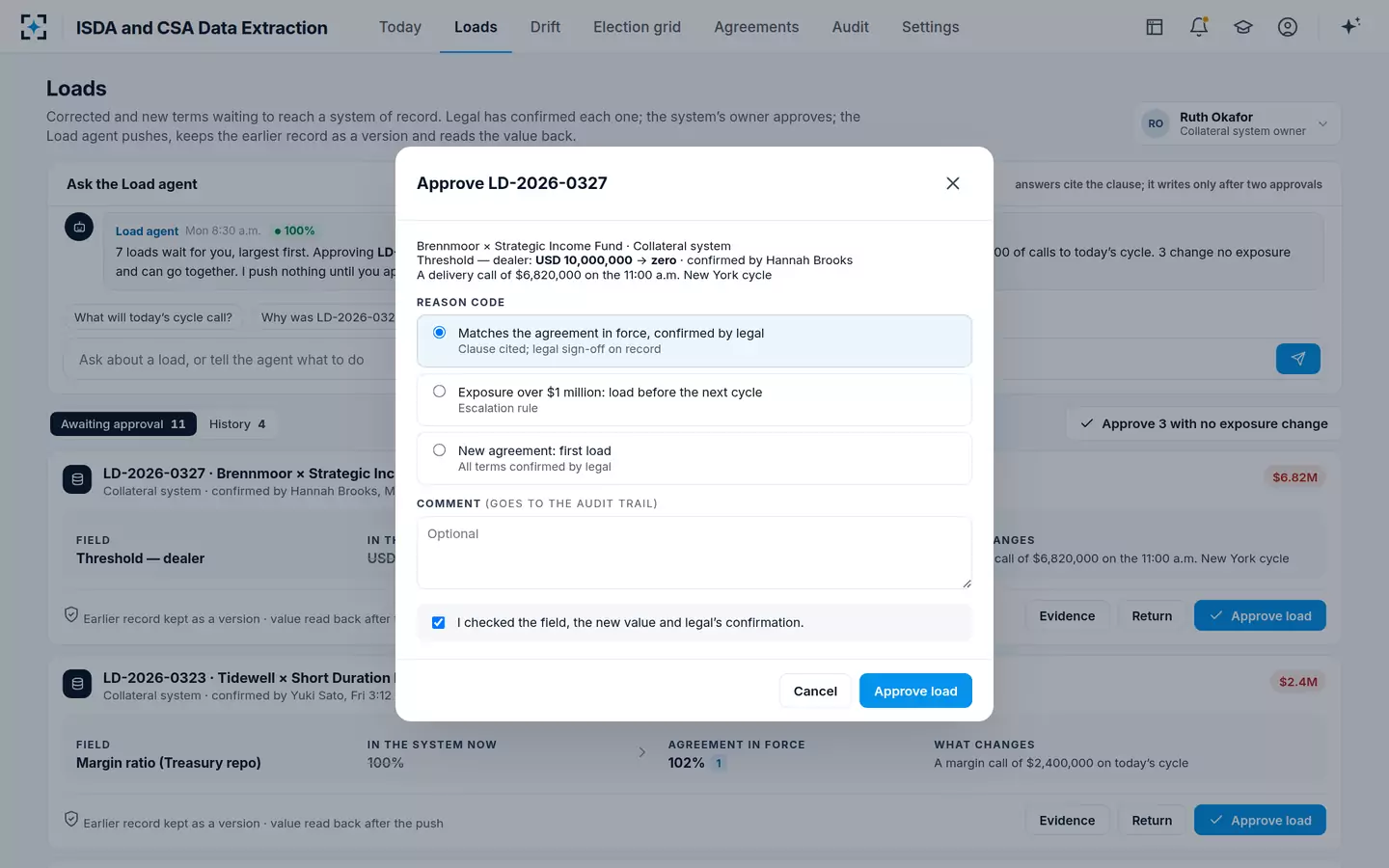
The collateral system owner approves one load, with legal's confirmation beside it
How long does a person take to abstract one agreement?
Hours, not minutes, and most of the time is not spent reading. No regulator or independent study publishes abstraction times for derivatives agreements, so the only reliable figure is your own. Botminds' estimate for the sample firm puts the median at 3 hours 40 minutes per agreement with its amendments: half an hour finding the executed documents, an hour and a half abstracting the Schedule and collateral elections, three quarters of an hour ordering amendments, half an hour of legal checking and 25 minutes keying two systems. The breakdown, and how to measure your own, is in what one CSA costs to abstract.
What each seat loses when a term is wrong
Each seat loses something different, and usually without noticing. The table below sets out what each one runs, which rule or guidance sits behind it, and how a wrong term shows up.
What a wrong term costs each seat, and how it surfaces
| Seat | What it runs on the agreement | Rule or guidance behind it | How a wrong term shows up |
|---|---|---|---|
| Collateral operations | Daily calls and returns | Variation margin each business day (17 CFR 23.153); call procedures in the collateral agreement (2016/2251, Article 3) | A call not made, an over-call the dealer disputes, a late call |
| Counterparty risk | Exposure after collateral; limits | CVA and stress testing that reflect the legal terms (SR 11-10, for banks) | Exposure understated or limits breached on paper only |
| Treasury | Liquidity planning for margin calls | Eligibility under existing CSAs in liquidity risk management (FSB, 2024) | Assets assumed deliverable that a dealer may refuse |
| Legal | The terms in force | Documentation and disputes procedures; disputes over $20 million or EUR 15 million reported (23.502; 149/2013, Article 15) | A dispute that rests on a term nobody can trace |
| Fund accounting | Interest on cash collateral, distributions | The interest and distribution clauses of the annex | Income booked at the wrong rate or from the wrong payer |
Disputes deserve a note, because they are the one place the rules force a wrong term into view. A US swap dealer must notify the CFTC of a valuation dispute over $20 million that is not resolved within three business days with another dealer or five with other counterparties (17 CFR 23.502). EU dispute procedures must record "the length of time for which the dispute remains outstanding, the counterparty and the amount which is disputed", with a specific process for disputes "not resolved within five business days" (Regulation 149/2013, Article 15). A missed call is never disputed, so it never reaches these reports. That is why the sample firm's missed calls on one amended threshold ran for three years.
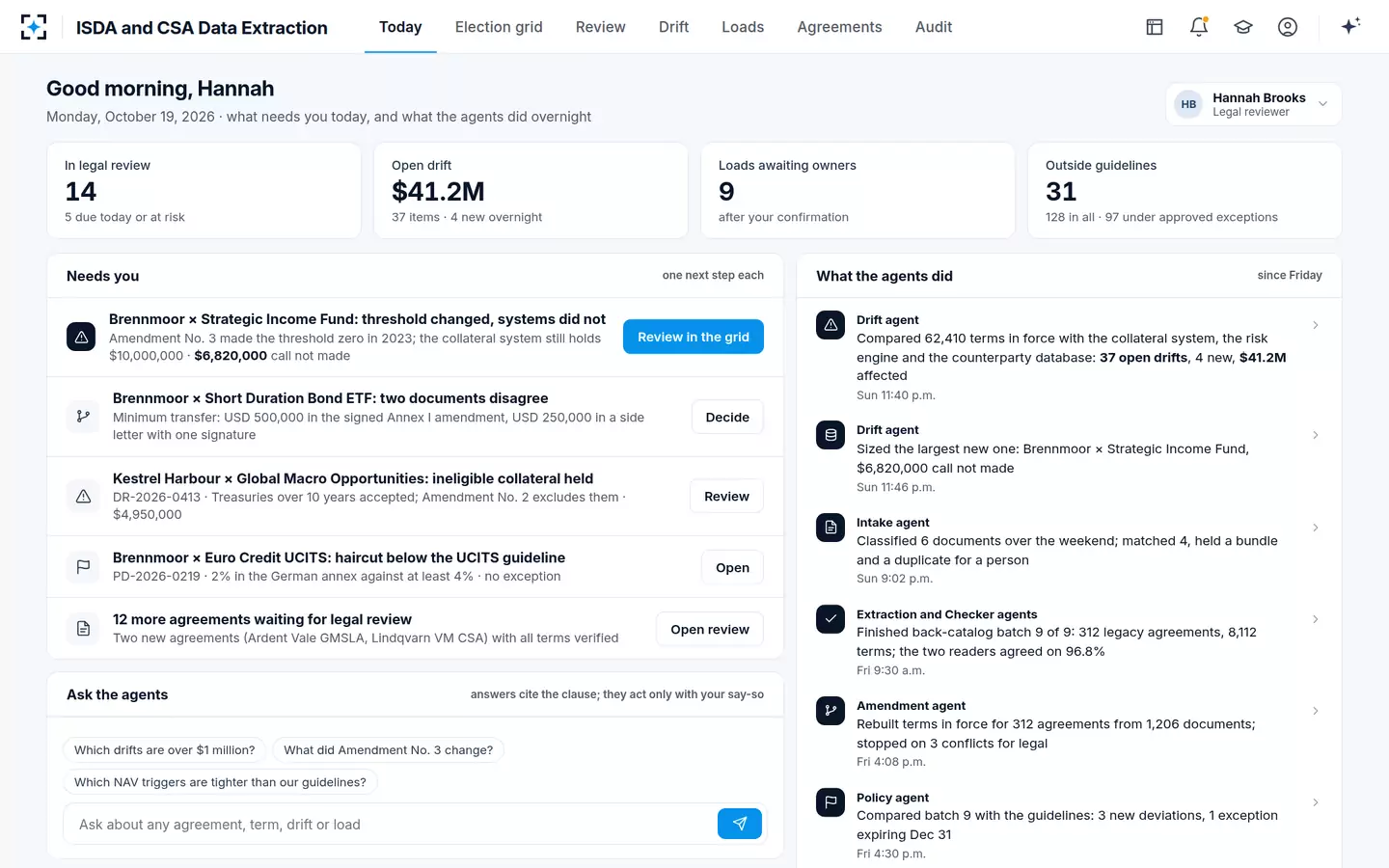
The legal reviewer's morning: what needs her, and what the agents did overnight
Questions people ask
What is the difference between an ISDA and a CSA?
The ISDA Master Agreement and its Schedule govern the trades: payments, netting, defaults and termination. The credit support annex governs collateral against the exposure those trades create. An ISDA CSA agreement means the two together, and the annex cannot be read without the master.
Who owns the CSA after it is signed?
Legal owns the document and the terms in force; collateral operations and counterparty risk each own their system's copy of the terms. The friction comes from those copies drifting from the document, which no single owner sees.
Does a fund need a CSA to trade swaps?
To trade uncleared swaps with a regulated dealer, in practice yes: US rules require the dealer to have credit support arrangements in its documentation before or with the first swap, and US and EU rules require daily variation margin with financial counterparties such as funds.
How many fields are in a CSA?
A standard annex has around a dozen core elections, but abstraction usually captures far more because each election varies by party, currency, asset or rating. The sample firm's documentation analyst abstracted 30 to 150 fields per agreement by hand, depending on the agreement.
Who should approve a change to a CSA term in a system?
The owner of that system, after legal has confirmed the term in force and a different person has verified the extraction. In ISDA and CSA Data Extraction the collateral system and the risk engine have separate owners, and each approves its own load.