ISDA credit terms are the negotiated numbers and triggers that decide when one party can close out the other and how exposure is collateralised: additional termination events such as NAV triggers, the cross default threshold, set-off, the independent amount, eligible collateral and haircuts, the minimum transfer amount and notification times. In most firms legal negotiates them, but credit risk owns the thresholds and treasury owns the collateral terms, and the firm has to decide, in writing, who may accept which number. Bank supervisors expect "a formal process for negotiating legal agreements" with "approval steps and responsibilities of applicable departments", and swap dealers must have documentation policies approved in writing by senior management. The work is hard because the owners sit in different seats and the questions travel by email, days apart. Botminds' ISDA Negotiation places each term on the fund's playbook and routes it to its owner with the clause, the precedent and the negotiator's reason attached.
The examples come from a fictional sample firm, its funds and its dealers, as they run through the solution.
One dealer's draft, split by who owns each term
23
negotiated terms in a four-document package of 85 pages
5
thresholds approved by credit risk before the first turn
3
collateral terms approved by treasury
1
concession beyond the playbook, approved by the deputy general counsel
Which ISDA terms are credit terms, and who owns each?
Credit terms are the ones that change the firm's exposure to the counterparty or its rights on the counterparty's default; language terms change how the agreement reads without moving the exposure. The line matters because credit terms need an owner outside legal. The table shows a common split, as the sample firm wrote it down.
ISDA credit terms, where they sit, and the seat that owns the number
| Term | Where it sits | Owner of the number | Why that seat |
|---|---|---|---|
| NAV trigger (additional termination event) | Schedule, Part 1(h) | Credit risk | Sets when the dealer can close out every trade with the fund |
| Cross default and its threshold | Schedule, Part 1(c) | Credit risk | Links this agreement to the fund's other debts |
| Set-off and its affiliates | Schedule, Part 5 | Credit risk, with legal | Decides which affiliates' claims can be netted on close-out |
| Independent amount | VM CSA | Credit risk | Extra collateral beyond mark-to-market |
| NAV reporting deadline | Schedule, Part 3 | Credit risk | Feeds the trigger the dealer monitors |
| Eligible collateral and haircuts | VM and IM CSAs | Treasury | What the fund must hold and can deliver |
| Minimum transfer amount, notification time, interest | VM and IM CSAs | Treasury | Drive daily margin operations |
| Custodian and account control | IM CSA, control agreement | Treasury | Where initial margin sits and who can release it |
| Language-only terms | Throughout | Legal decides alone | No change to exposure or collateral |
Regulation draws the same line from the other side. A swap dealer's trading relationship documentation must include "credit support arrangements" containing "initial and variation margin requirements", "types of assets that may be used as margin and asset valuation haircuts", investment and rehypothecation terms, and "custodial arrangements for margin assets" (17 CFR 23.504(b)(3)). Every item on that list is a treasury or credit decision before it is a drafting one.
What supervisors and margin rules expect of the negotiation process
They expect a written process with named approvers, not a negotiator's judgement alone. The interagency guidance on counterparty credit risk tells banking organisations to "have a formal process for negotiating legal agreements. As a best practice, the process would include approval steps and responsibilities of applicable departments", and adds that "it is important that systems used to measure CCR incorporate accurate legal terms and provisions" (Interagency Supervisory Guidance on Counterparty Credit Risk Management; the Federal Reserve's SR 11-10 notes the guidance was revised on June 2, 2026 to remove references to reputational risk).
Swap dealers have it in rule form. Their documentation policies "shall be approved in writing by senior management", and "an independent internal or external auditor" must conduct "periodic audits sufficient to identify any material weakness in its documentation policies and procedures" (17 CFR 23.504). A nonbank security-based swap dealer's procedures must cover "determining, approving, and periodically reviewing credit limits for each counterparty, and across all counterparties" (17 CFR 240.18a-3(e)).
The European and UK margin standards add the exception discipline. Counterparties' collateral risk procedures must provide for "the authorisation and recording of any exceptions to the risk management procedures" and "the reporting of the exceptions … to senior management", and the terms of the netting and collateral agreements must be agreed "at the latest, at the moment" the contract is concluded (Delegated Regulation 2016/2251, Article 2, UK version). A concession that leaves the playbook is exactly such an exception.
Decision rights written as routing rules
The practical form of decision rights is a routing table: each class of term, the seat that must approve it, and how long that seat has. The sample firm wrote eight rules, and the one that saves the most time is the fourth: terms near the edge of the playbook go to their owner the moment the draft is read, in parallel with the negotiator's review.
Eight routing rules that turn ISDA decision rights into a working process
| Rule | Terms | Approver | Service level |
|---|---|---|---|
| R-1 | NAV triggers, cross default, independent amount, NAV reporting | Credit risk | 1 business day, then the deputy general counsel |
| R-2 | Eligible collateral, minimum transfer, timing, interest, custodian | Treasury | 1 business day, then the deputy general counsel |
| R-3 | Language-only terms | The negotiator decides; no further approval | — |
| R-4 | Near-the-line terms | The owner sees them in parallel on arrival | Before the first turn |
| R-5 | Any concession beyond walk away | Term owner and the deputy general counsel | 1 business day |
| R-6 | Release of any turn to a dealer | Deputy general counsel, after all approvals | Same day |
| R-7 | Playbook change | Deputy general counsel and the term owner | 5 business days |
| R-8 | Booking to the collateral system | Treasury | 2 business days |
ISDA Negotiation keeps the routing rules as settings, with an owner for each
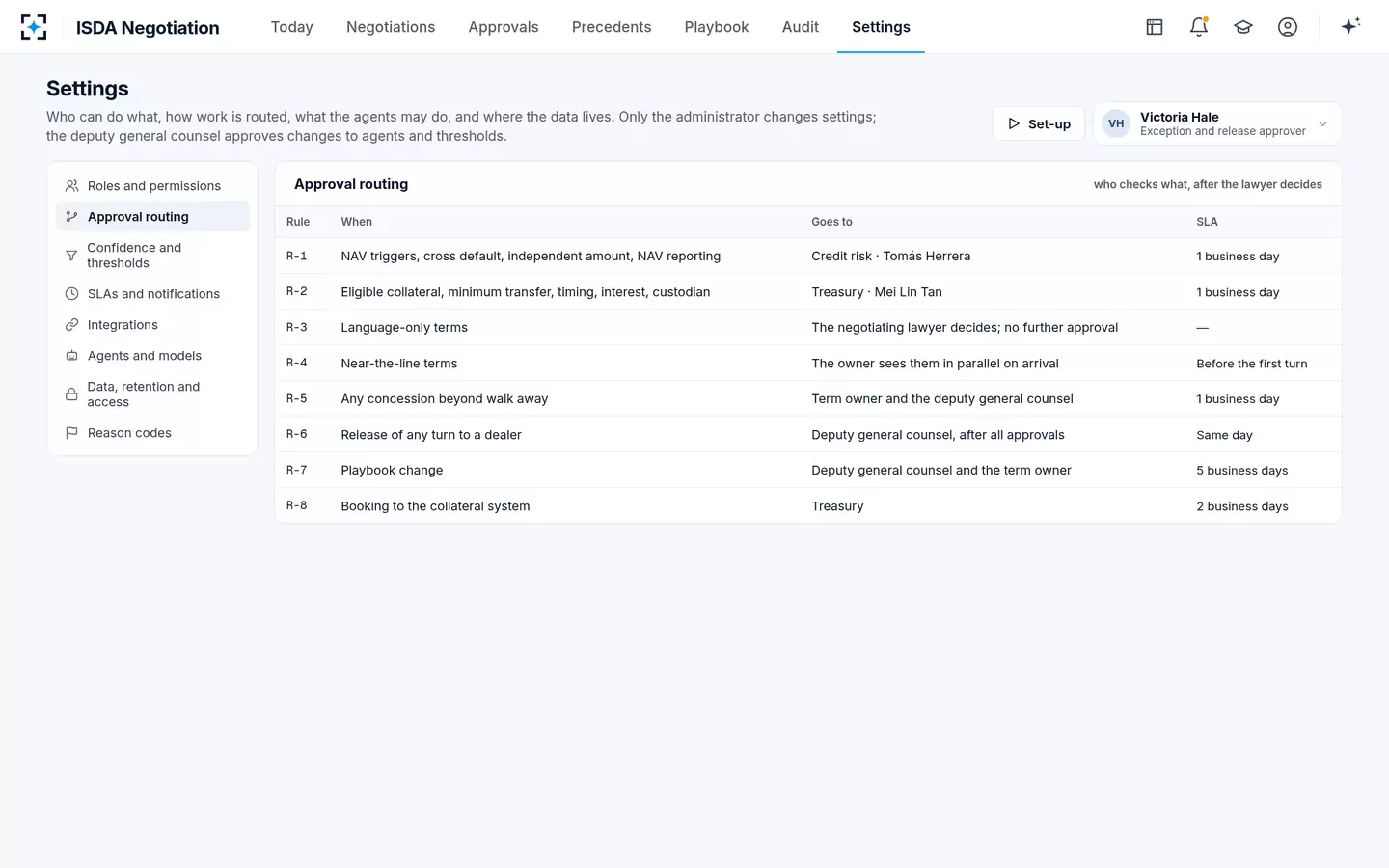
Three properties make the table work. Every term class has exactly one approving seat, so nothing waits for a consensus. Every approval has a clock with an escalation, so a credit officer on leave does not stall a fund's trading start. And release is a separate decision from approval, held by someone who can see that every owner has decided. Where the days go when these properties are missing is measured in ISDA negotiation delays.
One NAV trigger, from the dealer's ask to credit's approval
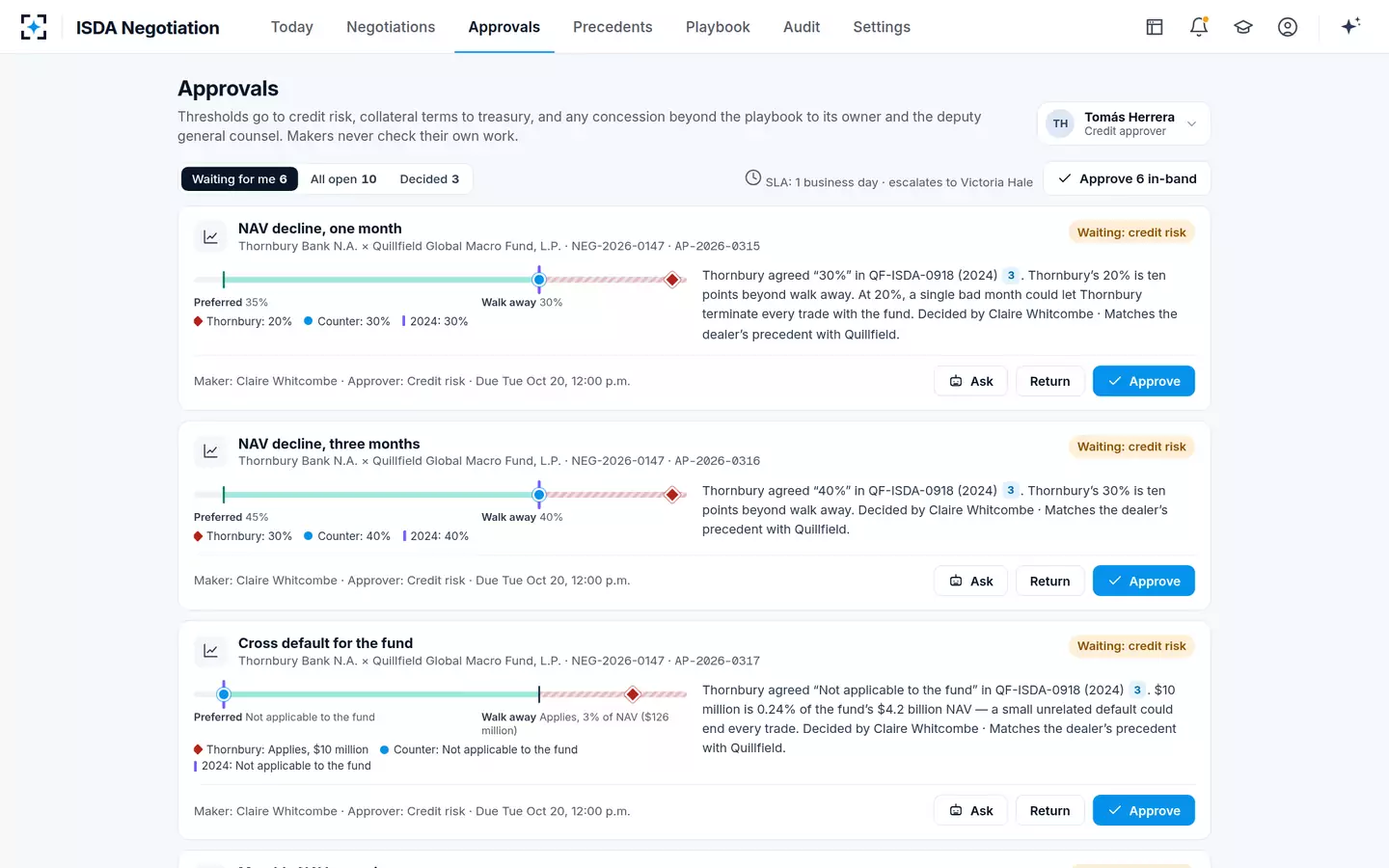
A NAV trigger shows the split at its clearest: legal finds and counters the term, credit risk owns the number. In the sample, a dealer's draft asked for an additional termination event at a 20% one-month decline in the fund's net asset value. The macro fund playbook's preferred position is 35%, its walk-away 30%.
How a NAV trigger travels between legal and credit risk in ISDA Negotiation
Agent
Reader and Playbook agentsExtract the trigger from Part 1(h)(i), page 6, place 20% below walk away and send it to credit risk in parallel.
Never: Never treat near the line as approved
Agent
Precedent agentFinds the same dealer accepted 30% from another of the firm's funds in an agreement executed March 14, 2024.
A person decides
NegotiatorCounters at 30%, citing the precedent, with a reason code; asks the agents why 30% and not 35%.
Agent
Checker agentRe-reads the redline blind and finds the defined term in Part 5(n) still carries the dealer's figure; the Drafter conforms it.
A person decides
Credit risk officerApproves 30% one-month and 40% three-month with an attestation, seeing the scale, the precedent and the maker.
A person decides
Deputy general counselReleases the turn once every owner has decided.
The precedent is what makes the counter credible to the dealer and the approval fast for credit. A counter anchored on what the same dealer already gave the firm is hard to refuse, and a credit officer who sees that the firm has lived with 30% at this dealer since 2024 is approving a known risk, not a new one. Only executed or approved positions count as precedent in the solution; an agreement older than five years is shown but cannot be the anchor.
Why credit risk, not legal, sets the cross default threshold
Because the threshold is a judgement about the fund's balance sheet, not about drafting. Cross default links the ISDA to the fund's other borrowings: a default above the threshold elsewhere becomes an Event of Default here. A number that is small relative to the fund makes the agreement fragile; one that is large protects nothing. In the sample, the dealer asked for cross default to apply to the fund at $10 million, which was 0.24% of the fund's $4.2 billion of net assets: a small, unrelated default could end every trade. The playbook's walk-away was cross default at 3% of NAV, about $126 million; its preferred position, and the dealer's own 2024 agreement with the firm, was not applicable to the fund. The negotiator countered on that precedent, and credit risk approved it.
The same logic runs through the other credit terms. Whether an independent amount is needed where initial margin already applies, how many business days the fund has to report its NAV, and which of the dealer's affiliates may set off claims on close-out are exposure decisions. The negotiator frames each one; credit decides it. How firms set the number itself is covered in setting the cross default threshold.
Collateral terms belong to treasury, and fail after signing
Collateral terms belong to treasury because treasury lives with them every day: what the fund must hold, what it can deliver by when, and where initial margin sits. They also fail later than credit terms. A wrong eligible-collateral schedule or notification time usually surfaces at the first margin call, when the signed CSA and the collateral system disagree.
Some of the numbers have regulatory edges the negotiator must respect. Under the CFTC's margin rules for uncleared swaps, "Minimum transfer amount means a combined initial and variation margin amount under which no actual transfer of funds is required. The minimum transfer amount shall be $500,000" (17 CFR 23.151). A counter that drafts a higher figure for a covered dealer is not a concession the dealer can make.
Approvers see each term with its evidence before the turn is released
Treasury's second decision comes after signature. In the sample, the Booking agent compares each signed collateral term with the collateral system and the counterparty database and prepares the update, but never pushes it without a treasury check, and never overwrites a live agreement without keeping a version. The interagency guidance's line about systems that "incorporate accurate legal terms" is met here or not at all.
Who can concede an ISDA credit term beyond the playbook?
No single person should. A concession beyond the playbook's walk-away position is a credit decision made under deadline, and the safe design requires two names: the owner of the term and a senior legal officer, usually the deputy general counsel. The negotiator can still propose it; the process makes sure it carries a reason, a comment and the approvals it needs.
In the sample, the dealer asked for set-off with all of its affiliates. The negotiator conceded set-off with one named affiliate, as the dealer had obtained from the firm in 2024. That was beyond walk away, so it became a playbook exception, and the negotiator had to confirm it was beyond the approved playbook before it went to the deputy general counsel, who approved it. The exception is the item the margin standards call an exception to be authorised, recorded and reported.
Exceptions also carry information. When the same concession recurs across negotiations, the playbook is out of date, and the right response is a playbook change approved by the term owner, not a string of exceptions. Measuring that pattern is the subject of ISDA playbook concessions.
Where ISDA decision rights break down
The failures are predictable, and each leaves a trace a general counsel or an internal auditor can test. The checklist below is one an internal audit team can run each year, read-only, against closed negotiations.
Nine tests of ISDA decision rights on closed negotiations
- Did every credit term reach credit risk?
NAV triggers, cross default, set-off, independent amount and NAV reporting, each with an approval.
- Did every collateral term reach treasury?
Eligible collateral, haircuts, minimum transfer, notification time, interest and custodian.
- Did the approver see the clause, not a paraphrase?
The scale, the precedent and the negotiator's reason, attached.
- Did anyone approve their own work?
Maker and approver must differ on every decision.
- Was every concession beyond walk away an approved exception?
With the term owner and the deputy general counsel, and a reason.
- Do definitions match the numbers they serve?
A defined term left at the dealer's figure can undo a counter elsewhere in the Schedule.
- Is the same dealer getting different terms from different funds?
Compare executed positions across the firm before conceding.
- Was the turn released only after every owner decided?
Release is a separate decision, logged with its time.
- Did the signed collateral terms reach the collateral system unchanged?
Reconciled field by field, with a treasury check.
The sixth test catches a failure that no approval process prevents on its own. In the sample, the defined term "NAV Trigger Event" in Part 5(n) still said 30% over three months after the counter in Part 1(h)(ii) had moved to 40%. Credit risk approved 40%; the Schedule, unfixed, would have restored the dealer's number. The Checker agent found it by re-reading the redline blind.
What ISDA Negotiation changes for each seat
The solution does not move any decision between seats. It changes what arrives at each seat and when, so that owners decide from evidence rather than reconstruct the question from an email.
Five seats in an ISDA negotiation, and what each keeps in ISDA Negotiation
Today
Reads each package against a playbook memo, emails credit and treasury, and searches a shared drive for precedent.
With agents
Opens the terms already placed on the playbook, off-playbook first, with the dealer's precedent on each line.
Still theirs: Every position and every word of the redline.
Today
Gets thresholds by email, without the clause or the precedent.
With agents
Approves each threshold with its scale, the precedent, the negotiator's reason and the maker beside it.
Still theirs: NAV triggers, cross default, set-off, independent amounts, NAV reporting.
Today
Learns the collateral terms when they are re-keyed after signing.
With agents
Approves collateral terms before release and each booking field by field after signature.
Still theirs: Eligible collateral, minimum transfer, timing, interest, custodian.
Today
Cannot easily prove no concession left without two names on it.
With agents
Is the second name on every exception and releases a turn only when every owner has decided.
Still theirs: Exceptions, playbook changes and every release.
Today
Rebuilds who conceded what from email threads and document versions.
With agents
Reads one append-only trail, asks it whether anyone approved their own work, and exports one pack.
Still theirs: The annual test of the controls, read-only.
Where it does not fit is worth knowing before buying. The solution does not set the playbook, which the firm's owners write and the Playbook agent never edits; it does not send anything to a dealer, which only a released turn does; and it cannot supply precedent a firm has never executed. A firm with a handful of dealers and one fund may find a written routing table and disciplined email enough.
Questions people ask
What are credit terms in an ISDA?
They are the terms that change the firm's exposure or its rights on default: additional termination events such as NAV triggers, cross default and its threshold, set-off, independent amounts and, in the credit support annexes, eligible collateral, haircuts and minimum transfer amounts. Legal negotiates them; credit risk and treasury usually own the numbers.
Who approves ISDA terms at a bank or a fund?
Practice varies, but supervisors expect "approval steps and responsibilities of applicable departments" in the negotiation process, and swap dealers' documentation policies must be approved in writing by senior management. A common split gives credit risk the thresholds, treasury the collateral terms and a senior lawyer the exceptions and release.
Can the negotiator accept a lower NAV trigger to meet a trading deadline?
Not alone, if the firm's decision rights are working. A trigger below the playbook's walk-away is a credit decision; in the sample firm it becomes an exception that needs the credit owner and the deputy general counsel, with a reason recorded.
What is the minimum transfer amount limit under US margin rules?
Under the CFTC's uncleared margin rules, the minimum transfer amount is a combined initial and variation margin amount under which no transfer is required, and it is set at $500,000. Treasury should own the figure in the CSA because it drives daily margin operations.
How should playbook exceptions be governed?
Each one should be authorised, recorded with its reason and reported to senior management, which is what the European and UK margin standards require of exceptions to collateral risk procedures. When the same exception recurs, the playbook itself should be changed with the term owner's approval.
How do firms keep collateral terms in the CSA and the collateral system the same?
By comparing each signed term with the system field by field before it goes live, with treasury approving the update. In ISDA Negotiation the Booking agent prepares and reconciles the update but never pushes it without a treasury check.