ISDA negotiation is the process of agreeing an ISDA Master Agreement's Schedule, the credit support annexes and, for a fund in scope of the uncleared margin rules, the initial margin documents and custodian agreement with each dealer, term by term, before the first trade. It decides when a fund can trade: US and EU rules require the documentation to be in place before or at the moment a dealer enters into an uncleared swap, so a fund without a signed ISDA with a dealer cannot hedge with that dealer at all. The process is slow less because the documents are long than because each number has an owner outside legal, and the questions travel between them by email, days apart. Botminds' ISDA Negotiation attacks the waiting: agents read the dealer's package, place every term on the fund's playbook, find the dealer's precedent and draft the redline the day the draft arrives, and route each number to its owner at once.
No regulator or independent study publishes how long ISDA negotiations take, so the timings on this page come from a fictional sample firm, Quillfield Capital, and are labelled as its estimates or its sample data. The rules come from the CFTC, the SEC and the EU and UK margin regulation.
Where an ISDA negotiation’s first turn spends its time
5.0days
the sample firm’s 2025 median, in business days, from a dealer’s draft to the first turn by hand
fictional sample, firm’s estimate
1.5days
of those spent on credit and treasury sign-off and releasing the turn, as long as reading
fictional sample, firm’s estimate
0.8days
median to first turn in the sample firm’s reports since go-live, on its sample data
fictional sample
Can a fund trade swaps before the ISDA is signed?
Not with a regulated dealer, for uncleared swaps. A US swap dealer must have its trading relationship documentation signed before, or at the same time as, the first swap with any counterparty (17 CFR 23.504(a)(2)), and the SEC applies the same rule to security-based swap dealers (17 CFR 240.15Fi-5). In the EU and the UK both counterparties must have agreed the terms "at the latest, at the moment in which a non-centrally cleared OTC derivative contract is concluded" (Delegated Regulation 2016/2251, Article 2).
The list of what must be agreed first is long. The CFTC requires agreed terms on payments and their netting, defaults and termination events, how amounts are calculated and netted on termination, transfers, governing law, valuation and disputes, plus the credit support arrangements: margin, eligible assets and haircuts, rehypothecation and custody (§23.504(b); the ISDA Schedule guide sets the rule's text beside the Schedule). Any interim arrangement a dealer offers must itself meet those rules, so the trading start waits for the agreement.
For a fund in scope of initial margin, there is a second document set. A US swap dealer must collect initial margin "On or before the business day after execution" from a covered counterparty, held "pursuant to custodial arrangements that comply with § 23.157" (§23.152), and §23.157 requires a custody agreement with an independent custodian that bars rehypothecation (§23.157). A fund is a covered counterparty if, with its margin affiliates, its average month-end notional of uncleared swaps and similar contracts for March, April and May exceeds $8 billion (§23.151). For those funds, the initial margin CSA and the custodian's account control agreement are also on the critical path.
How long does ISDA negotiation take?
It depends on the dealer, the fund and the package, and no regulator or independent study publishes a benchmark. The useful measure is not the elapsed time to signature, which depends on how fast the dealer replies, but the time the fund holds the draft: days from the dealer's draft to the fund's first turn, and from each dealer turn to the fund's reply. Those are the days a fund controls.
In the sample firm, the first-turn median for 2025 was five business days. Its own estimate split them into logging the draft and matching it to a fund (0.5 days), reading the Schedule, both CSAs and the account control agreement against the playbook (1.5), finding what the dealer accepted for another fund (0.5), drafting the redline, cover note and issues list (1.0), and credit and treasury sign-off and release (1.5).
Where a first turn’s days go, by hand and with agents
2025, by hand: 5.0 business days
- Log and match · 10%
- Read against playbook · 30%
- Find precedent · 10%
- Draft · 20%
- Sign-off and release · 30%
Since go-live: 0.8 business days
- Log and match · 12.5%
- Read · 25%
- Precedent · 12.5%
- Draft · 12.5%
- Sign-off and release · 37.5%
The second bar is the argument of this page. Once the agents do the reading, precedent search and drafting, sign-off and release become the largest share of what is left, nearly two-fifths, because approvals are the part that should not be automated. A faster negotiation is therefore one in which the approvers get better questions, not one in which they are skipped.
What slows ISDA negotiation?
Five things slow it, and only one of them is the length of the documents. The others are the owners, the precedent, the consistency of the package and the dealer's own turns.
The owners come first. Credit risk owns thresholds and NAV triggers, treasury owns collateral terms, and each question to them goes with whatever context the lawyer had time to write. The precedent is second: what the same dealer gave another of the firm's funds sits in a shared drive or someone's memory, and a negotiator who cannot find it either asks for too much, which costs a turn, or concedes too much, which costs the fund. Third, consistency: the Schedule and two credit support annexes must agree, and in the sample package they did not, with a margin notification time of 11:00 a.m. in one CSA and 10:00 a.m. in the other.
The dealer's turns are fourth. A returned draft must be compared with the last one, including changes the dealer did not mention; in the sample firm's intake one dealer's third turn carried a new phrase in a variation margin CSA paragraph, "unless the amount is less than USD 50,000", that its cover note did not mention. Fifth, language: a German framework agreement must be read in German before it can be placed on any playbook.
Who holds the ISDA draft longest?
On the fund's side, the draft waits longest with the people who own the numbers, not with the lawyer. In the sample firm's estimate, sign-off and release took as long as reading; with the reading done by agents, they took the largest share of what remained. The table sets out the steps of a first turn and the seat that holds the draft at each.
The ISDA negotiation process, step by step, and who holds the draft
| Step | Who holds it | What can stall it |
|---|---|---|
| 1. Log the dealer’s package and match it to a fund and negotiation | Documentation analyst or intake agent | An unknown fund or entity; a draft that arrives by portal, not email |
| 2. Read every negotiated term, with its page | Negotiator or reader agent | Scans, other languages, four documents that disagree |
| 3. Place each term on the fund type’s playbook | Negotiator or playbook agent | A playbook that is a memo, not a scale |
| 4. Find what this dealer accepted before | Negotiator or precedent agent | Agreements in a shared drive; superseded versions |
| 5. Draft the redline, cover note and issues list | Negotiator or drafting agent | Clause language that is not in the firm’s library |
| 6. Decide each term | Negotiator | Waiting for steps 7 and 8 before deciding |
| 7. Approve thresholds and triggers | Credit risk | Questions without the clause or precedent attached |
| 8. Approve collateral terms | Treasury | Collateral consequences not quantified |
| 9. Approve any concession beyond the playbook | Term owner and deputy general counsel | Deadline pressure |
| 10. Release the turn | Deputy general counsel | Approvals still open |
What does a delayed ISDA cost a fund?
A delayed ISDA costs a fund in four ways: exposure it cannot hedge with that dealer, worse pricing from a smaller set of dealers, concessions made to meet a date, and the hours of lawyers and approvers spent chasing. No regulator or independent study publishes a figure for any of them, and the sizes differ for every fund; what a fund can do is measure its own, term by term.
The cost of an ISDA negotiation delay, in four terms a fund can measure
Unhedged exposure
Exposure the fund meant to hedge × days without the hedge
Zero if the fund can hedge with another dealer already signed; large if this dealer was chosen for a product others will not offer.
Portfolio management and risk
Narrower dealer panel
Price on trades done with fewer dealers − price with the full panel
Visible in execution quality reports when a desk could not ask the dealer it wanted.
Trading
Deadline concessions
Terms signed beyond the playbook to meet a trading date × their value
A NAV trigger, threshold or eligible-collateral cap that will apply for years, to every trade.
Credit risk and general counsel
Chasing hours
Hours of lawyers and approvers on logging, finding precedent and email × loaded cost
The part of the five days that is not judgement.
Legal operations
The third term deserves the most attention because it lasts longest. In the sample negotiation, the dealer's draft capped eligible Treasuries at ten-year maturity. The fund held $1.84 billion of Treasuries, $610 million of them maturing after ten years. Accepting the cap to make a Monday trading date would have made a third of the fund's Treasuries ineligible as collateral with that dealer for the life of the agreement. The delay costs days; the concession made to avoid it can cost years.
How do you speed up ISDA negotiation?
Speed up ISDA negotiation by removing the waiting, not the review: route every term to its owner as soon as the draft is read, anchor counters on the dealer's own precedent, check the package for consistency before it goes out, and hold a service level on the first turn. Each of those cuts days without moving a decision away from the person who owns it.
Parallel routing is the biggest lever. In the sample firm, terms near the edge of the playbook go to credit risk and treasury the moment the draft is read, so their view is ready when the negotiator reaches the term. Precedent is the second: a counter at what the dealer already accepted for another fund "is hard to refuse and saves a turn", in the words of the agents' explanation in the sample. The third is a blind second read before release, which caught a definition in the sample Schedule that would have undone a counter. The fourth is a clock: the sample firm's first turn is due in three business days, after which it escalates to the deputy general counsel.
One more lever sits outside the negotiation. A CFTC rule effective August 17, 2026 lets an eligible seeded fund be "deemed not to have any margin affiliates" for three years after its manager first invests for it (91 FR 45134; §23.151), which can keep a new fund out of initial margin scope, and out of the initial margin CSA and custodian agreement, while it launches. US banking regulators measure the same $8 billion threshold over June, July and August daily averages (12 CFR 237.2), so a fund trading with both kinds of dealer should check both.
ISDA Negotiation builds the first turn in six minutes, step by step, and stops at the lawyer
What ISDA Negotiation changes, and what it does not
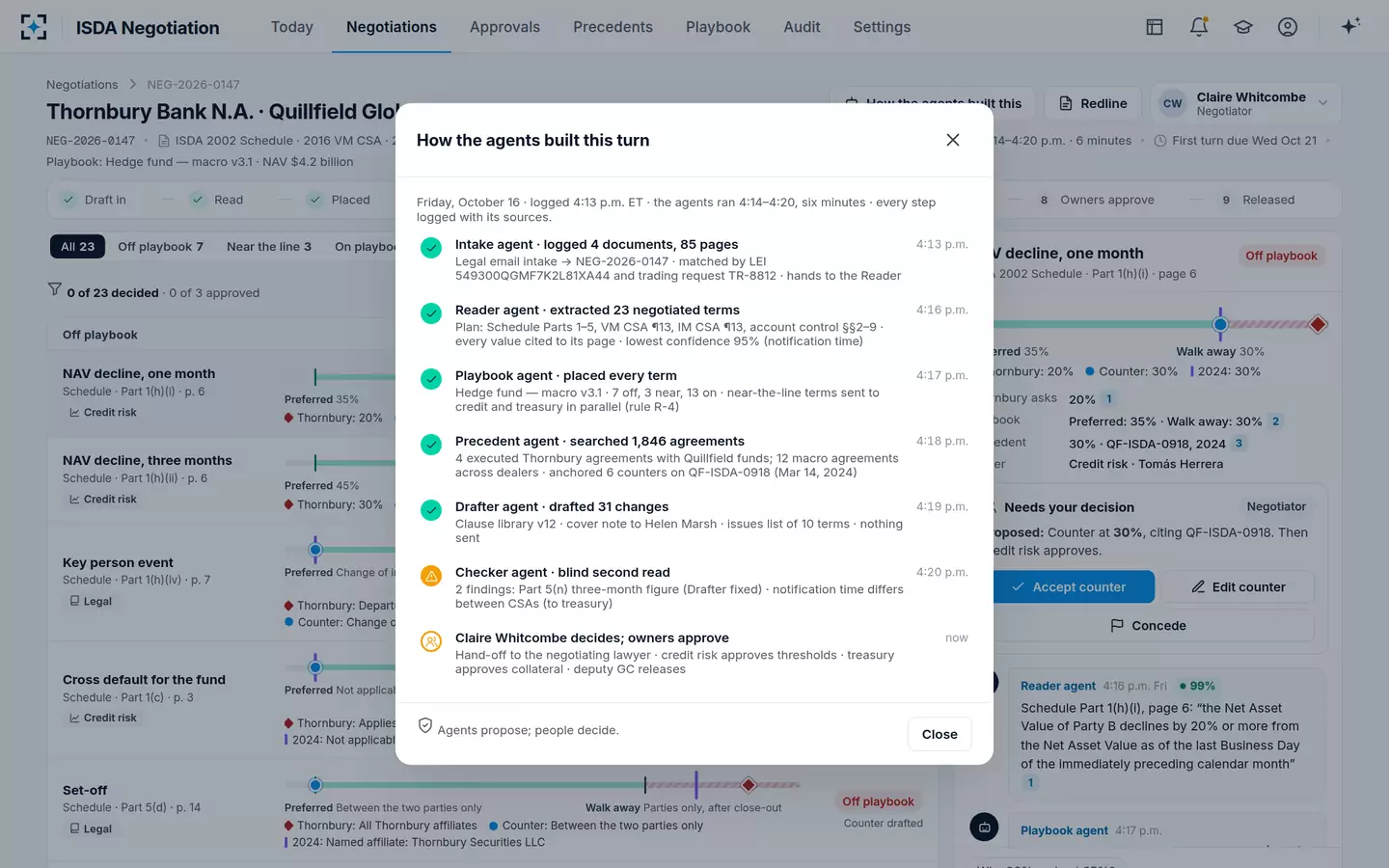
ISDA Negotiation changes when the decisions can start, not who makes them. In the sample case, a dealer's 85-page package arrived at 4:12 p.m. on a Friday; by 4:20 p.m. the 23 terms were read, placed and cited, six counters were anchored on the dealer's 2024 agreement with another fund, the redline was drafted and checked, and the near-the-line terms were already with credit and treasury. On Monday morning the negotiator started with decisions. The turn was released the next business day after the draft arrived, once every owner had decided.
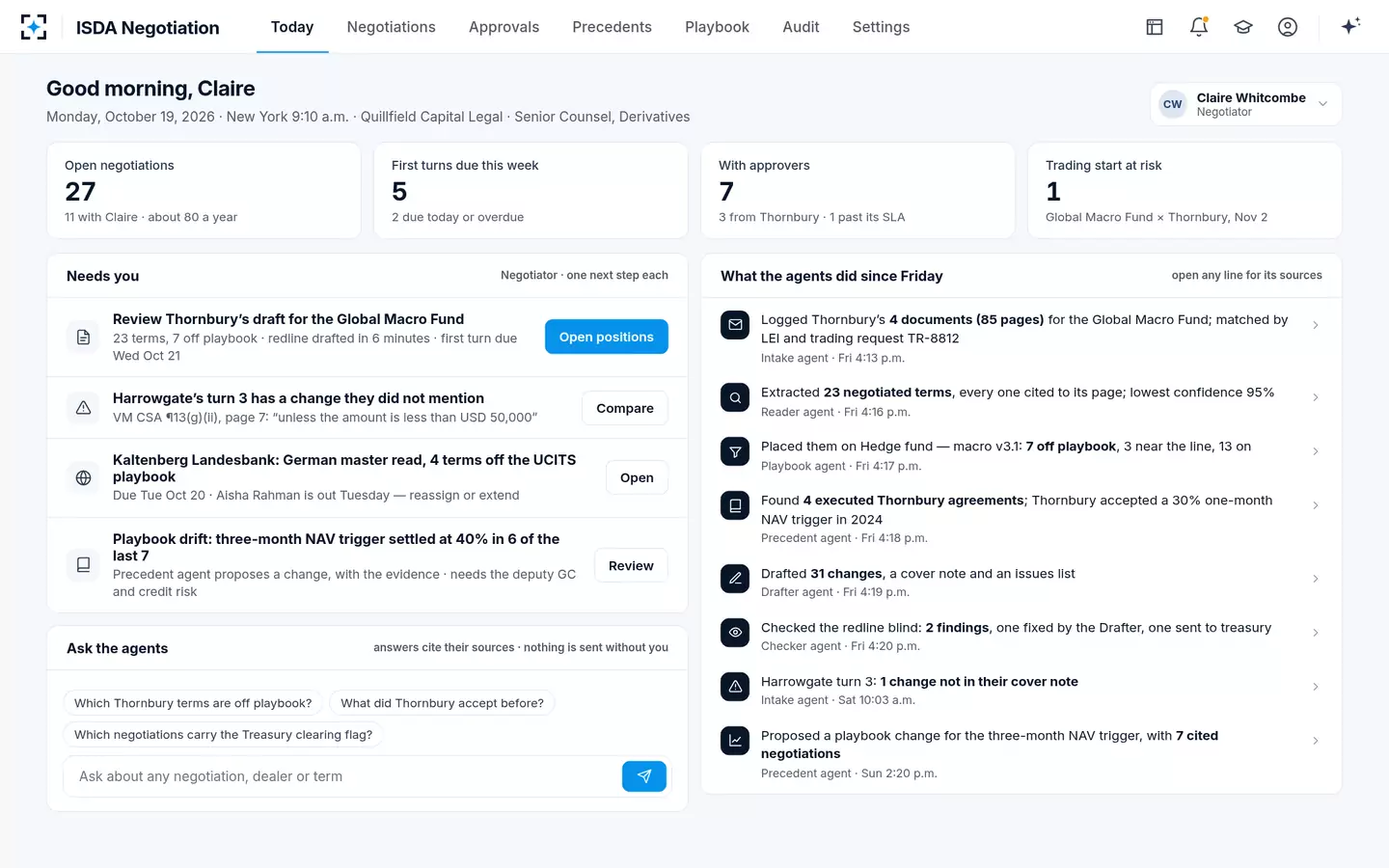
The negotiator's Monday view shows the effect: five first turns due that week, seven items with approvers, one trading start at risk, and for each negotiation one next step. What used to be a list of drafts to read is a list of decisions to make. The seats that make them are described in who decides ISDA credit terms, and what to require of software before trusting it with the first five steps is in ISDA negotiation software lawyers will actually use. The same approach applies to the repo and clearing agreements due under the Treasury clearing mandate.
The negotiator’s Monday in ISDA Negotiation: decisions, not drafts
Questions people ask
What is a first turn in ISDA negotiation?
The first turn is the fund's first response to the dealer's draft: a redline of the Schedule and credit support annexes, a cover note and usually an issues list. It is the step the fund controls entirely, which is why its timing is the most useful internal measure.
Can a fund trade under a long-form confirmation while the ISDA is negotiated?
Only if the dealer agrees and its own documentation rules are met; a US swap dealer must have the trading relationship terms in writing before or with the first trade. Funds should treat interim arrangements as exceptions, with the same approvals as a concession.
How many turns does an ISDA negotiation take?
No regulator or independent study publishes a figure. The number of turns falls when counters are anchored on terms the dealer has already accepted elsewhere, because those are the counters a dealer is least likely to reject.
Why do dealers send their own paper?
Because the dealer must evidence compliance with its own documentation and credit policies for every counterparty, and its form already carries them. The fund's job is to turn that form into its own positions, which is where a playbook and the dealer's precedent matter.
Does the initial margin CSA take longer than the ISDA Schedule?
It adds a third party. The custodian must sign an account control agreement that meets the CFTC's custody rule, including a ban on rehypothecation, so the timetable depends on three parties, not two.