An ISDA playbook is a firm's written negotiating position for each term of an ISDA Schedule and credit support annex, by fund type: the position it prefers, the furthest it will go, who owns the decision, and why. It turns negotiation from a set of individual judgements into a policy. Most playbooks are memos, and whether negotiators follow them is rarely measured; a concession made under deadline pressure leaves no trace except in the signed agreement, and the next dealer asks for the same. Measure the human baseline first, the share of signed terms that sit outside the playbook today, because a playbook nobody measures is a wish list, and any claim that software improves on it needs a number to improve on. Botminds' ISDA Negotiation turns the playbook into a scale from preferred to walk-away for every term, places each dealer term on it, and makes every concession beyond walk-away an exception with two named approvers.
The playbook examples come from a fictional sample firm, Quillfield Capital, and its macro fund playbook. The regulatory expectations come from EU and UK margin rules, the Basel Committee and the CFTC, linked where used.
One playbook, one dealer draft
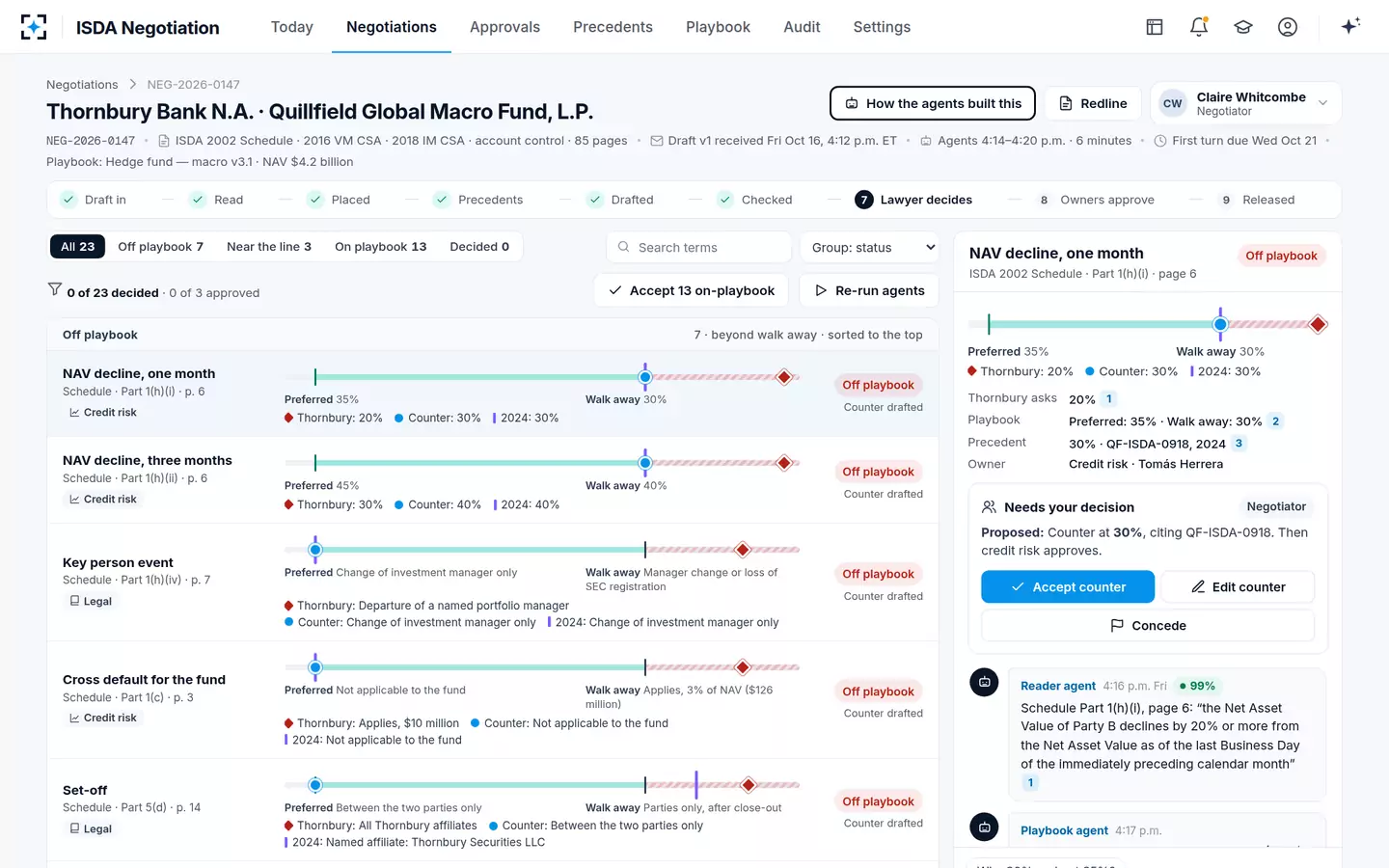
7 of 23
terms in one dealer’s first draft beyond the fund’s walk-away
fictional sample
1
concession beyond walk-away in the fund’s first turn, made as an exception with two approvers
fictional sample
6 of 7
recent agreements that settled the three-month NAV trigger at the walk-away level, prompting a proposed playbook change
fictional sample
What is an ISDA playbook?
An ISDA playbook is the firm's negotiating policy for derivatives documentation, written per fund type and per term. A macro hedge fund and a UCITS fund face different dealer asks and have different tolerances, so each needs its own positions on NAV triggers, cross default, set-off, eligible collateral and the rest. For each term the playbook says what the firm prefers, where it walks away, who owns the decision and what evidence supports the line.
Regulation does not require a playbook by that name, but it requires the thing a playbook is. EU and UK counterparties to uncleared derivatives must "establish, apply and document risk management procedures" for collateral exchange, including "the exchange of information between counterparties and the authorisation and recording of any exceptions to the risk management procedures", and must test and update them "as necessary and at least annually" (Delegated Regulation 2016/2251, Article 2, UK version). On the dealer's side, the Basel Committee says "banks should track non-standard contractual terms that are outside their credit policy standards" (Basel Committee, Guidelines for counterparty credit risk management, 2024). A fund's playbook is its version of that standard.
What should an ISDA playbook contain?
An ISDA playbook should contain, for each negotiated term and fund type, a preferred position, a walk-away position, the owner who approves anything in between, the reasoning, and the version and approval date. The table shows six Schedule rows from the sample macro fund playbook.
Six rows of one fund type’s ISDA playbook, preferred to walk away
| Term | Preferred | Walk away | Owner |
|---|---|---|---|
| NAV decline, one month (Schedule Part 1(h)(i)) | 35% | 30% | Credit risk |
| NAV decline, three months (Part 1(h)(ii)) | 45% | 40% | Credit risk |
| Key person event (Part 1(h)(iv)) | Change of investment manager only | Manager change or loss of SEC registration | Legal |
| Cross default for the fund (Part 1(c)) | Not applicable to the fund | Applies, at 3% of NAV | Credit risk |
| Set-off (Part 5(d)) | Between the two parties only | Parties only, after close-out | Legal |
| Monthly NAV reporting (Part 3(b)) | 20 business days | 15 business days | Credit risk |
Two features make a playbook measurable. First, positions are values, not prose: "35%" can be compared with a dealer's 20%, "a reasonable level" cannot. Second, each term has an owner, so the playbook doubles as routing: in the sample firm, NAV triggers and cross default go to credit risk, collateral terms to treasury, language-only terms stay with the negotiator.
A playbook also needs the reasons. The macro fund's walk-away on the one-month NAV trigger, 30%, is a credit judgement about how far its NAV can fall in a bad month without the dealer gaining a right to end every trade; the ECB's 2005 survey shows how much banks' own one-month triggers varied, from 10% to 25% (ECB, 2005). The detail of that term is in NAV triggers in an ISDA.
How do you know if negotiators follow the ISDA playbook?
You know by measuring signed agreements against the playbook in force when they were signed, term by term. The question is not whether negotiators read the playbook, but where the signed values landed: on the preferred side of walk-away, near it, or beyond it, and whether every term beyond it carried an approved exception.
The measure has three parts. The off-playbook rate: signed terms beyond walk-away divided by all negotiated terms. The approval rate: the share of those that had an approved exception before release, which should be all of them. And the dealer spread: the same term with the same dealer across the firm's funds, which shows when one fund got a worse deal than another. The sample firm's problem statement named the last one exactly: a concession made under deadline pressure meant "the same dealer ends up with a better term from one fund than another".
Where one dealer’s first draft landed on the fund’s playbook
A dealer's draft is the start of the measure, not the measure. What counts is the signed agreement, and the useful baseline is a sample of a year's signed agreements, read against the playbook versions in force when each was signed. The worked example below shows how to size it.
How do you measure concessions beyond the playbook?
Count every negotiated term in a sample of signed agreements, mark each on, near or beyond walk-away against the playbook in force at signing, and report the beyond-walk-away share with its uncertainty. A share without a range invites false precision; a share by term and by dealer shows where the pressure is.
Take an illustrative baseline: 40 signed agreements with 23 negotiated terms each, 920 terms in all, of which 46 were signed beyond walk-away. The off-playbook rate is 5.0%, and a 95% confidence interval for it, by the Wilson method, runs from about 3.8% to 6.6%. Terms within one agreement are not independent, because a deadline that forced one concession often forced two, so the real interval is wider; counting agreements with at least one concession gives a second view. If 9 of the 40 agreements carried at least one, that is 22.5%, with an interval of roughly 12% to 38%.
Measuring the playbook baseline in six steps
- Fix the playbook version for each agreement
Measure against the positions in force on the signing date, not today’s.
- Sample a year of signed agreements
All of them if there are fewer than about fifty; otherwise a random sample across dealers and fund types.
- Extract each negotiated term with its page
Two readers, or one reader and a check against the page, so the baseline itself is right.
- Mark on, near or beyond walk-away
And whether a term beyond walk-away had an approved exception before signing.
- Report rates with ranges, by term and dealer
Per term, per agreement, and the spread of the same term with the same dealer across funds.
- Repeat after any change
New playbook, new people or new software: the same measure, the same way.
The baseline is also the honest test of any automation. If agents place terms and draft counters, the question a general counsel should ask is whether the off-playbook rate and the dealer spread fell, and whether every remaining concession carried its approvals. In ISDA Negotiation the design target is the last: 100% of concessions beyond the playbook approved by the term owner and the deputy general counsel before a redline leaves. It is a target, measured in the live solution, and the baseline is what makes it meaningful.
ISDA Negotiation shows every dealer term on the playbook scale, beyond-walk-away first
Why the same dealer gets different terms from different funds
The same dealer gets different terms from a firm's funds because each negotiation starts from the dealer's paper and ends wherever that week's deadline left it. Nobody decides that one fund should accept a tighter NAV trigger than its sister fund; it happens one concession at a time, and it shows only when the agreements are read side by side. That side-by-side reading is the dealer-spread measure, and it is often more revealing than the off-playbook rate.
One dealer, four funds, five years: the spread a playbook should explain
| Term | Fund A, 2019 | Fund B, 2021 | Fund C, 2024 | Fund D, 2025 |
|---|---|---|---|---|
| NAV decline, one month | 25% | 25% | 30% | Not used |
| NAV decline, three months | 35% | 35% | 40% | Not used |
| Key person event | None | None | Investment manager change only | None |
| Set-off | Parties only | Parties only | Named affiliate, by exception | Parties only |
| Independent amount | None | 5% on FX options | None where initial margin applies | None |
| Notification time | 1:00 p.m. | 1:00 p.m. | 11:00 a.m. | 11:00 a.m. |
Some of that spread is policy. An ETF that does not use NAV triggers and a macro fund that does are different fund types with different playbooks. Some of it is history: the 2024 agreement got a wider NAV trigger than 2019 and 2021, which is the dealer moving in the fund's favour and the precedent every later negotiation can cite. And some of it is concession: the 2021 bond fund gave a 5% independent amount on FX options that no other fund gave. A playbook review should be able to say which is which for every cell; a cell nobody can explain is the concession the measure was built to find.
The spread also prices the next negotiation. When the same dealer asked the macro fund for a 20% one-month trigger in 2026, the negotiator could see that it had accepted 30% from a sister fund two years earlier, and counter there. Without the table, the dealer's history is in four PDFs and the counter starts from the dealer's draft.
What is a playbook exception?
A playbook exception is a concession beyond walk-away that the firm has approved, by name, before it reaches the dealer. In the sample firm, conceding set-off with one named dealer affiliate, as the dealer had obtained in 2024, became exception EX-2026-0412: the negotiator chose a reason code, "Dealer precedent with Quillfield", confirmed that the concession was beyond the approved playbook, and the exception went to the term owner and the deputy general counsel. The negotiator could not approve it herself, and exceptions are never approved in bulk.
Exceptions are the data a playbook learns from. An exception granted once to a dealer with a strong precedent is policy working. The same exception granted to five dealers in a year is a playbook that no longer describes what the firm signs, and it should change, or the negotiators should stop granting it. Measuring the two cases apart is impossible if concessions are not recorded as exceptions in the first place.
How often should an ISDA playbook be updated?
Review it at least annually and whenever the evidence says the market has moved; change it only with the term owner's and the general counsel's approval. The annual floor matches the EU and UK requirement that risk management procedures be "tested, reviewed and updated as necessary and at least annually" (Article 2(5)). The trigger for an off-cycle review is drift: the same concession recurring across negotiations.
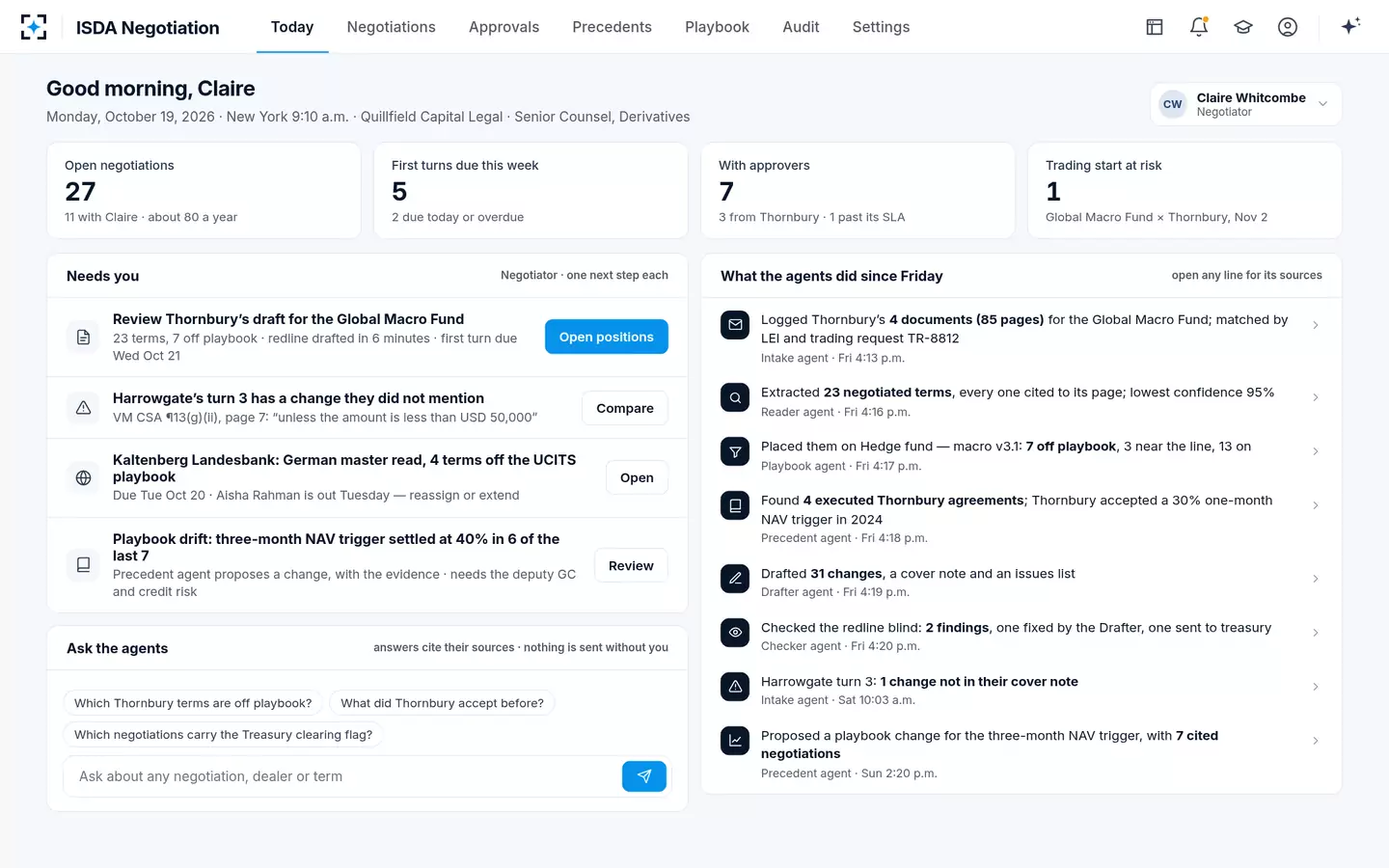
The sample firm's agents watch for that drift and propose, never make, the change. On the negotiator's Monday screen, one item read: "Playbook drift: three-month NAV trigger settled at 40% in 6 of the last 7", with the Precedent agent's proposed change and its seven cited negotiations, needing the deputy general counsel and credit risk. The firm's rule gives a playbook change five business days and two names. If they agree, the macro fund's three-month position moves; if not, the existing position stands and the negotiators know it is contested.
ISDA Negotiation flags playbook drift with the negotiations behind it
Can an ISDA playbook be automated?
The use of a playbook can be automated; the playbook cannot. Placing each dealer term on the scale, routing it to its owner, finding the precedent and drafting a counter inside the band are mechanical once the positions are values. Setting the positions, approving exceptions and changing the playbook are judgements, and in ISDA Negotiation agents never edit the playbook and never treat a near-the-line term as approved.
The boundary is the same one regulators draw for AI generally, and it is set out step by step in the guide to an ISDA AI tool. Before buying anything, measure the baseline on this page; when evaluating software, run the same measure on its output, as described in ISDA negotiation software lawyers will actually use. The CFTC's expectation for dealers, that documentation policies are "approved in writing by senior management" and audited periodically for "any material weakness" (17 CFR 23.504), is a fair standard for a fund's own playbook too.
Questions people ask
Is there a standard ISDA playbook template?
Each firm writes its own, because positions depend on its funds, investors and credit appetite. A useful template has one row per negotiated term and fund type, with preferred, walk-away, owner, reasoning, version and approval date.
Who should own the ISDA playbook?
The general counsel's office, usually the deputy general counsel or head of derivatives documentation, with each term's business owner: credit risk for thresholds and triggers, treasury for collateral terms. In the sample firm a playbook change needs the deputy general counsel and the term owner.
What is the difference between near the line and off the playbook?
Near the line is a dealer ask between preferred and walk-away, close enough to walk-away to need the owner's view; off the playbook is beyond walk-away. In the sample firm, near-the-line terms go to their owners in parallel on arrival, and off-playbook terms become exceptions if conceded.
Should a playbook differ by dealer?
Positions should differ by fund type, not by dealer, or the playbook stops being a policy. Dealer history belongs in the precedent: what each dealer accepted before is the evidence a negotiator uses to move a dealer inside the band.
How do you get negotiators to follow the playbook?
Make it the screen they work on rather than a memo they consult, route every term to its owner, and make going beyond walk-away require a reason and a second name. Then publish the measure: off-playbook rates by term and dealer show where the pressure is.