A NAV trigger in an ISDA is an Additional Termination Event, written into Part 1 of the Schedule, that lets a dealer terminate every transaction with a fund if the fund's net asset value falls by more than an agreed percentage over an agreed period: typically one month, three months and twelve months, each with its own level. Dealers ask for NAV triggers because a fund cannot offer what a company offers a lender, a credit rating and permanent capital; investors can redeem, and a falling NAV is the earliest public sign that they are. For the fund, the trigger is the most dangerous number in the Schedule, because it can end the hedges at the bottom of a bad month. Botminds' ISDA Negotiation reads a dealer's NAV trigger wording, places the levels on the fund's playbook, shows what that dealer accepted before, and sends the counter to credit risk for approval.
The research on this page is the European Central Bank's work on the triggers banks used with hedge funds, and the courts' reading of the Master Agreement. Examples of a live negotiation come from a fictional sample fund, Quillfield Global Macro Fund, and a fictional dealer, Thornbury Bank N.A.
NAV triggers: common, blunt and negotiated
15/25/40%
total NAV declines over one, three and 12 months that EU banks typically used as triggers in an ECB survey
ECB, 2007
<2%
of trigger warnings since 1998 were followed by the fund’s liquidation, in the ECB’s test on hedge fund data
ECB, 2007
20%
one-month NAV decline the sample dealer asked for, against the fund’s walk-away of 30%
fictional sample
What is a NAV trigger in an ISDA?
A NAV trigger is a Termination Event the parties add to the Master Agreement through the Schedule. The printed form leaves a slot for it: the Court of Appeal described Section 5(b) as listing Termination Events "including at sub-section (v) any “Additional Termination Event” specified in the Schedule to the ISDA agreement or in any Confirmation" (Lomas v JFB Firth Rixson, 2012). The trigger's wording, its levels and its look-back periods are all the parties' own; the slot it sits in is the form's.
The wording is short and every word in it matters. The sample dealer's draft read: "the Net Asset Value of Party B declines by 20% or more from the Net Asset Value as of the last Business Day of the immediately preceding calendar month". That sentence fixes three things: the measure (total net asset value, not value per share), the base date (last month-end), and the level (20%). A three-month version in the next sub-paragraph measured from "the third preceding calendar month". Change any one of the three and the trigger fires at a different moment.
The European Central Bank studied these clauses in 2007 and found them common. "Triggers based on the cumulative decline in the total net asset value of a fund are frequently used by banks to protect themselves against credit losses stemming from hedge fund failures," its Financial Stability Review reported (ECB, December 2007).
Why dealers ask for NAV triggers: a fund's capital can leave
A dealer asks for a NAV trigger because it cannot rely on a fund's capital staying put. The ECB put it directly: "The provisional nature of hedge fund capital owing to potential investor redemptions poses a significant risk for hedge fund counterparties and is one of the main reasons why hedge funds are unlikely to receive high credit ratings from rating agencies." A company's equity does not ask for its money back at month-end; a fund's investors can.
Bank supervisors push dealers the same way. The Basel Committee's 2024 guidelines tell banks to watch "material counterparty developments such as changes in the direction of their trading activities and performance (eg net asset value (NAV))", and say that "Banks with sound practices clearly define the types of allowable and necessary contractual terms which affect CCR – including, for example, early termination rights, margin lock- up agreements and default notification periods" (Basel Committee, Guidelines for counterparty credit risk management, December 2024). A dealer's credit policy therefore has a NAV trigger standard, and its negotiator has limited room to drop it.
That is also why the request is the same across dealers but the levels differ. The trigger is the dealer's substitute for a rating downgrade clause, and each dealer calibrates it to its own appetite for the fund's strategy, size and investor base. Once signed, a NAV trigger sits among the additional termination events a fund must be able to find quickly across every agreement, the problem taken up in where additional termination events hide.
How are NAV triggers set: monthly, quarterly or rolling?
NAV triggers are usually set as a ladder of declines over rolling windows, most often one month, three months and twelve months, each with a wider level than the last. The clearest published evidence of the levels banks used comes from a survey by the ECB's Banking Supervision Committee in 2005, in which seven large EU banks reported their triggers, as below.
The NAV decline triggers seven large EU banks reported to supervisors
| Bank reply | One month | Three months | Twelve months |
|---|---|---|---|
| Bank 1 | 15% | 25% | 35% |
| Bank 2 | 10–20% | 20–30% | 50% |
| Bank 3 | 15% | 25% | 35% |
| Bank 4 | 15% | 25% | 35% |
| Bank 5 | 20–25% | 25–30% | 35–40%, from the last fiscal year end |
| Bank 6 | 15% | none reported | 45% |
| Bank 7 | 20% | 30% | 40%, for larger funds; smaller funds might have lower triggers |
Three design choices show up in those seven rows. The window: most banks used one, three and twelve months; one used no three-month test. The base: one bank measured the twelve-month decline from the last fiscal year end rather than on a rolling basis, which makes the trigger tighten as the year goes on. And the size of the fund: one bank's levels were "All for larger funds, smaller funds might have lower triggers", so a smaller fund faced a tighter trigger for the same strategy.
The 2007 follow-up summarised the pattern: banks "typically used triggers of total NAV cumulative decline of at least 15%, 25% and 40% calculated on a rolling one, three and 12-month basis respectively, although there was some variation in thresholds across and within banks" (ECB, 2007). These are survey figures from 2005; they show the structure a dealer will propose, not where a negotiation will land today.
Should a NAV trigger count redemptions?
Most dealers' triggers count redemptions, because they measure total NAV; funds that can, ask for value per share instead. The difference is the whole point of the clause. The ECB explained that per-share triggers "only take into account the size of negative investment returns", while total-NAV triggers "capture the joint impact of negative performance and investor redemptions". The 2005 survey footnote said the triggers were "Normally including redemptions", and listed among the terms hedge funds pressed for "a definition of NAV based on NAV per share rather than on total NAV" (ECB, 2005).
One bad month, two definitions of NAV: the same fund breaches one trigger and not the other
Total NAV (the sample dealer’s wording): $4.20 billion
NAV per share (what funds ask for): Value per share 100.0
Total NAV (the sample dealer’s wording): −7%, to $3.906 billion
NAV per share (what funds ask for): −7%, to 93.0
Total NAV (the sample dealer’s wording): $546 million (13% of opening NAV)
NAV per share (what funds ask for): No effect on value per share
Total NAV (the sample dealer’s wording): $3.36 billion
NAV per share (what funds ask for): 93.0
Total NAV (the sample dealer’s wording): 20.0%
NAV per share (what funds ask for): 7.0%
Total NAV (the sample dealer’s wording): Breached: the dealer may terminate every trade
NAV per share (what funds ask for): Not breached
Total NAV (the sample dealer’s wording): Not breached
NAV per share (what funds ask for): Not breached
A 7% loss is a bad month, not a crisis. With redemptions in the measure, it becomes a 20% decline, and under a 20% trigger the dealer may end every trade. That is the systemic concern the ECB's supervisors raised in 2005: total-NAV triggers meant "a widespread run on hedge funds by investors would give banks the opportunity to terminate all transactions and, if exercised, could escalate financial instability, not to mention having disastrous consequences for the funds affected" (ECB, 2005).
A dealer that will not move to a per-share measure may still accept a wider total-NAV level, a longer window, or a base date that excludes the month's redemptions already notified. Each is a different clause, and each needs its definition checked against Part 1, because NAV trigger definitions often sit in a separate part of the Schedule from the levels.
Is a NAV trigger an event of default?
No. A NAV trigger is a Termination Event, not an Event of Default, and the difference reaches beyond the dealer. The ECB noted that "in contrast to events of default, termination events generally do not trigger cross-defaults with third parties." A fund whose ISDA calls a NAV breach an Event of Default risks a breach that spreads to its other agreements through their own cross-default clauses; the cross-default mechanics are in the guide to the cross default threshold.
It also matters inside the ISDA itself. Section 2(a)(iii) makes each payment "subject to (1) the condition precedent that no Event of Default or potential Event of Default with respect to the other party has occurred and is continuing" (Lomas, quoting the 1992 form). The Court of Appeal held that under that condition a non-defaulting party's payment obligation is "suspended (rather than extinguished)" for as long as the default continues. The condition's first limb names Events of Default, not Termination Events, so a NAV breach worded as a Termination Event does not by itself let a dealer withhold payments; it must designate an Early Termination Date to stop them.
What happens when a NAV trigger is breached?
When a NAV trigger is breached, the dealer gains a right to end the trades the clause covers, which in the sample dealer's draft meant every trade with the fund, and in practice it usually uses that right to renegotiate. The Master Agreement's termination right is built for the whole relationship: after an Event of Default, the Court of Appeal noted, "It is not an option to terminate one transaction and leave other transactions un-terminated" (Lomas, 2012). A fund should read which trades its NAV trigger reaches as closely as the level.
The ECB found that banks seldom pulled it. "Banks are more likely to use breaches as an opportunity to investigate the reasons behind them, rather than choosing the termination option. A breach may free the bank from various obligations to the hedge fund client, for example, in relation to term margins or margin lock-ups, thereby allowing it to raise margin requirements, increase haircuts and possibly introduce additional risk mitigation measures." A breach is therefore a repricing event first: the fund keeps its swaps, at a higher margin.
The termination right still sets the tone of that conversation, and its value to the dealer depends on which way the trades are. A dealer that is out of the money gains little by terminating. Lehman's collapse showed the same logic in reverse: "Many nondefaulting counterparties were out-of-the-money and would have owed large termination payments to Lehman, so they chose not to send a termination notice" (Fleming and Sarkar, Federal Reserve Bank of New York, 2014).
Do NAV triggers predict hedge fund failure?
Not well. Testing the three common triggers against hedge fund data from 1994 to 2006, the ECB found they caught between a sixth and two-fifths of liquidations and that almost every warning was a false alarm: "since 1998, based on 24-month moving windows, less than 2% of the warnings issued were correct predictions of cases where liquidation subsequently occurred."
NAV triggers catch some failures and raise many false alarms
The ECB's conclusion is the fund's best argument at the table: "All in all, it appears that total NAV triggers are not very precise early warning signals of hedge fund liquidation." It added that "other information, e.g. a hedge fund's investment strategy, age, total NAV size or return volatility, should also be taken into account". A fund that offers the dealer that information, more often, has something to trade for a wider trigger.
The research also explains why funds win wider levels from some dealers and not others. "Owing to strong competition among prime broker banks for lucrative hedge fund servicing business, some larger hedge funds have reportedly managed to negotiate relatively low threshold values of total NAV triggers", the ECB wrote, by which it meant triggers that need a larger decline before they fire. Relationship size buys room; a fund's own precedent with the same dealer usually buys more.
How do you negotiate a NAV trigger?
Negotiate a NAV trigger on five levers at once: the level, the window, the measure, the base date, and the remedy. Funds that negotiate only the percentage leave the other four to the dealer's form. The ECB's 2005 survey shows each lever in use: funds pushing for higher levels and per-share measures, and some asking for "“super collateralisation” triggers (i.e. higher margin requirements) instead of early termination".
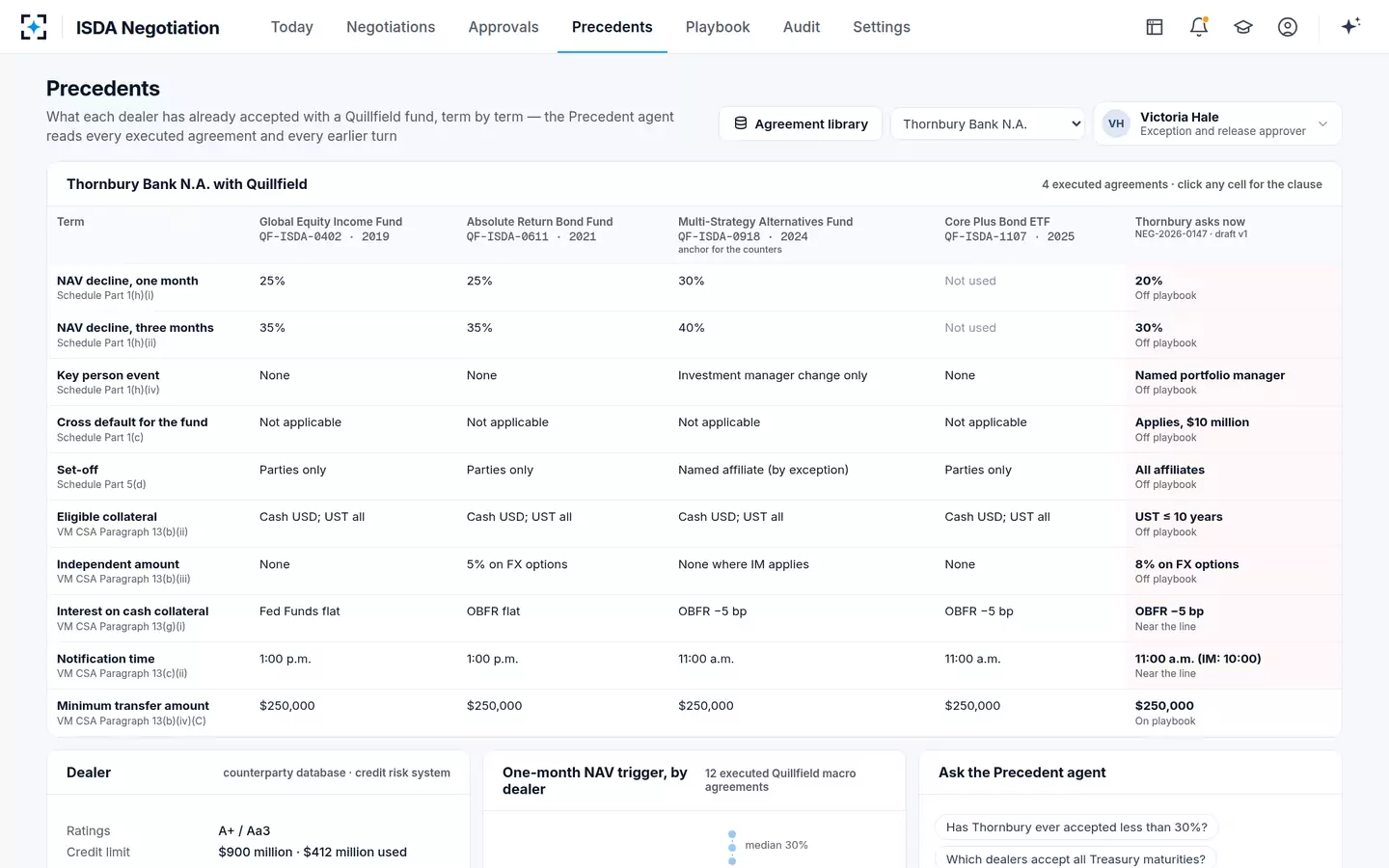
The strongest argument is the dealer's own history. In the sample negotiation, Thornbury asked for a 20% one-month and 30% three-month trigger. Its four executed agreements with other Quillfield funds showed what it had already accepted:
What one dealer accepted for one-month NAV triggers, agreement by agreement
The counter anchored on the 2024 agreement, not on the fund's preferred 35%. When the lawyer asked why, the agents' answer was that opening at 35% "would ask Thornbury for more than it ever gave Quillfield", while 30% was hard to refuse and saved a turn before the fund's trading date. The reasoning is ordinary negotiation practice; what changes is that the precedent is on the screen when the lawyer decides, not in a shared drive.
Three drafting checks belong with every counter. Make sure the defined term matches the levels: in the sample, the Schedule's "NAV Trigger Event" definition in Part 5(n) still said 30% over three months after the counter in Part 1(h)(ii) had moved to 40%, which would have undone the counter. Tie the trigger to the NAV reporting clause: the sample fund agreed monthly NAV statements within 15 business days, and the ECB noted intra-month NAV estimates "are not usually used as a basis for a termination event". And write down why the number was accepted, because the next fund will need the same argument; measuring how often concessions leave the playbook starts there.
ISDA Negotiation’s view of one dealer’s NAV triggers across four executed agreements
Who owns the NAV trigger decision at a fund?
Credit risk owns the number; legal owns the words; the general counsel's office owns any concession beyond the playbook. A NAV trigger is a credit term with legal drafting around it, and treating it as a drafting point is how a fund ends up with a 20% trigger nobody in risk approved. In the sample firm's routing rules, NAV triggers, cross default, independent amounts and NAV reporting all go to the credit risk officer within one business day, with escalation to the deputy general counsel.
The credit risk officer's question is the one in the sample approval: at 20%, "a single bad month could let Thornbury terminate every trade with the fund." Approving the counter means checking that number against the fund's own drawdown history and redemption terms, which only the fund knows. A fund with quarterly liquidity and limits on how much can be redeemed at once has less redemption risk inside a one-month window than a fund with monthly liquidity and none, and its trigger can be argued accordingly.
Credit risk approves NAV triggers in ISDA Negotiation with the dealer’s precedent beside each
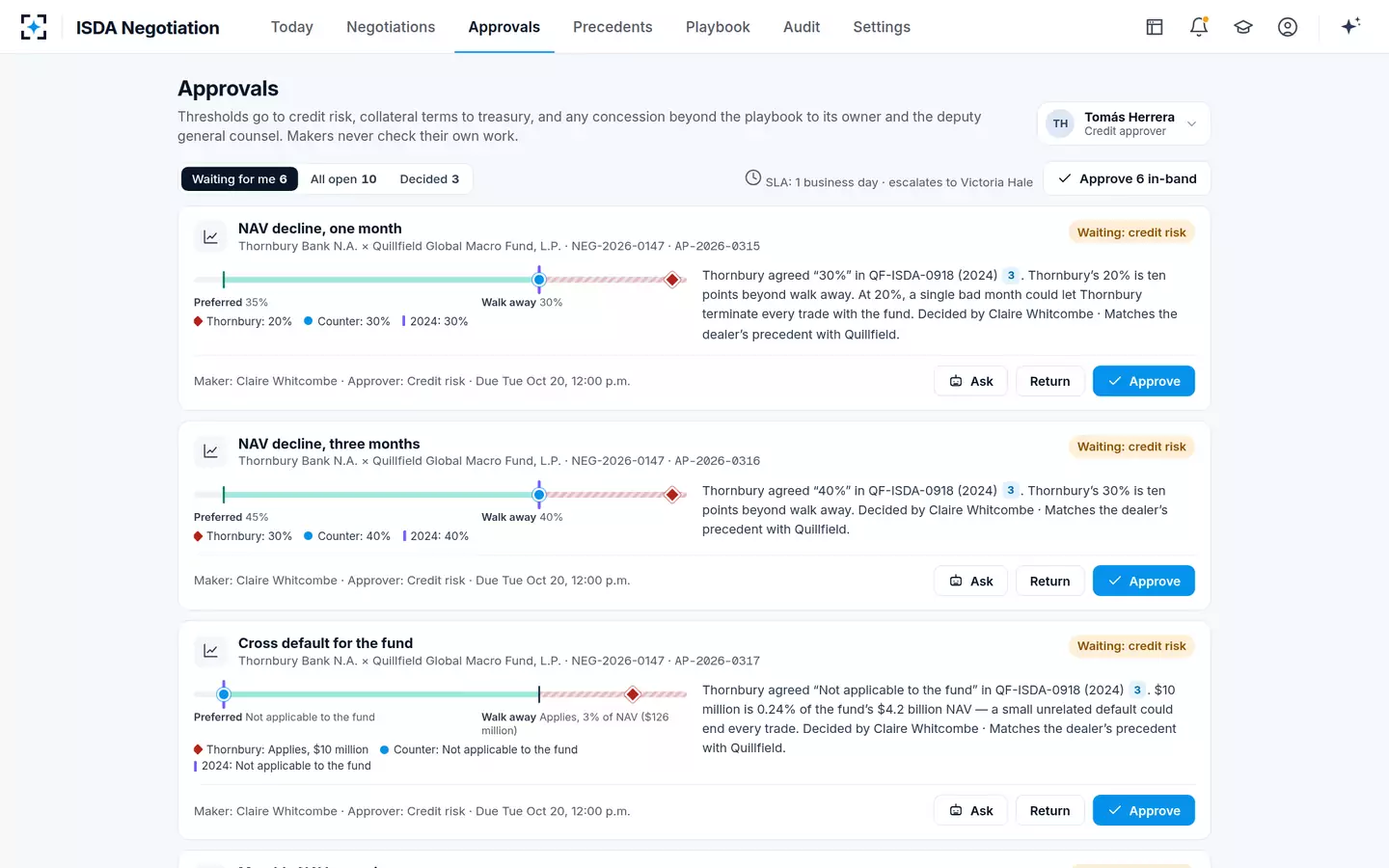
That division of labour is the reason the playbook sets a preferred level and a walk-away level for each window, by fund type: the lawyer can move inside the band, credit approves the result, and anything outside the band becomes an exception with two names on it. The playbook's structure is covered in the guide to the ISDA Schedule's elections.
Questions people ask
What is a typical NAV trigger in an ISDA?
No regulator or independent study publishes current market levels. The ECB's survey of large EU banks in 2005, reported in 2007, found triggers of at least 15%, 25% and 40% total NAV decline over rolling one, three and twelve months, with variation across and within banks.
What is the difference between a NAV trigger and a NAV decline trigger?
They are the same clause under two names. Both describe an Additional Termination Event that fires when net asset value declines by a set percentage over a set period; the ECB calls them "NAV decline triggers" or "total NAV triggers" when they count redemptions.
Can a fund cure a NAV trigger breach?
Only if the trigger's own wording gives a cure or remedy period, so it has to be written in. Funds sometimes negotiate a remedy short of termination, such as the "super collateralisation" triggers, meaning higher margin instead of early termination, that the ECB's 2005 survey reported funds requesting.
Do NAV triggers apply to the dealer as well as the fund?
In the sample, as in the ECB's descriptions, they apply only to the fund, because a dealer's credit is measured by its rating. The equivalent clause on the dealer's side is a ratings trigger; in the Lehman v Klaus Tschira litigation, the Schedule made a Lehman entity's failure to maintain a ratings level an Additional Termination Event.
How often must a fund report NAV to a dealer?
As often as the Schedule requires, usually monthly. The ECB found most hedge funds supplied monthly NAV statements, and that intra-month estimates were not usually the basis of a termination event; the sample fund agreed to deliver its month-end NAV within 15 business days.
Should key person events be negotiated with NAV triggers?
Yes, because both are Additional Termination Events in Part 1(h) and dealers trade one against the other. In the sample, the dealer asked for the departure of a named portfolio manager; the counter limited the event to a change of investment manager not replaced by an affiliate within 30 days.